
Charles Sumner devoted most of his political career to ending slavery in America, championing the cause of abolition when it was politically an uphill battle. After the Civil War ended that struggle, he pressed for essential civil rights for African Americans as leader of the Radical Republicans in Congress. Without Sumner’s efforts, emancipation might have taken much longer. In 1867, with some hesitation over the cost, Summer built a grand mansion for himself at the corner of H Street and Vermont Avenue NW, across from Lafayette Park. It became a personal refuge when the pressures of his public life were most taxing.
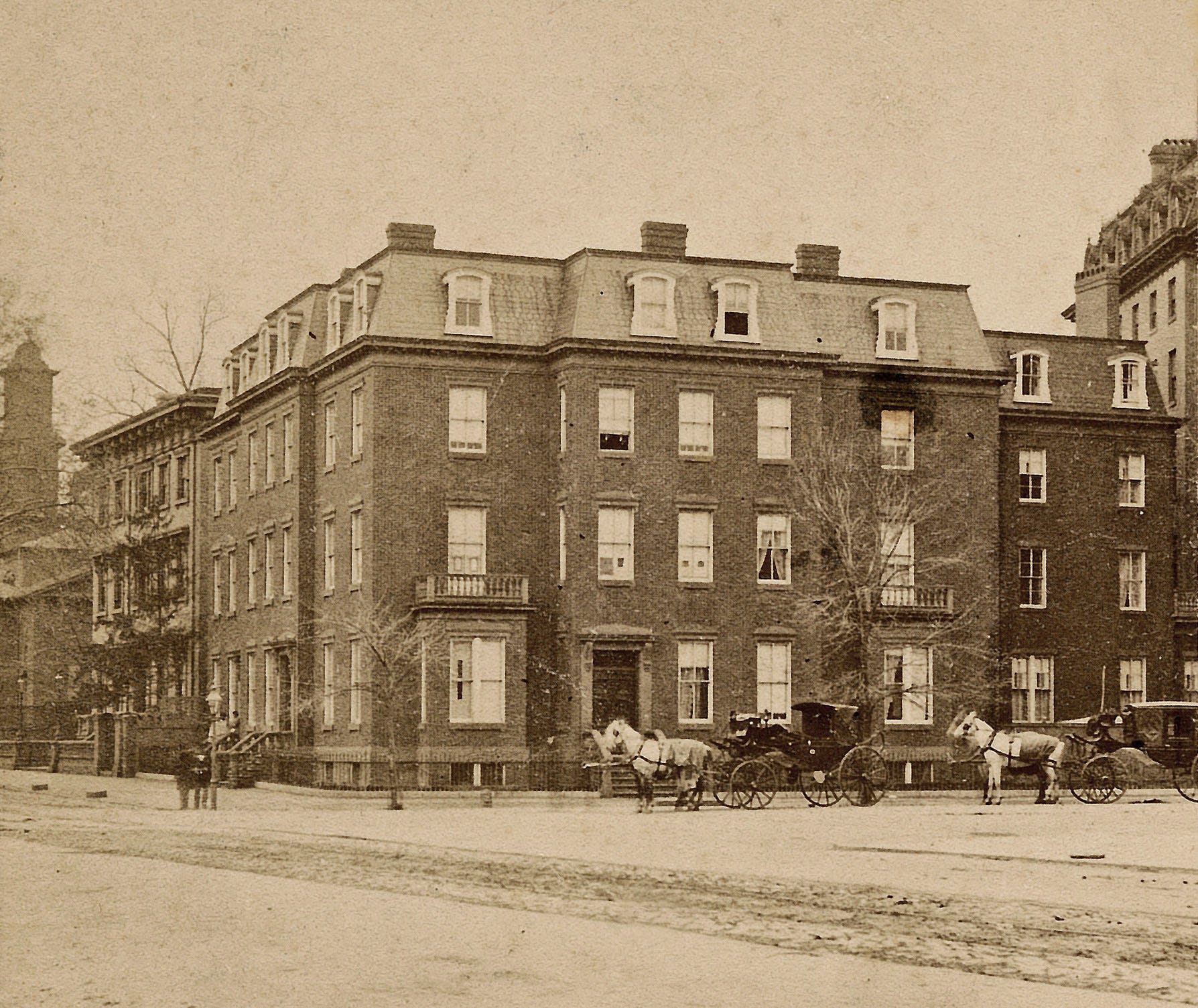
Sumner was a celebrated orator, packing the halls of Congress when he gave speeches that forcefully condemned slavery with deft and irrefutable arguments. When he died, he lay in state in the Capitol Rotunda—only the second senator after Henry Clay to do so—and was widely lionized for his role as the moral center of the country in its most divisive days.
But on a personal level, he was not terribly approachable or even likable. From an early age, he had great difficulty connecting with other people and had a brooding, introverted, and self-righteous manner. His friends at Harvard enjoyed intellectual discussions with him but teased him for his lack of humor. A young Oliver Wendell Holmes noted that “anything in the nature of a jest came very hard to him. He would look bewildered and distressed with the pleasantry that set a company laughing.”1 His relationships with family members were likewise strained.
This aloofness undoubtedly contributed to the famous incident where Sumner was caned on the Senate floor. Single-minded in his zeal to fight slavery, Sumner probably went too far in May 1856 when he delivered his famous “Crime Against Kansas” speech denouncing the pro-slavery Southerners who were trying to make Kansas a slave state. To a packed audience in the Senate chamber, Sumner denounced Senator Andrew Butler of South Carolina, who co-authored the Kansas-Nebraska Act, asserting that he had taken the “harlot slavery” as his mistress. Many on both sides of the debate thought the sexual innuendo inappropriate. Plus, the elderly and ailing Butler was not present to defend himself. Sumner went on to make fun of Butler’s slurred speech—the result of a stroke—calling it “the loose expectorate of his speech” and concluding that he “cannot open his mouth but out there flies a blunder.”
This was all too much for thin-skinned Rep. Preston Brooks, also from South Carolina and a relative of Butler’s, who could think of no other way to respond than with brutal violence. A few days after the speech, Brooks entered the Senate chamber and approached Sumner, who was seated at his desk signing copies of his speech. Brooks repeatedly struck Sumner on the head with a heavy cane, while fellow Southerners prevented bystanders from intervening. Summer was beaten bloody and unconscious, likely suffering concussions and a skull fracture.2
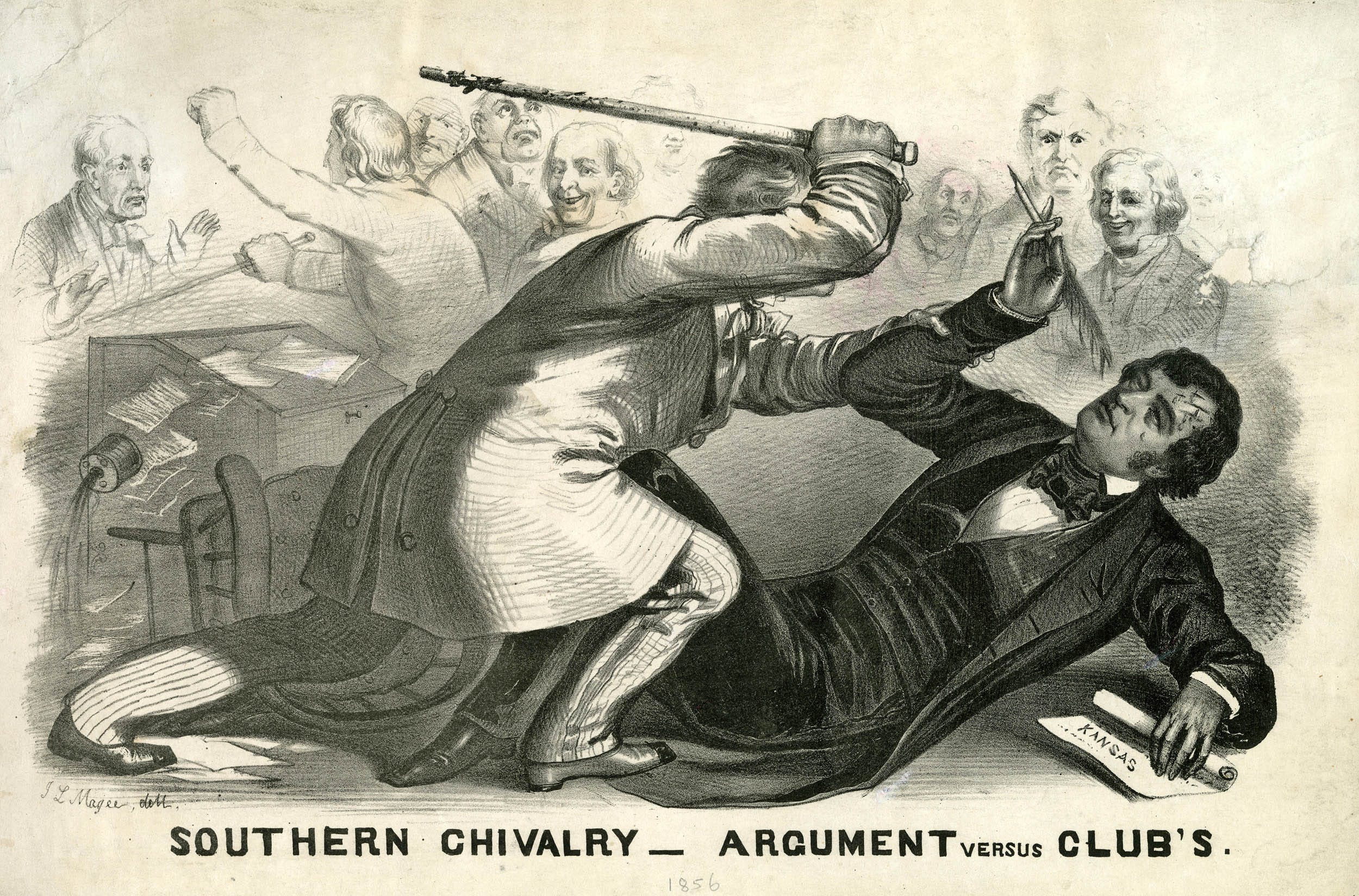
While Sumner was seriously injured and didn’t return permanently to his senate seat until 1859, his attack helped galvanize support for abolition among northerners. Many were shocked that a congressman would take such an uncouth act in the halls of the Capitol—and to do so in defense of human bondage. It seemed to show how fanatical the southern slaveholders were. From that point, slavery’s days were numbered.
All this time, including through the Civil War years that followed, Sumner lived in rented quarters at 13th and F Streets NW. He never would have built and moved into the mansion on Vermont Avenue if it weren’t for a sudden romantic turn his life took in 1865. Sumner, a confirmed bachelor at 55, began courting Alice Mason Hooper, the 28-year-old daughter-in-law of Sumner’s friend, Rep. Samuel Hooper. Alice, a witty and sharp-tongued socialite whose husband had died in 1863, perhaps viewed Sumner as a powerful figure who could support her and her 7-year-old daughter, Bell. In any event, they were married in October 1866.
The couple spent a few months in newlywed bliss, but by early 1867 the marriage was in trouble. Alice insisted on going out to numerous late parties, which were too much for the often-exhausted Charles. Embarrassing him in public, she would tell him to go on home while she stayed at the parties. She despised her father-in-law, Samuel Hooper, whom Charles invited for dinner on a weekly basis. But at the same time the marriage was fraying, the Sumners decided to build a grand house more appropriate to their distinguished status than Sumner’s rented bachelor quarters. Charles worried about the expense but went ahead with the project anyway.
The marriage deteriorated even more as Alice began spending increasing amounts of time away from Charles. On one occasion when Sumner asked where she was off to, Alice responded, “God damn you, ‘tis none of your business. I will go where I please with whom I please.” In fact she was usually with a dashing young attaché of the Prussian embassy, Baron Friedrich von Holstein. Soon Washington was full of gossip about Mrs. Sumner and the state of her marriage. When the baron was recalled to Prussia, newspapers run by Democrats wrote that Charles had been jealous of the Baron and had engineered his recall (not true). Beyond that, Charles’ austere reserve did him no favors, as many gossipers speculated that the real problem was that he was impotent. Through it all, Charles refused to address any of the rumors or impugn his wife in any way. However, in April, he told Alice that he could not live with her any longer. He insisted they maintain strict outward civility and deny any domestic issues. Furious with him, Alice then traveled to Europe with her daughter Bell for the summer.3
In November, the Evening Star attempted to tamp down the rumor-mongering: “Mrs. Sumner is about to return from Europe, and, if her health permits, to join the Senator in Washington in presiding over his new and magnificent mansion on Lafayette Square—which, contrary to common report, has not been disposed of.”4 The newspaper was correct that Sumner still owned the mansion, but Alice was not going to live there. Charles was unsure whether to take on such a large place just for himself. Samuel Hooper urged him to move in anyway and make the house his own. He finally did so in December 1867, embracing the new house as a tranquil refuge from the pressures of his public life. It was certainly big enough for him to entertain close friends on a regular basis and provided ample room to show off his eclectic collection of fine art. Biographer Elias Nason writes:
Mr. Sumner’s house at Washington, a handsome structure with a façade of brown freestone, was built on an eligible site subsequent to 1867 [It was actually finished in 1867], and overlooks Lafayette Square. it adjoins the Arlington Hotel; and the entrance is near the center of the broad front. The sitting-room is on the right of the hall, which contains an old Dutch clock with a beautiful chime. The parlor, upholstered with yellow satin, is on the left, and above this Mr. Sumner’s sleeping-room, which commands a fine view of Lafayette Square and the White House. Contiguous to this room is the library, or what the senator called his “workshop.”
Of refined taste and high culture, Mr. Sumner had surrounded himself with rare and exquisite specimens of the fine arts, in the study of which he found a solace for his senatorial cares. His rooms were crowded with the works of genius,—rare and costly books, beautiful paintings, engravings, illuminated pictures, medallions, statues in bronze and marble,—so that they had almost the appearance of a museum of art….5
Regarding a painting by Tintoretto and pictures of the grand staircase of Versailles and the façade of the Louvre, Sumner told a friend, “When I come home from the senate tired and cross, I like to look at them: It comforts me to think there is something perfect and above criticism.”6 His collection included an illuminated prayer-book of Margaret of Anjou, which had cost three hundred dollars, as well as the Senate desk he was sitting at when Preston Brooks attacked him.
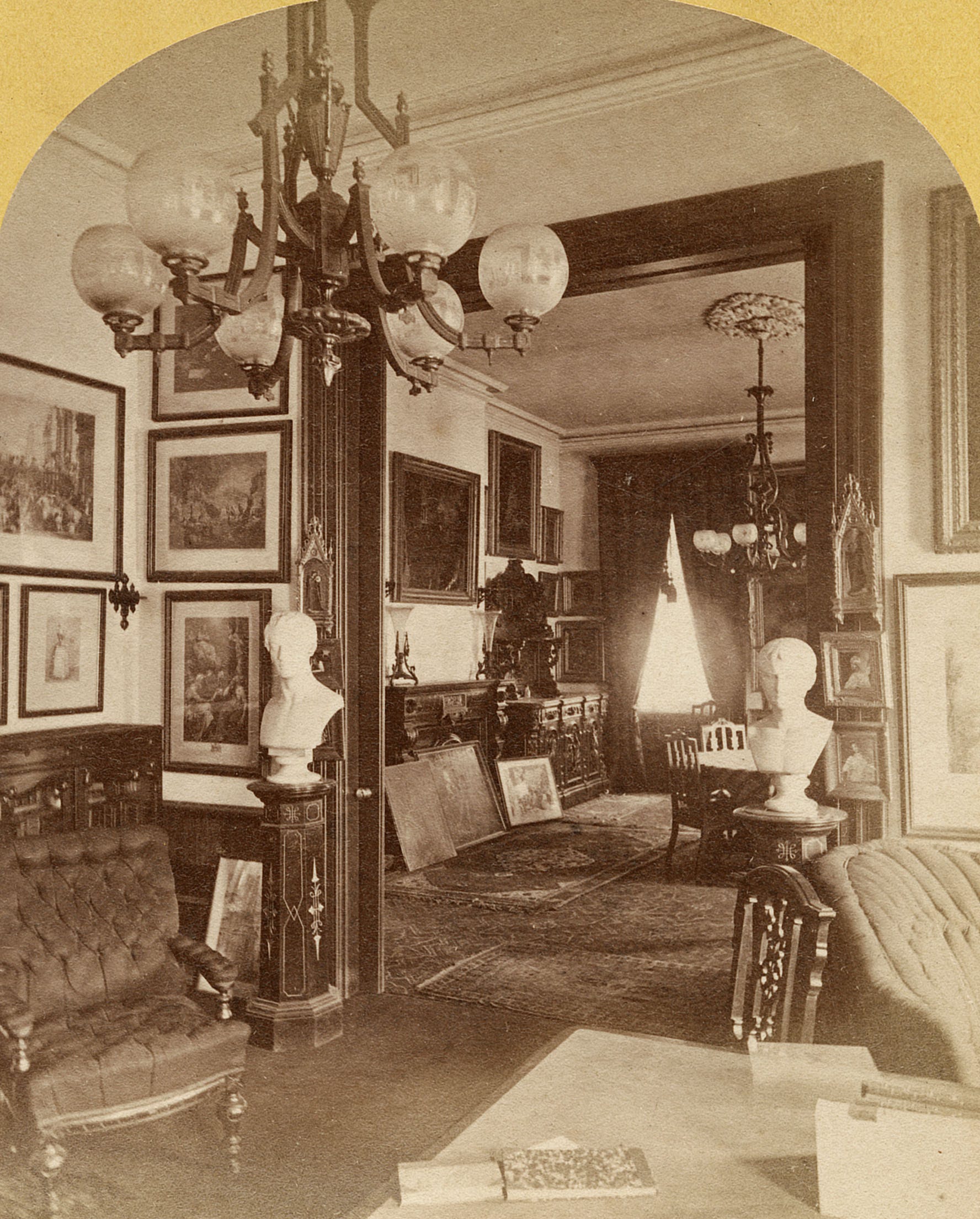
Some visitors sensed loneliness, although Sumner frequently appeared in good spirits at his home. Journalist Ben: Perley Poore penned a poetic description of Sumner’s days in the huge mansion:
[H]e lived alone for several years in his sumptuous house, which he adorned with superb works of art. Here he hospitably entertained personal friends and distinguished strangers. Unforgiving and implacable, his smile grew sadder, the furrows on his face deepened, and he lost his former bonhomie. He was a Prometheus Vinctus, bound to the desolate rock of a wrecked life, but heroically refraining from revenging his great wrong by attacking a woman.7
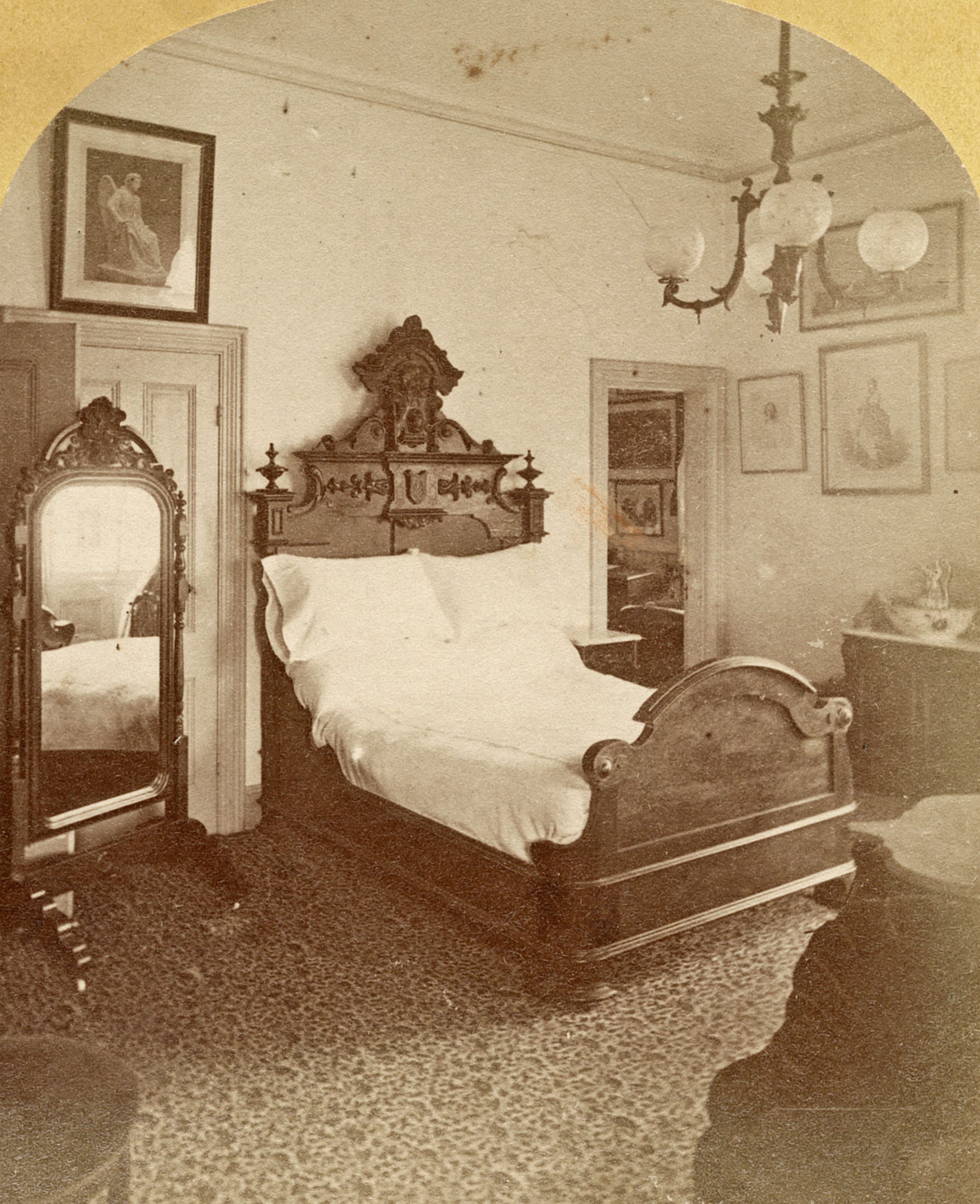
Sumner died in this house in March 1874. After several subsequent residents, the house was annexed by the Arlington Hotel, which William Wilson Corcoran had built next to it in 1869. The mansion was connected to the hotel and became a special suite for distinguished VIPs, especially foreign dignitaries on state visits to the nation’s capital.8
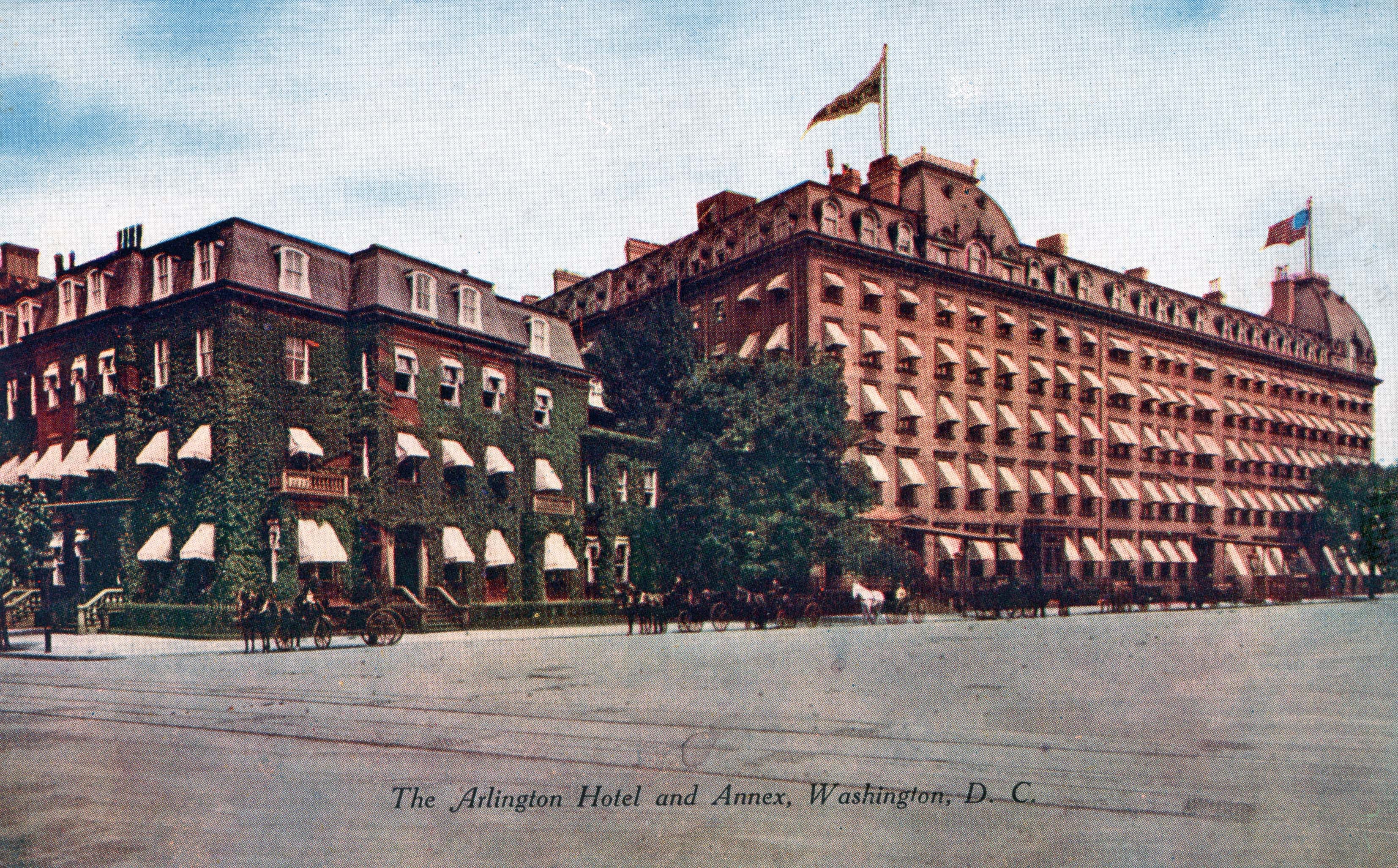
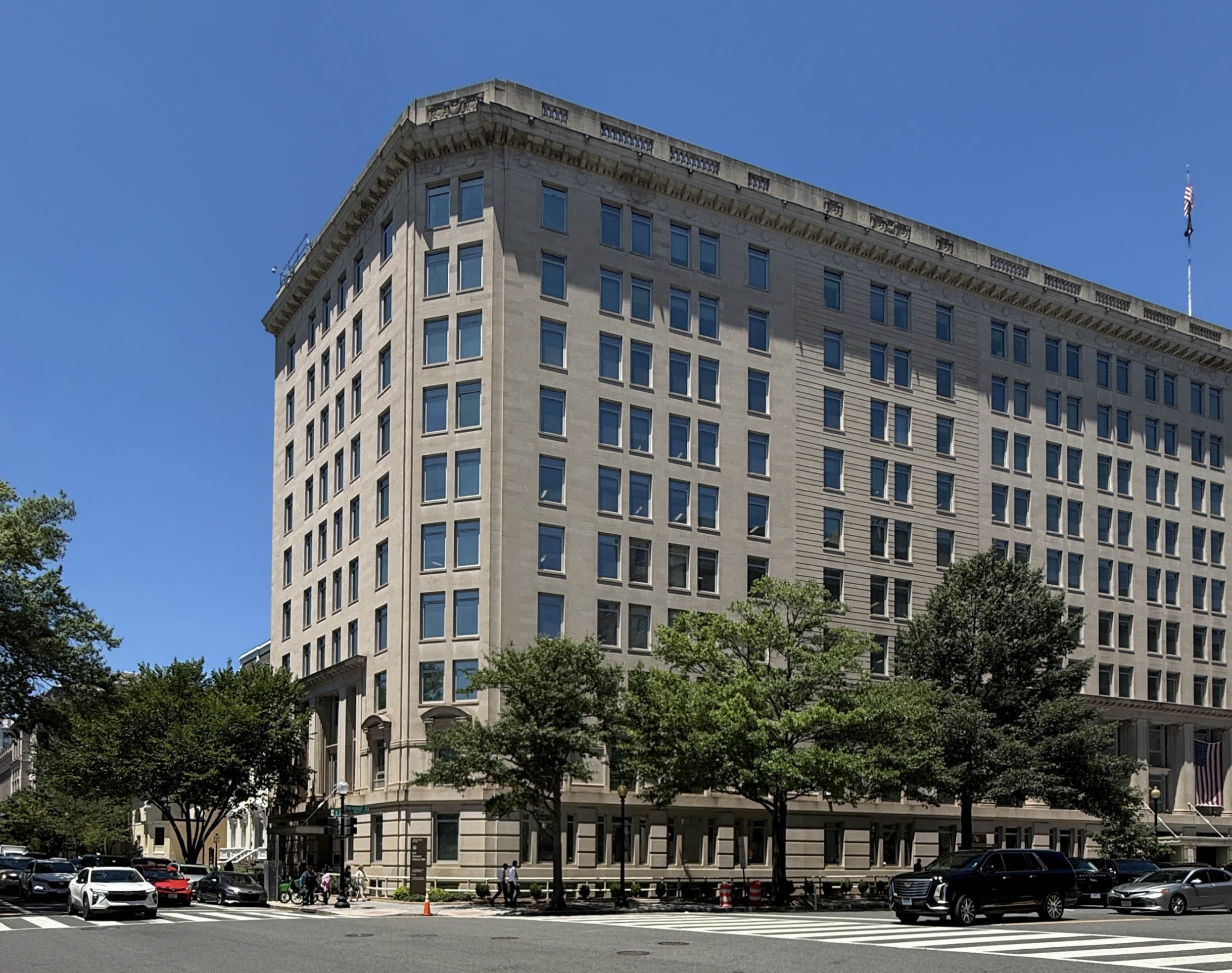
In the early 20th century, tour guides in “rubberneck wagons” would reverently point out the former residence of Senator Sumner to their carloads of sightseers. Meanwhile, the adjacent Arlington stood as the city’s most prestigious hotel in the late 19th and early 20th centuries. Nevertheless it—and the Sumner Mansion—were torn down in 1912 when plans were made to construct an even grander hotel, which was never actually built. Instead, the federal government acquired the property and erected on it what eventually became the headquarters of the Department of Veterans Affairs. No trace of Sumner’s distinguished home survives today.
Stephen Puleo, The Great Abolitionist: Charles Sumner and the Fight for a More Perfect Union, (St. Martin’s Press, 2024), 26.
Puleo, 359-64; “The Sumner Scandals,” New York Express, Oct. 21, 1867; “Mr. and Mrs. Sumner,” Charleston Daily News, Dec. 2, 1867, 1.
“Mr. and Mrs. Senator Sumner,” Evening Star, Nov. 8, 1867.
Elias Nason, The Life and Times of Charles Sumner (B.B. Russell, 1874), 335.
Ben: Perley Poore, Perley’s Reminiscences of Sixty Years in the National Metropolis, (Hubbard Brothers, 1886), Vol. II, 279.
John Clagett Proctor, “Passing of the Arlington Hotel,” Sunday Star, Apr. 4, 1948, C-2.
Comments
Nothing yet. Say the first thing.
Sign in to join the conversation.