
Why Your “Simple” SAFE Note Is Quietly Rewriting Your Cap Table
Quick question before you sign your next SAFE: do you know exactly what happens to your ownership the day all your outstanding SAFEs convert at once?
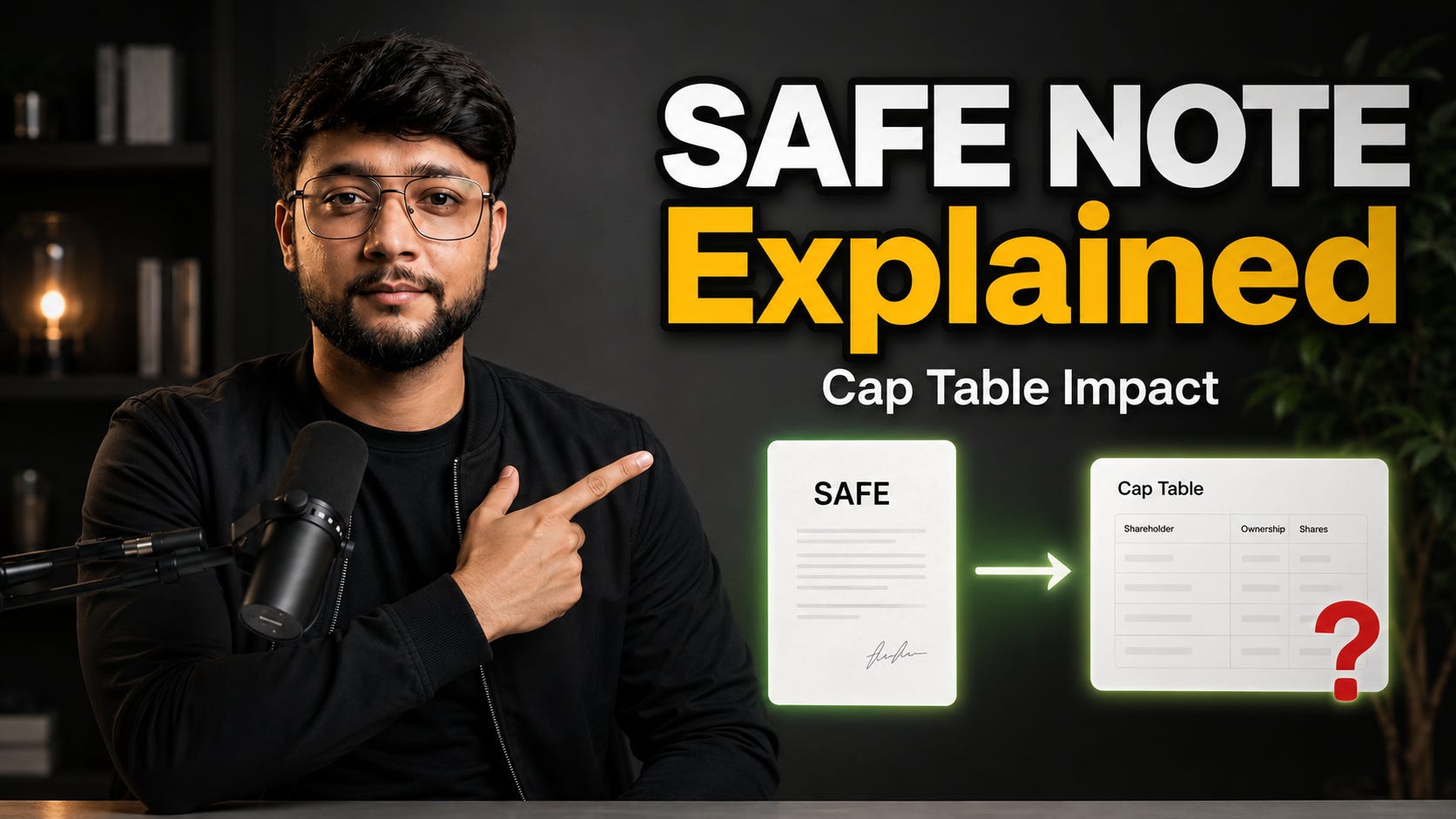
Most founders can’t answer that with a straight face. And that blind spot is exactly where things go wrong.
SAFEs are everywhere in early-stage fundraising right now. Carta’s most recent data shows they’re used in roughly 90% of pre-seed deals and about two-thirds of seed deals. Part of why they’ve taken over is speed.
A standard SAFE runs about five pages. A convertible note runs 15 to 20, plus weeks of legal negotiation. No interest rate, no maturity date, no drawn-out back and forth. You sign, you get the money, you move on.
But “fast to sign” and “easy to understand later” are two completely different things. And SAFEs are only simple until you’ve signed more than one.
Here’s the thing people gloss over: signing a SAFE doesn’t change your cap table that day. Nothing converts yet. You’re agreeing that this money turns into equity later, at your next priced round, based on a valuation cap, a discount rate, or both.
Thanks for reading! This post is public so feel free to share it.
That delay is exactly why founders get surprised. You can sign three or four SAFEs across 12-18 months, feel totally fine about each one on its own, and then find out what they actually add up to only when your priced round forces all of them to convert on the same day. By then, it’s too late to renegotiate anything.
The 2018 switch that still catches people off guard
If you learned about SAFEs a few years back, or you’re working off an old template, there’s a change you need to know. Y Combinator rewrote the standard SAFE in 2018, flipping it from pre-money to post-money math.
That sounds technical, but the real-world effect is simple and important: every SAFE you sign now dilutes only you and your existing shareholders. Not the earlier investors. Each SAFE holder’s ownership percentage gets locked in the moment they sign, based on the post-money cap. You’re the one absorbing all of it, every time, going forward.
That means the more SAFEs you stack before a priced round, the more of your own ownership you’re quietly giving away, one signature at a time, without seeing it reflected anywhere until conversion day.
Most SAFEs use one or both of two mechanisms:
A valuation cap sets a ceiling on the price at which the SAFE converts. It protects the investor if your company’s valuation jumps before your priced round. Say someone invests $500K on a $5M post-money cap. Simple division tells you their locked-in ownership: 10%, no matter what your eventual round values you at.
A discount rate just knocks a percentage, usually 20%, off whatever price your new priced-round investors pay. If new investors pay a dollar a share, your SAFE holder pays 80 cents.
When a SAFE includes both, here’s the mechanic that decides the actual outcome: the conversion compares the price under the cap against the price under the discount, and converts at whichever is lower, meaning more shares for the investor.
In most real conversions, the cap wins by a wide margin. The discount only comes out ahead when your priced round lands unusually close to the cap valuation itself.
If you’re negotiating a cap today, current market data gives you a real anchor. Non-AI startups are generally seeing pre-seed caps somewhere in the $6M-$10M range, and seed caps around $10M-$15M. AI-focused companies are commanding a noticeable premium on top of those numbers, often two to three times higher.
Worth noting too: among SAFEs issued to U.S. startups last year, only about 1% went out completely uncapped. And the investors who do offer uncapped SAFEs don’t get a pass for it.
One investor’s reaction to that stat was blunt: it signals a fund that doesn’t fully understand what it’s doing. If someone hands you an uncapped SAFE, that’s worth a direct conversation about why.
There’s a rough threshold worth keeping in your head: once you’ve stacked somewhere north of $1.5M-$2M in SAFEs, that’s usually the signal to stop and go raise a priced round instead of adding one more.
Past that point, the combined dilution gets genuinely hard for anyone, investors or founders, to hold accurately in their head. You’re negotiating each new SAFE blind to what the whole picture will look like on conversion day.
It’s rarely misunderstanding any single SAFE’s terms. It’s failing to model all your outstanding SAFEs together, as a group, against your actual priced round valuation, before you sign that round’s term sheet.
If you only check your most recent SAFE, or eyeball an average cap across all of them, you will get the number wrong.
And you won’t find out how wrong until your cap table gets finalized in front of your new lead investor, who has almost certainly already run this math themselves. That’s not a conversation you want to be catching up in.
Do this modeling early, with a real cap table tool or your lawyer, well before you’re deep in term sheet negotiations.
By the time an investor is asking pointed questions about your fully diluted ownership, you need to already know the answer, not be calculating it live.
A SAFE is simple to sign. It is not simple to stack. Know whether you’re on a pre-money or post-money version.
Know your cap, your discount, and which one actually controls the math when it converts. And model every SAFE you’ve got outstanding as a group, before you sign your next round’s paperwork, not after.
This isn’t legal advice. Talk to a lawyer before you sign anything with real money attached.
No posts
Comments
Nothing yet. Say the first thing.
Sign in to join the conversation.