
This is the third in a series of bonus essays that accompany the documentary Overshoot: Navigating a world beyond 1.5°C
It was a Tuesday when the Prime Minister sat down to contemplate Britain’s destruction by atomic bombardment.
His name was Clement Attlee, and he’d only been in office for a few weeks. But the day before the election that swept his party to power, the British government had formally agreed with American plans to destroy Japanese cities with atomic bombs.
We all know what happened next. So did Attlee, who was shaken by the profound implications of the bomb for Britain and the world. So, on Tuesday, 28th August 1945, he wrote a top-secret memo. Here it is:
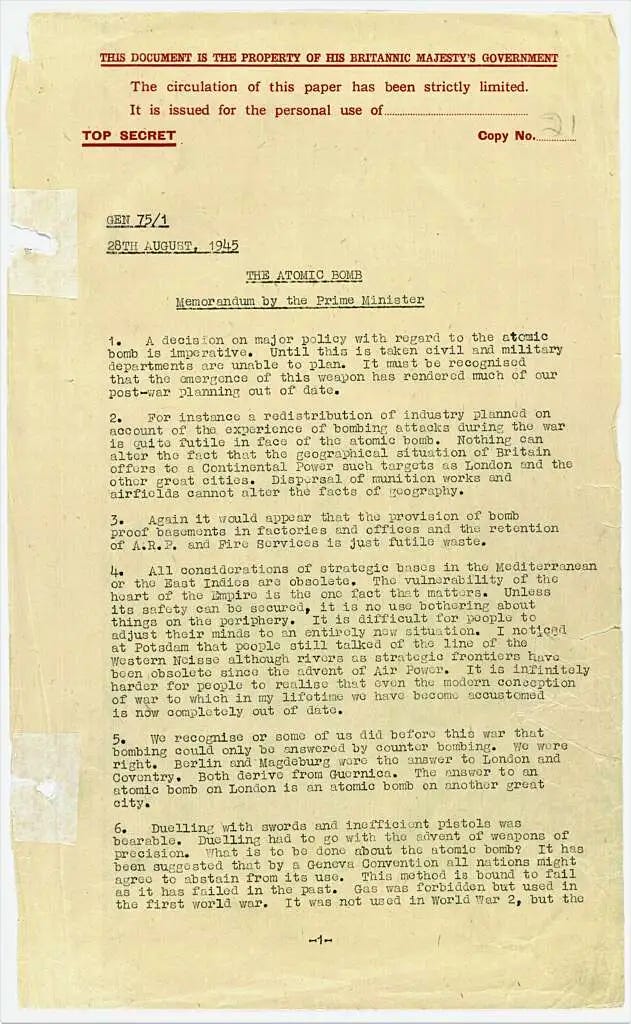
It is astonishing, eighty years later, to read it. The sentences are staccato, the stream of a consciousness grappling with the gravity of this new era, born from the fires of those hateful days in Hiroshima and Nagasaki. This was a world-historic moment. As Attlee wrote, “no government has ever been placed in such a position as is ours today.”
And his analysis of the strategic consequences was crisp and - it turned out - prescient.
Attlee started by warning that the “emergence of this weapon has rendered much of our post-war planning out of date.” Attlee was anticipating another world war, a common fear at the time, as tensions between the US and the Soviet Union rose.
In that war, the tactic of evacuating cities and redistributing industry across Britain – used to great effect in the preceding years to protect against Nazi bombing – wouldn’t work. Atomic bombs were too destructive, Britain too small; it couldn’t “alter the facts of geography.” Similarly, bomb proof basements and air raid shelters were “just futile waste.” Abroad, strategic bases dotted across the British Empire were “obsolete” due to the vulnerability of Britain itself.
This was a new reality. So, what was the new strategy?
Attlee grappled with two options. Firstly – ideally – all governments should recognise the threat posed by the bomb and “agree to abstain from its use.” But “this method is bound to fail as it has failed in the past,” like with the use of gas in WWI. So, the second option was the policy that came to be known as deterrence – or ‘mutually assured destruction’. As he put it, “the answer to an atomic bomb on London is an atomic bomb on another great city.”
Attlee implored the former option, hoping beyond hope that governments would see that atomic bombs meant the very conception of war must be “banished from people’s minds and the calculations of government.”
But, in the years that followed, this ideal option was overtaken by an arms race, the invention of far more destructive fusion bombs, and the policy of deterrence.
This is how Attlee’s memo is often remembered, as a remarkably thoughtful exploration of the strategic reality created by the bomb, one which mapped the contours of what should ideally happen and what might instead come to pass. It was an early example of an ongoing process – undertaken by governments around the world after 1945 – of understanding the new nuclear reality and developing strategies to match it. This process is undergoing its latest iteration, with the resurgence of nuclear tensions.
But when I first read the memo, I was struck by another connection to the present day.
Eighty years after Attlee grappled with the implications of the new nuclear era, the world is grappling with the emergence of a new climate reality, as the world overshoots 1.5°C of global heating and the Earth’s life support systems begin to buckle.
With it comes profound strategic challenges, ones that (to paraphrase Attlee) might render much of our previous plans out of date.
Yet - as we explored throughout our podcast documentary series, Overshoot: Navigating a world beyond 1.5°C - governments, other key institutions, and the people running them are struggling to understand this new reality and develop a strategy in response.
Like the pension funds who think 4°C - heating that would be globally catastrophic - will only marginally reduce their returns. Or the governments who are developing plans to adapt to this level of global heating, claiming their countries can “live with” it.
These fantasies are as dangerous as they are outlandish, confusing our understanding of the peril.
And they’re both cause and effect of something deeper: a profound crisis of worldview, an inability to face the gravity of this moment. Which is something Attlee also experienced.
In the memo he laments that:
“It is difficult for people to adjust their minds to an entirely new situation. I noticed at Potsdam that people still talked of the line of the Western Neisse although rivers as strategic frontiers have been obsolete since the advent of Air Power. It is infinitely harder for people to realise that even the modern conception of war to which in my lifetime we have become accustomed is now completely out of date.”
It wasn’t just that people were juggling with the enormity of the nuclear reality. They were struggling even to get their heads around the implications of the emergence of industrialised, total war, which meant rivers were no longer physical impediments to earthbound armies.
Something similar is happening today with the escalating climate reality.
And, as far as we know, the current Prime Minister has not sat down to write an urgent memo on the planetary crisis and its profound strategic implications.
It is an important time to consider the strategy being pursued to tackle climate change.
After a golden period of climate awareness and action following the 2015 Paris Agreement, obstruction of progress is reaching new heights, epitomised by the actions of the US under Donald Trump. Yet even before his election, overshoot of the 1.5°C goal set in Paris was underway.
There are many ways to think of the concept of ‘strategy’ when it comes to action on climate change. It is a global problem, but there is no cohesive, singular global strategy. For a start, there is no world government, so action is mediated by treaties, norms, and expectations between national governments and wider society.
Many of these governments have strategies for reducing their domestic emissions. Campaigners and advocacy organisations pursue strategies to influence all this, as do businesses, who have additional strategies for profit-making from clean technologies. Other businesses prosecute strategies to actively obstruct climate action. Philanthropists - on both ‘sides’ - have strategies to support influential thinkers and doers.
And so on.
But across all these dimensions of what - aggregated globally - makes up a kind of collective, piecemeal strategy to tackle climate change, some conceptions of what people are doing are largely shared, at least by those who wish to tackle the problem.
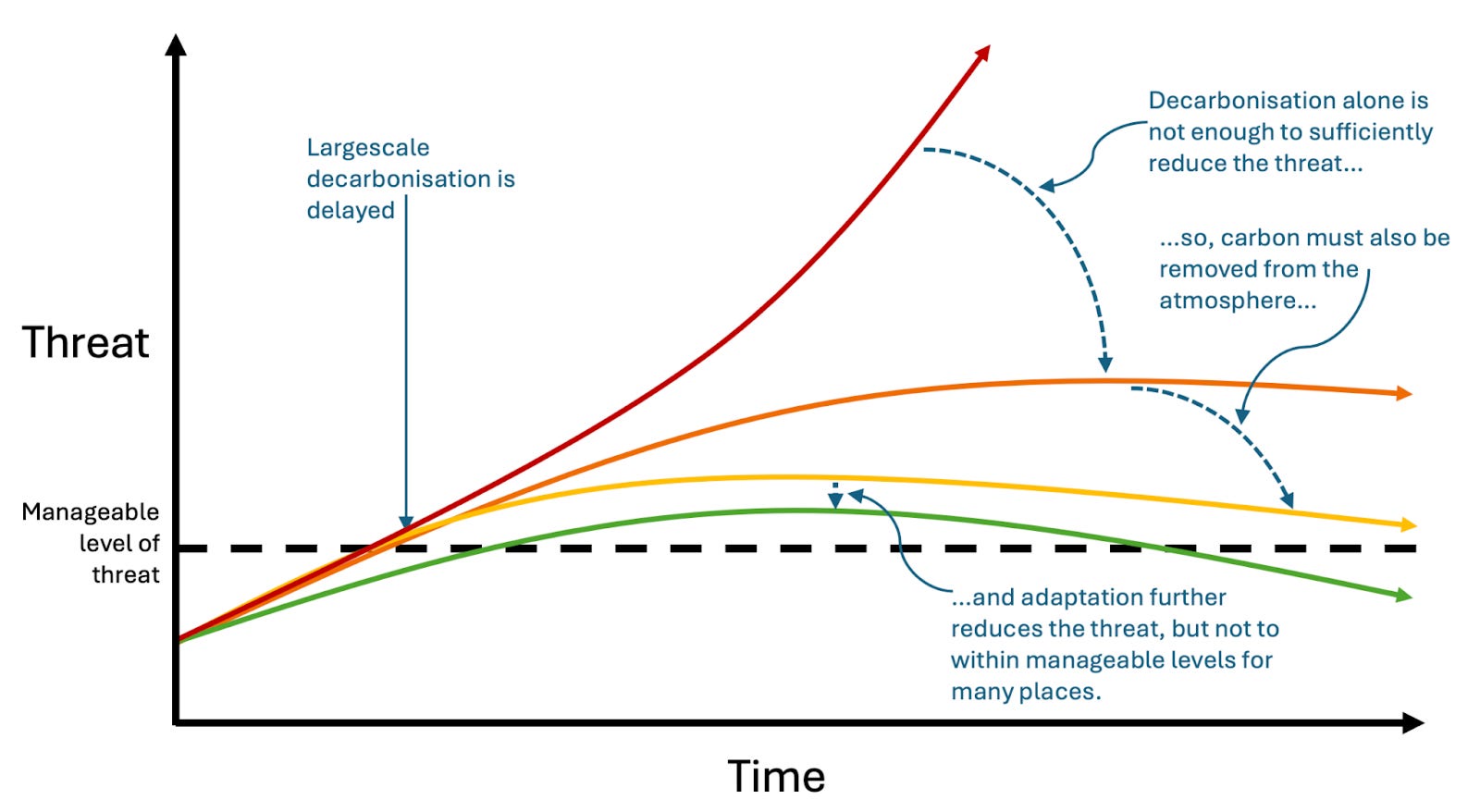
One is that if nothing was done about climate change, the threat would become too great, not just in certain places but globally. I’ve represented that on this crude graph:1
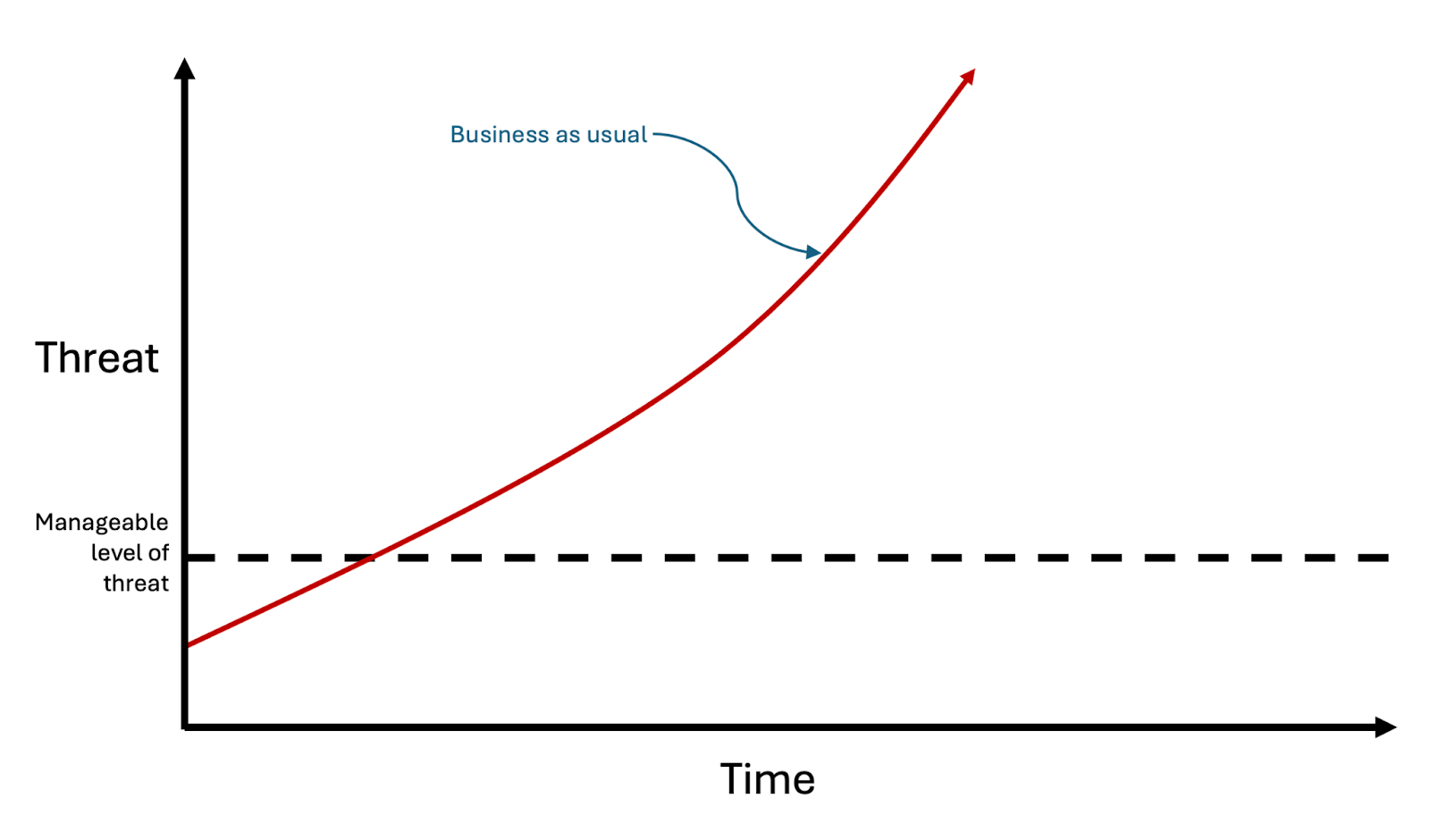
Greenhouse gas emissions must be reduced. This is the only way to reduce the threat, otherwise the world would head along some version of the red line. It was clear decades ago that avoiding this would require rapid and large-scale decarbonisation, not prevarication. I’ve set out that pathway in orange on the next graph below.
But it would still take time to undertake the shift in global society needed to wean the world off fossil fuels. In that time, the threat would proliferate and there would be unavoidable damage. So, decarbonisation should be paired with ‘adaptation’ to make societies hardier, helping manage the threat in the interim, all while decarbonisation did the work of capping the threat overall - and so taking the world on the green path here:2
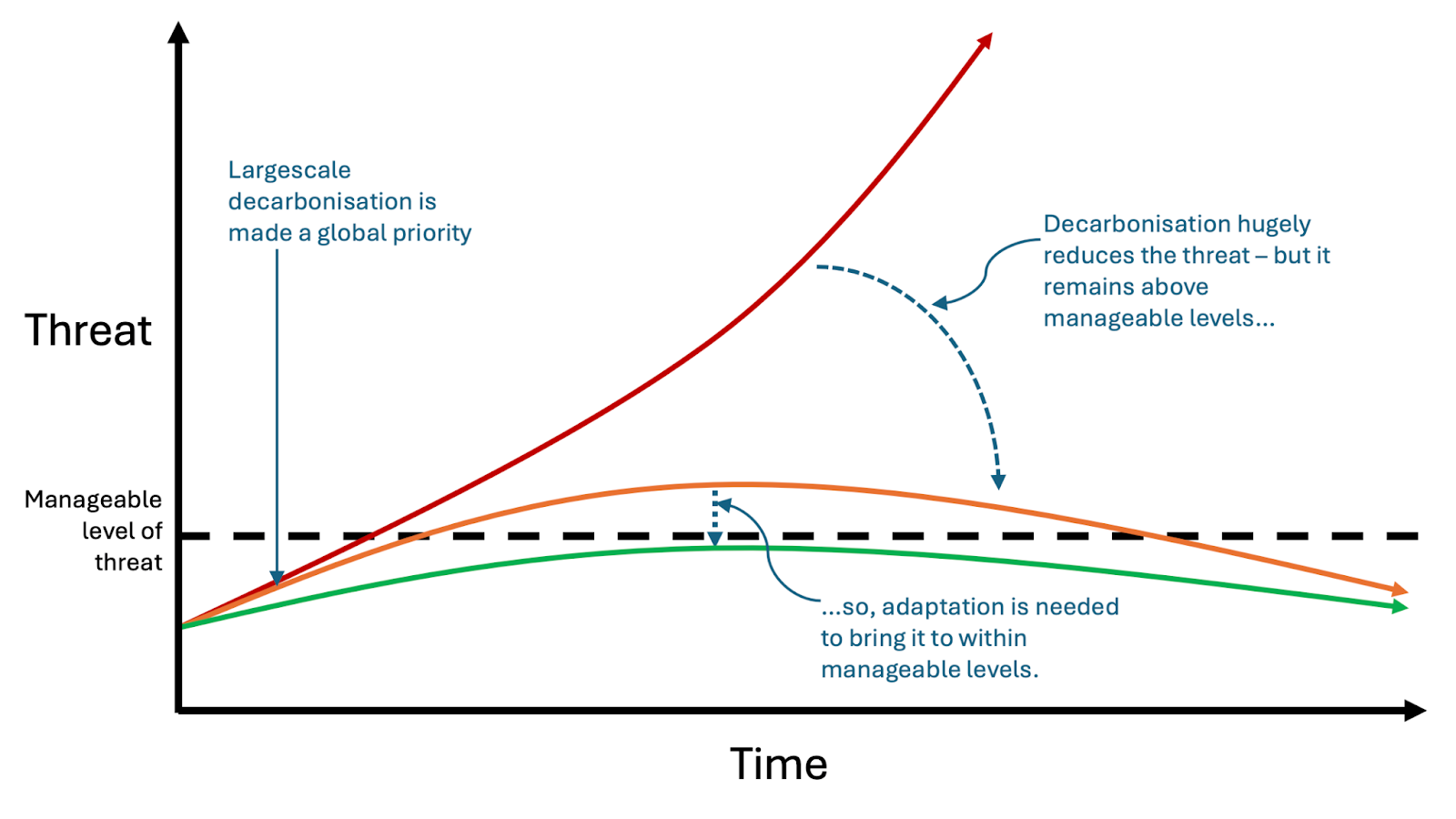
This is how many have conceived of the global strategy for climate change over the last few decades.
Yet large-scale decarbonisation was not made a global priority. Much progress has of course been made, particularly with the collapsing price of renewable energy. But cheaper renewables have not yet stopped global emissions going up each year, with 2025 set to break 2024’s record.
So, the world is facing a far greater threat. This means the strategy has to shift.
In particular, huge amounts of carbon must now be sucked from the atmosphere, cleaning up the mess made by the failure to rapidly decarbonise - as we explored in episode two of Overshoot. That’s the yellow pathway on the next graph, below.
Whether we like it or not, carbon removals are now a key part of the strategy, and probably have been since at least 2018, when the IPCC released a special report on the 1.5C goal. In it, over 90% of the pathways for staying below 1.5C required significant carbon sucking.
The scale is daunting and a tragic indictment of the world’s failure to act. According to a global assessment of carbon sucking technology, the world needs to deploy an additional 5 billion tonnes of carbon sucking capability by 2030. Only the global petroleum industry has come close to developing the capability to move a similar scale of stuff, moving around 4.5 billion tonnes of oil from the Earth’s crust in 2024.
So, the strategy in the minds of many now looks like this:
Yet we are a very long way from sucking 5 billion tonnes of carbon from the atmosphere each year come 2030. There are four years left and when considering all the carbon expanded in the business operations that sit around carbon sucking projects, they overall still emit more carbon than they remove. Crucially, the future burden of carbon sucking can be limited by making deeper changes to societies that reduce consumption among high-consuming groups.
Meanwhile, the ‘adaptation gap’ - between what’s needed at current levels of climate change and what’s implemented - remains vast and, in many places, is growing. Even wealthy countries are failing to prepare for today’s climate impacts, let alone the threat of 2/3/4C+ that’s on the cards. Much is already being lost and more is inevitable.
What’s more, the international order that enabled the extraordinary feat of collective action in Paris a decade ago is breaking down. Competition and norm-breaking are the order of the day. The COP process is openly maligned. Even governments that have traditionally worn their climate credentials with pride are seemingly cooling their commitments.
Climate strategy seems to be in crisis.
In the early eighties, the Cold War strategy seemed to be in crisis, too.
Nearly four decades had passed since Attlee’s memo. Things had played as he predicted and feared. The bombs were now orders of magnitude more destructive than those dropped on Hiroshima and Nagasaki. There were over 60,000 of them, held by eight countries, with the vast majority in the US and Soviet Union, their number ratcheted up each year by the inexorable logic of deterrence. The answer to thousands of nuclear bombs on America was thousands of nuclear bombs on the Soviet Union.
Then, in 1981, Ronald Regan was elected US president. He took a more aggressive stance on the Soviet Union.
One of the outwardly stated concerns of his administration was that the Soviet Union could launch a first strike: a bolt from the blue. This argument had been gaining traction in the preceding years, as set out this documentary from the time, produced in partnership with the US Department of Defense and the RAND Corporation think tank.
To deter the Soviets from doing this, the US had developed capabilities to fight back through hidden submarines and high-flying aircraft. So, even if the Soviets struck first with a massive nuclear attack, they would come to regret it. As the Reagan administration’s guidance on nuclear weapons put it: “The United States’ nuclear capability must prevail even under the condition of a prolonged war.”
This all meant things were feeling quite febrile. I spoke to Roger Bolton, who was a senior producer at the BBC, about this period.
“...suddenly after a strangely quiet period about 15, 16 years since the Cuba Missile Crisis, suddenly things looked a lot more uncertain. The other thing that happened around that time was that the Americans also moved cruise missiles to the UK and used the American bases here. This re-energized the CND [Campaign for Nuclear Disarmament] movement and you also had women occupying a former disused airfield [at Greenham Common] and so the temperature was going up and up and there was a sense in which a confrontation with the Soviet Union was much more likely.”
0:00
-0:39
But for the US to credibly say its nuclear capability could prevail, some form of American society would have to survive the first strike, so that the nation was still capable of carrying on the war. This is the strange Cold War logic of deterrence. If it looked like America could still carry on fighting then the Soviets would be deterred from striking in the first place, as they would eventually be annihilated.
But there were big concerns that the Soviets were doing something that unsettled this delicate balance of terror. Roger explored this in a documentary - called If the Bomb Drops - first broadcast in 1980. Here’s a short clip:
This horrified the Americans. The Soviets seemed to have worked out a way to protect their population and so were seemingly better able to continue fighting a nuclear war. They had the advantage.
So, the US government came up with grand plans to keep the nation going after an all-out nuclear war. Like burying industrial equipment to shelter it from the worst of nuclear blasts, as shown in this short clip:
We featured another of these plans in episode four of Overshoot: the US Postal Service plan for delivering the mail after a war.
In Britain, the policy of successive governments had largely been the one anticipated by Attlee all those years before: that it was “futile waste” to have grand plans for survival, considering that Britain’s relatively small landmass would be pulverised by hundreds of megaton-sized nuclear bombs within minutes from the outbreak of war.
But the heating up of the Cold War under Reagan got people talking. Here’s Roger Bolton again:
“We had a situation where we had virtually no civil defence. We did in Switzerland, every house in Switzerland - as the documentary, If the Bomb Drops, shows - were required to have bunkers and so on. In this country we weren’t thinking about that, strangely. And so people were saying, well look, if you do believe in the deterrent, part of the deterrent has to be the provision for some form of survival afterwards to match the Soviet Union.”
0:00
-0:25
These arguments were persuasive and the government stressed that it did have some plans. Many of these focused on keeping the government going, with huge bunkers built to maintain post-war operations. For the wider population, the ‘Protect and Survive’ public information campaign was developed, which gave advice on how to prepare for post-war life.
Both approaches were exposed as ludicrous in Roger’s documentary.
It leaked the Protect and Survive TV broadcasts - which were only meant for broadcast in the lead up to a war - and then got a family to build the crude shelter the general population was advised to assemble.
It was useless.
Elsewhere in the film,3 government officials admit they might not even turn up to man the dingy bunkers, and would rather stay (and presumably die) with their families:
But not everyone was convinced.
In the early eighties, you could still watch documentaries like this and think there was a chance of survival, particularly as in it, many experts claim that a significant majority of the population could live on after a nuclear exchange.
This is because nuclear weapons were often talked about as if they were just ‘bigger bombs’.
The cities would be destroyed, with fallout a problem in the vicinity of the prevailing winds, but otherwise, it seemed plausible that in whole tracts of countryside, some kind of society could continue.
But then something happened which made this view untenable.
The day before Christmas eve in 1983, the journal Science published a paper called ‘Nuclear Winter: Global Consequences of Multiple Nuclear Explosions’.
It caused a sensation.
Its authors included Carl Sagan, the world-famous public intellectual. Another was Richard Turco, who came up with the name ‘nuclear winter’. This was the idea that the vast fires caused by the nuclear explosions would send pollution into the atmosphere. There, it would mask the Sun, leading crops to die, and causing a global famine.
So, it wasn’t just the immediate impacts of the bombs that people should worry about. It was the domino effects, like a nuclear winter causing famine. But not just that. Other dominoes included the destruction of ports, the collapse of the financial system, and so on.
These domino effects were explored in another BBC documentary called On the Eighth Day, which you can watch here. It is crisp, accessible, and politically brave:4
Richard Turco explained all of this to us in episode four of Overshoot, where we explored how many assessments of climate change today make a similar mistake, only looking at the immediate consequences and not the domino effects, like heat waves destroying crops, leading to food crises, which can have more domino effects, like on social cohesion and even conflict.
When you consider these domino effects, we have to revise our understanding of the climate threat, appreciating it’s far greater than some might think, at least for countries like Britain.
And this is what happened in the 80s with nuclear war.
Soon, the apocalyptic implications of nuclear winter entered the wider culture. They did so through films like Threads (by, again, the BBC) and When the Wind Blows, both of which simulate a nuclear winter and the other domino effects of nuclear war and how futile government plans would prove to be.
When I spoke with Richard, he mentioned one such plan. In the 1980s, he was in the UK for a lecture tour, sometime after the publication of the nuclear winter paper. At one event, someone came up to Richard and showed him some booklets published by the government:
“And one of them was very interesting. It was published by the civil defence authorities. And it had to do with if there were a nuclear attack on Britain. ‘Here’s what the farmers of Britain should do. They should go out into their fields and pastures with sheets and put the sheets over the livestock.’ Then, after the radioactivity has settled, you would go back into your fields and pastures and pull the sheets off the livestock, removing the radioactive ash from the animals. This was a serious thing. I mean, it was so funny. We got a huge number of laughs out of it. Throw sheets over your livestock so you can just quickly remove the radioactive fallout!”
0:00
-1:06
I have to admit, I didn’t believe him. But after some digging, we found the booklet, sequestered in the archives of the Wellcome Collection in London.
It was called ‘Civil Defence and the Farmer’, published in 1985 by the-then Ministry of Agriculture, Fisheries and Food.
It gave guidance on how to prepare for and act after a nuclear war. After quickly ruling out nuclear winter as uncertain speculation, the booklet sets out how to protect your cattle. And down the list is - I was astonished to see - the use of “thin sheeting” to protect cattle from radiation.
After the fallout has settled, the farmer is advised to whip it off and then await instructions on the radio for what to do next.
It was quite something to read this soon after interviewing Roger Bolton, whose job - as someone senior in the BBC - would have been to do post-war broadcasts, hiding in a small bunker under a radio tower (which it was assumed would survive), something he wasn’t sure he’d be able to do. Even if he did, where is the farmer taking the (presumably) irradiated milk? Etc., etc…
But things like this brought alive to a wider audience just how ludicrous the government claims were that the population could be in any way protected.
People were outraged.
This naturally called into question the whole strategy pursued by the government in the nuclear era. And that led to more than just a dedicated core of campaigners becoming actively opposed to governments’ nuclear strategies. A kind of nuclear spring.
This bottom-up pressure played a role in the end of the Cold War, as did the shifting social economic reality of the Soviet Union, which soon fell apart, partly sped on by the manifestation of another nuclear risk, with the explosion at Chernobyl and the huge impact that had on the politics of the region.
All this meant the world transitioned to a better strategy for managing the risks of nuclear war, including new treaties.
Well, until now…
But something like this has yet to happen with climate change. There is a remarkable lack of outrage in the general population at the similar failure of strategy which is now becoming apparent, though there is growing disquiet among some in the professionalised climate community.
This has led some people to propose that more direct interventions into the climate system are needed, such as injecting aerosols in the atmosphere to reflect sunlight and therefore temporarily reduce the spiralling temperature increase (like a managed and far less severe version of the nuclear winter effect).
This is often called ‘solar radiation management’ or SRM for short.
We could include it in my crude graph of climate strategy. Here, further delays to decarbonisation mean the threat is even greater - intolerably so - including the risk that disastrous tipping could be triggered. It will take time to reduce emissions and suck sufficient carbon from the atmosphere to stabilise the situation. And in the meantime, the threat would be so great there might be dire limits to adaptation.
This is where SRM comes in, offering a reprieve while we are waiting for the other parts of the strategy to kick in. This pathway is illustrated with the purple line:5
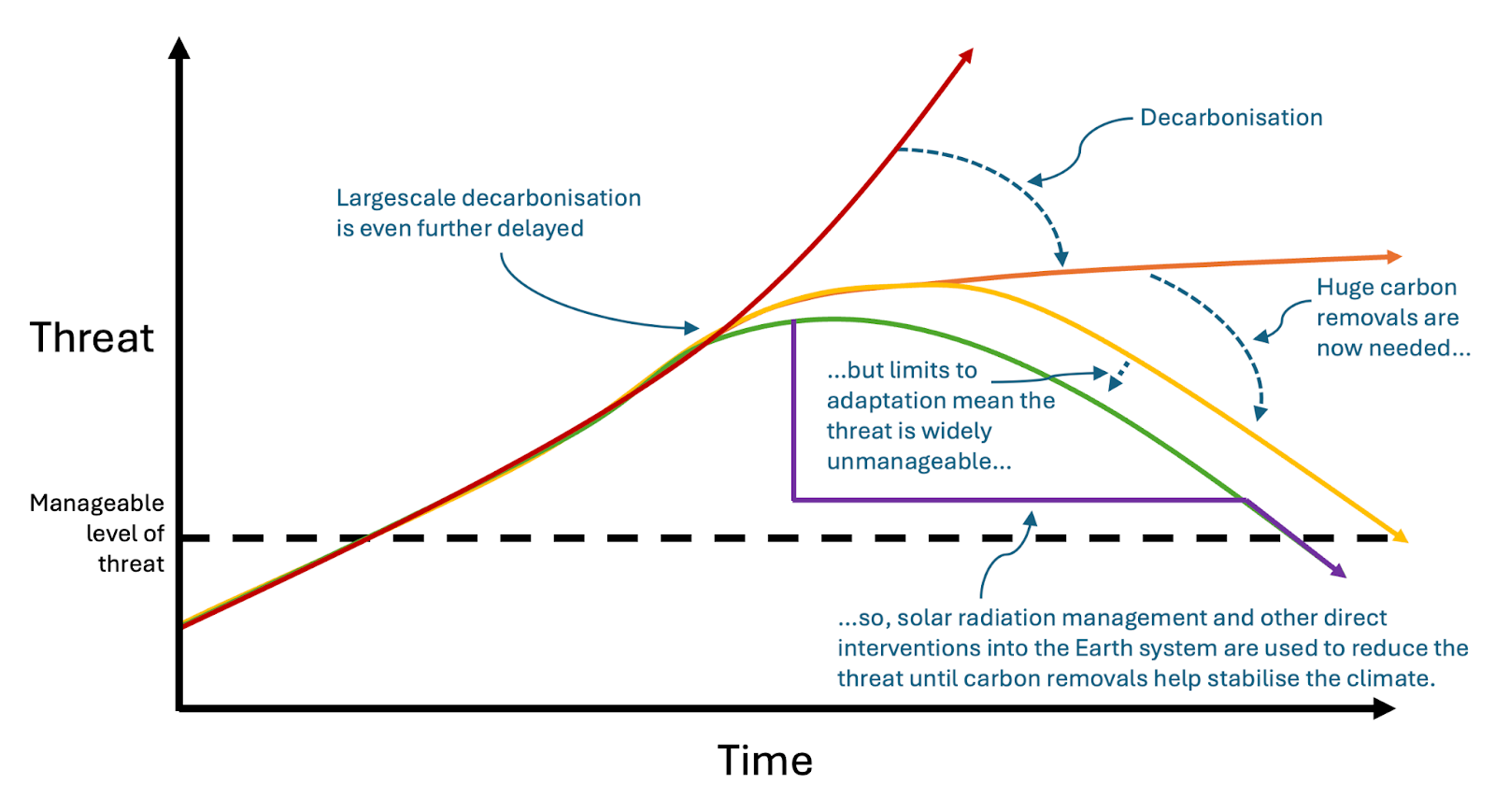
As any SRM researcher I have spoken to openly admits, there are huge questions about the plausibility of something like the purple line, including technical possibilities, how anything like this would be governed, whether it would be used as an excuse for the further delay on emissions reductions, and whether its deployment could have risky, unintended consequences, which might mean the purple path actually heads upwards, adding more threat.
But even if SRM was an effective tool, playing out something like the purple pathway above, there are other big blind spots in the climate strategy in the new reality.
We touched on three in Overshoot.
Firstly, the climate threat doesn’t just evolve smoothly. That’s how I’ve represented it in the graphs above and how it’s largely represented in any other graphs, conversations, or actual strategies. Yet we know this isn’t true. It is clearly playing out in the opposite way, a chaotic, see-sawing escalation of impacts.
Moreover, we now know that the risk of triggering tipping points is far higher than previously thought. So, the threat could - and most likely will - escalate in surprising, nonlinear ways. This erodes the strategy. I represent this in orange on a new graph below.
Secondly, even if the climate threat were to evolve largely smoothly, there is still the matter of all the other environmental issues, like the loss of biodiversity and depletion of water. These cannot be separated from the climate threat.
This is because the world is facing a full blown crisis in what scientists call the ‘Earth system’. Like organs in a human body, the planet has different systems that must individually be healthy in order for the whole to also be healthy. The Earth system is the system of systems making up our planetary body.
Take the destruction of forests. This is a major issue in its own right, destroying habitats, driving species loss, and causing many other environmental ills. But it also undermines the ability of nature to suck carbon from the atmosphere. So, the more it happens, the more our climate strategy is undermined. What’s more, the effects of climate change are doing this too, with drought, wildfires, and other climate impacts eroding the ability of nature to suck down carbon, in turn.
Scientists call these ‘feedbacks’, like when you hold a microphone near a speaker and it feeds back, creating an intolerable squeal; a vicious cycle or doom loop. For forests, more climate change means more forest-killing impacts, which means more carbon stays in the atmosphere, which means more climate change - and so on.
So, even if the climate threat evolved smoothly, these feedbacks could erode the strategy - which I’ve illustrated with the yellow line on the graph below.
The third threat to climate strategies is something that I and colleagues call ‘derailment risk’. We used the story of Valencia to illustrate this in episode four of Overshoot. In late 2024, a climate-driven disaster triggered a series of events that boosted the influence of climate-denying politicians.
This year, we at the Strategic Climate Risks Initiative - the organisation which co-produced Overshoot - published a major report warning how this dynamic is growing: that climate consequences can frustrate climate action.
It’s a particular problem in lower-income countries, which are increasingly stuck in a vicious cycle, in which worsening climate disasters divert resources away from proactively adapting. Here’s Dr Jimmy Fletcher, a former Saint Lucien minister, and a key part of the triumph in Paris in 2015, setting out this doom loop:
“I think something people don’t understand is that many of our countries find themselves in a continuous cycle of repair and recovery. No sooner have we dealt with one extreme weather event - and the extreme weather events are not just hurricanes, not just storms, but they are droughts, the floods - there are so many things that we have to deal with. And the governments of these countries have to be digging deep into their pockets, into the treasury, so that they can respond to these things. You’ve never really fully recovered from the last extreme weather event when you have to now start finding a way to repair from the most recent weather event.”
0:00
-0:38
Into the future, this ‘derailment’ dynamic could mean that the spiralling impacts of climate change and their domino effects get in the way of deploying and sustaining the world’s carbon sucking capabilities. They could be too costly. They could cause more geopolitical rifts. They could cause changes in policy that lead carbon sucking plants to be closed by populist governments who think it’s ‘too late’ and adaptation is the only way forward. And so on.
Whatever the mechanism, derailment risk also needs to be in our conception of the strategic reality, alongside nonlinear impacts and Earth system feedbacks. I’ve illustrated it with the dark blue line on the graph that shows all three of these strategic challenges together.
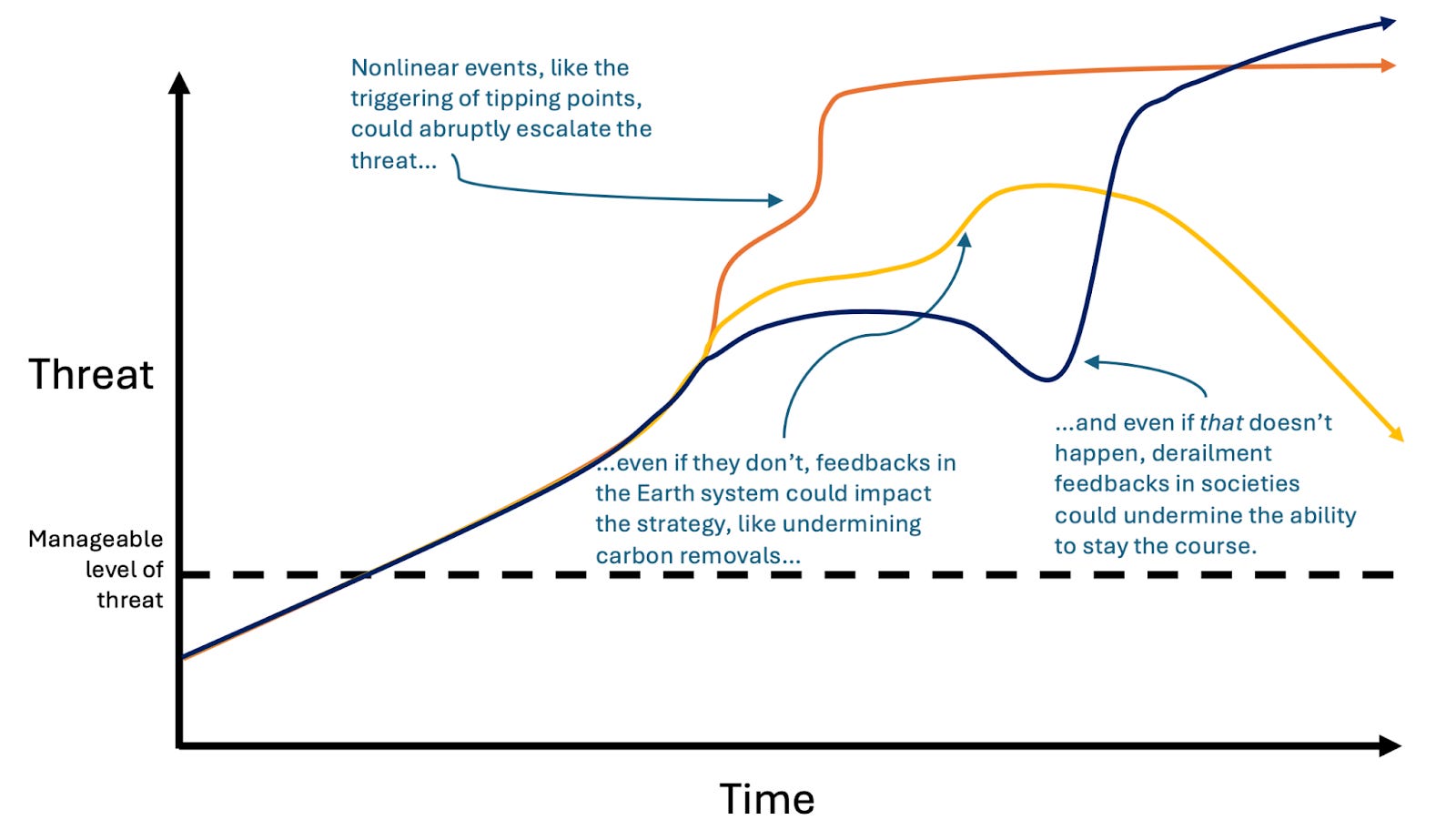
These factors that should feature in any modern-day version of Attlee’s memo on the new climate reality. And they all show that we need to evolve the strategy, making it fit for the scale of the Earth system and the pace of the unfolding crisis.
What is that strategy?
That’s a huge question and one that we are grappling with across all our work at the Strategic Climate Risks Initiative. Overshoot is one of our contributions to the conversation. We use the analogy of a ship ending up in a storm, after having initially hoped to sail around. The crew must then pivot, facing up to the new reality and executing a strategy to handle it.
Something similar is needed for the new climate reality.
In developing that analogy, we had the pleasure of speaking to some champion sailors (you can hear them in episode one). Through those conversations, we identified five broad areas for such a strategy, which might help us now with the Earth system situation:6
Situational awareness. You need a really high resolution on your understanding of what’s around you, so you can better spot what might be unavoidable and therefore must be better managed and what’s unmanageable and so must be avoided. Bad risk assessment is our climate version of a faulty radar.
Resilience. You must protect yourself so you can stay focused on navigating. So, adaptation must become a big priority, far more than it currently is.
Speed. But the nature of the Earth system ‘storm’ is that we can’t just hunker down. Some will try this, walling off the world. That’s a recipe for derailment and disaster. So, adaptation will have to accelerate decarbonisation - something we explored in episode four with the story of a low carbon house survived a wildfire.
Decision-making. We need ways to make all this happen, ensuring everyone is bought in and playing a role to prosecute the new strategy.
Stories. We need stories to make sense of all this, contextualising how it came to this and processing the chaos and the worst to come, all while staying focused on keeping a course.
And it’s that last one that I think is particularly important right now, at this current moment of climate despair and confusion. Our series is our humble contribution.
Because alongside the grief, as the fires rage and the fear grows, we need stories of focus and struggle, justice and hope as we head into this next phase, battening down the hatches with an unshakable resolve to fight for a future against the lashing fury of this storm.
Thank you to Roger Bolton, Richard Turco, Jimmy Fletcher, Lee Clarke, Mick Jackson, Overcoat Media, and all the others we engaged with who inspired us as we explored the connections between nuclear weapons and climate change. Particular thanks to all the artists who brought alive the escalating risk of nuclear war in the 1980s and to those who are trying to do so today. We need you more than ever.
This is a very crude representation and is only intended to illustrate my point. I just drew it on PowerPoint.
…and so hard to imagine something like this being made today.
Again, let me stress that this is a very crude representation, the function of which is only to illustrate my point.
No posts
Comments
Nothing yet. Say the first thing.
Sign in to join the conversation.