
Happy Wednesday Storytellers,
It’s a deliriously jubilant week in New York City. The Knicks captured their first championship in 53 years on Saturday night. I fell in love with the Knicks when I was eight years old, during the last years of their 1990s heyday. This was before box scores on ESPN.com, so I’d spend the game tallying their points, rebounds, and assists on a giant legal pad. (I was—and remain—a huge nerd.) My heart broke when they lost in the finals to these same Spurs 27 years ago.
I’ve never seen anything bring together the city like this—I watched the finals with anti-sports snobs, doormen, and club kids who all fell under the spell of this team. It revealed something I’ll write about in more depth this summer: Sports aren’t just a game; they’re a cinematic universe. A grand soap opera that sucks us all in. That’s what people usually miss, but the 8.5 million people in NYC experienced this week.
I won’t post the full videos my friends took of my rabid celebrations after the game because I would still like people to hire me for corporate speaking gigs and storytelling workshops in the future, but here’s one of the more restrained moments:
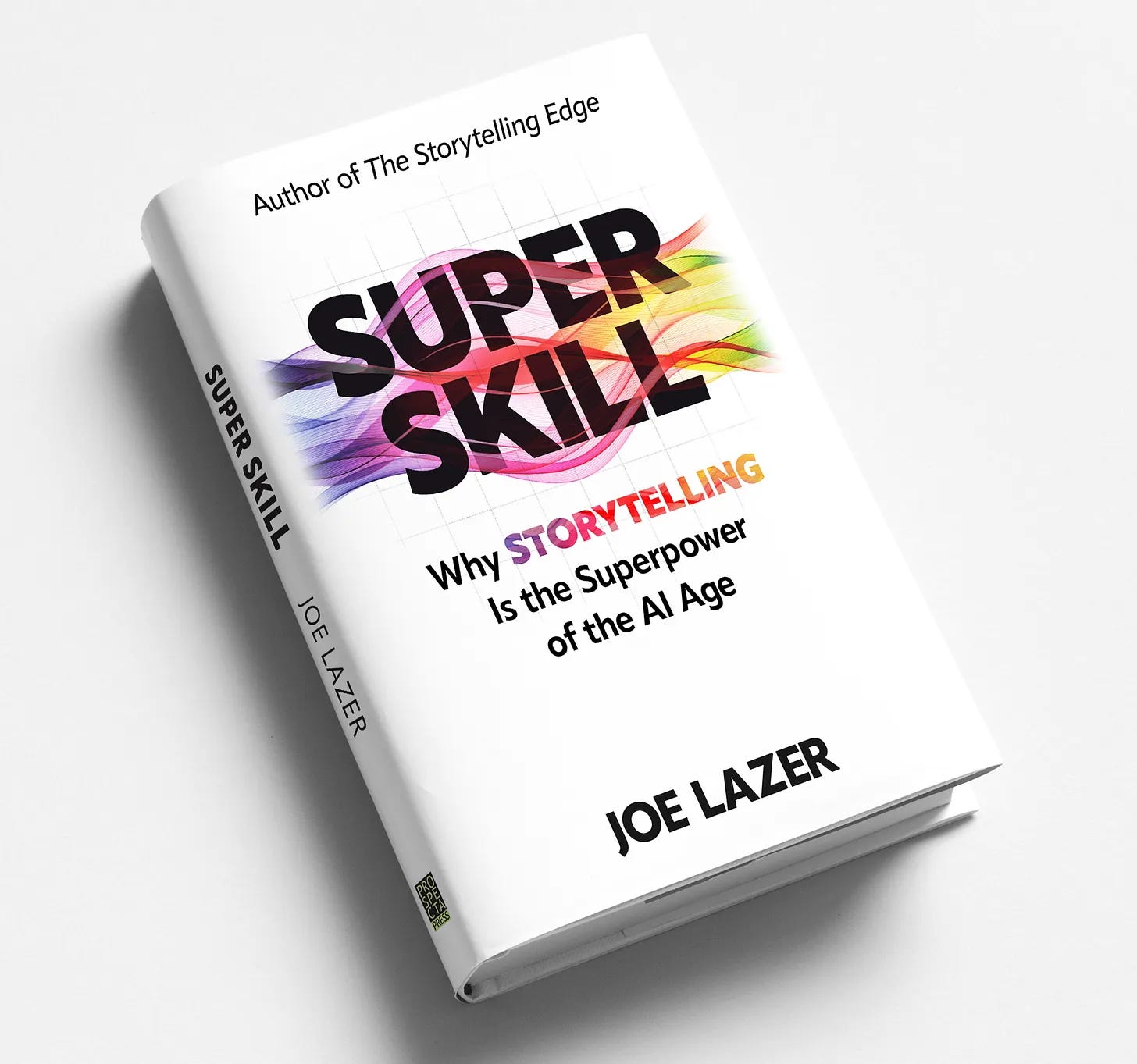
On tap this week: The storytelling skill that almost no one teaches, but is arguably the most important of all: active listening. This essay is adapted from my #1 New Release Super Skill: Why Storytelling Is the Superpower of the AI Age. As a reminder, you’ll get a personalized, signed copy of Super Skill—plus access to my new storytelling course and our live monthly content strategy mastermind group—when you upgrade to a paid subscription. You’ll also support my work as an independent writer. To celebrate the Knicks’ championship, I’m giving my biggest discount ever on paid subs: 30% off for the next 72 hours, which means that it’s only about $4/month!
Brandon Stanton’s journey to becoming one of the world’s most famous storytellers began in the unlikeliest of places: a Chicago bond trading desk.
Stanton never planned on being a bond trader. In college, he majored in history. He also loved politics—while in college in 2007 and early 2008, he canvassed for Barack Obama’s campaign across the country. He grew so convinced that Obama would beat Hilary Clinton for the Democratic nomination that he took out a $5,000 student loan to bet on Obama’s victory. When he told this story to a friend who was a bond trader in Chicago, the friend offered to get him a job. A willingness to take risks, the friend said, was the one trait that separated successful traders from mediocre ones.
Stanton was the type of person who gets obsessed with his hobbies. He majored in history because he devoured historical biographies, reading them every day. He didn’t just canvas once for Obama; he went all in. So naturally, he became obsessed with bond trading, and his risky style paid off. It was like a high-stakes game of poker every night. In his first year out of college, he made six figures, more money than he’d ever imagined.
But as the Great Recession disrupted the markets, Stanton’s risk-heavy approach backfired. He grew terrified of losing his job; bond trading had become his entire life. He realized he needed something that would give him a sense of purpose and identity outside of the markets, so after a brutal day at work, he made an impulse purchase: a Canon EOS 7D camera. Stanton spent his weekends traveling all over Chicago, photographing graffiti, landscapes, and candid photos of people.
A few weeks later, Stanton lost his job. His great fear had come true. So he took a walk and asked himself, “What do I want to do?” For two years, he had been so focused on mastering bond trading that he’d barely thought about anything else. He made a vow: He’d make just enough money to allow himself to spend his time doing something that nourished him in the moment. And that was photography.
A few days later, Stanton moved to New York City with a bold plan. He’d photograph 10,000 New Yorkers and plot them on a map, creating a photographic census. Sure, he’d never been to New York and only knew two people there, but it was one of the most diverse cities in the world. What better place for this kind of art project? He started a blog to document his work and called it Humans of New York.
His friends and family thought he was insane.
The $620 in unemployment he received every two weeks was just enough to rent a small room in Brooklyn and survive, as long as he ate only peanut butter and jelly sandwiches and scrambled eggs. He committed to working non-stop and raced around the city, snapping pictures of 30-40 people each day, determined to hit his goal of 10,000 portraits as soon as possible.
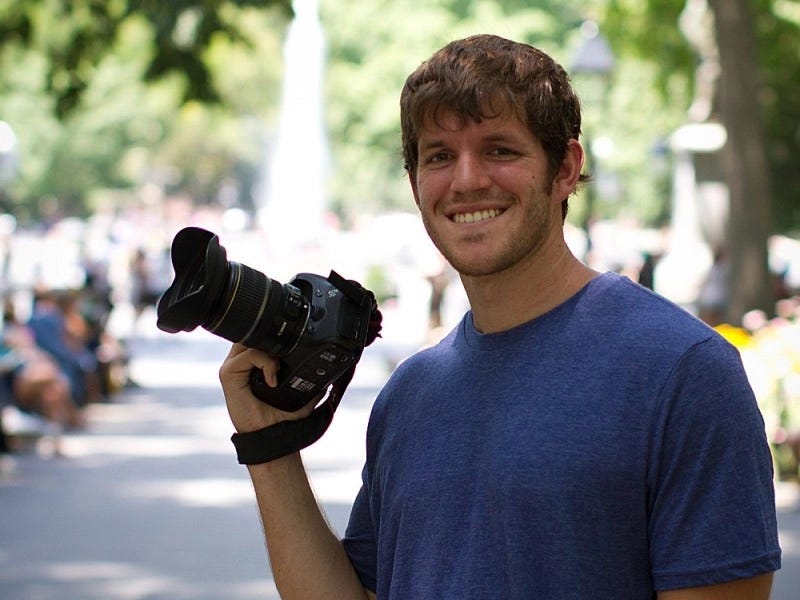
After six months and thousands of pictures, Stanton’s project was floundering. To gain traction on the blog, he’d started a Facebook page, but his posts usually only got a few likes. He spent Christmas Eve alone in a diner, wondering what he was doing with his life.
Then came the green lady.
She was dressed all in green—green shoes, socks, pants, gloves, jacket, muffler—even her hair was green. It was like her stylist was Kermit the Frog. Stanton took a picture of her and hated it; the composition was all wrong. He was close to scrapping his post about her when he remembered an exchange they’d had.
“So do you do a different color every day?” he asked.
“No, I used to go through different stages. But then I found that I was happiest when I was green, so I’ve been green for 15 years,” she responded.

Stanton put that exchange above the picture and posted. It got 67 likes—making it his top-performing post by far. “It was a eureka moment,” he later told The Profile. “I realized that people were much more interested in learning about these people than they were in seeing these people.”
Stanton changed strategy. Instead of racing around New York photographing people, he started listening to their stories, often chatting with his subjects for over 90 minutes. He began incorporating short profiles of each subject alongside their photos on his blog and Facebook. People loved it. In 2011, he took a walk in Central Park with a friend and excitedly announced that he was gaining 10 new Facebook followers each day. At this rate, he’d be at 10,000 followers in three years!
Stanton’s projection was way off. Three years later, he’d have 10 million followers and sit atop the New York Times best-seller list for non-fiction.
So often, we think of storytelling as a performance—seizing the stage, grabbing attention, and putting ourselves front and center. But the world’s greatest storytellers know something else. If you want to be a great storyteller, you need to be a great listener.
Active listening is one of the most critical skills in your storytelling arsenal. It not only allows you to mine the raw material you need to tell great stories and craft rich characters; it also helps you build stronger bonds with everyone in your life. And a study by researchers in Japan shows us why.
In 2014, researchers in Japan set out to answer a simple question: What happens in someone’s brain when they feel heard?
To find out, they invited 22 participants into an fMRI machine, which would track their brain activity in real time. As the subjects lay inside the machine, they told stories about emotional experiences to a counselor who sat just outside. But there was a twist: Sometimes the counselor responded with active listening; they were engaged and empathetic. Other times, the counselors were passive and indifferent.
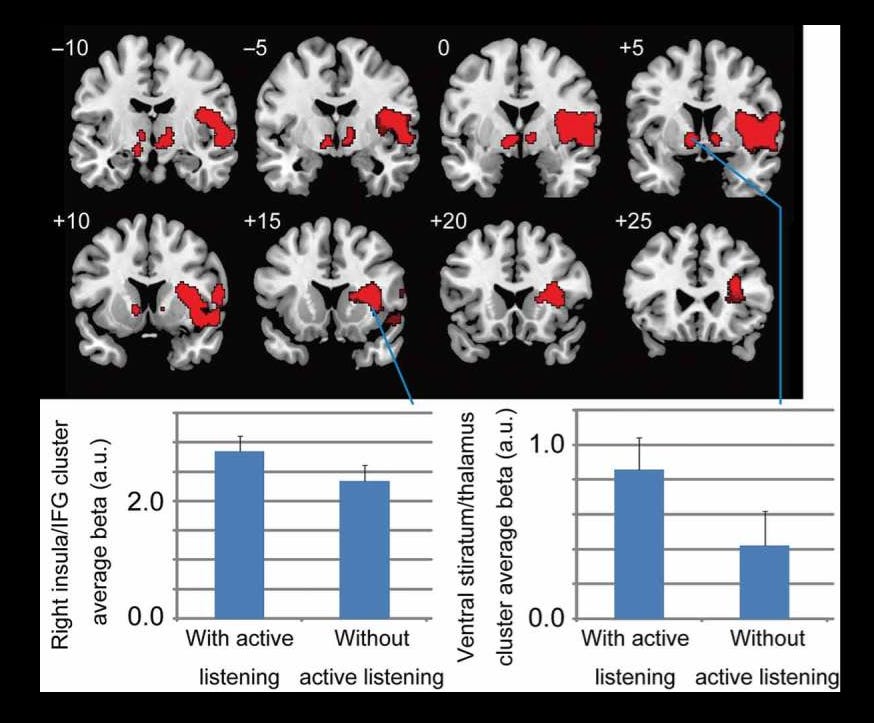
What they discovered was striking. When participants talked to a counselor who practiced active listening, the part of the brain associated with reward and pleasure, the ventral striatum, lit up. Being listened to felt incredible. It triggered the same parts of the brain that activate when you’re having sex, doing drugs, or eating a delicious cake. But that wasn’t all. Other parts of the brain associated with emotional regulation and empathy—the right anterior insula and the inferior frontal gyrus—lit up as well, suggesting that participants were reprocessing past experiences more positively.
The participants opened up more and rated the counselors who listened actively much more highly. They liked them. They trusted them. And they were eager to work with them again.
Active listening has two powerful effects. First, it makes us better storytellers. When people open up and share their stories with us, it gifts us the information and inspiration we need to craft rich characters and a compelling narrative.
Second, active listening strengthens relationships with the people around us. We are storytelling animals, and our brains light up when others listen to our stories. It’s the easiest way to build affinity and trust with your colleagues, bosses, direct reports, customers, and prospects.
By actively listening, you activate the pleasure centers in their brains and win their trust. Even if you never write a word, practicing active listening will strengthen your bonds with your bosses and colleagues, giving you a key advantage in your career.
For years, I’ve been fascinated by how to become a better listener. I’ve interviewed close to 1,000 people in my career, and I’m always in awe of how world-class interviewers like Oprah, Fresh Air’s Terry Gross, and Stanton make it seem so easy. What magical powers do they have that get people to tell their stories? I’ve listened to hours and hours of them explaining their process, and dug into the science of active listening. Along the way, I’ve identified five keys to active listening that will invite people to share their story with you:
(You can remember this as STORY. I am a sucker for memetic acronyms.)
When we tell a great story, the neural activity of the storyteller and listener literally syncs through mirror neurons. If I tell you the story of a harrowing travel experience when my cruise ship was taken over by pirates, your brain will see the pirates and mirror that experience. It’s a powerful bonding experience that you can trigger not only by being a good storyteller, but also by being a good listener.
Being a good listener starts with demonstrating that you’re in sync. That means using body language and facial expressions that mirror the speaker’s emotional state and responding in subtle, natural ways.
As Stanton began interviewing his subjects for Humans of New York, he realized that his superpower was his ability to approach people in a relaxed way that put them at ease.
“Over time, I learned it has nothing to do with the words I was saying. It has everything to do with the energy I was giving off,” he told photographer Eric Kim.
He always approaches people from the front with his arms in a wide, relaxed stance. And when he goes to ask someone if he can take their picture, he crouches down, making himself as small and non-threatening as possible.
Throughout her storied career, Oprah has interviewed more than 37,000 people. In an interview at the 2013 Forbes Summit, she revealed that everyone she interviews —from Barack Obama to Tom Cruise to Beyoncé—asks the same question: “Was that okay?”
“What I learned in all of those thousands of interviews is that there is a common denominator in all of our human experience,” she said. “Everybody wants to know, did you hear me, and did what I said matter?”
Oprah has learned that the key to a great interview is making her subjects comfortable, and more than anyone, she’s mastered the art of doing so. She uses “facial language” to sync with her subjects: steady eye contact, empathetic expressions, and leaning in to let them know she’s listening and connected to their story. There’s an entire grammar in her cheeks, eyes, and brow that makes the interviewee feel secure, and the audience feel like they’re part of an intimate moment. Ninety percent of human communication is nonverbal, and Oprah speaks this language better than anyone else.
Whenever you’re sitting down with someone that you want to invite to share your story, focus intently on your body language. Are your arms open rather than crossed? Are you relaxed? And as they begin to tell their story, are you leaning in, making eye contact, and following along with every word? Story-listening starts with showing you’re in sync.
Therapeutic research shows that if you want people to open up and share their stories, you need to create an environment of trust and “psychological safety”—the belief that they can speak without risk of punishment or humiliation.
Stanton accomplishes this in three ways: First, he pulls out his phone and shows his subjects Humans of New York to demonstrate that this isn’t some weird street prank, and that he’ll represent them positively. Before the interview, he tells people that some of the questions will be hard, and that they don’t need to answer anything they don’t want to. He also tells them that if they share anything sensitive, they can opt to have their hands or feet photographed instead of their face, so they remain anonymous. If they decide afterward that they don’t want him to post their story, he’ll honor their request.
Most great interviewers have a similar ritual to build trust with interviewees. At the 2022 Tribeca Film Festival, Oprah revealed the question she’s asked every guest backstage since 1989: “Please tell me what your intention is.” She then shares her intention for the interview to create a sense of trust and alignment.
Fresh Air’s Terry Gross tries to immediately eliminate concerns that she’s going to catch her guests in a “gotcha” moment. Before every interview, she tells her guests, “Let me know if I ask you anything too personal, and we’ll move on to something else because I don’t want to push you beyond what you’re comfortable saying.”
Ira Glass, host of This American Life, establishes this trust by telling a quick story about himself to encourage others to open up. “I try to create a comfortable climate,” he told The New York Review of Books. “You tell a story about yourself where you’re being a human being. That permits them to be a human being back. It helps to get things more real.”
Creating an environment of trust and psychological safety not only helps people share their stories; it can also improve your team’s performance. In her landmark 1999 study, Harvard Business School professor Amy Edmonson found that creating an environment of psychological safety boosts team learning, performance, and willingness to report critical errors.
If you want to invite someone to share their story, ask yourself: “What concerns do they have? What can I say to make them feel safe and like I care?” It’s a powerful approach whether you’re interviewing someone for a podcast or YouTube show, getting job candidates to open up, or trying to build stronger relationships with your team.
If you’re a manager, let them know that anything they say will stay between you, and share your own story to invite reciprocation. If you’re mentoring someone, you could tell them about a time you screwed up early in your career, emphasizing that mistakes are an inevitable part of learning. If you’re trying to build rapport with a prospect, it can be as simple as asking them why they decided to take the call. And if you’re interviewing someone for a show you’re hosting or a story you’re writing, take a page from Oprah — ask what their intention for the interview is and share your own.
What makes Humans of New York so engaging is Stanton’s ability to get people to open up about the most intimate moments of their lives. He usually begins an interview with one of three questions:
What’s the greatest struggle in your life right now?
What do you feel most guilty about?
How has your life turned out differently than you expected it to?
Since he’s already built a sense of connection and trust, people open up right away, revealing their struggles with money, love, health, and even their identity.
The key is to start with an open-ended question that invites a story rather than a yes/no question. Research on ethnographic interviewing shows that the most effective questions focus on feelings, not facts.
Change up your opening questions based on who you’re interviewing and what you know about them. For instance, Stanton traveled to Jordan and Turkey in 2017 to document the lives of Syrian refugees who had been cleared for entry to America. Instead of his usual questions, he went straight to the story he knew that people needed to tell: “Tell me about the day you left Syria.”
“They would start speaking in Arabic, and they would stop, and then tears would start coming down their face,” he told ABC News. Their stories led to an incredible series, The Syrian-Americans, that raised empathy for Syrian refugees.
In 1957, renowned psychologist Carl Rogers coined the term “active listening,” introducing one of the most powerful tactics for demonstrating empathy: Reflecting and paraphrasing the speaker’s words and emotions back to them.
For instance, if someone says, “I just feel so overwhelmed lately,” you can reflect back by saying, “It sounds like you’re carrying a lot right now and it’s starting to weigh you down,” demonstrating empathy and inviting them to share more.
Oprah is a master at this. Her reflection technique pairs emotional validation with strategic reframing, taking what guests say and reflecting it in slightly different language that invites deeper exploration. Take her 2021 interview with Meghan Markle and Prince Harry after they were stripped of their royal protections. She opens by inviting Meghan to share her story — her early work, independence, and advocacy for women’s rights, prompting Markle to open up: “That’s the sad irony of the last four years,” she said. “I’ve advocated for so long for women to use their voice… and then I was silent.”
“Were you silent? Or were you silenced?” Oprah responded.
In just seven words, Oprah shows that she’s listening to Markle intently. With that question, Oprah invited Markle to finally share the turbulent story of her time with the royal family, in an interview that would be watched by over 60 million people.
Later in the interview, Markle, who’s half-black, mentioned that the royal family had expressed concern about her baby’s skin color, and Oprah reflected the question to her, inviting her to open up. “There’s a conversation with you about how dark your baby is going to be?”
Terry Gross’s trick is to focus on a specific word that the subject said, and reflect it back to them, asking them to go deeper. “I’ll take a key word that somebody has said, or phrase, and I’ll say, ‘You said this, what do you mean by that?’ Because it’s a way of getting deeper into what they just said. Often the way of getting deeper is to go back to what somebody said and basically say, take it to the next step,” she explained during a 2020 National Press Club Journalism Institute event.
For Humans of New York, Stanton put a twist on this practice by challenging subjects in his reflection, pointing out inconsistencies. As he told The Profile: “Challenging somebody is a form of respect because it shows that you’re listening so closely that you’re noticing inconsistencies in their story.” Other than his go-to openers, Stanton never comes with any other pre-set questions. His interviewing style is reflective, inviting people to go deeper and share more of their story.
If you want people to let you in and open up with their story, consciously practice reflecting their words back to them. You’ll be surprised by how much they share.
In a 2018 interview with author and podcaster Tim Ferris, Stanton reflected on what’s made Humans of New York such a sensation, with over 30 million followers across social channels, a TV show, and millions of books sold. He attributed it to his ability to yield space to his interview subjects, creating a bubble where the rest of the world melts away.
“Humans of New York works because the people on the street that I meet are thankful to have someone really listen to them,” he explained. “This magic happens where they’re willing to let me into a space in their mind or their souls that they don’t let people into… The way you get into that deep space is presence. It’s 1,000% being there. You’re not looking at a list of questions.”
The other part of yielding space is silence. Therapeutic research reveals that yielding space by being fully present without judgment creates the psychological safety needed for someone to be vulnerable and tell their story. Stanton tries to feel for these moments when he should be silent. “You can feel when the person is being truthful, no matter what language they’re speaking,” he wrote in his 2020 book, Humans. “Because truth is often spoken haltingly. With pauses. Like it’s being dug up, one spoonful at a time, from somewhere deep. Truth feels heavy. It has gravity.”
Yield space for those pauses, and incredible stories will flow. Like Stanton, you’ll unlock countless new stories to tell, and build lasting bonds with bosses, teammates, customers, and every industry leader you interview.
Want to get top content strategies and insights in your inbox each week? Then subscribe to this newsletter and check out my best-selling new book, Super Skill: Why Storytelling Is the Superpower of the AI Age. You’ll also get a personalized, signed copy of Super Skill when you upgrade your subscription to paid. (About $4/month for the next 72 hours!)
Comments
Nothing yet. Say the first thing.
Sign in to join the conversation.