
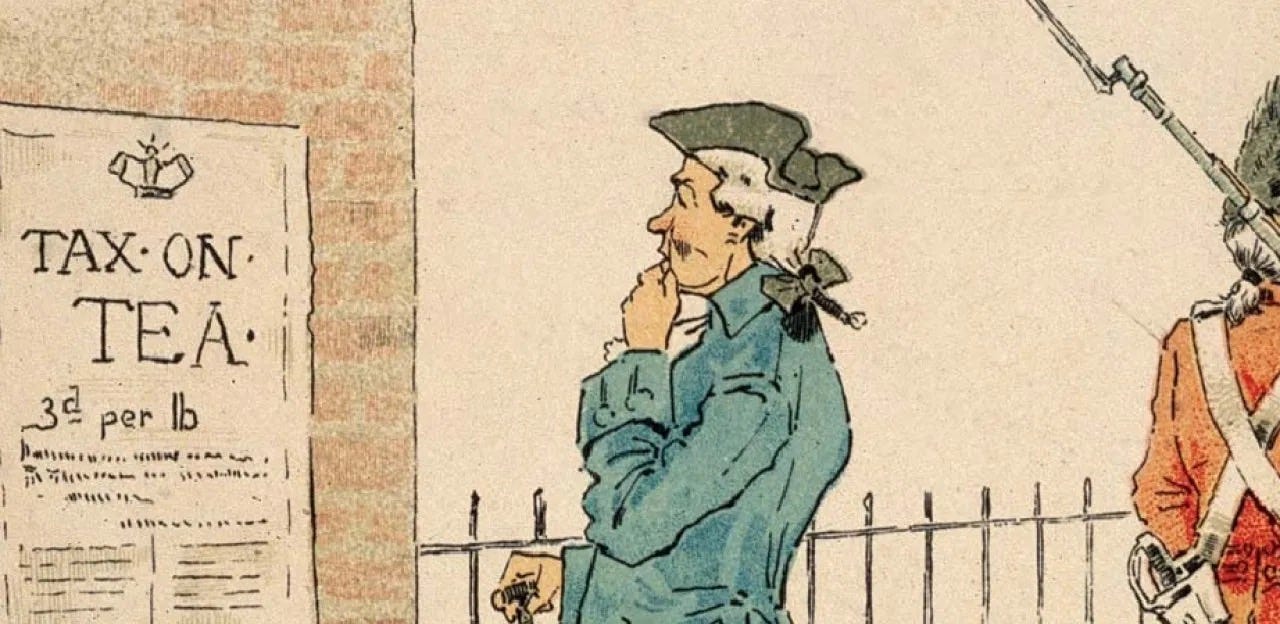
For most of the last thousand years, Ireland administered justice outside the state.
What it had instead was the brehons. They were professional jurists drawn from hereditary legal families. They trained for years, sometimes decades, in legal interpretation, memory, and the recitation of precedent. They were independent of kings and chieftains. Opponents chose which brehon to bring a case to. Their authority did not come from a sovereign or an army, but from trust, tradition, and kinship. His reputation was the only thing keeping him in business.
Fun fact: the restitution was enforced by independent guarantors, legal seizure of goods, public shaming, and kinship pressure. Trust in the system and in the ruling was everything.
A brehon was, in the most precise sense, a decentralized private judge with a market-tested reputation.
This worked, with some interruptions and gradual encroachment, from roughly the 8th century until the English finally abolished it in the 17th century. The system held together for about 800 years without a state administering it.
Closer to home and closer in time: from 1790 to about 1850, most of the long-distance roads in the eastern United States were built and operated by private companies Granted, these held charters issued by various levels of government. According to Daniel Klein from George Mason University, more than two thousand private turnpike companies financed, constructed, and maintained toll roads during the nineteenth century.
These were equity-financed corporations operated for profit, during a time when bailouts were not prevalent. In New York alone, between 1790 and 1821, the state spent roughly $622,000 on roads and bridges. Private investors during the same period put $11 million into turnpike companies and another $850,000 into bridge companies. The American road network, in its formative period, was overwhelmingly a private undertaking funded by user payment at the tollgate.
The objective in Medieval Ireland was to provide access to justice, and in the newly independent America it was to provide access to new territories to settle the land and connect the centers of production.
A peasant in Medieval Ireland could choose the best one from several different judges to bring his cause to and get justice, and a book publisher from Philadelphia could expect paper to come from Pittsburgh timely and soundly, for him to conduct his business and plan ahead. They both could trust that they could complete their tasks without having to think of who provided justice or roads, and what their motivations were.
These fun historical facts came to mind as I read appalling, simpleton arguments for and against property taxes, triggered by two events: a recent Florida Legislature’s vote on a referendum that might extend the Homesteading Rule, basically abolishing property taxes statewide; the announcement by Jersey City Mayor Solomon that they are hiking property taxes by 20% and a SCOTUS decision that upheld the taking of a generational home in Michigan. Major blows to both camps, those issues have social media property tax appreciators repeating the well known yet unfunded argument of “who will build the roads”, and abolitionists victoriously chanting “muh freedom”.
The current arrangement, in which urban services are provided by a local government monopoly funded by property taxes, is not the only arrangement that has ever existed. It is not even close. Besides the Turnpikes, Railroad companies were also private, as was the NYC Subway, where private entities competed to provide service. It was never black or white either. Private ownership often came with special government charters, and private operation sometimes ran into headwinds and cried to government for help. But history, as I argue in this essay, is sufficient grounds to question how we raise and manage taxpayers money by levying property taxes, and whether those levies are the only inevitable way of paying for urban services.
History contains a wide range of models that societies have attempted in order to fund and deliver services people need. Most of those arrangements would strike a contemporary American taxpayer as exotic. They were not exotic at all at the time.
For roughly the first five thousand years that humans collected property taxes, levies were tied to an asset’s income-producing capacity, and not to its market value. The current American model, where the tax follows speculative market value irrespective of what the owner does with the property or earns from it, or even the size of his income, is roughly two hundred years old. The inevitability argument collapses the moment we put the timeline on paper.
Ancient Egypt, around 3000 BC, taxed grain harvests at approximately twenty percent of yield. Tax assessors counted cattle, checked crop output, and recorded the size of each holding. The taxpayer was the farmer, and the tax base was what the land produced. Mesopotamia, Persia, China, and Babylon all operated on the same productivity-based principle. Rome formalized the productivity-based taxation under Diocletian around 287 AD, combining assessment of labor and livestock with cultivated land. The tax was explicitly tied to agricultural productive capacity.
Medieval England continued the pattern. Royal surveyors recorded for each manor what it could yield in agricultural output, livestock, mills, and fishponds. British tax assessors in the fourteenth and fifteenth centuries used ownership or occupancy of property to estimate a taxpayer’s ability to pay. The tax was on the faculty to generate income from the asset.
Colonial America inherited this approach. The Massachusetts Bay colony assessed taxes in 1634 on each man 'according to his estate,' where that meant his productive capacity. A person’s farm acreage, soil potential, timber stand, or livestock count was a reasonable proxy for that person’s earning capacity.
The American shift to market-value taxation of property can be dated precisely. Illinois adopted the first state constitutional uniformity clause requiring property to be taxed by value in 1818. By the end of the nineteenth century, thirty-three states had adopted similar uniformity clauses. By 1902, property taxes comprised 68 percent of combined state and local revenues. The model we take for granted is roughly two hundred years old. The five-thousand-year prior tradition tied taxation to productive output.
Industrialization made the proxy unusable. Wealth moved into wages, financial assets, and intangible capital that property taxes did not touch. The reasonable response would have been to abandon the property tax model in favor of taxes that followed where income was actually produced, so that non-income producing assets would not be unfairly taxed, which would have destroyed wealth by triggering forced sales or seizing property over unpaid levies.
Instead, American states kept the property tax and pointed it at a new target: the speculative resale value of residential houses, which produce no income at all. This was the path of least resistance, not the only possible one. Real estate sits still, shows up on a map, and cannot be moved offshore or hidden in a numbered bank account, which made it the weakest link left to tax once income detached from land. But easy doesn’t mean necessary.
Nothing compelled the states to find a new tax at all. They could have funded services through use-based fees, capturing value at the time of transaction, or delegated provision, the same way other societies did before and since. The new tax was reached for because it was convenient to administer, and its convenience is precisely why no one stopped to ask whether a better mechanism existed. Inevitability was assumed, never demonstrated.
The result is a levy that taxes nothing the historical model would have recognized as taxable. A paid-off asset that has not been liquidated generates no revenue for the owner. Yet cities tax the market value under threat of foreclosure.
Acknowledging historical precedents changes the property tax conversation. Property taxes as understood today are not inevitable. They have not been inevitable for most of human history. The question worth asking is whether the specific model prevalent in America today, which taxes the speculative market value of non-productive residential property under threat of seizure, is defensible.
The seizure mechanism is at play at the Supreme Court, as I write this. The Michigan home of the Pung family was taken not by a distant bureaucracy but by a local assessor who, told by an administrative judge that the family owed nothing, answered that she did not care what he said. Proximity did not restrain her and she chose to double down.
The strongest defense of the current taxation to urban services pipeline rests on two pillars. The first is that local government is close to the people it serves, and that proximity produces accountability. The council member who approves the school budget shops at the same grocery store as the district schoolchildren’s parents. The county supervisor who funds the homeless services agency drives past the encampments. Closeness is supposed to act as a corrective.
The second pillar is the public goods argument. Many urban services are non-excludable, which is to say you cannot charge users individually because you cannot exclude non-payers, and you have to have a single collector of revenue and a single payer for services.
A clean street benefits everyone who walks it. A functioning sewer system serves the parcel that paid for it and every parcel downstream. Encampment cleanup, street lighting, public safety, stormwater management, and the maintenance of the public realm all share this property. The argument follows that competitive private provision will systematically underdeliver, because the private provider cannot capture the full value of what it produces.
A coercive taxing authority would be therefore required, the argument goes, and the local jurisdiction, being closest to the problem, is the most defensible level at which that authority should sit.
These arguments are worth taking seriously. The economics and the historical evidence behind them can be questioned, but the intention and the fear about changes causing chaos in services are real. The question, however, is whether the model delivers the results it promises.
Consider Los Angeles’s massive spending on homelessness. From fiscal years 2020-2021 to 2023-2024, the city alone poured about $3.6 billion into services, with $1.28 billion in just 2023-2024. The Los Angeles Homeless Services Authority (LAHSA), the main coordinating agency, ballooned from a $63 million budget in 2015 to $845 million in 2023. That funding flowed to over a hundred nonprofits and programs, all tasked with reducing the homeless population, clearing encampments, and housing people, yet the incentives were misaligned from the start.
A March 2025 court-ordered audit of roughly $2.3 billion across three major programs revealed serious accountability failures. Independent contractors operated with vague agreements and poor record-keeping, making the money hard to track. The city didn’t routinely reconcile spending against budgets, and at least $513 million allocated in 2023-2024 went unspent. A federal task force is now probing potential fraud, while Los Angeles County pulled its funding from LAHSA to create its own department. Outcomes remain disappointing: the county’s point-in-time homeless count rose from ~59,000 in 2019 to 75,518 in 2023, then 72,308 in 2025. This is still 22.7% higher than pre-pandemic levels. Independent analysis suggests official counts understate street homelessness by 26-32%, meaning reported “declines” likely reflect counting changes rather than real progress.
This is not a system that has been starved of money or one that suffers from distance between government and constituents. The mayor of Los Angeles declared the emergency, council appropriated the funds, the local agency hired the contractors and they received the money. And after roughly $3.6 billion of municipal spending in four years, the encampments remained, the population grew, and an audit covering more than half that spending could not say where the money went.
The Los Angeles example is large enough to feel abstract. In Montclair, New Jersey, where I live, the public school district recently disclosed a budget deficit of approximately $19.6 million, spread across two fiscal years: $12.6 million for 2024-2025, and $7 million for 2025-2026. The proposed solution was to ask Montclair homeowners, via special election, to cover the gap through a one-time property tax increase of approximately $1,117 on a home assessed at the township’s average of $639,630, plus a recurring annual increase to fund the second year.
In a town of roughly forty thousand people, where school taxes already make up 56.7 percent of the average property tax bill of $22,487, this is not a story of distance breeding indifference. The board of education is local and members are elected. The administrators are local. The auditors are local. The voters are local. Proximity did not prevent the abuse of trust and mismanagement.
The honest objection to these two examples is that I picked them. Most property tax dollars do not vanish into a billion-dollar homelessness apparatus. They repave a road, staff a firehouse, run a library that opens on time.
Since the intention is to have a fair account, let’s look into the median cases, and not just the scandalous ones. Even where the firehouse shows up and the road gets paved, we have no benchmark to affirm with 100% certainty whether that was the most efficient way to raise the money or deliver the service. The presence of a monopoly (or in this case the local government as sole service provider) makes market pricing impossible to calculate, which is the only mechanism that could tell us. There is no competing provider, no opt-out, no second price to compare against. A service that exists is evidence the service exists. It is not evidence that it is funded by the least distorting instrument available, or priced at what it should cost, or delivered at the standard a contestable market would force.
The absence of a benchmark is not proof of efficiency. It is the absence of proof in either direction. That uncertainty alone makes the question worth opening, even if in the end we conclude that the present arrangement was right all along.
The public goods argument and the proximity argument can both be true and the system can still fail. Example after example we confirm they are not, in practice, the safeguards they are claimed to be. Local government has misaligned incentives just as other levels of government. The assumption that closeness and a coercive taxing authority together produce accountability is one of the more comforting fictions of American civic life.
Whatever your opinion about property taxes, there are a few unquestionable facts that we have to agree on. You can read the premises below and conclude that property taxes should be raised, lowered, restructured, or abolished. It doesn’t matter. The facts themselves do not require any particular conclusion. They are simply the case and constitute the baseline to begin the conversation.
The owner has not sold the asset. No liquidity event has occurred. The tax is assessed against a theoretical market value the owner may never actually capture. Non-payment triggers a legal process that can result in the loss of the property and any equity accumulated above the tax debt. A homeowner who paid off the mortgage forty years ago, owes nothing to any bank or private party, and has neither the income nor the intention to sell can still lose the house to the state for non-payment of taxes on a paper appreciation she never asked for and cannot spend.
And the backstop is not symmetric with private debt, which is the analogy defenders reach for. A mortgage lender who forecloses sells the house, takes what it is owed, and returns the surplus to the owner. For most of the modern era, several states let government do something no private creditor may. It could seize the home, sell it, and keep the entire proceeds, surplus included. Oakland County, Michigan, took a house over an eight dollar debt. Isabella County seized the Pung family home, assessed near two hundred thousand dollars, sold it at auction for seventy-six thousand, kept all of it, and evicted a family over roughly two thousand dollars the tax tribunal had already ruled they did not owe. The Supreme Court called this practice unconstitutional in Tyler v. Hennepin County in 2023, and revisited it in Pung in June 2026. Even the corrected rule measures what the owner gets back against the auction price, not the value of the house. The mechanism is what it is.
Whether you think this is justified or confiscatory, the mechanism is what it is.
The taxpayer cannot choose a competing provider, cannot decline services he does not use, and has no mechanism to verify whether what he is paying corresponds to the cost of what he is receiving. A childless couple pays for the school system. A vacant lot pays for fire protection it does not need. A parcel on a heavily trafficked corridor and a parcel on a quiet side street pay rates based on assessed value, not on the cost of providing them with services. The bundle is fixed by the jurisdiction. Whether this structure is necessary for the provision of public goods or whether it enables waste and rent-seeking is a separate question. The structure itself is not in dispute.
And that goes for services we agree that we need. On top of that, there’s a plethora of programs, projects, and contributions towards which municipalities do not have a constitutional obligation to allocate taxpayer money. From sports stadiums and discretionary exemptions to churches and other organizations, to direct funding of interest groups, too many pennies on each dollar the city spends go to places other than funding infrastructure and urban services.
The objective of a city is to provide adequate living conditions for residents. Roads, waste collection, sanitation, electricity, etc. How we reach that objective is a matter of policy.
Alternative funding mechanisms exist and have been implemented by actual societies, with very successful outcomes. Whether they can be assembled into a full replacement of property tax revenue is the question I return to at the end.
User fees are the simplest one. They depend on whether you engage a service, and how much of those services you use. Arguably, they break the subsidized funding of e.g. school systems. Public school funding is possibly the hardest case for any property tax replacement.
The link between property taxes and public schools is a historical accident of American policy. Several states have already moved away from it. Vermont overhauled its school funding system after the Brigham decision in 1997, shifting to a statewide property tax with state-level distribution to address inter-district inequity. Michigan's Proposal A in 1994 cut local school property taxes and replaced most of the lost revenue with a higher state sales tax. Hawaii operates as a single statewide school district funded primarily at the state level.
Schools can be funded without local property taxes, or at least without taxing non-productive, owner-occupied, paid-for residential property. Questions of results per dollar spent, literacy and numeracy rates, charter schools, and the growth of homeschooling belong in the conversation, but they lie outside the scope of this essay. Here we treat public-school funding simply as a line item that must be covered by some revenue stream.
The hard question is whether the American attachment to the property-tax-for-schools model is producing outcomes anyone would defend on the merits.
Another alternative to property tax revenue that is widely used in cities in America, where property owners contribute through special assessments to a fund that manages ground activities and activations, is the Special Improvement District. Granted, these assessments are levied on top of property taxes, and the fund takes many forms, most typically a nonprofit corporation that is entitled by the municipality to implement a pre-approved mandate. But the logic stands: all commercial property within a boundary pool their contributions to fund urban services. Since all property within the boundary generates revenue for property owners, the assessments are tied to land productivity, in a poetic kind of way.
Land value capture at the moment of transaction or development is a tool that shows very good outcomes when it comes to funding large urban operations. A textbook case is from Brazil, where they created “Urban Operations Consortiums”, public-private entities that extend certificates for building rights that are sold in the market. Developers invest in upzoned areas, and keep their profit, but the money they paid for the certificates finances large infrastructure projects. Look up “Faria Lima” and “Agua Espraiada” for very solid examples of how this works. This scheme can be scaled down to use in tourist attractions, public art investment, and other urban components with measurable ROI, which can be then used to fund services.
And then, of course, is the private provision of excludable services through direct user payment, as in the American turnpike era, or the Indianapolis waste collection service structure, where various providers, including the public company, compete for routes. Even mediation, arbitration, and dispute resolution by private professionals operating within a reputational market, as in the brehon system.
Whether any of these are preferable to the current property tax model is a matter for argument. That they exist, and have been used, is a matter of record.
Given the structural facts above, the historical breadth of alternatives, and the fact that the proximity and public goods defenses together have not, in practice, delivered the accountability they were supposed to produce, a few questions become worth asking out loud.
There is no catalog of wholesale replacements to urban services provided by the local government and funded by property taxes. If the services that can be delegated are delegated, and if the revenue for the specific non-excludable services can be raised at the moment of transaction or development, then the broad taxation of residential property on unrealized value alone would have no remaining justification.
At this time, however, I cannot come out in support of the abolition of property taxes. At least until the replacement mechanism creates the necessary revenue stream to cover the costs of operating the city and providing services, while easing the burden on homeowners. Until that moment, I can only offer questions as a takeaway:
• Is the property tax the most efficient mechanism for funding urban services, or simply the most administratively convenient one for the entity that collects it?
• If we were designing the funding system for an American city from scratch, with no path dependence, no existing bureaucracy to preserve, and no developed productive economy for the first few years, would we land on property taxes as the most effective revenue source? If not, what would we choose, and why?
• Is there a version of municipal finance in which taxpayers can see, parcel by parcel and service by service, what they are paying for and what they are receiving? If not, why not?
And the question that hangs over the others: if proximity does not produce accountability, what does?
I do not have clean answers to any of these. Given the vitriol that commenters have shown toward schemes like Florida’s homestead rule extension that would effectively abolish property taxes for 60% of owner-occupied homes statewide, it’s important that people understand what is behind those taxes and what unintended consequences we might avert if we have this conversation in the open, respectfully, and intelligently.
Jaime J. Izurieta is the founder of Storefront Mastery and the author of Main Street Mavericks. He writes about cities, urban economics, storefronts, and the ground floors that make urban life worth living.
No posts
Comments
Nothing yet. Say the first thing.
Sign in to join the conversation.