
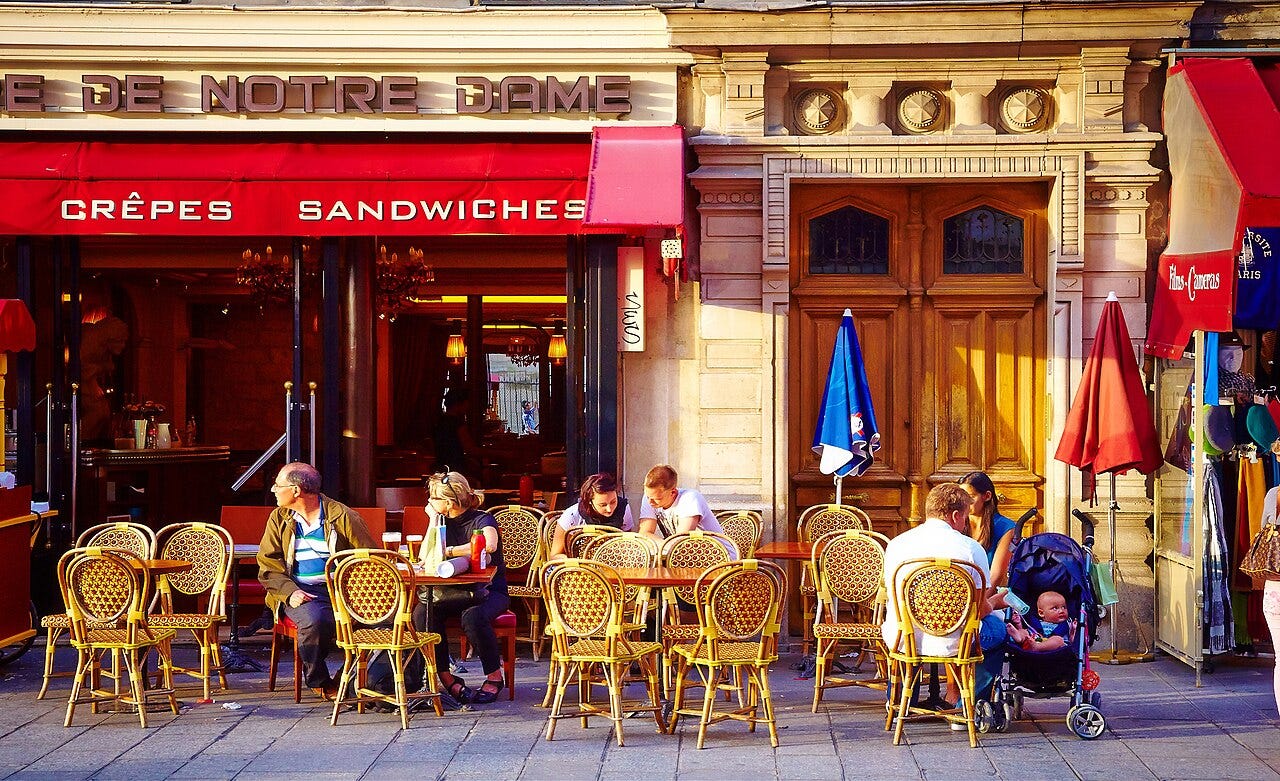
Howard Schultz went to Milan in 1983. If you don’t know who that is, he’s the architect of the Starbucks brand’s shift from a local roaster to a worldwide story. In Milan, Schultz walked into an espresso bar and had a career-changing moment: he understood that the café was a social institution.
What Schultz brought back to Seattle was an iconic pivot idea. He saw the coffee house as a neighborhood institution where coffee is not taken to-go. He experienced the flair of Italian coffee culture and thought that the centuries of compounding could be designed, replicated, and scaled for American consumers.
Starbucks formalized the experience and removed the specificity. Where the Café de Procope and the Café Tortoni were irreplaceably in Paris and Buenos Aires, the Starbucks coffee shop on any given corner, from Seattle to Cincinnati had the same sophistication and cosmopolitan allure. The service delivery became the product.
It worked, spectacularly, because it answered a real need. Mid-1990s American cities had largely lost their third places. The diner was dying. The bar required alcohol. The park required good weather and proper garbage collection. Starbucks filled a genuine civic void with a commercial product, and millions of people voted for it with their feet and their dollars.
The critique that Starbucks homogenized the coffeehouse, killed the local café and replaced character with formula is fair. But the more interesting observation is what it revealed about cities. When Starbucks landed in a neighborhood, it wasn’t replacing a vibrant café culture. Usually it was replacing nothing. The need had been there all along. Starbucks just showed up with a green apron and a comfortable chair and asked if anyone wanted to sit down.
Fortunately, for localism buffs and urbanist types everywhere, it did not replace the small coffee shops, but operated on a separate dimension. More about Starbucks later.
The story of coffee is an urban story. Its culture and lore has grown with cities and now it’s an indistinguishable part of the urban experience. Most experts maintain that it starts in Yemen, around the 15th century. Beans brought from neighboring Ethiopia were known as qahwa and chewed or brewed by monks and travellers in the appropriately named port of Mocha. It was there that they figured out it could be roasted and ground to produce something closer to what we now know.
The popularity of these beans grew, and the port of Mocha became the coffee capital of the world for nearly two hundred years. And as it happens in port cities, where trade and exchanges produce the best ideas, the coffee house was born, and spread to other urban centers in the Arabian Peninsula.
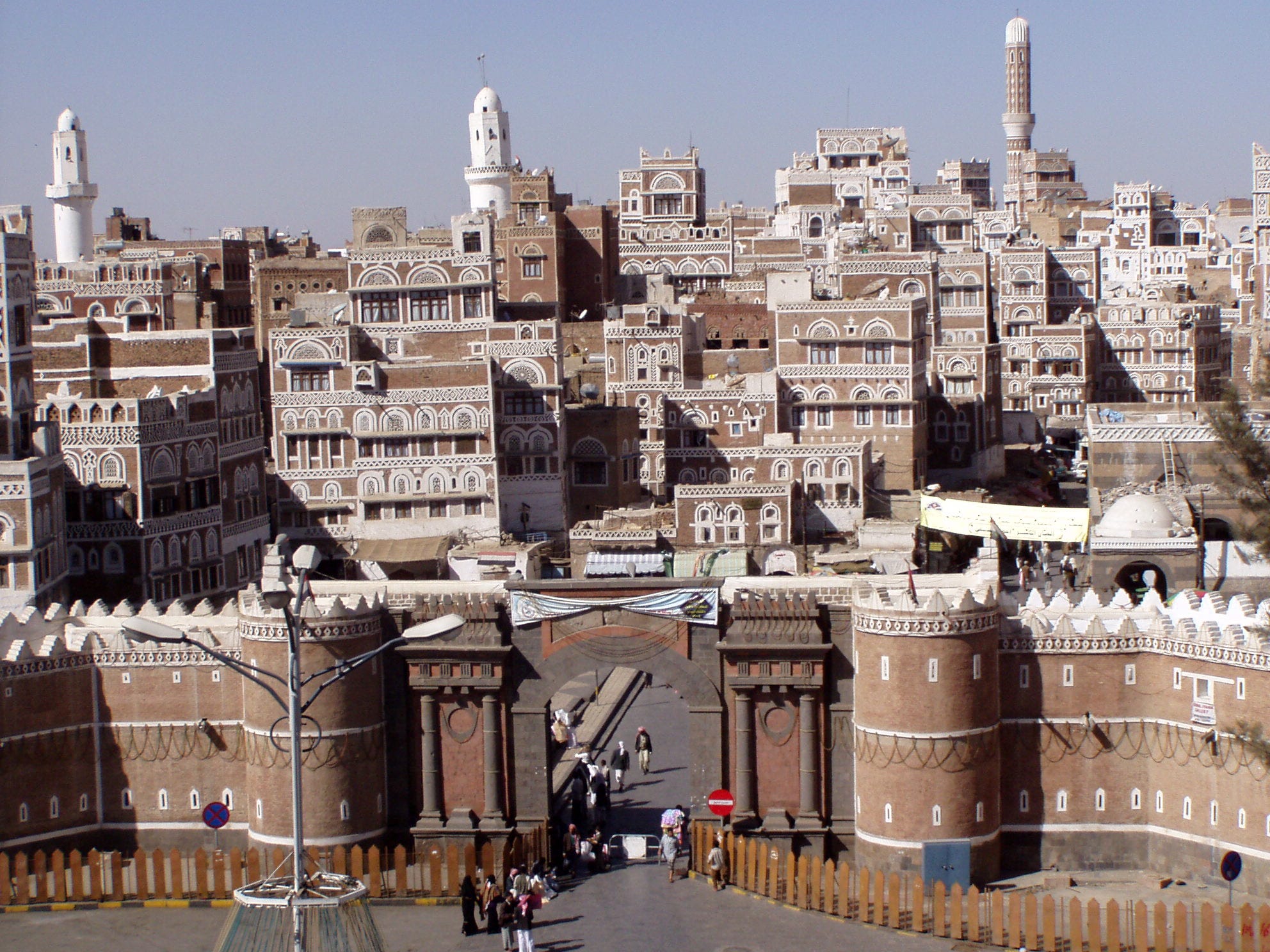
Alcohol was forbidden so the coffeehouses became the Arabian equivalent of the European taverns: a gathering place and intelligence hub, the room where things happened. In San’a and Aden and across the Yemeni plateau, cities organized themselves around these places the way medieval European towns organized themselves around the church square. The coffeehouse was civic infrastructure.
In the mountain villages of Yemen, multistory tower houses of stone and mud brick, some rising eight stories above narrow streets, fitted with intricate alabaster windows that diffused light into their top-floor rooms. The “room with a view,” called mafraj in the Yemen, was where guests gathered, coffee was served, and conversation happened. The whole building was essentially a vertical third place.
When the Ottoman Empire absorbed Yemen in the 1530s, coffee traveled to the confines of the Empire. Within decades, Istanbul had hundreds of coffeehouses.
The Ottomans, consummate administrators of public life, understood how coffee culture intersected with city governance. The coffeehouse became the place where you learned the news, where merchants negotiated, where poets recited, where men of different classes sat within arm’s reach of each other. It was a democratic room Which is why the Sultans occasionally tried to ban it.
Murad IV, in the 1600s, shut the coffeehouses down on the grounds that they were hotbeds of sedition. He was right. That was exactly what they were, and why they mattered. Sedition is just politics practiced by people who don’t have a palace. You need somewhere to do it.
Bans never hold. The Sultans had not yet heard of the Streisand Effect. The coffeehouses always came back. Legal or underground, cities will always have places where ideas move faster than institutions, and coffeehouses have long offered that very space.
A century later, the Ottomans decided that Europe would be a good place to expand their Empire. Jan III Sobieski had other plans. The mythical legend of Viennese coffee goes through the siege of 1683, when the Ottoman army retreated and left sacks of strange beans behind. Vienna took coffee and made it European.
The Viennese added the Kaffeehaus as a total environment. Design elements such as marble tabletops, newspapers on wooden poles, chess tables, and some of the most elaborate pastries. Croissants are a metaphor for Vienna eating the crescent. In French, pastries are known to this day as “Viennoiserie”.
The Viennese coffeehouse was a place where a man could occupy a table for the better part of a day on the strength of a single cup and no one would throw him out.
This was a city living in its coffeehouses. Freud, Trotsky, Klimt, and an obscure painter who shall remain nameless, had their regular tables. Stefan Zweig wrote about the Viennese coffeehouse as “a sort of democratic club to which admission costs the small price of a cup of coffee.”
The coffeehouse was a third place decades before Ray Oldenburg was even born. Home was first. Work was second. The coffeehouse was the third thing, the one that made living in the city feel like living rather than just existing.
The Café de Procope opened in Paris in 1686 and has been operating, more or less continuously, ever since. Voltaire drank there. Rousseau drank there. Diderot apparently used a marble table as a desk. When the French Revolution came, the cafés of Paris were where it was rehearsed, argued over, and finally decided.
In Barcelona, the tradition took a slightly different flavor. The cafès of the Eixample district, Gaudí’s Barcelona, became part of the texture of a city that understood street life as a serious matter. The evening walk along the avenue ended in a café. Business happened in cafés. So did romance, and politics, and the slow Catalan art of conversation conducted without apparent urgency.
The Latin American Boom, the most prolific group of writers in the Spanish language in the twentieth century, started when exiled writers like Cortazar, Vargas Llosa and Garcia Marquez met, mingled, and wrote their homesickness and misery away in the European coffeehouse.
Where the Viennese lingered, the French theorized, and the Catalans traded, the Italians built the bar, a standing operation, a quick exchange, a shot of espresso consumed at the counter in the time it takes to say good morning and mean it. The Italian bar is designed for connection at speed.
The Italian coffee bar is democratic in a way the salon never was. There is no premium on lingering. The doctor and the delivery driver drink standing at the same zinc counter, pay the same price, exchange a few words or don’t, and move on. The transaction is fast but the relationship is long. You go to the same bar for thirty years. The barista knows your name on the first day and your daughter’s name on the third. The counter is short but the social contract is deep.
And because the bar is on the ground floor, facing the street, integrated into the fabric of every neighborhood, it pulls the city’s social life down to the sidewalk level. It is a vertical sidewalk with an espresso machine.
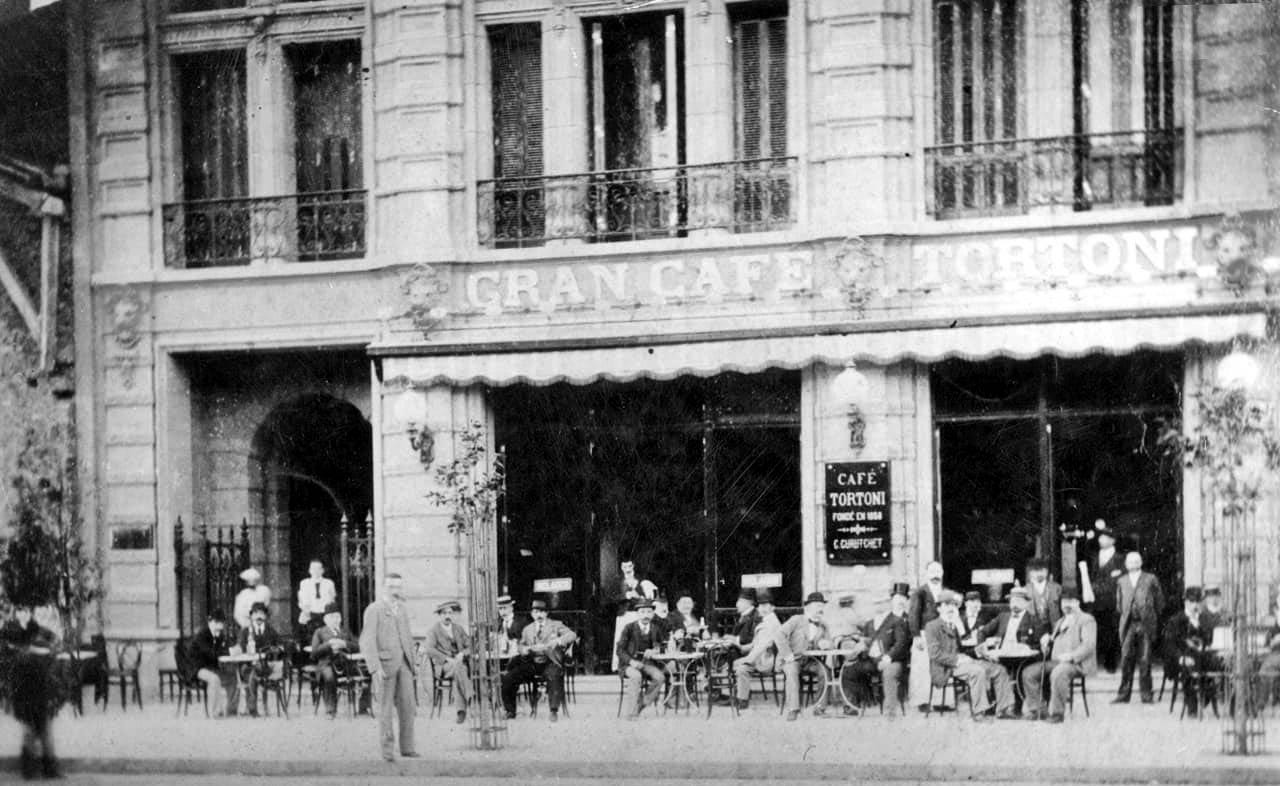
Buenos Aires imported this and made it magnificently its own. The confiterías and cafés of Buenos Aires are places where hyperlocal identities were crafted. The club, birthplace of Messi, Maradona, and some of the best football players in the world, was originally a mix ot the Italian bar with the Viennese Kaffeehaus, sprinkled with the Argentine talent for stretching an afternoon into an eternity.
Buenos Aires is a city built by hardworking, entrepreneurial immigrants who understood that the café was what you built first, before you built anything else, because the café was how you claimed the city as yours.
The history of coffee keeps proving, city after city, century after century that people need a reason to be in public that isn’t an errand. This is where relationships emerge, businesses are closed, ideas are taken to action, and countries become great.
The story of coffee throughout history is the story of the city trying to solve the same problem. How do you make strangers into neighbors? How do you give people a reason to claim public space as their own? How do you build the room where the city becomes itself? The Cubans have answered this question in the sweetest possible way, as I wrote here last week.
Before coffee was a beverage, it was an excuse to leave the house, to sit across from a stranger, argue about poetry, meet a co-founder, or find a ship to take you to Tatooine. The cup was almost beside the point. What mattered was the room it put you in, and the people it put you next to.
The story of coffee is typically a product story, the bean, its origin, the altitude, and the fair treatment of growers, and a commodity bought and sold. But that version misses the whole thing. Coffee is, and always has been, a city story.
Jaime J. Izurieta is the founder of Storefront Mastery and the author of Main Street Mavericks. He writes about cities, storefronts, and the ground floors that make urban life worth living.
No posts
Comments
Nothing yet. Say the first thing.
Sign in to join the conversation.