
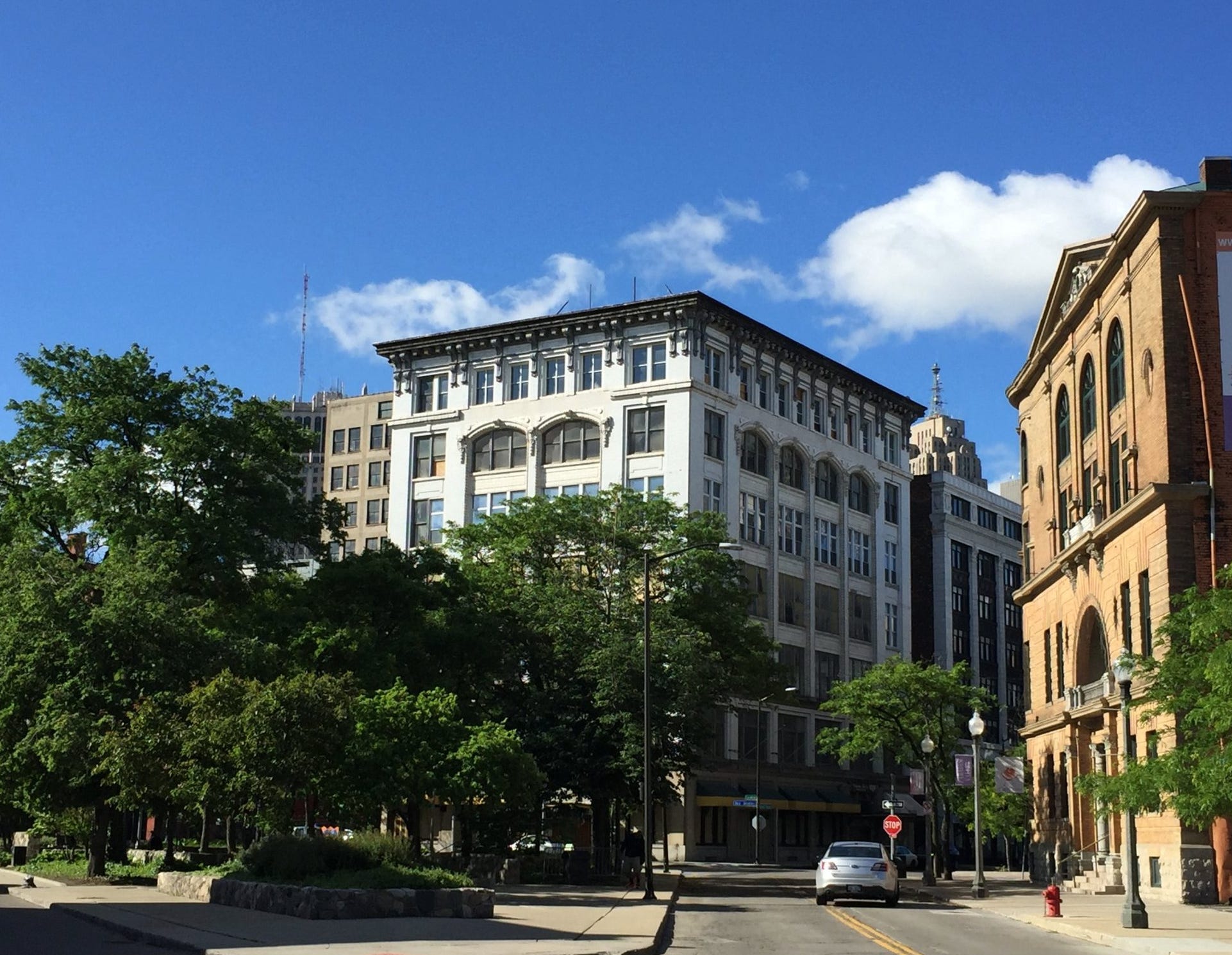
In 1904, a guy from Saint Louis could walk out of his house on a tree-lined boulevard, past a corner bakery, a tailor, and a newspaper stand, catch a streetcar to the World’s Fair, and find more than a handful of reasons to feel that he lived in one of the greatest cities on the planet.
He wouldn’t have been wrong.
Saint Louis in 1904 was hosting the Olympics and the World’s Fair at the same time. Cincinnati had opera houses that rivaled Vienna’s. Detroit was building wealth at a pace that made European industrialists nervous. These weren’t provincial outposts pretending to be Paris. They were American cities doing what American cities did best: growing fast, building beautifully, and generating staggering amounts of prosperity from the ground up.
Then we broke them.
Not all at once. Not with a single policy or a single war. But through a slow, compounding accumulation of rules, incentives, and decisions that, one by one, moved the center of gravity away from the street and into the private realm.
Here’s where my fellow urbanists usually lose the plot. They see a gorgeous square in Bologna or a charming lane in Bruges, and the takeaway is: “Why can’t we have that?” And then someone on social media posts a photo of a strip mall in Houston and everybody nods sadly and says, “Because America.”
But that comparison is broken in two directions.
First, those European places didn’t get charming because someone in a Brussels office building drew up a master plan and sent it to the provinces to implement. Bologna’s porticoes were painstakingly built by local wealth created by local merchants, in a small republic, over centuries, through an organic process of trial, error, and neighborhood pride. They didn’t just appear in Europe, and they won’t in America either.
Second -and hear me out because this is the part that really matters- American cities were on that same trajectory. The pre-WWI American downtown was a machine for building civic wealth. Mixed-use buildings. Ground-floor retail. Apartments above shops. Streetcars. Dense, walkable, beautiful, tree-lined neighborhoods financed by the people who lived in them. Cincinnati’s Over-the-Rhine district had more Italianate architecture per block than most Italian cities.
We didn’t lack the culture, drive, or trajectory. We centrally planned it all away.
The long World War that began in 1914 and ended (?) in 1945 changed the definition of wealth on both sides of the Atlantic, and did it in diametrically opposed directions.
In Europe, the devastation was physical. Cities rebuilt, often on top of the same bombed-out bones, keeping the medieval street patterns, the narrow lots, the human scale. Not always out of love for tradition, though. Sometimes just because the old foundations were still there and it was just cheaper. The result, over decades, was your Warsaws and Dresdens that kept the spatial DNA that makes walkable places work: short blocks, mixed uses, ground-floor activation, the whole recipe.
The control group was your Rotterdams, which reimagined the city much like the American Urban Renewal movement did, but with streetcars.
In America, the devastation was conceptual. We didn’t lose buildings to bombs. We lost them to ideas. The idea that the car was the future. The idea that density was dangerous. The idea that separating where you live from where you work from where you shop was not just practical but moral. And, worst of all, the idea that we could legislate risk out of the city building equation.
We wrote that ideology into zoning codes, highway funding formulas, mortgage underwriting standards, parking minimums, and then acted surprised when our cities started to feel like they’d been designed by someone who had never walked anywhere.
Established cities in the Northeast lasted longer, but we destroyed much of what made Detroit, Saint Louis or Cincinnati 19th century World-Class cities, and replaced it with what makes the Bay Area, South Florida, the TX triangle 21st century World-building cities. Most people in the city building sector have yet to comprehend this subtle nuance.
These 21st century cities built extraordinary wealth in the decades that followed. World-changing companies, medical clusters, space programs, technological empires. Those places won economically despite terrible urbanism. Imagine what they could do with less friction and better bones.
They did it all in terribly inhuman urban conditions, because they chose their battles: instead of fighting a Historic Preservation committee for 11 years to hang a sign, they chose the path of least resistance. That sprawling, unwalkable urban pattern is the pressure valve, the escape hatch, the off-ramp shortcut we take when we choose wisely between innovation and progress, and legal challenges to a bureaucrat’s last stand.
By a perverse combination of over-regulation, under-enforcement, and passive tolerance to decay, that wealth escaped and accumulated in private spaces: in office parks, in gated subdivisions, country clubs, and corporate campuses surrounded by parking lots. The public realm, our beloved streets, our once bustling sidewalks, our downtowns, were left to fend for themselves.
And it couldn’t. I discuss the economic explanation in my previous post: The Polite Crowd Ghosts First
Here’s a thing about cities that sounds simple but has massive consequences: a city is the product of billions of tiny decisions. Not one grand plan. Billions of decisions by millions of people about where to open a shop, where to live, where to walk, what to build. When those decisions are free to happen, cities tend to organize themselves beautifully. Not perfectly. But beautifully. The messiness is part of the magic.
Rules exist because we need some guardrails. Nobody wants a slaughterhouse next to a kindergarten. Fine. But what happened in America was beyond simple guardrails. We designed a straitjacket and achieved the feat of putting it on ourselves.
We didn’t just separate slaughterhouses from kindergartens. Also coffee shops from apartments. We made it illegal to build a duplex on most residential lots. We required so much parking that the parking lots became bigger than the buildings they served. And we did it in councils elected by the people.
We created review boards and overlay districts and conditional use permits and environmental impact studies and historical commissions and design guidelines that, taken individually, each might even seem reasonable, but taken together, made it nearly impossible for a normal person to build a normal building on a normal street.
The compounding effect of millions of rules is not a city that works. It’s a city that freezes.
Think about compound interest for a second. If you put a hundred dollars in an account that reinvests its 7% yield each year, in ten years you have about two hundred bucks. In thirty years, you have nearly eight hundred. The math is boring at first and then it gets dramatic.
Now flip it. Instead of compounding growth, imagine compounding friction. Every year, a few more rules get added. A new setback requirement here. A new parking minimum there. A stormwater retention mandate. A landscaping buffer. A façade review process. None of them, individually, is a death blow. But each one makes the next project slightly harder, slightly more expensive, slightly less likely to happen. A huge regulatory snowball.
After fifty years of that, our cities are not slightly worse than they were before the 40s. Our cities have completely stopped building. Save for a few outliers, the number of permits in what are supposed to be our wealthiest cities is ridiculously low. While housing prices keep climbing like Artemis II, to the Moon.
The only people who can navigate the regulatory maze are large developers with teams of lawyers and lobbyists. The corner baker, the immigrant entrepreneur, the young architect with a wild idea are totally priced out. Not by the market. By the rules.
And what happens when the only people who can build are the big players? You get the same building everywhere. The same five-over-one apartment complex with the same broken-up massing and incompatible materials, and the same vacant retail on the ground floor. You get a city that looks like it was assembled from a kit and doesn’t take off.
Meanwhile, something interesting happens to the public realm.
There is a brain drain, but not the kind people usually talk about. It’s not that smart people leave the city entirely. It’s that the smartest, most ambitious, most entrepreneurial people route around the city. They go where the friction is lowest.
They build their companies in suburbs with permissive zoning. They live in private communities with their own roads and amenities. They shop online. They mingle at the Country Club. Work out in members-only gyms. They work from home. They exist in the city’s tax base but not in its daily life.
What’s left in the public conversation are people who care genuinely and deeply about the city, but who often lack the economic literacy to understand what’s actually killing it.
They fight for more regulations to solve problems created by too many regulations. Massive face-palm.
They demand affordable housing while supporting the zoning codes that make housing unaffordable. They want vibrant downtowns but oppose the density that makes downtowns viable.
It’s not that they’re doing this on purpose. It’s that the system has trained them to see every problem as a design problem or a moral problem, when most of them are incentive problems.
A few years ago, a friend who runs a small restaurant told me she wanted to put a sandwich board on the sidewalk outside her shop. A-frame sign. Maybe two feet wide. She’d hand-paint it every morning with the daily specials.
The city said no. The sign violated the sidewalk obstruction ordinance. She could apply for a variance, which would cost $500 in fees, take four to six months, and require approval from three separate boards.
She didn’t put the sign out. She also didn’t renew her lease. She chose to go through the brain damage of moving to a new town twenty minutes away, where the process took one phone call, a simple $100 fee, and an online permit.
Multiply that by ten thousand entrepreneurs. A hundred thousand business owners. A million taxpayers. That’s how you hollow out a city. Not with a wrecking ball. With a form.
So here’s the thing. We don’t need to become Europe. We never needed to become Europe. The nostalgia for narrow cobblestone streets, bike lanes, and lively squares misses the point entirely. What made Bologna’s porticoes and Amsterdam’s squares great wasn’t that they were old or narrow or European. It was that they were built by the people who used them, in response to real conditions, without anyone’s permission from far away.
That’s what American cities did before we forgot how. And that’s what places like the Texas Triangle and South Florida prove we can still do: build world-class prosperity when the friction is low enough to let it happen.
The problem isn’t aesthetics. It’s not that we need more bike lanes or more murals or more placemaking. The problem is that we’ve built a system where the compounding cost of compliance has overtaken the compounding benefit of investment. Where the rules meant to protect the city have become the thing that’s strangling it.
The fix isn’t complicated to describe. It’s brutally hard to execute. Reduce the friction. Simplify the codes. Let people build. Let the corner baker put out her sandwich board. Let the immigrant open a restaurant without $50,000 in permitting fees. Let the young developer build a four-unit building on a lot that’s been vacant for fifteen years.
If your greatest fear is that deregulation hands the city over to greed, consider that greed already runs the current system. Greed already operates from the public sector as it does in the private. Worse, some times. It’s human nature.
Deregulation doesn't introduce greed to city building. It just changes who gets to play. And when more people get to play, the city gets more interesting, not less. Beauty has historically been a byproduct of competition, trust, and proximity, not of compliance.
Free cities are seldom ugly. They’re messy, sure. They’re unpredictable. But they are alive. And alive is what we should be aiming for.
Not charming. Not European. Not nostalgic.
Alive.
No posts
Comments
Nothing yet. Say the first thing.
Sign in to join the conversation.