
Dear StopWatchers,
This edition of our regular newsletter roundup is long, but also short. You may have guessed that the final output is already edited down from a glut of allegations and revelations of police misconduct, corruption and more. But this one appears to have been particularly busy, so we had to omit more stories than usual.
Still, we were somehow blessed by the Gods of Gallows Humour with a flood of stories centred on police racism, both within and outside of the institution, almost as if it were timed specifically for Black History Month. So kind.
This month also marks 15 years of StopWatch as an organisation dedicated to challenging police malpractice primarily (but not exclusively) through the lens of stop and search, and standing up for the safety of racialised, marginalised communities across England and Wales.
As you’ll gather from this month’s coverage, it is more crucial than ever that the rights and protections we’ve gained in the face of police violence are held and strengthened. While we rely on the generosity of trusts and grant funders to critically challenge police actions, every week it is harder to do so against the backdrop of expanding state power, police secrecy, and eroding civil liberties. So we’d absolutely appreciate any one-off or regular donations to help support our work. If you can, please Donate by clicking on the button below. Thank you.
This month saw a deluge of media coverage over police activity from the very first day, as BBC Panorama aired an undercover journalist’s foray into the same Charing Cross police station that three years ago was at the centre of a WhatsApp scandal revealing racism, misogyny and officers revelling in the use of force.
We noted some of the incidents in a social media post, which included:
A station sergeant counselling the undercover journalist in how to be discreet when debriefing on excessive use of force during the weapon search of a detainee in the custody suite (they found nothing)
One officer boasting about threats to break fingers of people brought to the station who refuse to be fingerprinted (screenshotted image below)
Another officer revealing his rampant xenophobia over a casual after work drinks chat
And yet another officer admitting that getting into scraps was the main reason he wanted to join the police force

Sir Sadiq Khan, mayor of London said ‘it was sickening to watch police officers – those who are tasked with keeping our communities safe – display such blatant racism, misogyny, anti-Muslim hatred and excessive use of force’ (London Assembly, 02 Oct). Sickening, yes, but not surprising.
For their part, the Met confirmed that ‘within 48 hours of these allegations being received, nine officers and one staff member had been suspended, with two more officers removed from frontline duties’ (London Assembly, 15 Oct), and in reiterating the Met’s ‘resolve to identify, confront and get rid of [rogue officers]’, chief Sir Mark Rowley confirmed to the Assembly’s Police and Crime Committee (16 Oct) the removal of every custody sergeant and every detention officer from Charing Cross police station as part of a ‘hard reset’ of that unit.
But watching the documentary, you might get the impression – much like broadcast journalist Michael Crick – that if anything, officers’ willingness to use violence on custody detainees is normalised to a frightening degree.
![Michael Crick post on Twitter: 'I can’t help feeling BBC is underplaying its Panorama on the Met. They say it shows racism and mysogyny [sic] at Charing Cross police police. But the programme seems show a lot worse than that – that Met officers regularly use violence.'](https://substackcdn.com/image/fetch/$s_!FIY8!,f_auto,q_auto:good,fl_progressive:steep/https%3A%2F%2Fsubstack-post-media.s3.amazonaws.com%2Fpublic%2Fimages%2F3024da95-2af6-405b-983f-e8de18cf52f4_865x246.png "Michael Crick post on Twitter: 'I can’t help feeling BBC is underplaying its Panorama on the Met. They say it shows racism and mysogyny [sic] at Charing Cross police police. But the programme seems show a lot worse than that – that Met officers regularly use violence.'")
With that in mind, it beggars belief that the publication of the not-so-rapid police accountability review (originally slated for early spring) recommended – amongst other things – that ‘the law be changed so that a higher standard of proof is required in use of force misconduct cases’ (Gov.uk, 23 Oct). This means that cases ought to meet the ‘criminal standard’, so that accusations of officer misconduct must convincingly argue that a police officer failed to act on an honest belief.
This is a misleading framing of the matter as a progressive move in service of greater accountability, when in truth:
the only reason why the issue was raised was because the UK supreme court (no less) rejected officer W80’s appeal to avoid facing misconduct charges over fatally shooting Jermaine Baker in 2015;
there was no credible evidence for changing the law otherwise;
W80 was originally held to a ‘civil standard’ that required them to display a higher standard of proof: in other words, it was for the officer to explain how they acted not only honestly but also in a way that any layperson would deem it reasonable. In other words, was it reasonable to shoot at close range an unarmed person whose hands were visible and empty at all times during the encounter?
diluting the onus on officers to claim they acted on an honest belief alone requires a degree of public trust in police conduct that the torrent of media reports suggest simply does not exist.
INQUEST director Deborah Coles condemned the review’s conclusions.
These new measures undermine the rule of law and the way it applies to police officers, increasing impunity and injustice. All the evidence is that what is needed is exactly the opposite. At a time when public confidence in the police is, understandably, at rock-bottom, these latest proposals are yet another insult to those rightfully seeking accountability. Deaths at the hands of the police are not isolated but part of a systemic pattern. These deaths happen within a racist, misogynist and corrupt system that inflicts daily harm on communities across the country. As exposed in the recent Panorama investigation into Charing Cross police station, this toxic culture runs deep. Rather than addressing such failings, the Home Office is pursuing one sided measures that will allow these harms to continue.
We agree that officers’ resistance to accountability should not be allowed to shape the police disciplinary landscape, as it will only put racialised communities and women at further risk of police violence. Unfortunately, the rule of law matters so little when it comes to police accountability that the government is willing to overturn two cases previously ruled on by the highest court in the nation just to placate the police (StopWatch, 23 Oct).
And no matter how much police chiefs try to assure us the institution is turning a corner by citing service satisfaction statistics from their own surveys and presiding over their own misconduct cases, they continue to be haunted by officers showing their true colours, both from their own ranks and towards the public:
Senior female Asian police leader alleges retaliation, discrimination and “boys’ club culture” inside influential policing body (Channel 4 News, 06 Oct)
Six Cambridgeshire police officers dismissed for gross misconduct after discriminatory WhatsApp messages exposed (ClickPeterborough, 07 Oct)
Police began spying on Stephen Lawrence campaign ‘almost at once’ after murder (Bicester Advertiser via PA News Agency, 14 Oct)
Met officer gets off with written warning after calling a Black woman a ‘daft cow’ during wrongful Croydon bus stop arrest (BBC News, 15 Oct)
Four Greater Manchester police officers to face misconduct hearings over alleged discriminatory and offensive conversations (Misconduct999.com, 16 Oct)
‘Damning’ review of anti-Black racism within Met police ‘buried’ by force (Guardian, 16 Oct)
IOPC wins high court challenge over lenient sanction for Cambridgeshire former officer DC Daniel Buckett (Misconduct999, 28 Oct)
Cambridgeshire police officer in misconduct hearing over racially and sexually offensive language (Cambs Times, 29 Oct)
Does anyone, let alone Black and Asian people, truly believe that police officers like the ones implicated in the aforementioned stories never act on their intentions? That police-controlled misconduct hearings will satisfactorily challenge the honest belief claims of their officers? That complaints against police violence will even be considered at a disciplinary level unless an officer is alleged to have committed said violence on a serial basis?
Or that any officer can be trusted to have enough of a conscience to admit to anything as heinous as, say, spying on Stephen Lawrence’s family in the aftermath of his murder? We know that the chair of the Undercover Policing Inquiry has recused one of the officers accused (HN81 or David Hagan) from giving oral evidence. ‘Deeply disappointed’ by the ruling, Stephen’s father Neville Lawrence told The Standard that ‘the absence of this accountability compounds the harm done’ (14 Oct).
Of the racism documented in the BBC Panorama programme, he said (The Canary, 07 Oct):
This is a sickness that the force was suffering from when Stephen was murdered 32 years ago and we have spent that time highlighting it but still it goes on. I have seen what the Met Commissioner has said in response, claiming that he is rooting out these officers, but this film shows he is only succeeding in encouraging them to hide in the system.
Tom Fowler, host of the spycops info podcast, who provides regular updates and live coverage of the inquiry, coined the sentiment neatly in a tweet.
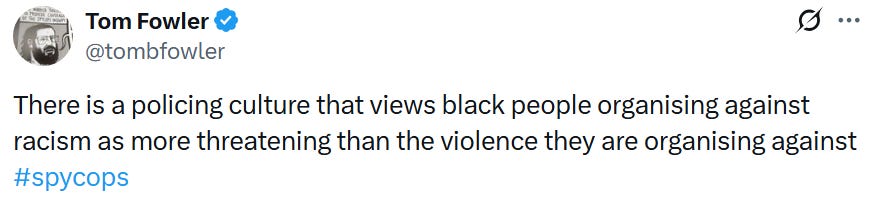
And so it goes that every week, the ghosts of racists past (and present) will emerge, unbidden, to haunt police forces across England and Wales, now and forevermore. That is, until and unless the police bosses accept their diagnoses ‘and take the medicine’, because – as Neville Lawrence puts it – ‘if you don’t take that medicine then you’re going to die. Simple as that.’
Long-awaited ‘precision’ stop-search pilot enhances nothing: The Met’s six-month study found no effect on weapon-enabled crime in designated ‘high harm’ areas (Barking & Dagenham and Lambeth), and no effect on officer conduct outside of the research period. Published almost two years on, the evaluation’s authors say more research is needed to understand its impact (Metropolitan police, 01 Oct).
Greater Manchester Police constable accused of using ‘unreasonable force’: The allegations relate to an incident on 2 June 2022, when the officer is said to have acted with unreasonable or disproportionate force. He is also accused of failing to maintain self-control and of not treating the suspect with respect or courtesy (Misconduct999, 02 Oct).
New Taser brings new and serious risks for children: The government has approved the introduction of the new Axon Taser 10, touted as ‘more effective than previous devices, being able to fire at greater distances’. The device can fire up to 10 single probes and the officer can determine where each individual probe is fired, unlike previous devices (Gov.uk, 03 Oct).
However, Children’s Rights Alliance for England warn that the greater potency of the new devices brings new and serious risks, chiefly that the barbs are heavier than previous models, and must penetrate the skin to deliver an electrical current. This will have ‘specific physiological implications for children, who are smaller in stature, have thinner skin, and reduced body wall-to-organ proximity’.
Transport police officer found guilty of assaulting teenage girl: A court has convicted British Transport Police (BTP) officer Adrian Young of assault by beating of a 15-year-old girl when detaining her at a train station last year. BTP officers responded to a request for assistance from railway staff after a child pushed their way through ticket barriers at Camden Road overground station. After PC Young approached the child, CCTV footage showed the officer restraining her by placing her in a headlock. The child remained in a headlock for approximately 30 seconds before PC Young pushed her back through the ticket barrier and placed his hand around her throat while pushing her up against a ticket machine. PC Young handcuffed and arrested the child, and she was later dearrested at the scene.
The IOPC also found that PC Young should face a gross misconduct hearing for allegedly breaching the police standards of professional behaviour (IOPC, 08 Oct).
Sexual misconduct complaints double in five years, but half of claims uninvestigated: Analysis of figures from police watchdog the Independent Office for Police Conduct (IOPC) shows that forces received 404 complaints for sexual misconduct in 2024-25 – the highest number on record in a single year – and up from 199 in 2020-01.
Sex discrimination claims also saw a significant jump, with a record number of complaints – 645 – in 2023-24 alone.
Complaints, which include claims of sexual assault, harassment and abuse of position for sexual gain, have risen at twice the rate of all other allegations made against officers in the past five years. Despite this, 51% of claims went uninvestigated between 2020 and 2024 (Independent, 12 Oct).
SNP votes to block Police Scotland’s facial recognition plans: The Scottish National Party have passed a resolution against ‘authoritarian’ live facial recognition (LFR) technology, committing to oppose the implementation of the LFR system if it is not passed through primary legislation at Holyrood (Holyrood, 13 Oct).
Black Londoners disproportionately strip searched by Met police: Black Londoners are nearly three times more likely to be strip searched than white suspects. Between January and August 322 Black adults were strip-searched compared with 113 white adults. No illegal items were recovered in almost half of cases involving black people. The success rate was much higher among white people, with officers 11% more likely to find drugs during their searches.
Our executive director, Habib Kadiri, said: ‘It seems as though police operations are geared towards an implicit assumption that if you strip search a black person in London then you are more likely to find something on them’ (The Times, 13 Oct).
UK’s National Black Police Association to give forces racial equality ratings: The NBPA is working with academics to design a way to rate forces on issues including trust and representation. The body announced the move at its annual conference this month, where police leaders discussed issues including the exposure of racism at Charing Cross Police Station by the BBC, the Police Race Action Plan, and calls to abolish non-crime hate incidents (Policing Insight, 14 Oct).
At least two officers barred from service every day: Figures from the College of Policing show 735 officers were banned from returning to service in the year to the end of March, compared to 593 in the previous year, an increase of 24%. The most common reasons for the dismissals were dishonesty (126 cases), discriminatory behaviour (95), unlawful access or disclosure of information (82), inappropriate communications (81), and sexual offences or misconduct (72). Child sexual offences were involved in 21 cases, while abuse of position for a sexual purpose was named as one or more of the reasons for 31 dismissals.
The Met barred 183, GMP 43, Thames Valley 40, West Midlands 37, and West Yorkshire 31.
While most of the 735 officers added to the barred list last year were constables (640), there were two chief superintendents and one chief officer among those struck off (Sky News, 15 Oct).
A regulatory wild west over Live Facial Recognition standards: A Home Office source has admitted that the government does not keep any record of the settings used by each police force, saying that this information is already available on police force’s websites.
The admission comes as MPs urge the government to introduce strict laws clamping down on police officers’ use of LFR. The equipment has been deployed by police for almost a decade with no specific legislation governing its use, despite concerns that the equipment is racially biased and could damage civil liberties.
Former Conservative Party culture secretary John Whittingdale warned that without more robust safeguards in place, he feared a future ‘more authoritarian government’ could one day use LFR to track citizens’ movements (PoliticsHome, 19 Oct).
LFR vans come to Manchester: The Home Office supplied the force with two LFR vans, deployed in Sale town centre on October 21 and 23 ostensibly to tackle a ‘shoplifting surge’. Greater Manchester police have also claimed that the vans will be used where an operational need has been identified – not exclusively but areas with crime issues and large footfall, as well as music and sporting events (GMP, 17 Oct).
Former Northants police chief faces criminal charges: Nick Adderley has been charged with fraud and misconduct in public office following allegations that he made false claims about his military service and educational achievements when applying to work for the police.
Proceedings against the defendant are active; Adderley will appear at Westminster Magistrates’ Court on 10 November 2025 (Crown Prosecution Service, 21 Oct).
Detective constable charged over alleged inappropriate contact with women: A Warwickshire police detective has been charged following an IOPC investigation into allegations of inappropriate contact with two women he met through his duties. John Littlewood, who worked in the force’s child abuse, trafficking and exploitation team, faces two counts of improper exercise of police powers and privileges by a constable (BBC News, 22 Oct).
Force hired recruits with criminal records: Avon and Somerset police hired new recruits with criminal records without properly considering the risks, according to a report by inspectors.
His Majesty’s Inspectorate of Constabulary and Fire & Rescue Services (HMICFRS) assessed the force in three areas and found that of 37 vetting cases it investigated, the force did not ‘consider identified risks or relevant risk mitigations’ for 10 of them, concluding the force requires improvement “in all areas” looked at: vetting police officers; upholding the standards of professional behaviour; and tackling potential corruption (BBC News, 29 Oct).
Articles | Institute of Race Relations
Banbury, Oxford (18-19 Oct)
Stratford (13 Oct)
Parts of Gorton and Stockport (11-12 Oct)
Southport (26 Oct)
* This is not a comprehensive list
Stay safe,
StopWatch.
Comments
Nothing yet. Say the first thing.
Sign in to join the conversation.