
Dear StopWatchers,
November was an important month for the number crunchers among us. The Home Office published annual releases on both stop and search and uses of force by police forces across England and Wales, keeping us busy with pages and pages of spreadsheets. As we continue to make sense of the data over the coming months, we encourage you to check our website for analyses making sense of what the figures mean for marginalised and racialised groups.
We were on the panel at a community event hosted Bristol Copwatch, and supported the Safety Not Surveillance coalition’s campaign stunt against so-called ‘crime-predicting’ tech at the APCC NPCC Partnership Summit 2025.
We hope you enjoy this month’s newsletter.
On the first day of the month, 11 people were injured in a stabbing incident on a train at Huntingdon, Cambridgeshire. While both the home secretary (Peterborough Today, 03 Nov) and leader of the opposition (Impartial Reporter via PA news agency, 02 Nov) insisted only on examining the situation from a policymaking perspective once the facts became known, the political knee jerking truly began once British Transport Police revealed such details.
While a relatively contemplative Conservative party leader Kemi Badenoch told the BBC’s Sunday With Laura Kuenssberg programme that politicians needed to have ‘a conversation’ about the causes of violence on Britain’s streets, her shadow home sec Chris Philp was quick to call for the police to ‘dramatically increase the use of stop and search’ in order to take more knives off our streets. Citing two studies of questionable value, he claimed in parliament that:
We should triple the use of stop and search to get knives off our streets, and we should introduce year-round surge policing in the top 5% of high crime hotspots, which will include many train stations.
- Chris Philp MP, House of Commons, 03 Nov
Quite aside from the nightmarish implications of Philp’s fantasy – airport-style security at train stations, anyone? – and freedom of information records suggesting that amnesty bins are far more effective in recovering offensive weapons (StopWatch, 23 Nov), we have written at length about the many, many, many problems with the ‘just do more stop and search’ argument to get knives off the streets. We shan’t repeat them here. Call us if you care to learn something, Chris. You know where we are.
Besides, annual stop-search trends indicate a different story emerging from law enforcement operations. The annual ‘Stop and search, arrests, and mental health detentions’ statistical bulletin (Home Office, 06 Nov) revealed an increasing tendency of some of the country’s largest police forces in and England and Wales to use powers granted to them to search without suspicion (StopWatch, 06 Nov).
There was a tiny fall in the number of stop-searches overall: 528,582 in 2024/25, -1.4% on the previous period (536,217 searches in 2023/24), driven by fewer searches conducted under the regular suspicion-led powers (section 1 and associated legislation). But this masked increases in the use of suspicionless stop-search powers over the same period. This is driven by a rise in section 60 powers, where, despite most forces seeing no need to employ the power at all, the Metropolitan police searched Black people 18 times more often than white people, a far greater disparity than the other most frequent users of the power.
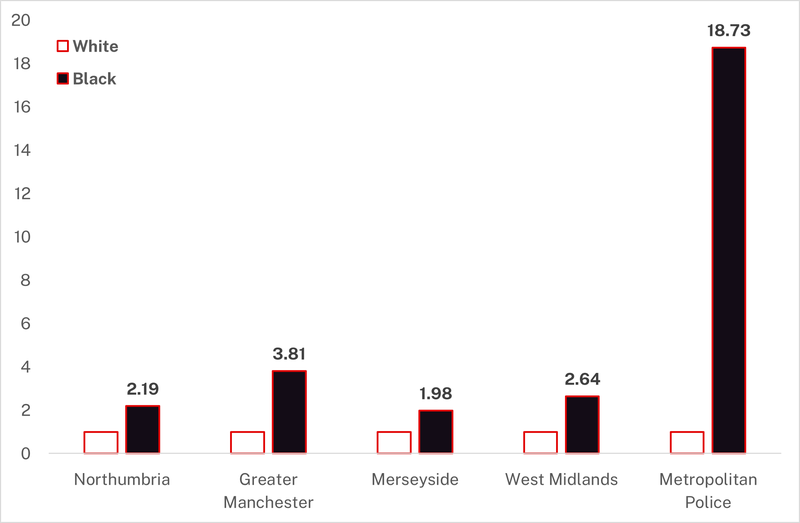
We suspect this stark differential is the result of an operational decision by Met chiefs to use section 60 to ramp up racial profiling.
None of it changed the fact that drugs remain the most common reason for a search (61% of all searches in England and Wales in 2024/25), and that the vast majority of searches (67%) end with no further action taken.
And then there is the conduct of police officers. How can we have confidence in mass racial profiling initiatives if a force’s own personnel can’t at least pretend to not be racist?

Between misconduct cases, gatecrashing memorials, and a police culture that makes racial harm ‘inevitable’, it’s harder to convinced of the argument that the ethnic disparity in stop-searches is for Black people’s own good (The Guardian, 07 Nov / The Justice Gap, 10 Nov).
In short, you can’t stop and search your way out of knife violence, yet Chris Philp is happy to imply that Black people’s lives are collateral in the pursuit of matching ethnic disparities in stop and search arrests with that of homicides. Who said the police don’t like targets?
StopWatch is a volunteer led organisation that relies on the generosity of trusts and grant funders to operate. We DO NOT accept funding from the government or police as we believe this would compromise our ability to critically challenge.
We’d appreciate any one-off or regular donations to help support our work. You can click on our Donate button below to go through to our donation page.
The father-of-six was knocked down and killed in a car crash after he was arrested by police then driven almost 4 miles away and left in his boxer shorts to walk home barefoot without any money or his mobile phone.
A hit-and-run driver was later jailed for causing Roper’s death by dangerous driving. Now a Greater Manchester police officer involved in Roper’s arrest (David Wood) has been demoted in rank from a sergeant to a constable following an investigation by the police watchdog. The Independent Office for Police Conduct (IOPC) said it also found misconduct against a now former sergeant, while 2 constables who breached the standards of behaviour will undergo ‘reflective practice aimed at improving their performance in future’.
Joyce King, Mr Roper’s mother, said PC Wood should have lost his job after ‘abandoning my son by the roadside’. (Manchester Evening News / BBC News, 06 Nov).
Deaths in police custody | INQUEST
Automated reforms save money: A National Audit Office report has identified investments in digital technologies like facial recognition and artificial intelligence as critical to raising productivity amongst police forces.
Last year, police forces reduced their financial reserves by £276m and borrowed £632m to fund 60% of investment programmes. Lincolnshire police withdrew the most from its financial reserves in 2024/25, using more than 6% of funds, followed by the Met police at 4%. Reliance on borrowing for investment is expected to rise further, exposing forces to higher debt repayments and future risk, according to the spending watchdog (Sky News, 03 Nov).
Facial recognition falsely alerting Black people, but to be trialled at UK borders anyway: The Met’s annual review on its use of live facial recognition found that between September 2024 and September 2025, 962 people were arrested following LFR deployments. They also reported no arrests from false alerts over the period, but 10 people – including 8 Black people – were falsely alerted by the system, of whom 4 were approached by officers.
Jasleen Chaggar of Big Brother Watch told the BBC that it was ‘disturbing that 80% of the innocent people wrongly flagged by facial recognition were Black’, pointing out that ‘no law in this country has ever been passed to govern live facial recognition’.
Elsewhere, the Home Office has announced plans for its Immigration Enforcement service to begin testing the use of live facial recognition |on people immigrating to the UK via legal ports of entry.
The short proof of concept trail will test the effectiveness of LFR at Holyhead using equipment from South Wales police and Greater Manchester police to identify individuals who appear on UK watchlists prohibiting them from entering the UK (DIGIT News, 10 Nov).
Abolition is possible… for PCCs: A major policy announcement from the Labour party this month will bring to an end the ‘failed experiment’ of police and crime commissioners (PCCs) in England and Wales by 2028 (LabourList, 13 Nov).
Addressing the House of Commons, policing Sarah Jones said the move would save £100 million this parliament. Once delivered, the change would save £20 million a year, or equivalent to 320 extra police constables.
It has been welcomed in some quarters, with The Fire Brigades Union general secretary Steve Wright branding the decision to combine police and fire service governance as a ‘failed and dangerous experiment’. Wright said: ‘Fire and rescue is a humanitarian service and is not about law enforcement. Attempts to combine governance with the police force have proved disastrous. In areas where oversight of the fire service has been handed to a police and crime commissioner, democratic accountability has gone out the window.’
However, others have expressed their dismay at the lack of information provided over the reassignment of responsibilities, with current Durham PCC Joy Allen telling ITV News that what will happen is ‘clear as mud’ (ITV News, 14 Nov).
Disclosing ethnicity of suspects fuels prejudice, say anti-racist campaigners: A joint letter from more than 60 organisations (including StopWatch) to the home sec and the chair of the National Police Chiefs Council calls for the ‘divisive guidance’ over the disclosure of suspects’ ethnicity in high-profile criminal investigations to be revoked with immediate effect.
Led by Runnymede Trust, the open letter raises concerns that the practice has ‘becom[e] a catalyst for crime reporting reminiscent of the 1970s and 1980s – reviving a focus on race and migration status’ and ‘fostering a dangerous and misleading conflation between race, migration, and criminality’. It also mentions evidence of a five-fold increase in the use of descriptors such as certain foreign nationality, asylum status and ethnicity in crime between identical date ranges 2 years apart.
The letter reads: ‘There is… no evidence that releasing a suspect’s ethnic identity, nationality, or immigration status would prevent civil unrest. On the contrary, the guidance normalises ethnicity and migration status as relevant factors in crime reporting, increasing suspicion towards communities of colour who already bear an unjust burden of suspicion.’
Articles | Institute of Race Relations
Swindon (24 Nov)
‘Hockley in the north, the Jewellery Quarter, [Birmingham] city centre, Brindleyplace and Broad Street and down to Highgate and Bordesley’ (08 Nov), Lozells, Hansworth, and Witton, Birmingham (17 Nov)
Cheetham Hill and Crumpsall (11 Nov)
Stocksbridge Village and Huyton (08 Nov)
* This is not a comprehensive list
Stay safe,
StopWatch.
Comments
Nothing yet. Say the first thing.
Sign in to join the conversation.