
Microsoft 365 Copilot launched in November 2023. Twenty-seven months later, roughly 3% of Microsoft 365’s 450 million paid users have converted to Copilot licences, approximately 8–15 million seats depending on the source. Microsoft cut AI sales targets by 50% after only one in five salespeople met quota. The stalling follows directly from infrastructure that can’t support the autonomy Copilot demands, and that gap is measurable before a single licence is provisioned.
Autonomy Class Attempted: A3 (cross-application reasoning with contextual authority)
Copilot sits inside Word, Excel, PowerPoint, Outlook, and Teams simultaneously. It reasons across emails, documents, calendars, chat histories, and SharePoint libraries. It drafts, summarises, and analyses. With Agent Mode now rolling out, it iteratively modifies files while explaining its changes.
Copilot’s propagation surface spans every file, conversation, and data object a user can access across Microsoft 365. It queries the Microsoft Graph, the unified API layer connecting all M365 services, to retrieve context from any source the user’s permissions allow. Cross-application reasoning at this scope is what makes Copilot valuable in theory, and what makes its infrastructure requirements so high in practice.
That propagation surface defines the load. The question is whether organisational infrastructure can stabilise it.
Observed Capacity: C1–C2 across critical stabilisation dimensions.
Microsoft’s own deployment guide, published January 2026 describing their rollout to 300,000 employees, reveals the infrastructure reality. Over 15% of business-critical files carry excessive permissions. Organisations must conduct data governance audits, remediate oversharing, implement sensitivity labelling, and configure Restricted SharePoint Search before Copilot can operate safely. Microsoft recommends a three-phase deployment (Pilot, Deploy, Operate) using SharePoint Advanced Management and Microsoft Purview because infrastructure isn’t ready for the load Copilot places on it.
The U.S. House of Representatives banned Copilot in March 2024 over data security risks. Amgen deployed 20,000 licences; employees defaulted to ChatGPT because Copilot’s outputs from their unstructured tenant were less useful than a general-purpose model with no organisational context. Microsoft’s own enterprise sales team struggled with daily usage despite immediate licence provisioning. Nearly half of IT leaders surveyed by Gartner reported lacking confidence in their ability to manage Copilot’s security and access risks.
Each of these signals traces to the same root: infrastructure capacity below the load Copilot requires.
Boundary Condition: Load (A3) exceeds stabilisation capacity (C1–C2) across 5 of 6 dimensions → Instability
Copilot’s cross-application reasoning requires context that is explicit, structured, accessible, current, and integrated across systems. Most enterprise M365 environments don’t meet that specification. The consequence: generic outputs, permission violations, confidential data surfacing in unexpected contexts, and users who try Copilot twice and revert to manual workflows. The AI reasons over noise, and noise produces noise.
Declared Load: A3. Stabilisation envelope required: C3–C4 across critical dimensions.
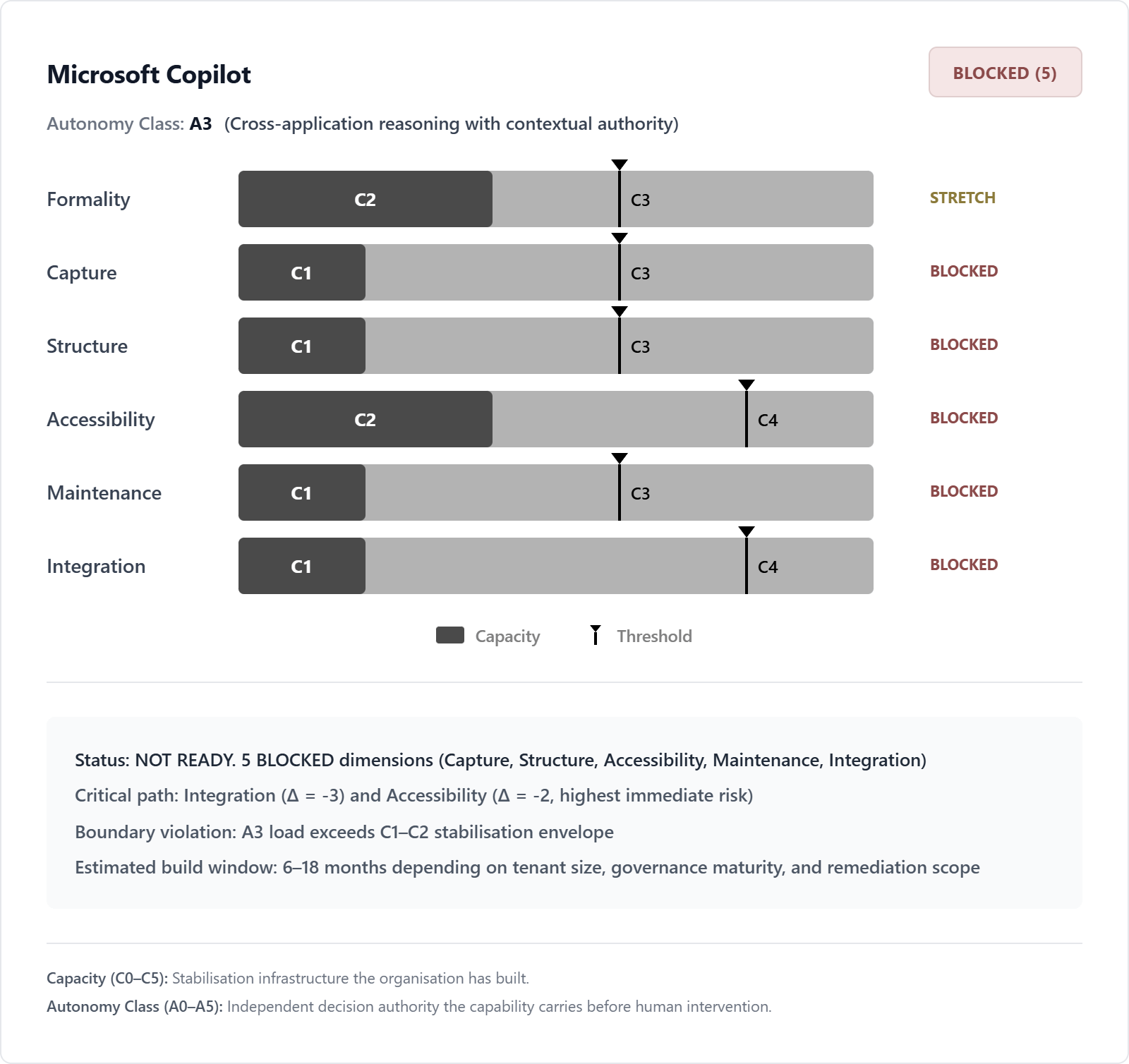
Formality | A3 requires C3 | Observed: C2 | Δ = -1 (STRETCH)
Copilot needs explicit, labelled context to reason well. Most M365 environments contain vast quantities of documents, but naming conventions are inconsistent, metadata is sparse, and critical operational context lives in email threads rather than formal repositories. Microsoft’s recommendation to implement sensitivity labelling before deployment acknowledges that Formality capacity is insufficient for the declared load. Humans compensate by knowing which documents matter and which are stale. Copilot treats everything with equal weight.
Capture | A3 requires C3 | Observed: C1 | Δ = -2 (BLOCKED)
Organisational knowledge enters M365 through ad hoc means: someone creates a document, sends an email, posts in Teams. No systematic capture mechanism ensures that decisions, context, and updates flow into retrievable form. Meeting summaries exist only if someone writes them. Project decisions live in chat threads that scroll off-screen within days. Copilot can only reason over what has been captured. In most organisations, the critical 20% never was.
Structure | A3 requires C3 | Observed: C1 | Δ = -2 (BLOCKED)
SharePoint libraries accumulate documents over years without consistent taxonomy. File naming is idiosyncratic. Folder structures reflect organisational charts from three reorganisations ago. Copilot retrieves context from this unstructured mass, which is why outputs feel generic. The AI reasons over noise, so its outputs carry that noise forward. Microsoft’s Restricted SharePoint Search feature, which limits Copilot to curated site collections, exists precisely because the full corpus isn’t structured enough for AI retrieval at A3 load.
Accessibility | A3 requires C4 | Observed: C2 | Δ = -2 (BLOCKED)
Copilot’s most documented failure mode. Copilot inherits user permissions via Microsoft Graph. Misconfigured permissions, present in most tenants, cause Copilot to surface confidential HR data, financial projections, and executive communications to users who technically have access but were never meant to find them. The 15% over-permissioned files figure represents baseline risk; some security analyses suggest the real exposure is larger. Organisations must remediate permissions before deployment, a process that typically takes months. The AI can reach the data. Whether it should is a different infrastructure question entirely. A3 requires C4 in Accessibility because cross-application reasoning with contextual authority demands a permission architecture that distinguishes what the AI may surface from what users may technically access.
Maintenance | A3 requires C3 | Observed: C1 | Δ = -2 (BLOCKED)
Documents go stale. SharePoint sites accumulate obsolete content. Teams channels become graveyards. Without active maintenance, Copilot reasons over outdated context and presents it as current. A product spec from 2022 carries the same retrieval weight as one from last month. A departed employee’s draft strategy document surfaces as if it reflects current thinking. Most organisations have no systematic process for archiving, versioning, or deprecating content. Copilot amplifies the cost of this gap because it treats every retrievable document as potentially relevant.
Integration | A3 requires C4 | Observed: C1 | Δ = -3 (BLOCKED)
The critical path dimension. Copilot promises cross-application reasoning, but M365 applications store context in fundamentally different formats. Email context doesn’t link to document context. Teams conversations don’t connect to SharePoint files except through manual links. Calendar context exists independently of project context. Microsoft Graph provides API-level connectivity, but semantic integration, where context from one application enriches reasoning in another, requires infrastructure most organisations haven’t built. Copilot ends up reasoning within application silos rather than across them, missing the cross-functional context that would make its outputs valuable. A3 demands C4 here because the entire value proposition of cross-app reasoning collapses without integrated context.
Copilot is a Locked Vault case. The data exists inside the Microsoft 365 environment. The AI can technically reach it. But the infrastructure between the AI and useful context (permissions, structure, integration, maintenance) isn’t built to specification.
This explains why pilots succeed and enterprise rollouts stall. A curated group of users with clean data and configured permissions sees genuine value. At enterprise scale, Copilot encounters the full infrastructure reality: over-permissioned tenants, unstructured SharePoint, stale content, siloed applications. The vault is full. The locks are wrong.
The market explains Copilot’s challenges through three lenses, none of which reach the infrastructure layer.
Pricing lens. $30/user/month is too expensive without proven ROI. Real concern, but downstream of the actual problem. Organisations would pay $30 if the outputs justified it. Outputs don’t justify it because infrastructure can’t produce them.
Change management lens. Users need training, prompting skills, and workflow integration support. Microsoft and its partners have built entire practices around Copilot adoption. Training can’t extract good output from infrastructure that can’t produce it. Better prompts don’t fix over-permissioned SharePoint.
Product quality lens. Copilot’s outputs feel generic and unreliable. Closest to the root, but the cause is still mislocated. Outputs feel generic because the context Copilot retrieves is generic. Unstructured, un-maintained, un-integrated context flows through the model and produces unstructured, unreliable outputs. The model works. The infrastructure feeding it doesn’t meet spec.
All three diagnoses treat symptoms. The infrastructure gap is the mechanism producing all of them.
For a 5,000-employee organisation, Copilot deployment at full scale costs $1.8 million annually in licensing alone. Before those licences produce value, the organisation must invest in data governance remediation, permission auditing, SharePoint restructuring, sensitivity labelling, and integration configuration. Implementation partners estimate pre-deployment governance and integration work at 40–95% of licensing cost.
Year-one total cost to make Copilot work: $2.5–3.5 million. Cost of discovering it doesn’t work: $1.8 million in licensing plus six months of pilot that never scales. Both paths begin with the same infrastructure gap.
Underwrite assumes A3 capability. Infrastructure supports A1 at best.
Microsoft’s response to low conversion tells its own story. In January 2025, they introduced consumption-based pricing (Copilot Chat) to address enterprise resistance. In December 2025, they announced M365 suite price increases effective July 2026, bundling baseline Copilot features into core licences. The strategy shift: if customers won’t buy Copilot separately, embed it in what they already pay for. This changes the revenue model. It does not change the infrastructure gap.
Vertical movement (capacity build) unlocks horizontal movement (autonomy deployment).
The sequence matters:
Accessibility first. Remediate permissions. Implement least-privilege access. Deploy sensitivity labels. Highest-risk dimension and the one Microsoft explicitly requires before deployment.
Structure second. Audit and rationalise SharePoint. Implement consistent taxonomy. Archive stale content. Create curated site collections for Copilot retrieval scope.
Maintenance third. Establish information lifecycle management. Define retention policies. Implement version control and content deprecation workflows.
Integration fourth. Build cross-application context flows. Connect document management to project management to communication channels with consistent metadata.
Then deploy Copilot to the stabilised surface.
This costs less than deploying Copilot first and remediating after failure. It also produces infrastructure that supports any AI capability Microsoft ships next, including Agent Mode, which increases load further.
Microsoft 365 Copilot is the most widely deployed enterprise AI product in history. Its 3% conversion rate is the most visible demonstration of what happens when autonomous AI meets implicit infrastructure at scale. The market describes this as an adoption challenge because the infrastructure gap hasn’t been measured. Once measured, the diagnosis changes, and so does the investment sequence.
[Visual: Six-dimension capacity vs load chart. A3 load line, current capacity bars at C1–C2, required capacity at C3–C4, four BLOCKED dimensions highlighted.]
Check infrastructure feasibility of 700+ AI capabilities across different vendors, industries and business functions: contextcapability.com
CMC Level Assessment (C1–C2 across mid-market M365 tenants): Based on observable deployment patterns and Microsoft’s own guidance. SharePoint typically shows folder chaos without consistent structure (Structure C1), documentation practices vary by person/team (Formality C1–C2), no systematic content refresh cycles (Maintenance C1), basic M365 cross-app connectivity works but semantic linking absent (Integration C1). Microsoft’s deployment guide requiring governance remediation, permission auditing, and Restricted SharePoint Search before deployment validates these levels. Represents “mid-market modal” state: some organisations better (mature tech at C3), many worse. Confidence: MEDIUM-HIGH. Individual dimensions may vary ±1 level.
Copilot Requirements (A3 load requires C3–C4 across critical dimensions): Derived from capability analysis of cross-application AI reasoning. Copilot answering questions across M365 requires: explicit, labelled knowledge with clear provenance (Formality C3), systematic capture of decisions and context (Capture C3), consistent taxonomy enabling meaningful retrieval (Structure C3), permission architecture supporting AI access without oversharing (Accessibility C4), near-real-time content currency (Maintenance C3), and semantic integration across M365 applications via Graph (Integration C4). Validated against documented deployment failures where these dimensions were cited blockers.
Adoption Figures (3% penetration, ~8–15M seats): Multiple independent sources converge. Directions on Microsoft reported 15M paid seats (January 2026). Ed Zitron’s newsletter reported 8M active licensed users citing internal Microsoft materials (August 2025 data). Financial analyses consistently place penetration at 2–3% of 430–450M M365 commercial users. Microsoft’s own investor calls describe “seat-add and expansion phase.” Sales target cuts reported by The Information (2025).
Infrastructure Remediation Estimates ($2.5–3.5M year one for 5,000 employees): $1.8M licensing ($30/user/month × 5,000 × 12). Pre-deployment governance estimated at 30–50% of licensing cost based on implementation partner reporting. Governance work includes permission auditing, SharePoint restructuring, sensitivity labelling, and integration configuration. AI assistance provides 15–25% compression on technical work but cannot compress organisational coordination (stakeholder alignment, taxonomy agreement, change management) that represents 60–80% of remediation effort.
Timeline (6–18 months estimated build window): Five BLOCKED dimensions with gaps of 2–3 levels each. Variance driven by tenant size, starting governance maturity, systems landscape complexity, and whether pre-built integration platforms reduce custom development. The core constraint: making implicit organisational knowledge explicit while building cross-system integration, both of which require organisational coordination that AI cannot compress.
Microsoft Inside Track Blog. “Deploying Microsoft 365 Copilot in Five Chapters.” January 2026. Microsoft’s own deployment guide covering 300,000-employee rollout, governance requirements, and three-phase deployment blueprint.
The Register. "Microsoft reveals just 3.3% of Copilot Chat users pay for it." February 2026. 15M paid seats against 450M commercial base, Q2 FY26 earnings analysis, Mary Jo Foley penetration gap analysis.
Perspectives.plus. “Microsoft 365 Copilot’s Commercial Failure.” October 2025. Independent analysis citing 8M active licensed users (1.81% conversion) from internal Microsoft materials via Ed Zitron.
ByteIota. “Microsoft Copilot Adoption Crisis: Sales Targets Cut in Half.” December 2025. Sales quota failures, Amgen deployment outcomes, and Fortune 500 adoption claim analysis.
SAMExpert. “Enterprises Are Still Deciding if Microsoft 365 Copilot Is Worth It.” October 2025. CNBC Technology Executive Council survey: 50% rolled out, 17% declined, 33% still testing.
Lighthouse Global. “What Microsoft 365 Copilot Adoption Really Looks Like.” 2025. Governance-first deployment requirements, Echoleak vulnerability, UK government pilot (26 min/day saved, 20,000 users).
Concentric AI. “2026 Microsoft Copilot Security Concerns Explained.” December 2025. Over-permissioning risks, U.S. House ban, data governance requirements.
ITECS. “How to Deploy Microsoft 365 Copilot: IT Admin Guide 2026.” February 2026. 15% over-permissioned files statistic, three-phase deployment blueprint, pre-deployment governance requirements.
Petri.com. “Why Microsoft Copilot Adoption Is Lagging: The ROI Dilemma.” February 2026. Jared Spataro on 20–30% productivity gains not translating to measurable ROI.
Microsoft 365 Blog. “Advancing Microsoft 365: New Capabilities and Pricing Update.” December 2025. Official July 2026 price increases and Copilot Chat bundling into core suites.
Directions on Microsoft. “Microsoft to Increase Office Suite Prices Starting July 2026.” December 2025. 15M paid Copilot seats, pricing detail, bundling analysis.
Whatfix. “Microsoft Copilot Adoption: From Enterprise Rollout to Habitual Usage.” January 2026. Microsoft’s own sales team adoption struggles.
Related CMC Case Studies:
ServiceNow Now Assist: See Frame Velocity newsletter “ServiceNow Customers Will Stay Stuck at 40% Until 2027“ (January 2026) for full analysis.
Ford Dealer Inventory Search: See Frame Velocity newsletter “Working AI, Disconnected Infrastructure: Ford’s Islands Pattern” (January 2026) for full analysis.
Google Workspace Gemini: See Frame Velocity newsletter “Google Workspace Gemini: Running 240V AI on 120V Infrastructure” (February 2026) for full analysis.
Zendesk AI Agents: See Frame Velocity newsletter “The Zendesk Plateau: Why 80% Automation Promises Will Settle at 40%” (January 2026) for full analysis.
Amazon Q: See Frame Velocity newsletter “Amazon Q Works. Your Knowledge Infrastructure Doesn’t.“ (February 2026) for full analysis.
No posts
Comments
Nothing yet. Say the first thing.
Sign in to join the conversation.