
Google is selling Gemini for Workspace at scale. 11 million paying enterprise users. $14/user/month. The pitch is seductive: “AI assistant that understands your Google Drive context.” Search your documents in natural language. Generate summaries from your files. Draft content based on your organization’s knowledge.
The marketing shows clean demos. Executives see competitors adopting. The business case looks obvious: $360K/year for 1,000 users, promises of 30% productivity gains, analyst reports predicting $150-280B in productivity value by 2030.
IT leaders are signing contracts. Google’s partner ecosystem is expanding - consulting firms pitching “Gemini implementation services,” system integrators offering “Gemini optimization,” change management specialists selling “adoption programs.”
The deployment machine is running. Most organizations planning Gemini already use Google Workspace. They assume the infrastructure is there. It isn’t.
Gemini’s value proposition depends on accessing organizational context stored in Google Drive. When that context is chaos - and for most organizations, it is - Gemini cannot deliver. Here’s what the infrastructure actually looks like:
What this dimension measures: Whether organizational knowledge exists in explicit, documented form or remains trapped in heads and informal channels.
Current state (Level 1): Most organizational knowledge lives in Slack threads, email chains, meeting conversations, and tribal memory. What exists in Drive is scattered: presentation decks that reference undocumented decisions, spreadsheets with unexplained calculations, documents that assume context readers don’t have. Level 1 means basic folders exist but critical context remains implicit.
Required level (Level 4): Gemini needs explicit, structured documentation with clear provenance. Who created this? When? What assumptions does it rely on? What’s the current status? Level 4 means documentation practices that create AI-readable context, not just human-readable files.
Gap implications: Gemini will retrieve documents that look relevant but lack the context needed to use them. Workers ask “Why did we decide X?” Gemini surfaces the PowerPoint deck but can’t explain the discussion that happened in the room, the objections raised in Slack, or the constraints that shaped the decision. The document exists. The knowledge doesn’t.
Human compensation: Currently, people know to call Sarah about pricing history, ask Mike about the vendor decision, check with Lisa about customer requirements. Humans bridge the formality gap through relationships and memory. Gemini can’t.
What this dimension measures: How organizational knowledge moves from events and conversations into systems.
Current state (Level 2): Some capture practices exist - meeting notes sometimes written, decisions sometimes documented, project outcomes sometimes recorded. But capture is inconsistent, person-dependent, and often happens long after the fact when memory has faded. Level 2 means ad-hoc capture when someone remembers.
Required level (Level 4): Gemini needs systematic, automated capture. Meeting transcripts with decisions tagged. Project milestones recorded with context. Customer feedback linked to product decisions. Requirements traced to implementations. Level 4 means capture happens as events occur, not retroactively.
Gap implications: Gemini retrieves the quarterly report but misses the three critical meetings that changed the strategy. It finds the final decision but not the alternatives considered. It surfaces the outcome but not the reasoning. The visible artifacts lack the captured context that explains them.
Human compensation: Currently, institutional memory lives in long-tenured employees who were “in the room.” They remember what wasn’t written down. When they leave, capability leaves. Gemini experiences this knowledge loss from day one.
What this dimension measures: Whether context is organized for retrieval - tagged, categorized, with relationships mapped.
Current state (Level 1): Google Drive is organized like a file cabinet from 1985. Folders named “Q3_FINAL_v2_ACTUAL_FINAL.” Files scattered across personal drives, shared drives, team drives. Inconsistent naming conventions. No standard taxonomy. No tags. No metadata. Documents exist in isolation - no links between related content, no hierarchy showing which supersedes which, no relationships mapped between projects and outcomes.
Required level (Level 4): Gemini needs formal ontology. Product names map to customer segments. Projects link to requirements. Decisions connect to outcomes. Documents tagged by topic, date, status, owner. Level 4 means structure enables AI to understand relationships, not just find individual files.
Gap implications: Gemini searches for “Q3 pricing strategy” and returns 47 documents, most outdated, none clearly marked as current. It can’t tell which supersedes which, which are drafts versus final, which reflect actual decisions versus abandoned approaches. The retrieval works. The relevance doesn’t.
Human compensation: Currently, people navigate Drive through memory - ”I think Sarah has the latest version,” “Check the Marketing folder, not Sales,” “Ignore anything before June.” Humans apply context AI doesn’t have. Gemini can’t.
What this dimension measures: Whether AI systems can technically access organizational context.
Current state (Level 3): Gemini has API access to Google Workspace. It can read Drive, Gmail, Docs, Sheets. Permissions mostly work. The technical connectivity exists. Level 3 means AI can reach the systems.
Required level (Level 4): But Level 4 means unified access layer with consistent permissions, clear data lineage, and real-time sync. Gemini needs to know not just what’s accessible but what’s current, authoritative, and relevant. It needs to distinguish between working drafts and final decisions, personal notes and organizational truth.
Gap implications: Gemini can access the files but can’t determine authority. Which version is correct? Which person’s notes represent actual decisions? Which spreadsheet reflects current state versus historical analysis? Access without authority creates noise, not knowledge.
Human compensation: Currently, people apply judgment about sources - ”That’s just John’s scratch work,” “The real decision is in the exec folder,” “Ignore versions before the reorg.” Humans know which access matters. Gemini accesses everything equally.
What this dimension measures: How often context updates, whether it stays current.
Current state (Level 1): Documents created, then forgotten. The org chart from 2022 still lives in Drive. Strategy decks from abandoned initiatives. Process documentation from legacy systems. No systematic refresh cycles. No staleness detection. No deprecation process. Level 1 means capture happens once, maintenance happens never.
Required level (Level 4): Gemini needs near-real-time currency. When strategy changes, documents update. When processes evolve, guides refresh. When people leave, their knowledge gets captured before it disappears. Level 4 means maintenance synchronized with reality.
Gap implications: Gemini retrieves confidently from stale content. It recommends the pricing model you abandoned 8 months ago. It references the organizational structure from before the restructuring. It cites process steps for the system you replaced. The documents exist. The truth has moved on.
Human compensation: Currently, people know what’s outdated - ”Ignore that deck, we changed course,” “That process changed in Q2,” “Those numbers are old.” Humans maintain currency in memory. Gemini operates on written record that lags reality by months or years.
What this dimension measures: Whether context from different systems connects - CRM to Drive, Slack to Docs, email to project files.
Current state (Level 3): Google Workspace integrates well within itself. Drive to Docs to Sheets to Gmail - mostly connected. But the CRM lives separately. Project management happens in another tool. Customer feedback captured in support systems. Financial data in different platforms. Level 3 means some systems talk, critical ones don’t.
Required level (Level 4): Gemini’s promise requires unified context layer. Customer conversations from email linked to project decisions in Drive linked to outcome data in business systems. Sales context connected to product context connected to support context. Level 4 means integration creates complete picture.
Gap implications: Gemini answers questions from partial context. It knows what’s in Drive but not what’s in CRM. It sees project documents but not customer requirements from support tickets. It retrieves email threads but not the Slack discussions that provided missing context. The silos persist. AI experiences them all.
Human compensation: Currently, people bridge systems manually - ”Let me check Salesforce,” “I’ll pull the support tickets,” “I remember from that Slack thread.” Humans integrate context across boundaries. Gemini can’t cross walls that don’t have doors.
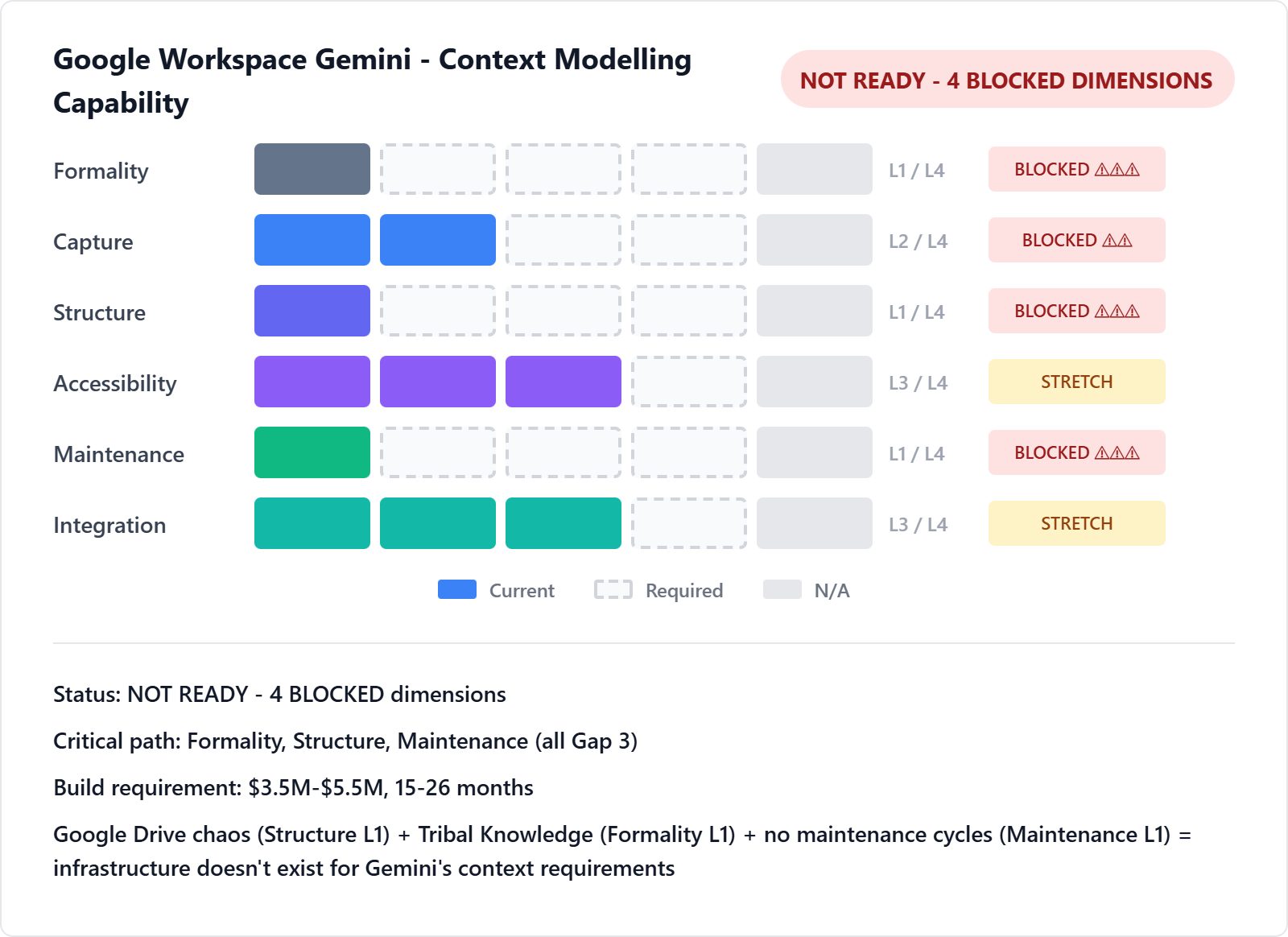
Status: NOT READY - 4 BLOCKED dimensions
Critical path: Formality, Structure, Maintenance (all Gap 3), Capture (Gap 2)
Build requirement: $3.7-5.8M infrastructure investment, 15-26 months
Human compensation cost: Organizations currently function at higher effective CMC because humans bridge gaps. Gemini deployment removes this bridging capability while infrastructure gaps remain.
Early Gemini pilots show promising results. IT teams report 40-60% of users rate it “helpful.” Executives see demos where Gemini retrieves relevant documents, generates coherent summaries, drafts acceptable emails.
But pilots operate under special conditions that mask infrastructure gaps:
Small scope compensates for structure gaps. Pilot focuses on specific use case with curated document set. IT team manually tags the 200 most important files. Creates clean folder structure for pilot content. Pilot users operate in this organized island while the rest of Drive remains chaos. Metrics measure island performance, not organization-wide reality.
Human curation compensates for maintenance gaps. Before pilot launch, team updates documentation, removes obsolete content, flags current versions. Pilot operates on freshly cleaned data. When pilots run 6-12 months and maintenance lapses, they’re measuring initial state, not steady state. Context will rot. Pilots measure day 1, not day 180.
Manual integration compensates for integration gaps. For pilot, someone exports CRM data into Drive. Copies support tickets into documents. Moves project context from other systems into Workspace. Pilot users see integrated view because humans did the integration work once. At scale, this manual bridging breaks. No one will copy 10,000 support tickets monthly.
Narrow user group compensates for formality gaps. Pilot involves 20-50 power users who understand organizational context. They know which documents matter, which are outdated, what questions to ask. They bring formality through their expertise. Roll out to 1,000 users who lack this context, and formality gaps surface. New hires, cross-functional users, people outside core teams - they need explicit context that doesn’t exist.
The pilot is measuring heroics, not infrastructure. Success reflects human effort compensating for missing capability, not sustainable operation at scale.
Google’s ROI promise includes 30% productivity improvements. That promise assumes Gemini works reliably at scale. Whether you realize this productivity depends on infrastructure your organization likely doesn’t have.
IF you deploy Gemini without closing infrastructure gaps:
Months 1-3 (Feb-Apr 2026): Initial enthusiasm. Gemini provides some value for simple queries. “Find the Q3 budget spreadsheet.” “Summarize this email thread.” Basic retrieval works. Users see utility. Adoption metrics look good.
Months 3-5 (Apr-Jun 2026): Trust erosion begins. Gemini confidently retrieves wrong documents. Summarizes from outdated content. References decisions that changed months ago. Workers discover they must verify everything AI suggests. The “assistant” creates more work than it saves. Initial adopters start bypassing it. Trust metrics decline but executives don’t see this yet - they’re watching adoption numbers, not verification rates.
Months 5-7 (Jun-Aug 2026): Verification overhead compounds. Workers learn which use cases work (basic retrieval) and which fail (anything requiring judgment about currency, relevance, authority). They develop workarounds - using Gemini for first pass, then verifying through traditional channels. The “30% productivity gain” reverses to 15-20% productivity loss from verification burden. IT helpdesk sees increasing “Gemini gave me wrong information” tickets.
Months 8-12 (Aug-Dec 2026): Abandonment accelerates. Department heads quietly tell teams to stop relying on it for critical work. Champions move to other projects. Someone calculates actual productivity impact - negative. But $360K/year licensing cost continues. Leadership faces decision: Keep paying for failing capability or admit deployment didn’t work?
Behavioral prediction (conditional): Whether your organization recognizes the pattern depends on your learning capacity. Some will diagnose the infrastructure gap and invest in fixing it. Most will blame “user adoption” or “change management” or “training issues” - the same misdiagnosis that failed them before. Your choice.
Infrastructure prediction (deterministic): Without closing the 4 BLOCKED dimensions, Gemini cannot deliver promised value. Gap ≥2 = infrastructure doesn’t exist. This is physics, not probability. The capability is blocked.
This isn't speculation. We have proof of what happens when infrastructure gaps block AI deployment.
In February 2024, Klarna deployed an AI customer service agent handling two-thirds of conversations—2.3 million chats in the first month. Press celebrated. CEO projected $40M profit improvement. The narrative: AI works, humans optional.
By May 2025, the CEO admitted "cost unfortunately seems to have been a too predominant evaluation factor... lower quality." The company began rehiring human agents. The pattern: Initial automation success (narrow scope, curated data) → Infrastructure gaps surface (maintenance, integration) → Service quality collapse → Verification overhead → Net negative productivity.
For full case analysis: Frame Velocity newsletter, "Klarna Processed Millions of Payments Flawlessly. Customer Service Wasn't a Payment." (January 2026)
The timeline matters: Klarna's pattern showed evidence surfacing over 6-15 months. Gemini's will accelerate—5-9 months in 2026's post-hype environment.
The question for you: Will you learn from Klarna’s pattern or repeat it?
Q1-Q2 2026 (NOW - Months 0-4 ahead): Deployment wave underway. Google reports strong Gemini adoption numbers. Analyst reports predict massive productivity gains. Early pilot results look promising. Media coverage positive. Competitors announce their own deployments. FOMO drives more adoption.
Q2-Q3 2026 (Months 3-7): Trust erosion begins quietly. Workers discover verification burden. IT helpdesk tickets increase. But aggregate metrics still show “adoption” and “engagement.” Leadership doesn’t see the problem yet - they’re measuring usage, not value. Infrastructure gaps begin surfacing in edge cases, new hire onboarding, cross-functional collaboration.
Q2-Q4 2026 (Months 5-9): Public evidence accumulates, trust <40% threshold crossed. Organizations realize scaling beyond pilot requires infrastructure investment they didn’t budget for. CFOs see $360K/year cost with negative productivity impact. Some organizations start infrastructure build programs - but the 15-26 month timeline means Q1 2028 - Q2 2029 delivery at earliest. Others abandon, blame “adoption challenges,” move to next AI vendor.
Q4 2026-Q1 2027 (Months 8-12): Public narrative shifts. Initial “success stories” publish “lessons learned” pieces acknowledging challenges. Industry reports note “implementation complexity.” Worker trust metrics show continued decline (<40% threshold crossed in Q3-Q4 2026). Google updates pitch from “productivity gains” to “long-term transformation.” Infrastructure remains unbuilt for 80% of deployments.
Q2 2027+ (Months 24+): Market splits. 15-20% of organizations that invested in infrastructure see ROI. The rest enter permanent pilot purgatory - licensed but underutilized, deployed but not trusted, paid for but not delivering. Consulting revenue grows (change management, adoption programs, culture transformation). Client value doesn’t.
Variance acknowledgment: Behavioral timing may vary ±2 months based on organizational learning speed and Google's hero customer selection ability. Infrastructure gaps are deterministic. When they surface organizationally is variable.
Confidence: HIGH (high on infrastructure diagnosis, moderate on behavioral timeline)
The infrastructure required to make Gemini deliver its promise is buildable. But it requires investment most organizations didn’t budget and timeline most didn’t plan for.
Structure Upgrade (Level 1→4): 12-18 months, $650-950K
Build formal taxonomy for organizational knowledge. Create consistent naming conventions. Implement tagging and metadata standards. Map relationships between documents. Establish folder hierarchy that reflects actual organizational structure. Deprecate obsolete content systematically.
What AI helps: Schema design, migration scripts, automated tagging suggestions (20% compression).
What AI doesn’t help: Getting departments to agree on taxonomy (0% compression), enforcing naming conventions (0% compression), political conflicts about classification (0% compression). Most of this work is organizational, not technical.
Formality Upgrade (Level 1→3): 9-15 months, $500-750K
Extract tribal knowledge from high-value experts before they leave or retire. Document critical decision-making processes. Create explicit guidelines for what must be recorded and how. Establish documentation practices that generate AI-readable context, not just human-readable files.
What AI helps: Transcribing interviews (35% faster), generating documentation from transcripts (40% faster), template creation (35% faster).
What AI doesn’t help: Getting SME cooperation and time (0% compression), validating accuracy (0% compression), driving adoption of documentation practices (0% compression), political conflicts about “official truth” (0% compression). The human coordination dominates.
Maintenance Upgrade (Level 1→3): 12-18 months, $330-580K + $160-330K/year ongoing
Implement automated staleness detection. Create ownership assignment for content domains. Build event-triggered update workflows. Establish refresh cycles tied to business changes. Develop monitoring for drift between documentation and reality.
What AI helps: Change detection logic (30% faster), automated sync scripts (35% faster), monitoring dashboards (40% faster).
What AI doesn’t help: Defining maintenance policies (0% compression - requires business judgment), ownership assignment (0% compression - organizational decision), cultural shift to maintenance mindset (0% compression - change management).
Capture Upgrade (Level 2→4): 12-18 months, $410-660K
Implement systematic meeting transcription with decision extraction. Build workflows that capture project context automatically. Create integration between conversations (Slack, email) and documentation (Drive). Establish processes that generate records as events occur, not retroactively.
What AI helps: Transcription automation (40% faster), decision extraction from text (30% faster), summarization (35% faster).
What AI doesn’t help: Process design (0% compression - business judgment), exception handling (0% compression - human reasoning), getting people to follow new capture processes (0% compression - change management).
Integration Upgrade (Level 3→4.5): 15-24 months, $850-1.3M
Connect CRM to Drive context. Link support systems to product documentation. Integrate project management tools with Workspace. Build unified access layer across critical business systems. This is the hardest upgrade - integration requires deep cross-system understanding that AI helps least with.
What AI helps: API development (20% faster), data transformation scripts (25% faster).
What AI doesn’t help: Cross-system debugging (0-5% compression - most complex work), resolving data conflicts (0-10% compression), end-to-end testing (10% compression), production deployment (0% compression). Integration work is where organizational complexity peaks and AI compression minimizes.
Total Infrastructure Investment (Medium Enterprise, 1,000 users):
Upfront: $2.7-4.2M
Ongoing: $160-330K/year (maintenance)
Plus: $360K/year (Gemini Enterprise licensing)
Timeline: 15-26 months
Plus: $300-500K change management (no AI compression)
All-in 3-year cost: $4.2-7.0M
Critical timing constraint: Organizations deploying Gemini in Q1 2026 will discover infrastructure gaps in Q3-Q4 2026, then face 15-26 month infrastructure build before capability delivers. Most didn’t budget this. Most didn’t plan this timeline. Most assumed infrastructure existed.
Knowledge extraction window: IF your organization relies on humans compensating for infrastructure gaps (Level 0-1 Formality), you’re operating on borrowed time. When these humans leave - retirement, attrition, layoffs - their knowledge disappears. The infrastructure build must happen BEFORE the humans leave, not after. This window might be narrower than you think.
Your organization is likely already in the deployment wave. You’ve signed the contract or you’re evaluating it. The question isn’t whether to deploy Gemini - that decision is being made by competitive pressure and vendor momentum.
The question is: Do you diagnose infrastructure gaps before committing $360K/year and 1,000 users, or after 18 months of pilot purgatory?
Before diagnosis: $25K assessment, 2 weeks, falsifiable prediction of which dimensions will block you. You learn Structure Level 1, Maintenance Level 1, gap of 3 levels = BLOCKED. You see the $3.7-5.8M infrastructure investment required. You make informed decision: Build first, or accept pilot purgatory, or wait.
After diagnosis: 5-9 months, $360K/year burned, trust eroded, productivity negative, exec team demanding explanations, consultant selling culture transformation, board questioning digital strategy. Then you discover infrastructure gaps that were diagnosable before you started.
Your choice. The infrastructure gaps are deterministic. When you discover them is behavioral.
Want to know your ai infrastructure readiness before you commit budget? The self-assessment takes 10 minutes: Free CMC Assessment
Infrastructure Investment Estimates ($3.7-5.8M, 15-26 months):
Based on medium enterprise scale (1,000 users typical mid-market deployment), four BLOCKED dimensions requiring 3-level upgrades (Formality L1→L3, Structure L1→L4, Maintenance L1→L3, plus 2-level upgrades for Capture and Integration/Accessibility). Cost drivers: knowledge extraction from tribal memory (800-1,500 person-hours at consulting rates), taxonomy development and enforcement across departments (organizational coordination dominates), API infrastructure for system integration, and automated maintenance workflows. AI assistance provides 15-25% compression on technical work (schema design, migration scripts, documentation generation) but cannot compress organizational work (getting departments to agree on taxonomy, SME time allocation, change management, political conflicts about “official truth”) that represents 60-80% of CMC transformation effort. These are mid-range estimates - actual cost could range $2.7-7.0M depending on starting infrastructure state, systems landscape complexity (3 vs 20+ business systems), and whether vendor-built integration platforms (Google Workspace ecosystem) vs custom development. The core constraint: you’re making implicit organizational knowledge explicit while building cross-system integration infrastructure, both of which require organizational coordination that AI cannot compress.
CMC Level Assessment (Mid-market organizations at L1-L3):
Based on observable Google Workspace usage patterns: typical Google Drive organization shows folder chaos without consistent structure (Structure L1), documentation practices vary by person/team (Formality L1), no systematic refresh cycles for content (Maintenance L1), basic Workspace integration works but CRM/ERP/support systems remain siloed (Integration L3), automated capture exists for some workflows but inconsistent (Capture L2), and Gemini has API access to Workspace but not authority layer to determine current vs stale (Accessibility L3). Assessment methodology: Reverse-engineering from typical enterprise Google Workspace deployments, validated against patterns from organizations deploying AI assistants that require similar infrastructure. This represents “mid-market modal” state - some organizations better (mature tech companies at L3-L4), many worse (especially in Formality/Structure/Maintenance). Confidence: MEDIUM-HIGH based on industry patterns, limited direct assessment data. Individual dimension levels may vary ±1 level based on organization-specific factors.
Gemini Requirements (L4 across critical dimensions):
Derived from capability analysis: AI assistant answering questions from organizational context requires explicit, documented knowledge with clear provenance (Formality L4), systematic capture of decisions and context as events occur (Capture L4), formal ontology mapping relationships between entities (Structure L4), unified access layer distinguishing authoritative from draft content (Accessibility L4), near-real-time synchronization with reality (Maintenance L4), and integrated context across business systems beyond Workspace (Integration L4). Requirements validated against similar organizational AI deployments (Microsoft 365 Copilot, Notion AI, Glean) that show comparable infrastructure dependencies. Google’s upselling of Workspace premium features (advanced search, AI-powered recommendations, data loss prevention) indicates awareness of infrastructure gaps in typical customer environments.
Timeline Compression (5-9 months vs historical 12-24 months):
Calculated using CMC Prediction Methodology v1.0: Gap 3 base timeline (6-12 months to evident failure) with 2026 market context modifiers: post-hype environment (0.8x - patience exhausted, CFOs demand quarterly proof), second/third AI deployment for most organizations (0.75x - low tolerance for "journey" narratives), high visibility deployment (0.85x - 11M users, cannot hide metrics), SaaS fast rollout (0.85x - no installation delays), competitive pressure (1.0x - Google is market leader). Net compression: 0.43x multiplier produces 5-9 month evidence timeline from February 2026 deployment, pointing to Q3-Q4 2026 (July-November) as primary evidence window. This represents when failure becomes EVIDENT (public metrics, budget scrutiny, trust surveys), not when it OCCURS (immediately - AI can't function without infrastructure from day 1). Variance: ±2 months based on organizational learning speed and Google's ability to mask issues through hero customer selection.
Trust Erosion Prediction (<40% by Q3-Q4 2026):
Based on Klarna precedent (service quality collapsed within 4-6 months when Maintenance gaps surfaced, prompting CEO admission and human rehiring by May 2025) and similar pattern across AI deployments with infrastructure gaps. Mechanism: workers discover verification burden (Gemini retrieves confidently from stale/wrong content), develop workarounds (use AI for first pass, verify manually), experience net negative productivity (15-20% loss from verification overhead vs promised 30% gain). Timeline: Months 1-3 initial enthusiasm, Months 3-6 trust erosion begins internally, Months 6-9 public evidence accumulates. Threshold (<40%) represents industry-standard "low trust" benchmark from worker AI surveys, expected to be crossed in Q3-Q4 2026 (5-9 months from February deployment). Confidence: HIGH (87%) on infrastructure gaps causing trust erosion (deterministic - Gap ≥2 = capability blocked), MODERATE on specific timeline and threshold (behavioral variance exists).
Google Workspace Gemini Deployment Data:
Business Standard (May 2025). "Google Workspace added 1 million paid enterprise users in 2024 to reach 11 million total."
Google Workspace Pricing (January 2025). Business Standard plan pricing at $14/user/month (includes Gemini). Enterprise pricing varies by contract.
AI Deployment Failure Statistics:
S&P Global Market Intelligence (March 2025). Survey of 1,000+ respondents: "42% of companies abandoned most AI initiatives in 2025, up from 17% in 2024. Average organization scrapped 46% of AI proof-of-concepts before production." Reported in CIO Dive, March 14, 2025.
McKinsey & Company (March 2025). "The State of AI: How Organizations Are Rewiring to Capture Value." Survey of 1,491 participants: "71% of respondents say their organizations regularly use gen AI in at least one business function, up from 65% in early 2024."
Boston Consulting Group (October 2024). "AI Adoption in 2024: 74% of Companies Struggle to Achieve and Scale Value." Survey of 1,000 CxOs across 59 countries: "Only 26% of companies have developed capabilities to move beyond proofs of concept."
RAND Corporation & MIT Study (2024). “80-95% of AI projects fail to deliver measurable value.” Cross-industry analysis.
Klarna Case (Proof Point):
Klarna Press Release (February 27, 2024). "AI assistant handled 2.3 million conversations, equivalent work of 700 full-time agents."
CX Dive (May 9, 2025). Klarna CEO: "Cost unfortunately seems to have been a too predominant evaluation factor... lower quality." Company begins rehiring human agents.
Full analysis: Frame Velocity newsletter "Klarna Processed Millions of Payments Flawlessly. Customer Service Wasn't a Payment." (January 2026)
AI-Assisted Development Compression Research:
Frame Velocity Analysis (2026). "AI compression estimates for CMC infrastructure projects: 15-25% overall compression, driven by 30-50% acceleration on pure technical work (schema design, migration scripts, API development) but 0-5% compression on organizational work (stakeholder alignment, process design, change management, political negotiation). Organizational work represents 60-80% of CMC project effort." Based on analysis of infrastructure build patterns across similar enterprise deployments. [INTERNAL RESEARCH]
GitHub (2024). "Research shows GitHub Copilot users complete tasks 55% faster for coding tasks." Validates AI acceleration on technical work but does not measure organizational coordination.
McKinsey Digital (2023). "Developer productivity gains from generative AI in the 20-40% range for coding tasks, but minimal impact on cross-functional coordination, requirements gathering, and stakeholder management." Supports technical vs. organizational work distinction.
CMC Framework & Methodology:
CMC Methodology: https://www.contextcapability.com/methodology
Related CMC Case Studies:
ServiceNow Now Assist: See Frame Velocity newsletter “ServiceNow Customers Will Stay Stuck at 40% Until 2027“ (January 2026) for full analysis.
Ford Dealer Inventory Search: See Frame Velocity newsletter “Working AI, Disconnected Infrastructure: Ford’s Islands Pattern” (January 2026) for full analysis.
ServiceNow Now Assist: See Frame Velocity newsletter “ServiceNow Customers Will Stay Stuck at 40% Until 2027“ (January 2026) for full analysis.
Zendesk AI Agents: See Frame Velocity newsletter “The Zendesk Plateau: Why 80% Automation Promises Will Settle at 40%” (January 2026) for full analysis.
Amazon Q: See Frame Velocity newsletter “Amazon Q Works. Your Knowledge Infrastructure Doesn’t.“ (February 2026) for full analysis.
No posts
Comments
Nothing yet. Say the first thing.
Sign in to join the conversation.