
When President Trump departed from the NATO summit in Ankara, Turkey, recently, the decision was made to switch planes. Instead of flying in the newly renovated jet with luxurious amenities given to him by the Qatari government, Trump boarded a jet that served as the previous Air Force One, saying he wanted the Qatari jet sent to U.S. military bases in Europe, where it could be shown off to the troops.
This explanation pegged the needle on the bullshitometer and sent reporters from the New York Times scurrying to learn the real reason for the change in plans. After Trump, flying on the older Air Force One, and the Qatari jet landed at Mendenhall Air Force Base in Great Britain, Trump boarded the newer plane for the flight back to the U.S.
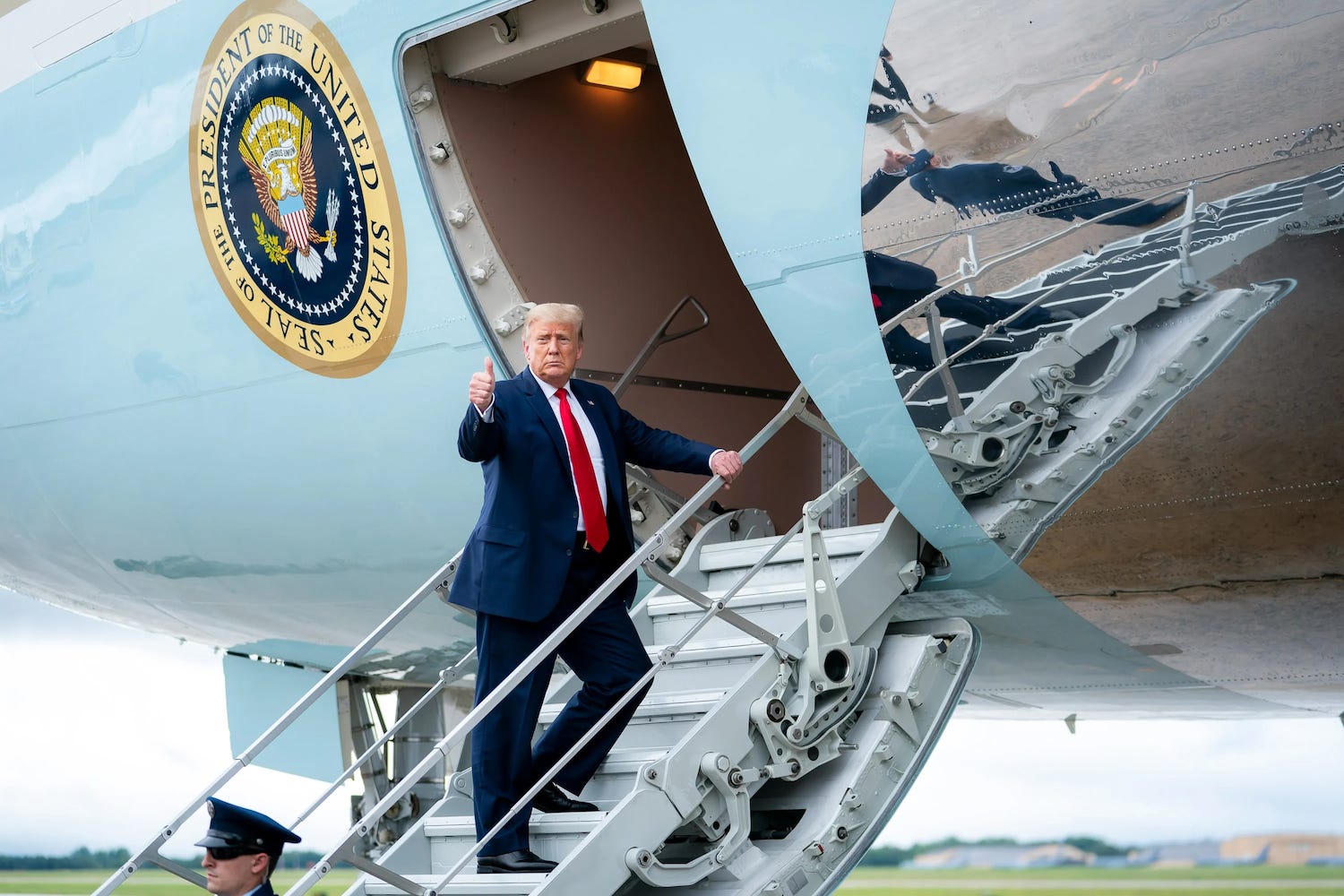
After some digging around, the Times reporters learned the truth about the switcheroo: The Qatari plane, rushed into service at Trump’s insistence, lacked some key security features that provide defense against antiaircraft missiles and systems to protect the plane “from the electromagnetic effects of a nuclear blast.” The Secret Service advised switching planes out of an abundance of caution when hostilities between the U.S. and Iran flared up again while Trump was in Turkey.
This was an important story that followed the pattern of carelessness with which the Trump administration goes about doing almost everything. In this instance, however, we’re not talking about a botched paint job in the reflecting pool at the Lincoln Memorial. Had Iran been able launch a missile and strike a defenseless Air Force One, it would have touched off a global conflagration with far greater consequences than higher gasoline prices.
Freedom of the press works in tandem with the public’s right to know, and in this case the public had a right to know that the administration was taking a security risk in using a plane for the president of the United States that was not equipped to defend itself. The reporters at the Times did their job as members of the Fourth Estate, the branch of government that holds the others accountable. Doing their job required them to use anonymous sources, and in most cases reporters are legally not required to reveal those sources. If reporters were required to name their sources whenever the government was looking for a leak, it would have a chilling effect on journalists’ ability to gather information.
Trump, of course, was livid about the Times’ story and wanted to find the leaker who revealed the planes were switched for security reasons. On Trump’s order, FBI Director Kash Patel subpoenaed the four reporters who wrote the story, compelling them to testify before a grand jury. There are exceptions for which reporters can be compeled to name of sources, like national security, but this was not the case with the Qatari jet. This was an attempt to intimidate and stifle the press, and while the Times’ reporters have the legal resources of a deep-pocketed media outlet, smaller outlets and independent journalists — like those publishing on Substack — don’t have those kinds of resources.
In an interview with NPR, the Times’ Executive Editor Joe Kahn said, “This doesn’t follow anything like standard Justice Department procedures for looking into a leak, where you try to identify the source of the leak, and you interview people who had access to the information. Going directly to the journalists like this is a naked act of intimidation.”
The Times’ lawyers have filed a motion to quash the subpoenas that is still pending, and a hearing is scheduled in court for Thursday. Meanwhile, the Times reported this week that the Trump administration issued subpoenas seeking phone and text records of the reporters AND their relatives, including spouses and parents. Seth Stern from Freedom of the Press Foundation said this:
“Even the Mafia says families are off limits. It’s gross that the administration — in its never-ending effort to harass and intimidate reporters who reveal its incompetence — is going after the communications of journalists’ relatives.”
Working for a media outlet owned by a big corporation can protect reporters from the devastating legal expenses involved in cases like this, but corporate ownership of media raises other problems. As I wrote earlier this year, big corporate owners of media outlets like the Washington Post and CBS News have a huge conflict of interest because of government contracts, mergers and regulations that can affect the bottom line of their other holdings. A vindictive administration can use its leverage to bend corporate-owned media to its will. The New York Times is an exception among big media companies, because its owners have no other corporate interests that can be exploited.
Going to a not-for-profit model like National Public Radio or the independent route of Substack can provide an alternative to easily-intimidated corporate media owners. Non-profits and Substack writers, however, don’t have the deep pockets to defend against legal challenges like egregious libel suits and specious subpoenas that are little more than fishing expeditions. If the resources are not available for journalists to defend themselves in court, it will have a chilling effect on their ability to use anonymous sources as well as the willingness of sources to speak freely to journalists.
To ensure that reporters can do their job without fear of being hauled into court, all journalists, whether independent or working for no-profits or publications with limited resources, must have access to pro bono legal assistance.
One of the organizations stepping up to fill this need is Reporters Committee for Freedom of the Press. From their website:
Since our founding in 1970, the Reporters Committee has operated a 24/7 Legal Hotline that provides assistance to journalists with a variety of media law and press freedom issues, including routine newsgathering questions on public records, subpoena threats, protest coverage, and more. It’s also available in emergency situations, including when a journalist has been arrested. We can help journalists and newsrooms anywhere in the country with public records and court access issues, subpoena threats, source protection, and other issues that may arise while newsgathering.
I wrote to Reporters Committee seeking information about the scope of their work, whether they’re able to respond to and assist on all the requests they get for legal assistance, but as of this posting I have not heard back. Among the nine organizations listed here that support press freedom, Reporters Committee appears to be the only one offering pro bono legal assistance.
Other groups focus on training and advocacy, like Freedom of the Press Foundation, which tracks press freedom violations and provides tools and training to protect sources.
While it’s encouraging that Reporters Committee provides free legal assistance, my guess is that the need for this type of help is far greater than any one organization can handle. Philanthropists and foundations, particularly those already funding endeavors to safeguard freedom of the press, should pool their resources to provide pro bono legal aid to any journalist under attack for simply doing their job.
No posts
Comments
Nothing yet. Say the first thing.
Sign in to join the conversation.