
“AI isn’t creative.”
I’ve heard this from Hollywood directors, ML researchers, and even AI ad startups. They’re half right. Ask AI to tell a joke, and it’ll pick from a handful of statistically likely jokes. Ask AI to imagine a dog, and 4 times out of 5 it’s a golden retriever.
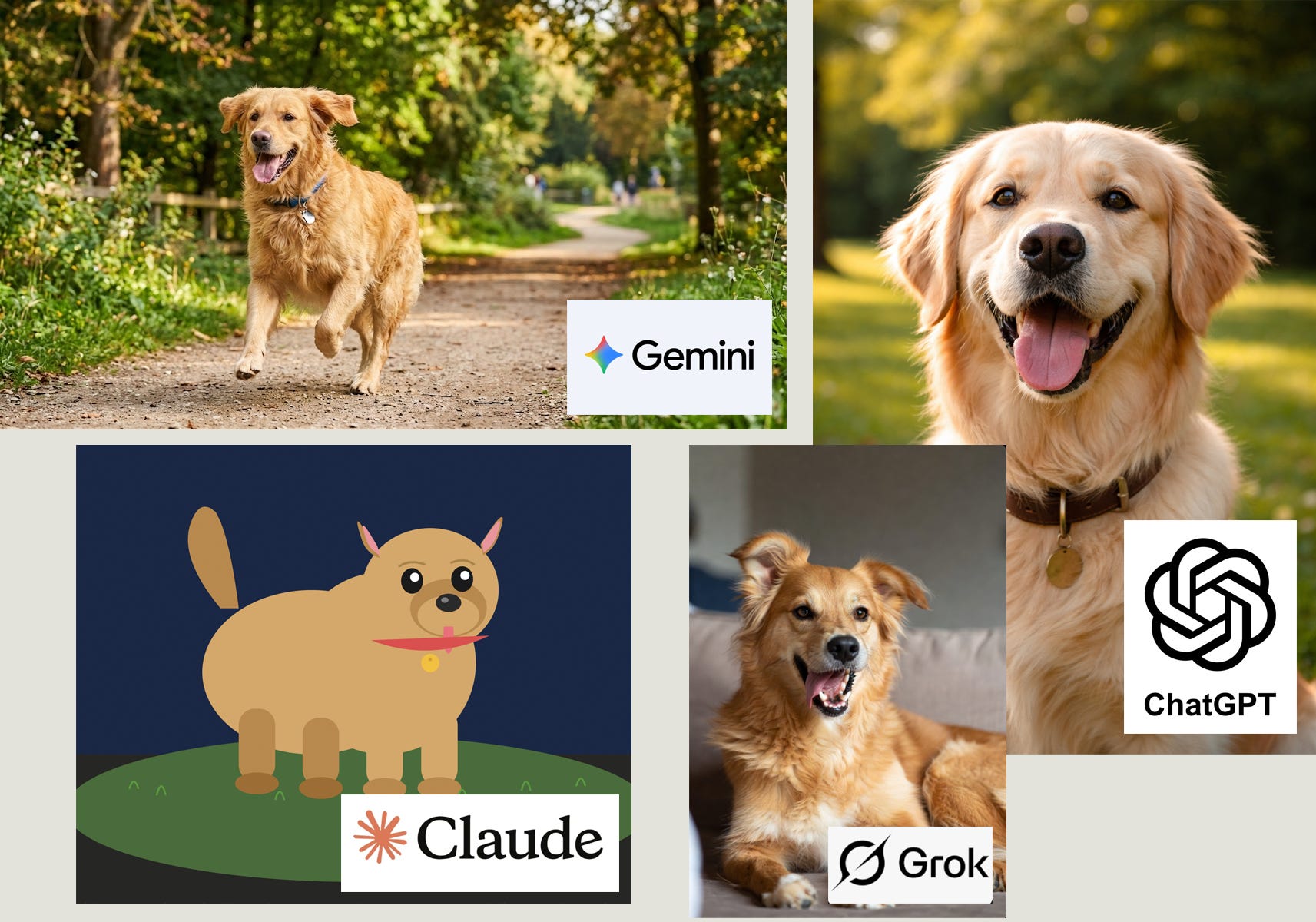
But the most demanding areas of AI– curing diseases, fighting wars, making people click ads– need original thinking. Artificial creativity is a type of artificial intelligence, but unlocking it looks different for LLMs than humans.
LLMs are sophisticated autocompletes trained on the text of the Internet. That’s great for answer engines where the correct answer is the most probable.
But if you want novelty, likely responses from a narrow repertoire will disappoint.
This is terrible for creative fatigue in advertising. If you ask Google’s image generator for a hundred Chewy.com ads, you’ll get 90 golden retrievers, some terriers, and maybe a cat or two.
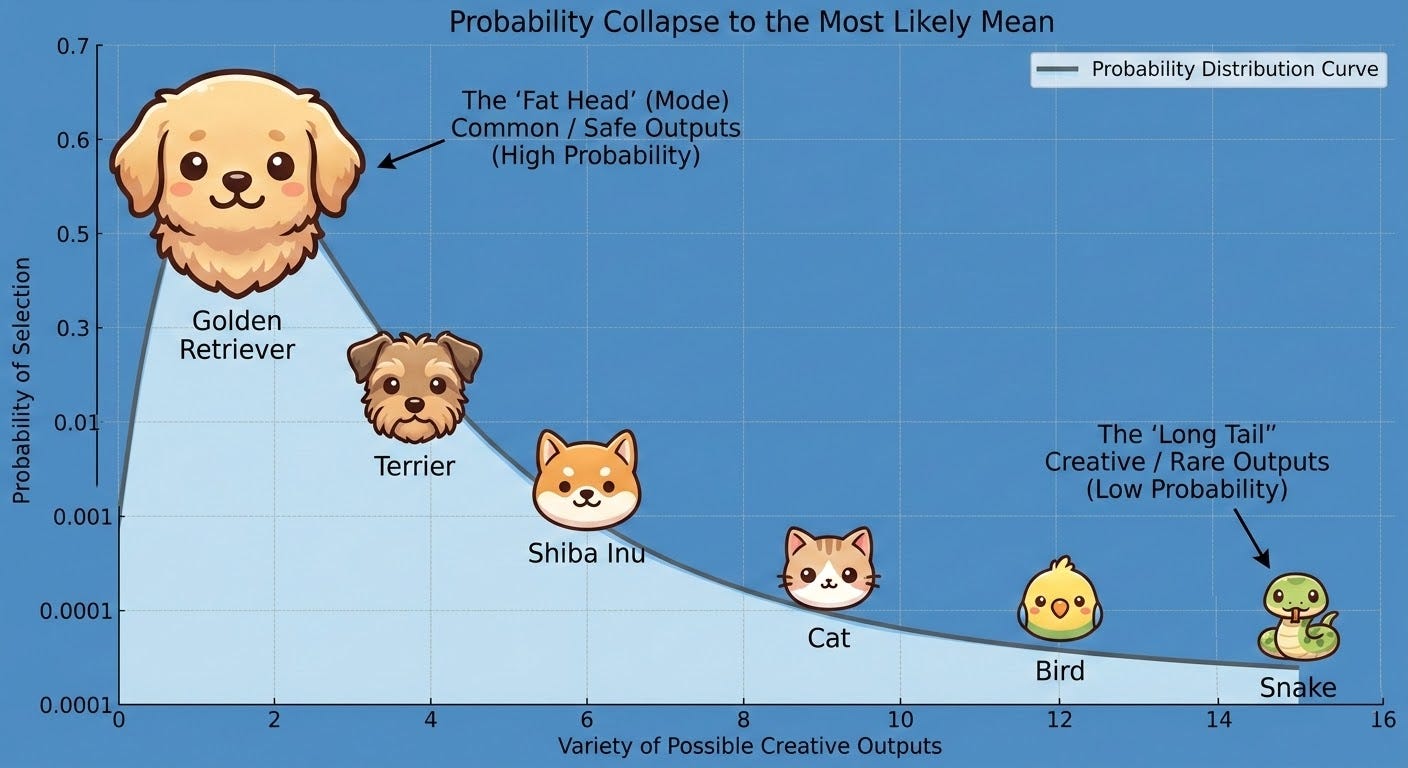
The prevailing discourse says AI is a tool for creative production; but ideas, taste, and judgement are the dominion of humans. Unless you get creative…
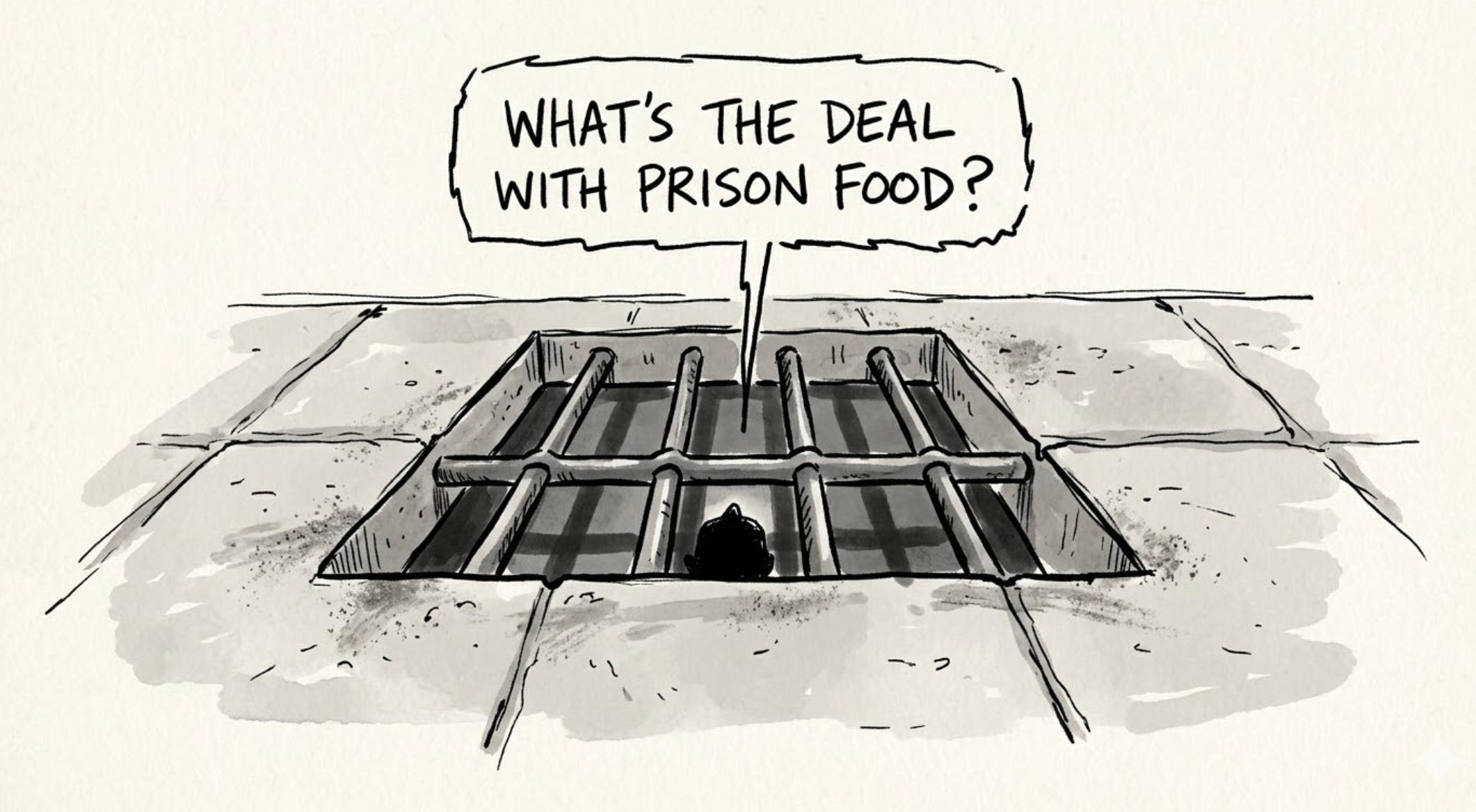
Jerry Seinfeld had a recent bit: “AI can’t do what I do. Artificial intelligence isn’t enough. You need dumb. You can’t teach dumb.”
Having done standup in NYC, I can confirm.
Andrej Karpathy agrees:
“You’re not getting the richness and the diversity and the entropy from these models as you would get from humans. Humans are a lot noisier, but at least they’re not biased, in a statistical sense. They’re not silently collapsed. They maintain a huge amount of entropy.”
Humans are continuously exposed to entropy. It’s a reason world models are the cutting edge for AI training. Conversely, if you locked Seinfeld in a basement from childhood then demanded jokes, he’d run out of material pretty fast. Creativity needs inspiration. Humans and AI alike need freedom to roam the world, scroll TikTok, absorb the zeitgeist, and talk to other people.
Robert Frost describes his creative process in 1939:
[Context] is the greatest help towards variety... We bring up as aberrationists, giving way to undirected associations and kicking ourselves from one chance suggestion to another in all directions as of a hot afternoon in the life of a grasshopper.1
Instead of confining AI to figurative basements, we need to let them engage with the world, pursue serendipity, make associations. Humans hold much more entropy in the backs of our minds than the largest context windows, but AIs can chase inspiration 1000x faster.
Humans in tech love to talk about “taste” as some ineffable value-add.
First, what is “good” taste? For ads, let’s use Ogilvy’s heuristic: a good ad is one that sells. Unfortunately, few humans can predict this reliably.
Veteran brand strategists whose entire job is having good taste often get this disastrously wrong (see Budweiser, Jaguar, Cracker Barrel rebrands). In practice, great taste means taking a lot of big shots, hitting a handful over a career, and not messing up too badly.
Most AI and human output is necessarily mediocre. Both humans and AIs can reliably tell when an ad is terrible, but AIs struggle to discern average from brilliant. The only way to tell slop from not is to expose your ideas to the world.
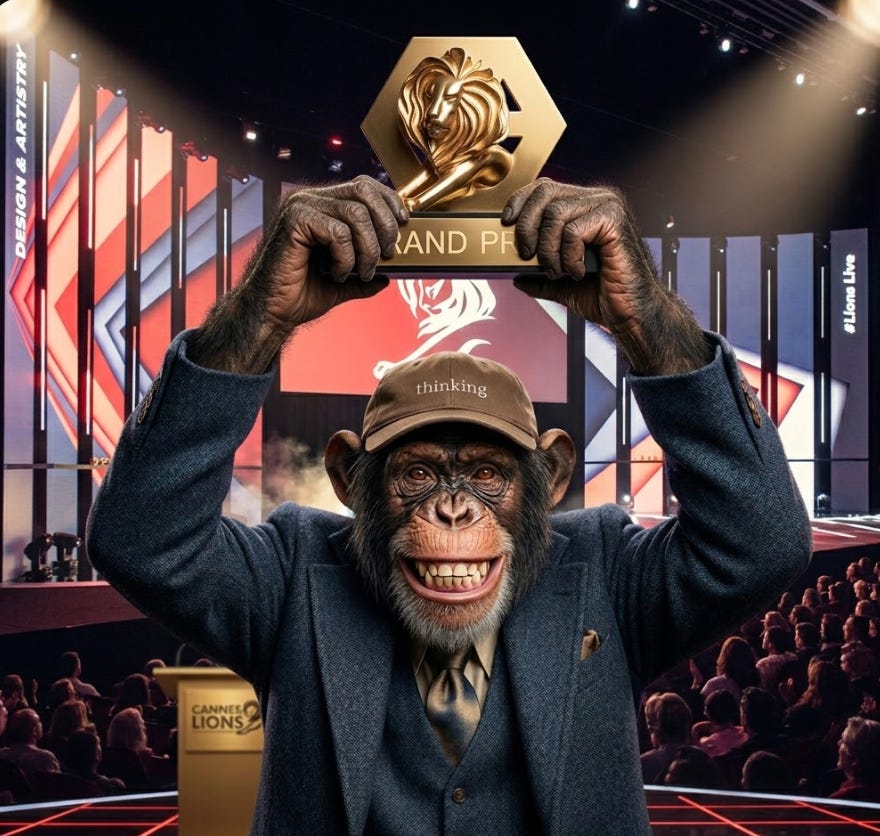
As the old thought experiment goes, infinite monkeys tapping on infinite typewriters are statistically certain to bang out the complete works of Shakespeare. LLMs are better than monkeys, and GPUs faster than typewriters. It’s never been easier to generate thousands of creative concepts and test them.

Foundation model training required paying legions of human data labelers for reinforcement learning. Amazingly, ads are negative-cost human evals that outsource the question of taste to humanity while getting paid by advertisers. The best human feedback is money.
Rather than a creative director taking a few sniper-like shots on target, with enough entropy creative AI can churn out thousands of concepts and test human reactions. Outside of gaming and high-frequency trading, there are few test environments better for rapid feedback at scale.
AI cannot yet write an original novel that holds up for more than a few chapters, but it’s more than creative enough to beat humans at banner ads:
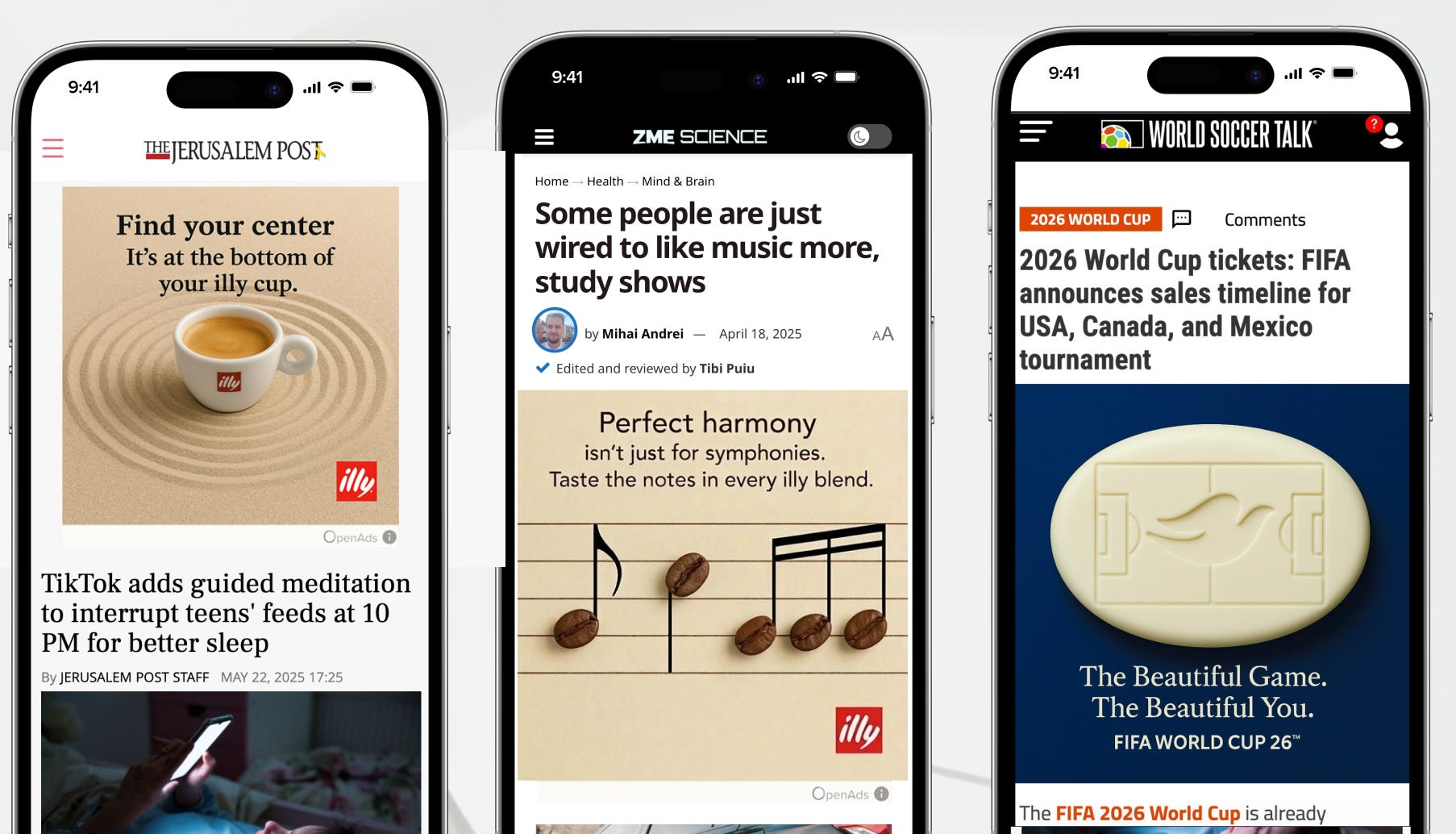
Each of these ads was inspired by its context and generated without human input. Making the connection between music ←→ notes ←→ coffee is an easy setup; connecting coffee beans ←→ noteheads shows the pattern-finding power of multimodal AI.
Human creativity could never meet programmatic advertising’s scale. But artificial creativity is as abundant as the contexts it operates in. Platform-wide, OpenAds has measured 220% higher clickthrough rates than the human-made ads running in those same ad slots. Top campaigns have hit 350% better CTR.
Our best ad delivered a 20.5x higher clickthrough rate than the human ads that ran in its place. That’s a banner ad performing as well as Instagram.
Just as human software developers adapted to AI coding tools, humans in creative roles need to find their comparative advantage working with creative AI.
The differentiated context, zeitgeist, and deep entropy in our brains lets us steer AI collaborators in promising directions. Our best ad campaigns start from a creative seed brands provide, which our AI then explores and tests at massive scale. It’s also up to humans to define the constraints they want the AI to work in. In one case, our AI flagged a luxury fashion house as so aspirational it felt inaccessible to Gen Z. The fashion house said, “that’s the point.”
Artificially creative systems aren’t yet2 capable of leaps of epiphany, relying instead on millions of stochastic monkeys tapping keyboards and millions of humans tapping ads to discover the winners. But with enough monkeys even the improbable becomes certain.
From “The Figure a Poem Makes,” 1939. Not unlike stochastic gradient descent.
The artificial creativity I’ve described is like Deep Blue, which beat Kasparov by making many simple calculations very quickly. Leaps of creative epiphany like AlphaGo’s “move 37” may need a different architecture than LLMs with creative harnesses.
No posts
Comments
Nothing yet. Say the first thing.
Sign in to join the conversation.