
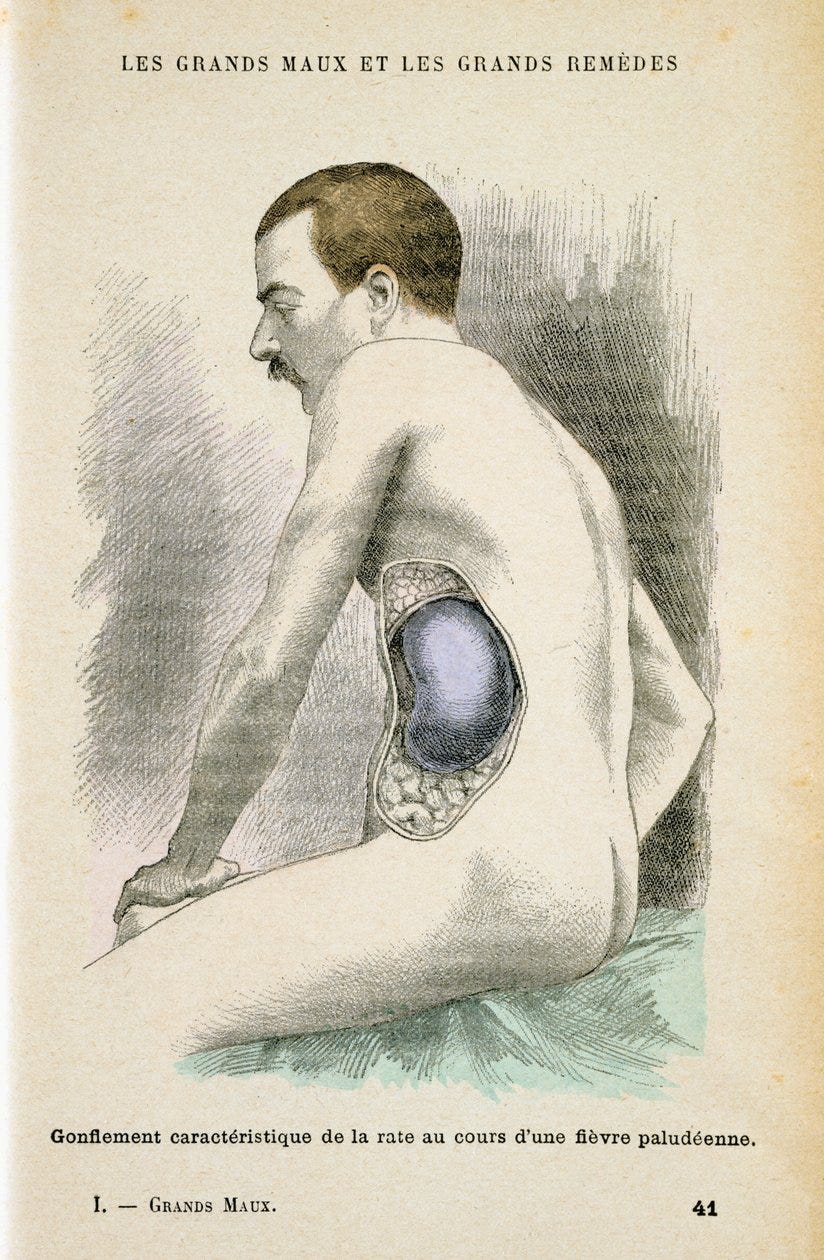
Unknown Artist, Enlarged Spleen, 1890
The other day, I watched a young lady stomp a Lantern Fly to death.1 It was a familiar thing: gleeful, shameless, and with prejudice. It had been a terrifically sunny day in Queens, and I said to my neighbor, “Look how much this young lady wants to kill. The Lantern Fly directive has unleashed something demonic in people — a license to murder, or what?” I felt one glass of wine drunk, sardonic, and funny.
She replied, “I think people are just happy to have something to do together. It’s a common cause.”
I thought about the remarkable compliance of our society as it regards sustainability, preservation, public health and the like. We’ve recycled and cut apart those plastic, beer can rings. We’ve switched to reusable grocery bags. Styrofoam. One time, I sneezed into the crook of my elbow on the subway. A sweet-looking old lady turned to me and said, “Nice, you’re well trained…” Oh, the shame! Oh, the righteousness!
Never are these drives more super-charged than when they are factored into our own personal wellness. In college, I remember Europeans smoking cigarettes beside their children in restaurants. Today, Paris is banning smoking on the street. And moreover — Wine Wine Wine is here to report — that the legendary bottle of wine at lunchtime just isn’t as common as it used to be. It’s Bad For You! Despite all cause mortality in the West on the rise, alcohol and tobacco consumption are at an all time low. In fact, there seems to be no greater threat to the health of a reasonable Westerner. While I have no business defending the use of tobacco, I’m starting to develop a funny intuition, however criminal. As the question of wine is concerned, I think there are some facts to consider that I will now discuss AT LENGTH!
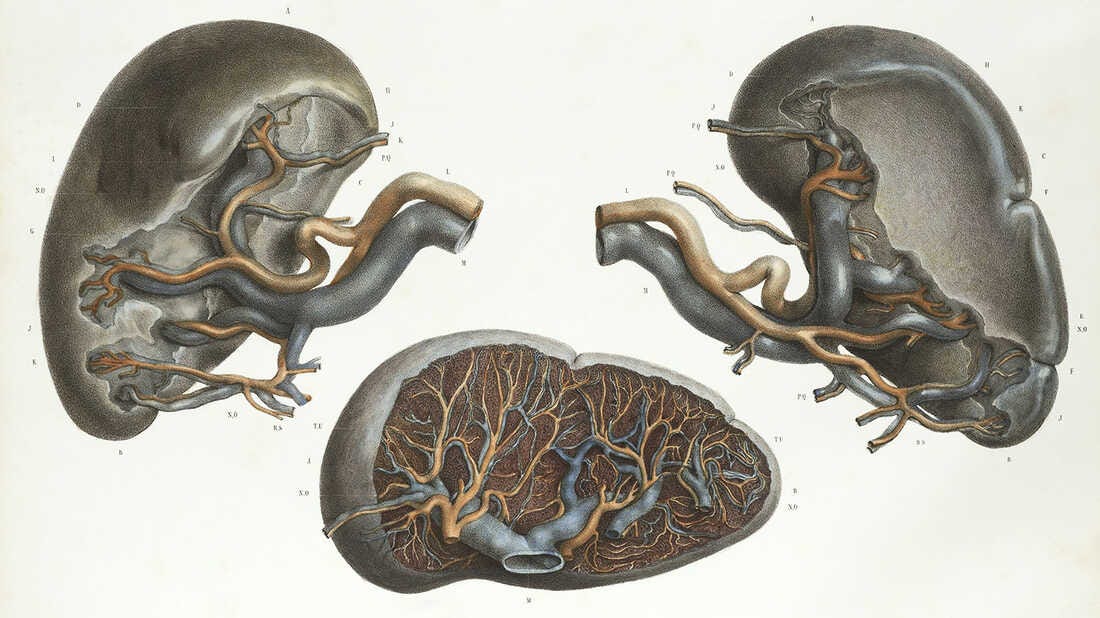
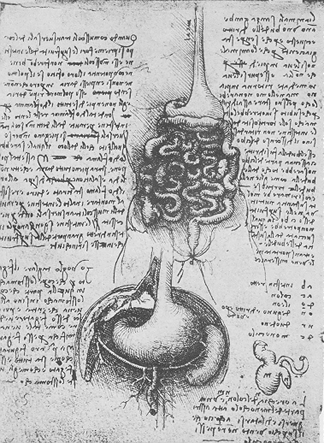
The spleen, shown in the 19th-century French anatomy atlas, Traite Complet de L’Anatomie de L’Homme.
Leaking
For a couple of years I lived with a fellow wine professional. Prior to that, I had small trepidations and both of us were warned against the idea for fear that our small, Ridgewood apartment might become a bacchanal for ethanol, volatile acidity, and insomnia. In fact, our home became a very peaceful solace for the two of us, and most of our wine devilishness occured “out there.” It was very comforting to have a fellow wine salesman to work out the vicissitudes of our slings and arrows. At the time, my stomach was a constant mess. I’d be in a huge amount of pain for days, followed by the severe anxiety wrought by heartburn and sleeplessness.
At the time, I attributed my condition to a study and obsession with Mosel riesling that lasted many years; first, because these low-ph wines would trigger my symptoms, and second because of the widely touted proposition that alcohol of any kind is a poison, detrimental to the proper functioning of the gut/microbiome/whatever they are lately calling it.
I recall a very pivotal day in the life of my lower dantian where Berlin, my roommate, said to me, “You know, Koreans never really get acid reflux, and we eat really acidic foods.” This seed of doubt grew into a lot of reading and changes to my diet that would ultimately cure me of my stomach issues. However, placing wine on either the nice or naughty list proves difficult when considering the confounding factors.
The positive argument for the proposition that “alcohol wreaks havoc on the gut” goes like this:
Alcohol denatures bacterial cells, killing “beneficial” colonies of your microbiome indiscriminately
Alcohol damages the lining of the stomach and esophagus by denaturing proteins that make up the joints of this lining, causing inflammation and shit in the bloodstream that shouldn’t be there.
Ultimately, alcohol seems to have a coercive effect on the living cells that it comes in contact with, so these effects are as intuitive as they are empirically verified.
Some other things with this kind of corrosive effect include vinegar, soda, fruit juices, lectins (concentrated in raw vegetables), coffee; food additives like citric acid, ascorbic acid, acetic acid and sugar — also highly processed grains like wheat. As with most things, the dose makes the poison. Were you to fill your empty stomach with pure ethanol, you would expire quickly. Do the same with vodka at 40% alcohol and you’ll experience chemical burns and ulcers. A couple of glasses of wine before a meal (10-15%), probably not so alarming.
Still, the risk of harm is non-zero and it would be reasonable to moderate your drinking — as regards your gut — were it not for the substantial benefits. I’ll just mention two very straightforward health benefits to your digestive system, but there are others. First, for reasons that remain unclear, small amounts of alcohol like we find in beer and wine (~5-15%) trigger a significant production of gastric acid in the stomach which helps your gut prepare to break down a meal.
Very often, I find that cultural habits and traditions around eating seem to confer these kinds of benefits to one’s health. Apero before a meal serves a similar purpose as acidic, vinegary appetizers (literally) at the start of a meal. For example, banchan in Korean culture confers these gastric benefits. Furthermore, banchan like kimchi, pickled vegetables, and other fermented foods are rich in the probiotic cultures that are purportedly so good for a healthy microbiome and stomach lining.
For my money, there is no product that you can buy in these United States with a more diverse and living culture than natural wine without added sulfites. If you buy fermented products in the supermarket like kimchi, sauerkraut, yogurt, kosher pickles, etc., they are all highly regulated and demand that producers use cultured communities of bacteria that can be identified and labeled (this is true of probiotic supplements as well). In short, most of the cultures on supermarket shelves are dead. Ask anyone who has ever tried to culture store-bought yogurt and they will tell you of the paucity of the yogurt after a generation or two. Try making your own kefir or sauerkraut and you will see how devoid of life even the “cleanest” grocery store products turn out to be.
Wine, happily, is not regulated in this way. Many natural wines are alive, active, and teeming with a community of microbes that your stomach has evolved to register and process. Those Mosel Rieslings I suffered2 were a lot like the litany of dead things we put in our bodies: energy in the absence of information. These foods become a solution our stomach can’t recognize, so the digestion slows and the most harmful aspects of these food rot in our stomachs and cause the havoc that is blamed on wine or alcohol. In reality, wine is excellent for the gut when wine is drunk before or during a meal (like most cultures traditionally do), and especially when the wine is natural and alive.
Electrons
Very many of our modern health issues are attributable to what’s called “oxidative stress.” In just the same way that an apple turns brown and breaks down, an old car begins to rust, or the way a glass of wine becomes nutty and bitter with oxidation, the living cells in our bodies malfunction, proteins fold incorrectly, and our DNA has trouble expressing itself in the presence of oxygen. Needless to say, this causes a litany of downstream disease like metabolic disorder, cardiovascular disease, and of course alcoholic liver disease and cirrhosis!
No! Help!
Oxidative stress has everything to do with electrons and the balance they like to have in your cells. You’ve likely heard the term, ‘free radical’. These are the purported villains in your body with an atomic structure such that there exists a “free” electron without a pairing. Since electrons like to be in twos, free radicals leech electrons from healthy cells (oxidation), and then the cells deform and everyone gets sick and dies. Oxygen (O2) is just strange. Because of its shape, it tends to have two unpaired electrons that are electrically eager to react with other atoms in order to round out the lone pairs.
Antioxidants, the heroes, the blueberries, the superfoods… are able to mitigate this imbalance in a number of ways such that atoms are donated the missing electron (reduction) and become coherent.
Wine has alcohol, which is processed in the liver, and byproducts of this process include some free radicals. Most notoriously, Acetaldehyde, which millenial Instagram brands target for hangover supplements. Yay! However, wine is a special alcoholic beverage. Wine comes with its own mechanism for balancing out its production of free radicals. Polyphenols, like resveratrol and other ones, are famously able to neutralize these free radicals in particular, but also other, problematic, reactive oxidative species (ROS). Once again, the dose makes the poison. Too much alcohol, and the liver is overwhelmed to the extent that free radicals will outstrip whatever benefit you get from the antioxidants. Wine also contains DHM, a flavonoid which eliminates free radicals specific to alcohol digestion.
What’s even more important is the environment into which the vino is poured. If you are already experiencing a lot of oxidative stress from crappy food, poor air quality, (**parental advisory**, your cell phone, nnEMF, Wifi, prescription drugs, etc.), then you’ll have a much lower threshold for what little bit of alcohol you're trying to onboard. I have a similar intuition here as I do in regards to a bit of kimchi before a big meal. There’s probably a reason why our grandparents (and their grandparents) were better able to enjoy a bottle of wine at dinner followed by coffee and cake every night. Jobs with greater activity, more time out in the sun, less processed food, and less of all the other culprits we know are slowly breaking down our bodies' ability to manage oxidative stress likely made the consumption of wine a lot easier.
A bad hangover is a good thing because it tells you that something in this environment was wrong. For all who wonder why certain days of drinking lead to considerations of a hospital visit, while others barely have an effect, the context and environment is everything. Will your hangover be worse if you drink on an empty stomach? Yes, you’re corroding your gut. Will your hangover be worse if your body is highly acidified and your mitocondria are already at their oxidative limit? Yes, you’re adding a detoxification task to a system that is totally fried.
Be like the great Jules Chauvet and drink wine out in the sunshine, amongst friends, with some real food, away from your phones and other weird bullshit, and drink to your hearts’ content. Literally!
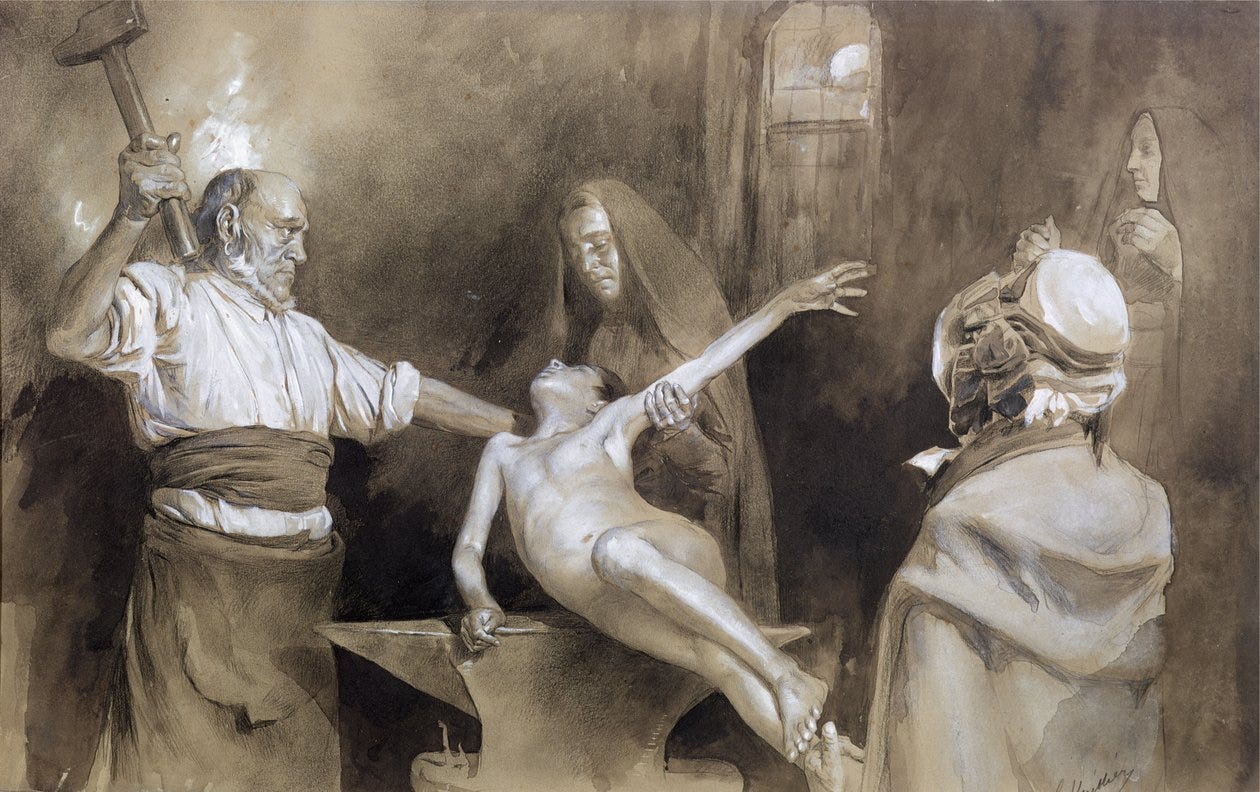
Hammering the Spleen by Gaston Vuillier
Heteroplasmy
Beyond resveratrol’s capacity as a simple, biochemical antioxidant, it is also fluorophoric, meaning its electrons absorb and emit light. Incredibly, beautifully, grapes absorb UV light from the sun (the sun we are told to avoid), which is then absorbed by resveratrol, and stored in water for our consumption and integration. Because resveratrol is fluorophoric, it emits light at a frequency that speaks to our mitochondria, regenerating confused organelles and optimizing the cells electric potential.
Wine drinkers consume a solution of sunlight and a special kind of water that is functionally much different than water that comes out of a bottle or tap. Everyone knows that water is made up of 2 Hydrogen atoms and 1 Oxygen atom. What you may have forgotten, is that Hydrogen has three naturally occurring isotopes: protium, tritium and deuterium, that refer to the number of electrons in the atom, and thus the atom’s charge and mass. So, there are at least three different kinds of water depending on the isotope of Hydrogen that’s present.
Each kind of water has a very different photoelectric effect, and functions differently inside of living cells. Just about all of the energy you consume on this planet comes as the result of a very familiar photoelectric system called Photosynthesis, where plants transform light, water, and carbon dioxide into sugar. This is a complex and elegant quantum reaction that’s by far the most efficient photoelectric system in nature or engineering, but plants aren’t the only organisms that function as a result of a quantum system of semi conductors. All living things do, and so the charge of the water inside the cell is extremely important.
In this context, we should think of photosynthesis as a kind of photoelectric charge separator. Photons hit chlorophyll and electrons become excited and bounce into a higher energy state, positively charging the chlorophyll (because it has lost an electron), and negatively charging some one or another acceptor molecule (because it gains an electron). The yield of this reaction is directly proportional to the amount of deuterium in the water just because the heavier water can’t be excited in this way.
Water with a lot of deuterium is called ‘heavy water’, because this isotope has an extra neutron in its nucleus, and so it is more massive. This leads to a number of downstream effects on the proper functioning of most living cells, but the effect is usually deleterious. At a very macro scale, crops that are watered with heavy water often yield half the produce with all other things being equal. Water with high amounts of deuterium is more massive, and thus lower energy/less excitable, and for biochemical purposes, that’s bad.
Mitochondrial respiration (including our own) is simply the reverse of this photosynthetic process, and is equally quantum coherent. Mitochondrial respiration only creates deuterium depleted water. This is the only kind of water that your cells can use for essentially the same reason as plants: deuterium is too big. Protium, or ‘structured water’3, is the water inside your mitochondria because it is small enough to fit inside the atomic channels proper to mitochondrial respiration. Deuterium gums things up and destroys the coherence of the system. Deuterium is heavy and holds onto atoms, where healthy cellular respiration wants electrons to move freely and effectively.
What’s the point?
Since resveratrol absorbs light at around the same spectrum that our skin does when it converts LDL Cholesterol into Vitamin D; it has a similar photoelectric effect on our mitochondria, and it is proved to enhance the function of our mitochondria’s vitamin D receptor. Thusly, we are better able to convert cholesterol to vitamin D with less direct sunlight.
Since the water in grapes are naturally deuterium depleted from photosynthesis (particularly in high altitudes where the groundwater is “lighter”), wine gives us an endogenous source of deuterium depleted water that gives negative charge (more free electrons), and thus more structure to our cells and proteins.
So, those beautiful alpine wines we love so much not only can help tune our bodies to better absorb the most beneficial aspects of sunlight, but also hydrate us with the water our cells need.
Godliness
Commonly, I say that my brothers and I were raised Italian. As the children of 3rd generation immigrants (you might say ‘fourth generation’, and stress a contradiction of terms), heritage is a sort of strange concept for us. But, since the four of us are all different colors, people love to ask, and for me this has been the simplest answer.
As a point of fact, I have a couple of Calabrian great-grandparents who very likely held a near-zero affinity for the burgeoning nation state of Italy, instead focusing on a small populace of their own, the 15th and last of whom was my grandmother, Elanora, which must have become Eleanor, who everybody called Pat because that was maybe less exotic.
All of that to say that I’m about as Catholic as I am Italian, but in just the same way that antipasti, the importance of “sauce,”4 and/or having an Uncle Leo has an outsized effect on your intuition throughout life, Catholicism has left me with direction in a moral and sensible place irregardless of whether The Creator was begotten by a Virgin Nazarene in the old country. More precisely, it has been strange to grow up in a country ruled by Ryans, McCains, Kennedys, Clintons and Grahams. This puritanical weirdness has very little to do with the Romans’ drunken Master, who literally turned himself into Italian bread and wine to prove that the universe is made of love and such. It is the infamous, Catholic lush, Gregory Hesse, who reminds us that it was the finger-wagging protestants who gave us the ‘pub’, a derivative of ‘public’, owing to the fact that drinking was to be done in public, not behind closed doors, in communion with one’s community, even if all the transubstatiative magic had surgically, Germanically, been sucked out of it.5
And if this ecclesiastic tone is too mystical and severe for your Bushwick sensibilities, I’d like to proffer only a practical reality to the Goodness of wine in the style of the great, pragmatic sage, William James, and take a look at the force of its argument. Here’s a favorite poem of Hesse’s to our point:
Heretics all, whoever you may be,
In Tarbes or Nimes, or over the sea,
You never shall have good words from me.
Caritas non conturbat me.But Catholic men that live upon wine
Are deep in the water, and frank, and fine;
Wherever I travel I find it so,
Benedicamus Domino.On childing women that are forelorn,
And men that sweat in nothing but scorn:
That is on all that ever were born,
Miserere Domine.To my poor self on my deathbed,
And all my dear companions dead,
Because of the love that I bore them,
Dona Eis Requiem.- Hilaire Belloc
In the words of William James himself, lecturing on Mysticism and Christianity:
“The sway of alcohol over mankind is unquestionably due to its power to simulate the mystical faculties of human nature, usually crushed to earth by the cold facts and dry criticisms of the sober hour. Sobriety diminishes, discriminates, and says no; drunkenness expands, unites, and says yes. It is in fact the greater exciter of the Yes function in man. It brings its votary from the chill periphery of things to the radiant core. It makes him for the moment one with truth. Not through mere perversity do men run after it. To the poor and the unlettered it stands in the place of symphony concerts and of literature; and it is part of the deeper mystery and tragedy of life that whiffs and gleams of something that we immediately recognise as excellent should be vouchsafed to so many of us only in the fleeting phases of what in its totality is so degrading a poisoning. The drunken consciousness is one bit of mystic consciousness, and our total opinion of it must find its place in our opinion of that larger whole.”
Even our most secular pursuits seem beholden to this logic. Wine for James is a source of presence, a fixing function for our consciousness that is an end in-itself. In Psalms, liturgy, Catholic prayers and scriptural proverbs, wine stands as a literal and figurative symbol for this psychological truth, but surely other cultural flavors exist. Tell us in the comments your favorite cultural correlate to the “the great exciter of the YES function in man!”
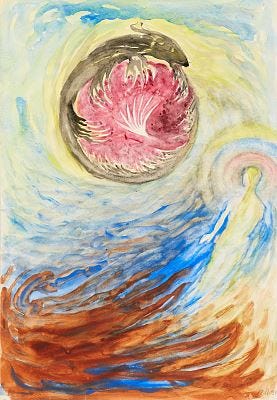
The Power of the Spleen, 1931 Klimt
Wine
Finally, briefly, an acknowledgment of the most healthful aspect of wine. Many of the most pinned and prominent voices in our field will insinuate that wine is about one thing or another: terroir, or something. Wine is essentially and always about people. Not winemakers, not the committees that decide what is Bordeaux and what is Barolo, but the person you clink your glass with and bless their good health.
From Socrates to Kant, the function of wine as a lubricant for conversation has been evident and regular. It’s sad that we seem to live in shame for this fact, or at least that we’re meant to feel that way for an ethic that turns our intuition against us. If you wake up after a night of sharing bottles and feel drained and unmotivated, the problem is with your company, not your wine. Good company gives you energy, and that exchange is made more efficient and more coherent with a glass of wine. Anyone who would choose to taste a rare or lauded bottle by themselves over the company of another person has a sickness, and you should avoid them. All real wine, the wine we are so graciously blessed with in our modern reality, is good. Your company, often, is diseased. I implore you not to forsake one for the other and to open your mind to something outside of your taste for the sake of pleasant company.
Bellanti F, Coda ARD, Trecca MI, Lo Buglio A, Serviddio G, Vendemiale G. Redox Imbalance in Inflammation: The Interplay of Oxidative and Reductive Stress. Antioxidants (Basel). 2025 May 29;14(6):656. doi: 10.3390/antiox14060656. PMID: 40563291; PMCID: PMC12189482.
Chauvet, Jules, and Hans Ulrich Kesselring. Le Vin En Question. Jean-Paul Rocher, 1998.
Goode, Jamie. SCIENCE of WINE : From Vine to Glass. S.L., Univ Of California Press, 2021.
Kelebek, Hasim, et al. “HPLC Determination of Organic Acids, Sugars, Phenolic Compositions and Antioxidant Capacity of Orange Juice and Orange Wine Made from a Turkish Cv. Kozan.” Microchemical Journal, vol. 91, no. 2, Mar. 2009, pp. 187–192, https://doi.org/10.1016/j.microc.2008.10.008. Accessed 13 May 2020.
Kruse, Jack. Epi-Paleo Rx : The Prescription for Disease Reversal and Optimal Health. United States, Optimized Life Plc, 2013.
Planck, Max. “The Meaning and Limits of Exact Science.” Science, vol. 110, no. 2857, 1949, pp. 319–27. JSTOR, http://www.jstor.org/stable/1676004. Accessed 20 Nov. 2025.
Pollack, Gerald H. The Fourth Phase of Water : Beyond Solid, Liquid, and Vapor. Seattle, Ebner & Sons, 2013.
Spanagel R, Siegmund S, Cowen M, Schroff KC, Schumann G, Fiserova M, Sillaber I, Wellek S, Singer M, Putzke J. The neuronal nitric oxide synthase gene is critically involved in neurobehavioral effects of alcohol. J Neurosci. 2002 Oct 1;22(19):8676-83. doi: 10.1523/JNEUROSCI.22-19-08676.2002. PMID: 12351742; PMCID: PMC6757777.
William, James. Varieties of Religious Experience. Longmans, Green & Co., 1902.
In New York, we kill these invasive species on sight, and we smile.
I still love Mosel riesling and drink it often, with a bit more cognizance.
Sometimes called, ‘metabolic water’
Nobody in New York says ‘gravy’. I don’t know where that comes from.
Incidentally, the provenance of greatest hereditary significance for me is the German Republic, where my Lutheran Grandfather took to drink in less of a religious way and more of a Hasbroian, “Hungry-Hungry-Hippo,” way. I note only the correlation.
No posts
Comments
Nothing yet. Say the first thing.
Sign in to join the conversation.