
When we plan out our future goals, our brains believe we’re on a spaceship with warp-speed capabilities.
Like the Millennium Falcon in Star Wars jumping to light speed, or Dark Helmut demanding a jump to ludicrous speed in Space Balls.
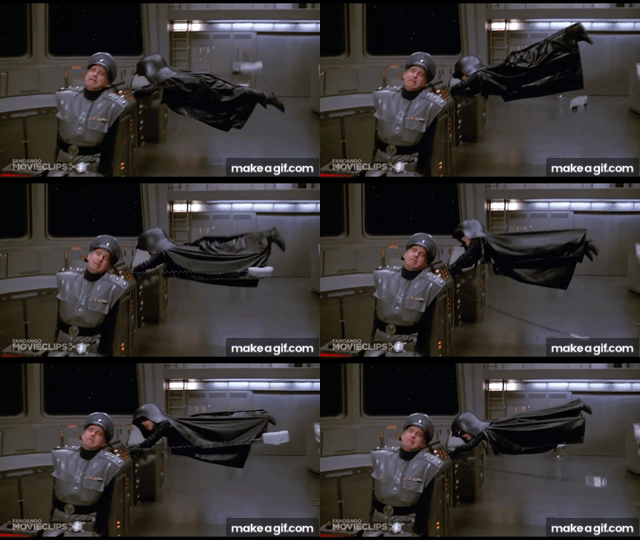
Because warp speed is Faster-Than-Light (FTL), we must be damn sure every tiny detail in our plan is perfect before we hit the big red button to turn on the warp drive.
If we use the wrong coordinates, or our math is off by a fraction of a degree, we might crash into an asteroid field or a star. Personally, I try to avoid crashing into stars at warp speed whenever possible.
This is how I used to think about my own life and goals: plotting a warp-speed destination.
I would envision a specific point in the future with a perfect day, full of puppies and millions of dollars and a jetpack, planned in great detail. I would then work tirelessly towards that specific future. I told myself as long as life went according to plan, and I worked hard, I would reach that goal and all of my problems would be solved.
(Spoiler alert: this worked for me until it didn’t).
Now, of course there are many successful people who pick a decades-long goal and actually achieve it.
Musicians who always wanted to perform on stage and then go on to become best-selling artists. Entrepreneurs who burn the boats behind them and go all in on their crazy business idea that changes the world. Olympians who dedicate their life to their sport, chase it with dogged discipline, win the gold medal, and then write the bestselling book about their pursuit of perfection.
Whether or not this success magically solves all their problems and creates endless happiness is another question.
(We also don’t get to hear from the thousands of people who also dedicated their lives in pursuit of those same exact goals and didn’t win. Those people don’t get book deals.)
So, having a 10-year singularly focused goal MIGHT be a good plan.
But it also presents some challenges. The grander, more detailed our life plan, the more perfectly we envision that future, the more rigid our definition of success becomes and the more devastated we are when life doesn’t pan out.
You’re probably seeing the potential problem here: Life isn’t like space travel with set coordinates.
It’s chaotic, always changing, and largely outside of our control. Life is under no obligation to do what we expect, no how badly we want to succeed and how disciplined we are. We will fail, life will get harder, and we will struggle. Not because we’re broken or because our plan was wrong, but because we are human and life is unpredictable.
There’s one perfect path in which we reach our goal, and infinite other paths in which we don’t.
On a long enough timeline, potential problems and setbacks become inevitable. This is why I’d like to propose an alternative framework for thinking about our plans for the next decade.
Instead of working backward from a future “dream life,” we can instead work outward from where we are today. We don’t need to plan for perfection. We’re going to prepare for uncertainty.
We’ll just need a different kind of ship…
Up until the 1970s, the prevailing theory for how the islands of the South Pacific were settled was “accidental drift.”
Westerners assumed that ancient civilizations, without the aid of maps or compasses, on catamarans made without any modern tools, must have accidentally stumbled across each island in the Pacific over a long period of time.
There was no way they could navigate without proper tools, right?
Fortunately, by 1975, modern technology had advanced enough to put the accidental drift theory to the test. Scientists ran sophisticated computer simulations that factored in wind and waves and currents. After sixteen thousand simulations, they discovered not a single simulated voyage was able to “accidentally” make the journey from eastern Polynesia to Hawaii.
Not one.
But computer simulations weren’t enough. A group of descendants wanted to prove Polynesian wayfinders could navigate without any modern technology.
And thus, the Polynesian Voyaging Society was formed.
This society constructed a catamaran named the Hōkūle‘a, the first of its kind in nearly six hundred years, without any modern conveniences or tools.
They recruited a navigator, Mau Piailug of the Caroline Islands, who had been trained by his father (and his father before him, and so on) in the navigational science of wayfinding. Piailug understood how clouds responded to certain incoming weather patterns. He knew that a white tern, a seafaring bird, would always return home to its island at night. Spotting one meant he was within 80 miles (129 km) of landfall and could simply follow the bird back to its home.
On clear nights, he navigated by the location of 220 different stars in the sky; each star during certain hours of the night could be lined up with the horizon. If he couldn’t see the stars, he could stick his leg in the water and feel different ocean currents to guide the ship. Each morning he could study the color of the sky, the position of the sun, and how the waves moved to help him course-correct the catamaran toward the next island.
This is how in 1976, the Hōkūle‘a sailed from Hawaii to Tahiti, a distance of 2,500 miles, without any navigational equipment.
Thanks to generous wayfinders like Piailug, the art of wayfinding has since been taught and passed down to future generations. Nainoa Thompson, taught by Piailug to navigate the Hōkūle‘a all over the Pacific, is now a folk hero in Hawaii for his wayfinding ability.
As Thompson explained to author Wade Davis in The Wayfinders, wayfinding is much closer to science than it is to art:
The skills of the traditional navigator are not unlike those of the scientist; one learns through direct experience and the testing of hypotheses, with information drawn from all branches of the natural sciences, astronomy, animal behavior, meteorology, and oceanography.
Rather than having a perfect map and GPS with a specific route to follow, wayfinders have a general idea where they are headed and then leverage their extensive training and context clues to help them navigate more accurately as they get closer.
This is the point in the essay where you’re probably thinking:
“Steve, is this where you use this obvious extended metaphor to explain your proposed life strategy?”
I knew you were smart. And good looking.
Instead of “I will work tirelessly towards a specific life goal years/decades from now,” wayfinding is different.
We instead pick a general direction, with our eyes always open to the possibilities and challenges around us. We accept what life is giving us at the moment: sun, waves, or rain. We have the flexibility to make adjustments along the way. When life throws a storm in our path, we know how to navigate our way back.
Wayfinding gives us permission to look at side quests, detours, and setbacks with curiosity instead of judgment. They are inevitable parts of life, so we might as well stop getting surprised when they happen. We know there’s no such thing as “back to square one.”
We get to bring all this past experience with us on future voyages.
This is the premise behind David Epstein ’s book Range: while the world demands we specialize and narrow our focus to a single thing, we should instead spend more time exploring widely.
Epstein shares the wisdom of Herminia Ibarra, a professor of organizational behavior at London Business School, who encourages her students to think about their careers as if they’re flirting with their possible selves.
Most career counselors advise their students to pick an end goal of “where do I want to be ten years from now?” and work backward to today to know how to get started. Ibarra instead encourages her students to start working outward from all the possibilities they have now.
Here’s why this can be so helpful:
Developing an attitude around exploring widely and flirting with our possible selves can result in more adaptable skills, a wider variety of experiences, and more life enjoyment.
Ibarra encourages us to be a scientist of ourselves, asking smaller questions that can actually be tested:
“Which among my various possible selves should I start to explore now? How can I do that?”
We all exist in a world in which the future is unknowable, change is the only constant, and career paths are disappearing overnight. This means having a wider and more random set of experiences can actually create more future-proof resilience and happiness.
This means that just because we’ve started down a path doesn’t mean we must stay on that path, even if we’ve dedicated our lives to that very path. We’re not confined to a particular future, even if it appears that way. We can appreciate what got us here, and then we can decide where to go with all the knowledge we have now.
This is best pictured in author Tim Urban’s drawing about life paths:
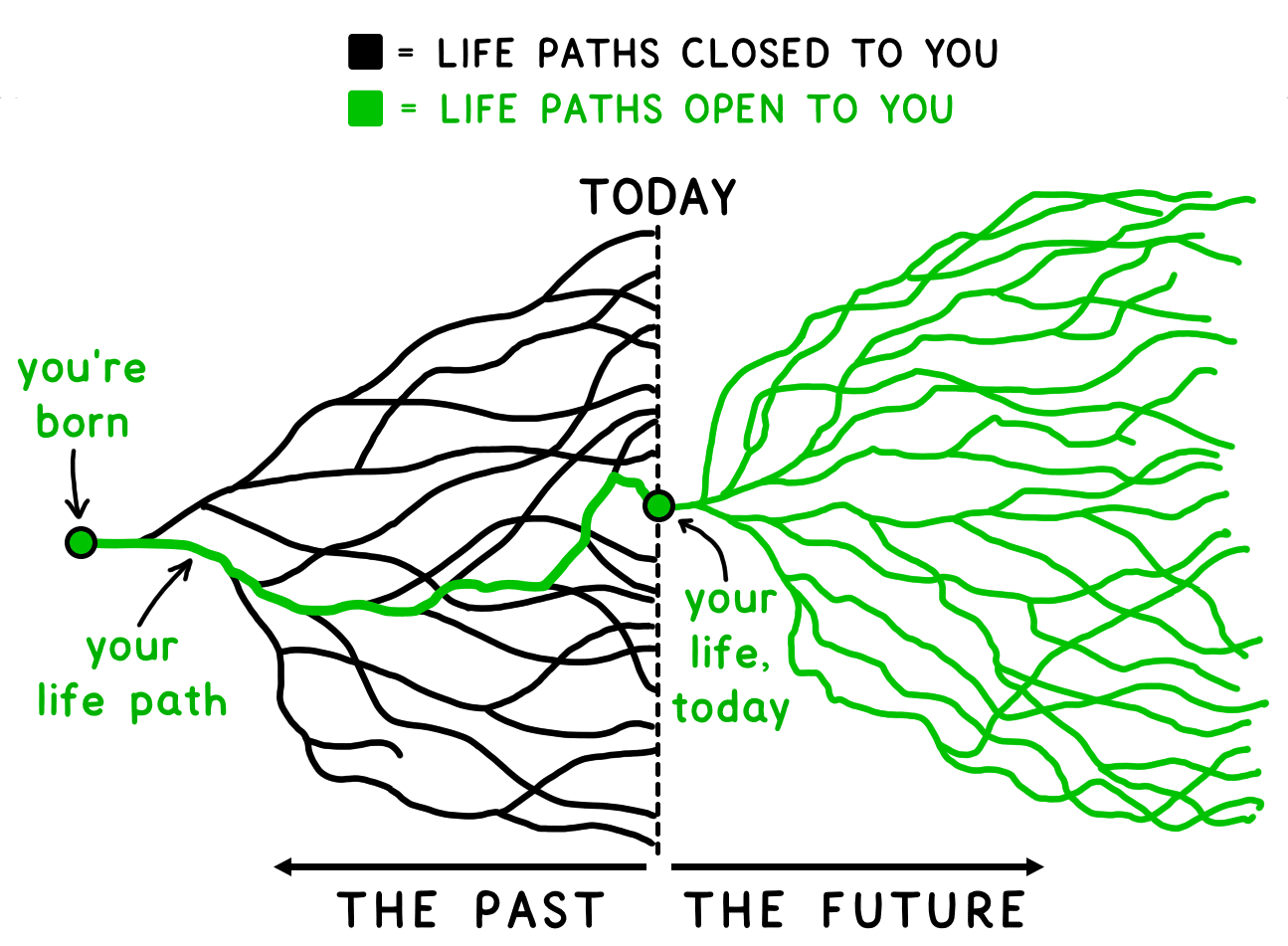
Returning to Ibarra, her research reveals that people who jumped to new opportunities, even if these felt like lateral or backward moves, would later report feeling more fulfilled and happier with their decision than those who stayed in the same job.
Put another way, the more “squiggly” our life line becomes, the more prepared we are for whatever might come our way next. This is true whether life chooses to make a change for us or we decide to change things ourselves.
For example, even if we we go all the way through law school, pass the bar, and become a lawyer, there’s no rule that requires us to be a lawyer forever. Four of my friends (Brett McKay, Jodi Ettenberg, Sam Vander Wielen, and Pat Lewis) are all recovering lawyers who now have found success in dramatically different fields.
The less attached we feel to one particular path or outcome, the more likely we are to identify which future paths are open to us. That path might look nothing like what we expected, but might result in a far more fulfilling, enjoyable life.
When thinking about the next decade, we don’t need to make a big, hairy, audacious goal.
We don’t need to burn the boats and go all in on a new career like we’re preparing for Ludicrous Speed travel.
We don’t need to plan out our perfect future life and set all our hopes and dreams on achieving that goal.
Instead, we can simply decide which paths are open to us today and start sailing in that direction.
If we can get comfortable with sailing into the unknown, amazing things might happen. Whatever tomorrow brings, we’re ready for it. Not because we expected a specific outcome, but because we were prepared for whatever happens.
This is how we end up choosing more uncomfortable zigzags that lead to more experiences and growth instead of the comfy path we’ve already chosen.
We could all probably use a few more squiggly lines when connecting the dots of our life looking backward.
As for me, I’ve shifted my life from warp speed planning to wayfiending over the past few years… especially after my carefully crafted plan for my personal and professional future didn’t pan out.
My recent (bestselling!) book, How to Try Again (which this essay is adapted from) is the result of this very wayfinding strategy.
I had a rough idea of what I wanted to write: a book that helps people try again after failure. I wrote a book proposal with a working title of “Restart”. I had an outline and summary and a sample chapter. I had enough to get started and begin sailing in that direction. But my final product looks nothing like the book I proposed, and it’s much better as a result.
Every few months, the draft would take a different turn, and I would follow that new path. I hit a personal storm for about a year that required some repairs and improvements.
It sucked, but I stayed afloat and kept sailing when possible.
Three years later, as I approached my destination, I narrowed my focus and got more specific so that I could reach the finish line: a book on a bookshelf. That was pretty much the only part of this project I could control. The rest was out of my hands, which is why I declared “expectation bankruptcy.”
Today, I find myself once again unsure of what my future will hold.
My book is now out around the world. AI is disrupting everything (and I hope I get left behind). I’m dating again. I’m not planning out where I want to be 10 years from now. I’m allowing myself to wayfind my way through life at the moment and take things as they happen.
If you’ve had a big life plan go awry in the paset, hopefully this essay can help you think differently about how to proceed.
Instead of trying to hold on a specific future more tightly, with even more pressure put on that goal needing to be achieved, you can instead wayfind your way toward the next thing that grabs your attention. When the waves and storms show up, you can trust in the fact that you’ll find a way to stay afloat, reorient yourself, and choose the path that life demands at that moment.
To borrow a killer quote from Zen practitioner Jon Kabat-Zinn:
“You can’t stop the waves, but you can learn how to surf.”
Or, in our case, sail.
-Steve
Comments
Nothing yet. Say the first thing.
Sign in to join the conversation.