
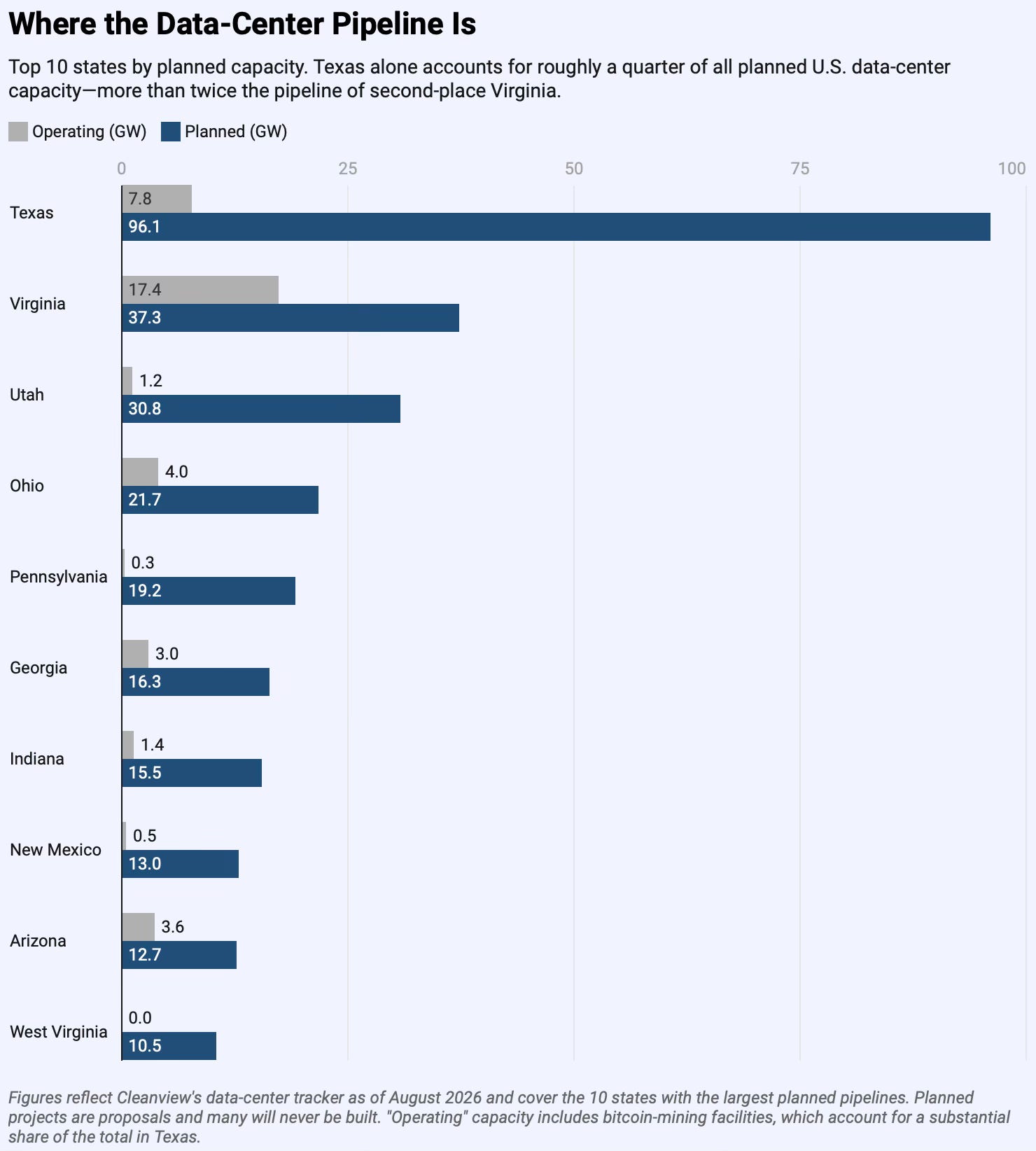
The arrival of next-gen Artificial Intelligence and the massive data centers to enable this revolution happened with great suddenness. And the backlash against data centers has arisen with equal suddenness over the last six months or so. (Our pal Robert Bryce is tracking this growing backlash in real time. And see below for a projection of data center plans from the Manhattan Institute’s Shawn Regan.) And it’s not just liberals and the climate-deranged who are predictably against data centers; it has gone bipartisan, with many leading Republicans and conservatives expressing opposition. It’s not just giving me whiplash; it is generating, in the words of the political philosopher Yogi Berra, a case of déjà vu all over again.
Much of the fuss over data centers is reminding me of the anti-nuclear power campaign of the 1970s and 1980s, which contributed significantly to crushing the nuclear power industry. The great irony in the case of zero-emission nuclear power is that a lot of older environmentalists today understand if we’d kept building them, we’d be easily meeting our supposed commitments to low-carbon electricity, leading some to regret their anti-nuclear agitations 50 years ago.
The anti-nuclear agitation of a generation ago rested on hysteria, exaggerated risks, and outright falsehoods, as we now know from the experience of the nuclear accidents we have experienced—especially Chernobyl in 1986 and Fukushima in 2011. Likewise a lot of the hysteria about data centers is built on exaggerations and falsehoods, though they deserve sorting out.
There are three aspects to the larger story. First, is AI “coming for your job,” or heading for some kind of SciFi dystopian nightmare culminating in Skynet and real-life Terminators in a couple decades? Those robot sprinters crashing into walls right now are amusing, but you know they will get better, and the future of warfare is likely going to go beyond the drones we’re seeing now in Ukraine and in Gulf War III and result in robot soldiers. More broadly, is the AI-revolution overhyped, along with the fears of its potential bad effects? I think so, but have no idea. These worries are serious and deserve thought.
But leave this aspect aside for separate discussion. The main attacks on data centers are that they will use too much water, and cause electricity rates to rise. These deserve separate treatment, too.
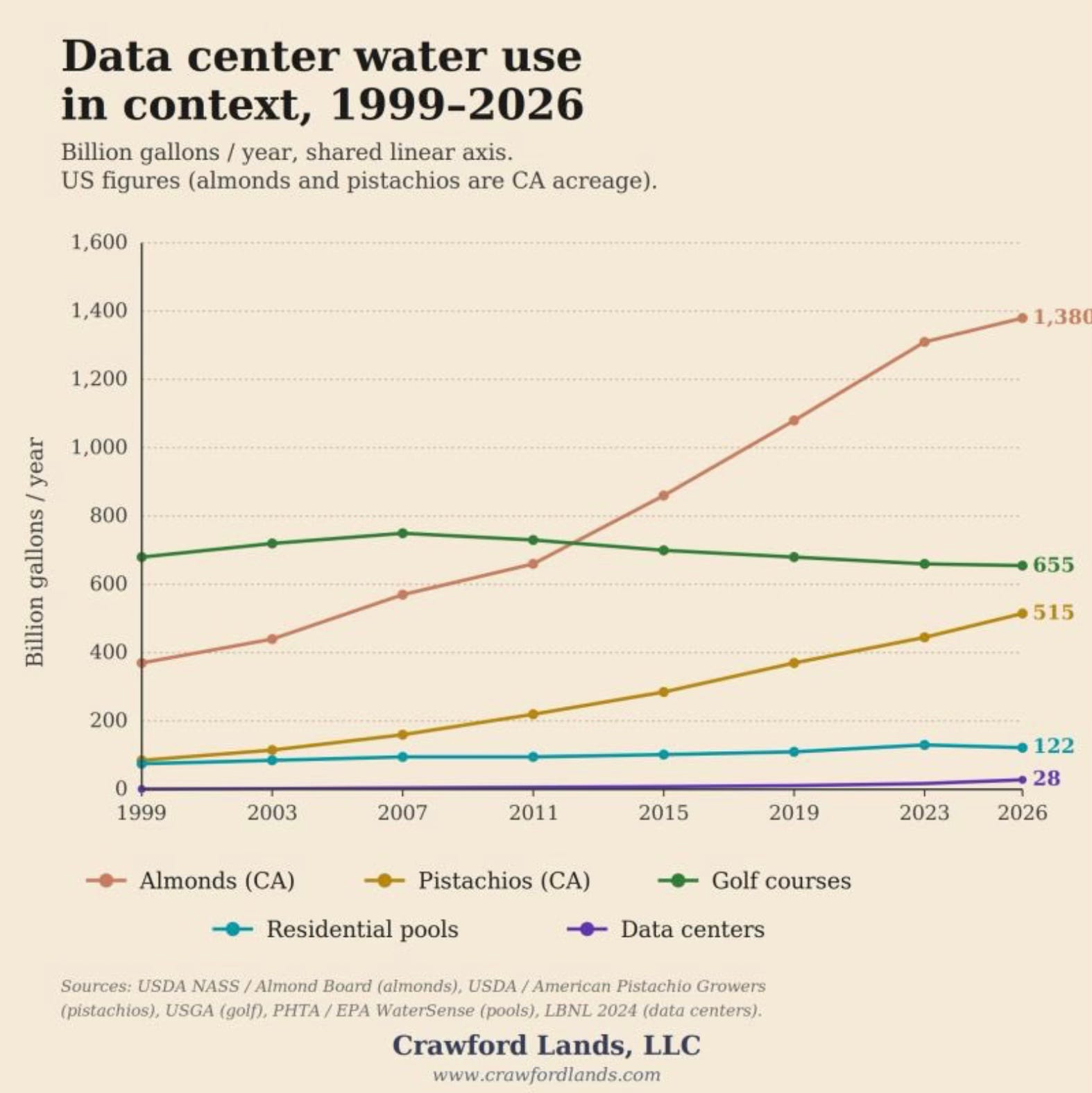
Both are largely red herrings, though the case of electricity demand and rate hike pressures have more ground for legitimate concern. Let’s dispose of water use. Although there are some legitimate site-specific water issues (a water-hungry data center in water-parched Arizona or Nevada doesn’t make much sense), overall data center water use is tiny compared to, say, golf courses or almond production in California. And the irony here is that the leading use of water in America is—or used to be until recently (I need to update my data set on this)—for electric power generation. Coal and older gas plants (and nuclear) boil lots of water to run steam turbines. But with coal shutting down, and next-gen gas and nuclear (fingers crossed) using much less water, data centers will be notionally using some of that water for their own needs, but likely much less than electricity generation has used for the last 75 years. Never mind almonds or other water-intensive ag uses.
Here’s one look:
The electricity story is different. People are right to be concerned with rising electricity rates, since rates have been rising substantially the last decade or more, chiefly because of the forced installation of “green” energy that ends up being more expensive on a system-wide basis than the power generation sources it is replacing. After years of essentially flat electricity demand in the U.S., most forecasts call for growing electricity demand dead ahead chiefly because of data center power demands. In many cases, however, the data center builders are providing their own electricity generation “behind the meter,” which means dedicated sources not directly connected to the grid. This is as it should be.
The irony of the scene is that the data center boom looked to be delivering perhaps the final blow to the climate crusade and the green energy madness. Confronted with the possibly economic bounty from data centers, many states and localities were tacitly shelving their Net-Zero targets, and looking more favorably on new gas-fired power plants and upgrading their electrical grids. That is, until the anti-data center agitation took off in the last few months.
This has the looks of a coordinated agitprop campaign similar to the anti-nuclear campaign of 50 years ago, in there are credible reports of foreign and left-wing funding behind the agitation. It is the last gasp of the climate left’s attack on energy that works, along with the class hatred of the tech sector (some of it well-earned by the clueless and presumptuous tech overlords). Never never underestimate the ability of the left to pivot instantly to exploit a new public concern.
The anti-data center agitation is not confined to liberals and leftists, however. It is a bipartisan cause now, as polls show widespread growing opposition to data centers across the political spectrum. But even if all the practical objections can be overcome, and, say, electricity prices actually fell as a result of the data center boom (which is a realistic prospect if the politicians and bureaucrats and environmental lawyers don’t get in the way—and how likely is it that they won’t?), the public would still likely hav strong anxieties and misgivings about it.
The deeper reason we should have expected public opposition to our brave new world of data centers comes from a minor modern classic published exactly 50 years ago, Fred Hirsch’s The Social Limits to Growth. Hirsch was a British economist and occasional writer for The Economist magazine who had the insight that the 1970s-era mania for the “limits to growth” based on resource constraints (think “Club of Rome” the population bomb, and the phony “energy crisis” of the time) was wrong-headed, but that there was rising social discontent with further economic growth that would be more politically relevant and powerful. It explained the popularity of anti-suburban sprawl movements that were spreading rapidly in the 1970s. In other words, he thought that increasing numbers of middle class citizens in prosperous countries would feel less and less direct benefit from further growth, even if it delivered constantly higher standards of living.

Hirsch’s rich analysis went far beyond simply being a new frontier of diminishing marginal utility. One of his observations was that “the tendency for greater affluence to make modern man more harried rather than less is the increasing time absorbed by the process of consumption itself. As output of material goods increases, while the time in which to use them remains constant, time becomes scarcer in relation to goods (the good intensity of time rises).” Hirsch wrote before the Internet revolution was a distant gleam in anyone’s eye, but consider how we all love the Internet, but can’t keep up with our out-of-control email boxes, not to mention all the websites and outlets we like to keep up with, but can’t. The AI revolution is probably just getting started, but already one can sense a deep ambivalence about the rollout of the chatbots that have put Indian call centers out of business. Are we really going to prefer a world in which reaching an actual human being on the phone is no longer possible, even if the chatbot can sort out your airline flight disruption problems quicker than a human being?
Other parts of Hirsch’s analysis bears on the revival of socialist enthusiasms among the young that we’re seeing right now, but let’s leave for another time that and other implications of his argument that can intersect with other avenues of inquiry, such as social psychology and plain old cussed human nature. There is one last succinct observation from the book that helps explain the widely perceived decline of sociability and friendliness of Americans in recent years:
Both sources of increased time pressure—the additional time needed for consumption and the additional income needed to maintain position in its broad sense—help to explain another phenomenon which some have observed in modern economies, and for which an economic solution is not usually offered: a decline in sociability, and specifically, friendliness. Friendliness is time consuming and thereby liable to be economized because of its extravagant absorption of this increasingly scarce input.
Comments
Nothing yet. Say the first thing.
Sign in to join the conversation.