
Announcement: The complete 3WHH Podcast crew is back together this week will and have a livestream of this week’s episode tomorrow at 4 pm PACIFIC time. Bookmark your calendar to tune in here, or if you are a subscriber, you’ll get an email the moment we go live. Now on to the news.
• Don’t look now but the populist revolt against the irresponsible and undemocratic governments of Europe proceeds apace. The latest poll out of eastern Germany, where provincial elections are imminent, shows the Alternative for Germany (AfD) party with a huge lead. Here’s what it looks like in bar graph form:
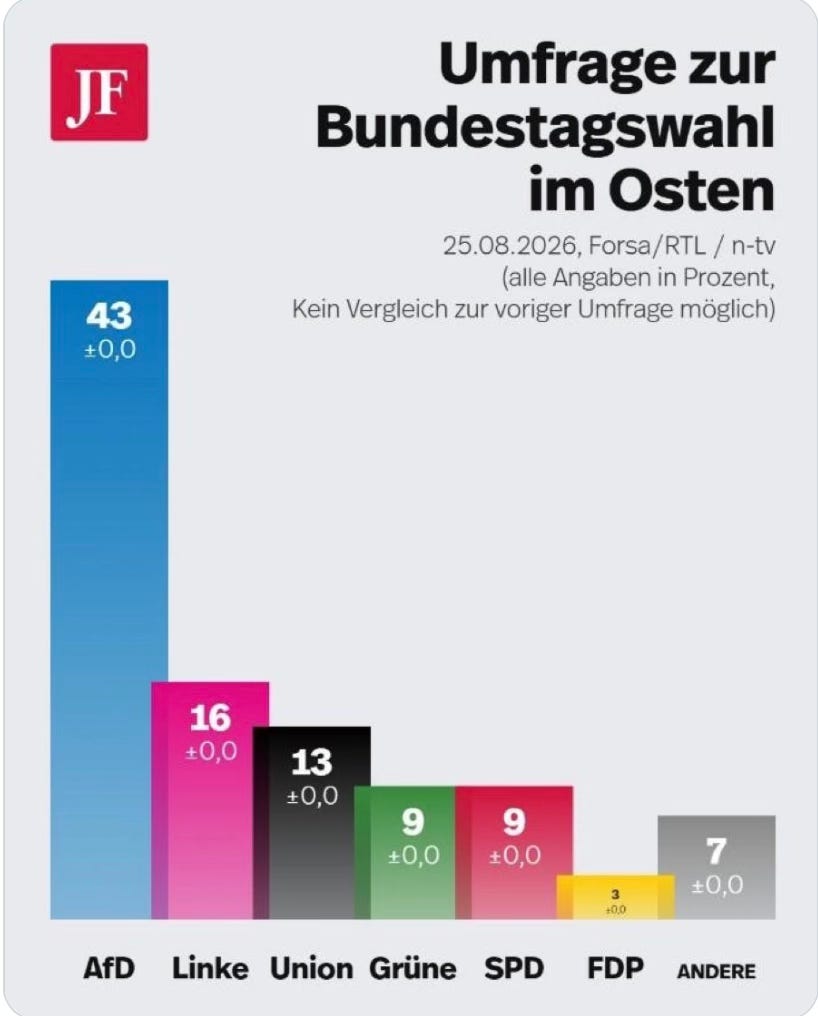
If the election returns this result, the other parties will surely attempt to form an incoherent coalition government to freeze the AfD out of power, with lots of loose talk about “the return of Hitler” or something. This will not go down well with Germans, let alone make obvious the hypocrisy of people who keep saying “protect democracy.”
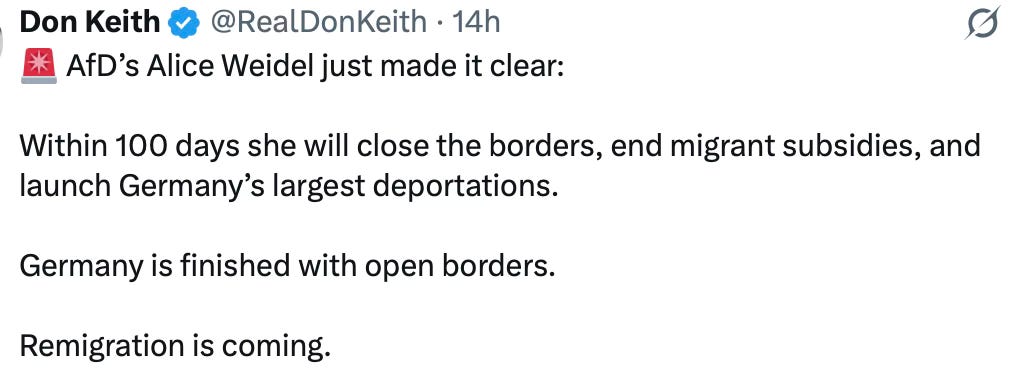
Here’s the main platform of the AfD at the moment:
The Atlantic offers this commentary on the possible consequences of this regional election:
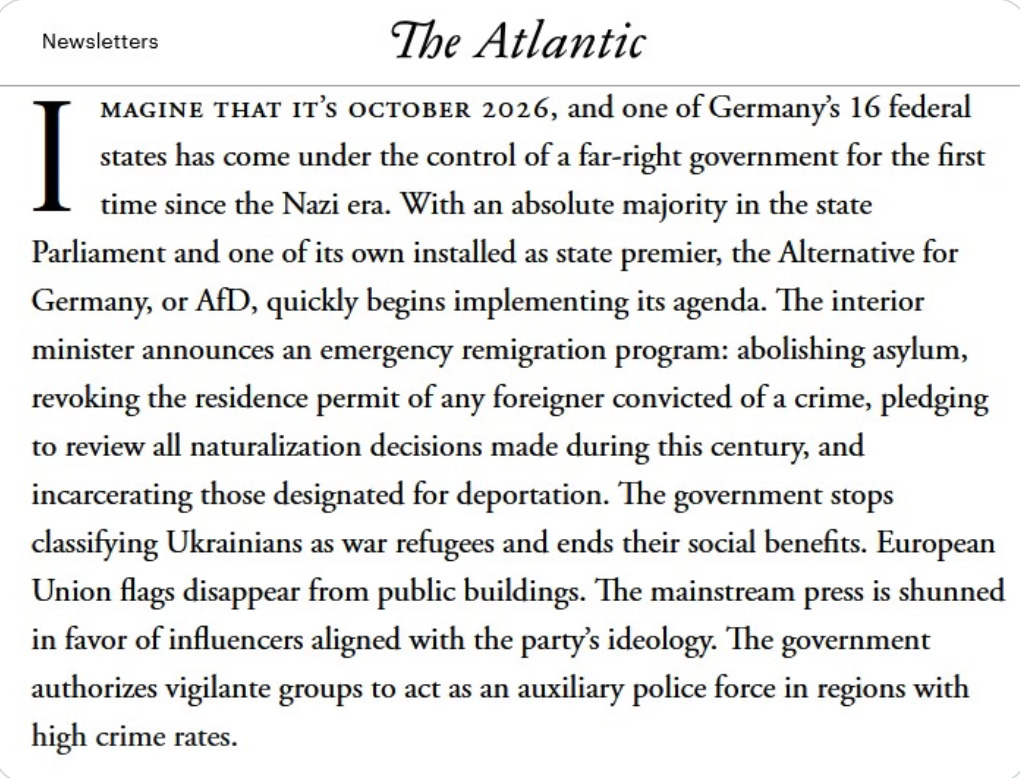
I’m confused though: I can’t tell whether The Atlantic intends this as a criticism or an endorsement, because it sounds pretty good to me.
P.S. Polls in other German states also find the AfD surging to a strong lead.
• Within minutes of the news of the horrific flash flood in Nepal today I had a notion to send out a Tweet to the effect that “Blaming the Nepal flood on climate change coming in three, two, . . .” But I ran out of time, yet was not disappointed. The CBS Evening News had no trouble attributing the flood “partially” to climate change, because the Himalayas are said to be warming more than the rest of the planet. I’m pretty sure I’ve run the headline gallery of the news media clips that claim that every local location on the planet it warming more than every other locations on the planet, because the whole issue is just that relentlessly stupid. Memo to Bari Weiss: your housecleaning isn’t finished yet.
• But the climate change-Nepal flood connection may not be the most stupid media cliché of the day. Today turns out to be “Women’s Equality Day,” which coincides with the anniversary of the ratification of the 19th Amendment in 1920 that bestowed the right to vote for women in the Constitution. (We don’t have any exit poll data from the 1920 election obviously, but it is conjectured that some of Warren Harding’s huge landslide majority in that election came from new women voters, because Harding was a hunk.)
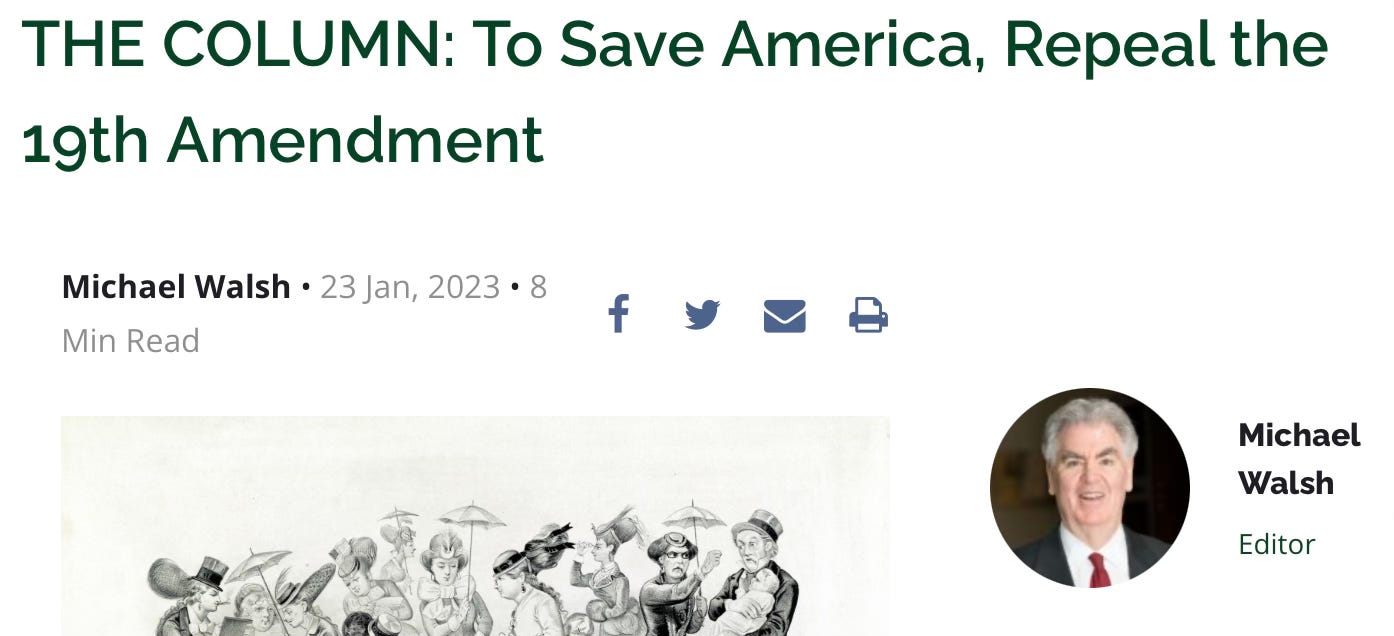
Sure enough, my local news channel repeated the long-debunked canard that women still aren’t equal to men because “women only make 81 cents for every dollar earned by a man.” I think even the New York Times has figured out how dumb this is. In any case, I can’t help but recall that a certain podcast co-host who appears here has often called for repealing the 19th Amendment, as has my pal Michael Walsh:
Which brings up a good occasion to share with our readers the speech Prof. Linda Denno (“Lucretia”) delivered in something of a command performance for Women’s Equality Day in Arizona a couple years ago. Although the speech mentioned the 19th Amendment in the title, there is a certain omission in the text itself (heh), prompting our Lucretia to note that “several persons actually commented that my speech seemed to be more about equal rights than women’s rights…” Precisely.
Anyway, herewith Prof. Denno’s address:
Good morning! Thank you so much for inviting me to speak at this Women’s Equality Day Observance. What a great opportunity to reflect on the progress this country has made toward fulfilling the promise of equal rights! As Martin Luther King noted, “When the architects of our republic wrote the magnificent words of the Constitution and the Declaration of Independence, they were signing a promissory note to which every American was to fall heir.” King understood that the failure of the founding generation to guarantee the exercise of equal rights to every American without regard to race, sex, or other irrelevant characteristic did not make the truth of human equality any less real. We can certainly question the consistency of those who asserted the self-evident truth of equality at the same time that they lived in a society that denied to many the enjoyment of that equality. But I ask you to consider what might have happened if those founders had simply looked around at the conditions of the time and said “White males who own property are equal to other white males who own property.” Would we today be celebrating Women’s Equality Day or the passage of the Nineteenth Amendment guaranteeing women the right to vote: In other words, would we as Americans have had anything to aspire to, or would we simply have continued to accept the status quo with all of its inequalities and injustices? Abraham Lincoln reminded us that the authors of the Declaration of Independence “did not mean to assert the obvious untruth, that all were then actually enjoying that equality, nor yet, that they were about to confer it immediately upon them. In fact they had no power to confer such a boon. They meant simply to declare the right, so that the enforcement of it might follow as fast as circumstances should permit.”
Lincoln’s commitment to equality—which he firmly believed was the principle upon which our nation was founded--inspired many to question the practice of slavery. The abolitionist movement prior to the Civil War included many now famous champions of women’s rights, such as Elizabeth Cady Stanton, Sojourner Truth, and Lucretia Mott. With the official abolition of slavery accomplished through the passage of the 13th Amendment, many of these women abolitionists turned their attention to securing women’s rights, something they believed was another major step toward the promise of the Declaration.
Traditional gender roles had been deeply ingrained in society for centuries, so opposition to women’s rights was often widespread and deeply imbedded. Thomas Jefferson remarked that “it is civilization alone which places women in the enjoyment of their natural equality.” What Jefferson meant by that was that those traditional gender roles were to a great extent the result of the necessary division of labor caused by scarcity, and not of course by any fundamentally meaningful differences between men and women. I often illustrate this point to my students by pointing out that I can work a full day at the college, stop by the grocery store on my way home, and prepare a meal for my family with fresh ingredients in half an hour. Before civilization brought about the era of modern conveniences, women were more-or-less stuck spending their entire day caring for the children, keeping house, and preparing meals.
Certainly, the status of women in this country has undergone a tremendous transformation, from having fewer of the rights we now take for granted to the situation today where women are in almost all respects equal before the law. That is why it is so important that we recognize the progress that has been made.
The journey to secure women’s rights—and especially women’s voting rights—was far from smooth. The suffrage movement faced stiff opposition from various quarters. Some argued, rather convincingly at times, that women’s involvement in politics would undermine traditional family roles, while others simply asserted that women lacked the capacity to make informed decisions. However, leading women of the suffragette movement worked tirelessly to overcome this opposition, reminding us that women, like men, often possessed the intellect and capacity to engage in civic affairs.
In this context, the passage of the Nineteenth Amendment in 1920 marked a cornerstone, an embodiment of the enduring American spirit that believes in and continues to fight for justice and equality for all. Although some states (including Arizona) had guaranteed the right to vote for women prior to the passage of the Nineteenth Amendment, proposing and ratifying an amendment to the U.S. Constitution began the process of securing this right throughout the nation. But because laws that govern voting are determined primarily by states under our federal system, the struggle for equal voting rights did not simply end with the Nineteenth Amendment’s passage, any more than the struggle for equal voting rights on account of race did not end with the passage of the 15th Amendment.
There is a tendency to look back upon our history and see only the worst deprivations of equality before the law; to see how women, different races, ethnicities, or religions have been discriminated against. But I would assert here today that the legacies of the abolitionist and the suffrage movement serve as a testament to the commitment to genuine equality and to the power of civic engagement to achieve that goal. It reminds us that progress toward equality of rights and equality of opportunity is often hard-won and that the republican principles we cherish require continual cultivation and vigilance. And we should never allow the fallacy of “equity,” or equality of result, to divert us from our commitment to genuine equality. The struggle for equality of rights reinforces the notion that active participation in our republic is a duty we all share. As we celebrate Women’s Equality Day and the important milestone of the passage of the Nineteenth Amendment, let us also commit ourselves to preserving and expanding the republican principles it represents. By ensuring that every citizen’s legitimate vote is protected, we honor the legacy of the abolitionists and the suffragists who moved us closer to fulfilling the promissory note left by the founding generation, that the rights guaranteed by our Constitution belong to all Americans. Thank you!
• A nice chaser to close out today’s insanity:
Comments
Nothing yet. Say the first thing.
Sign in to join the conversation.