
The Dual-Lever Strategy to Defeat ESSB 6346
In parts one and two, we built the case for why this is an income tax, not a “Millionaire’s Tax,” why it’s unconstitutional, and how it was constructed to get around the legal constraints on the branches of our state government. While it may seem like an audacious (or crazy) plan, let’s now explain how it works and what you can personally do about it.
This is a tax built on hubris and a dream. The dream is to enact a state income tax despite established constitutional and voter rejections over 93 years. The hubris is that because the progressive tide is high in a reliably Democratic Washington, lawmakers can use whatever means necessary to overcome those rejections and limitations, and an anti-Trump majority can be counted on to support their efforts. Using the same tired fair-share rhetoric (they didn’t earn that money, they’re the reason you’re not succeeding, and so on) that came back into vogue after the Great Financial Crisis of 2008, they must have thought no one would look under the hood.
The same hubris that propelled the income tax bill also undergirded two other gross overreaches this past legislative session. One was the transparent and hypocritical effort to impose a mechanism to remove duly elected sheriffs across the state. Nothing screams “protect democracy” quite like a Governor’s handpicked board that can reverse the will of the people to elect their own leaders. That law has already been legally challenged and has had a few favorable rulings initially.
The other law handed our state’s Attorney General carte blanche investigative powers to conduct warrantless searches of citizens for certain alleged infractions. While the majority party and its supporters yell incessantly about the lack of federal due process on matters such as immigration enforcement and deportation, they have no problem enshrining that same practice in state law. Well, at least Nick Brown as Attorney General has displayed a fidelity to unbiased use of his office and can be completely trusted to wield this power judiciously. His record speaks for itself.
The majority running Washington state is convinced of its own dominance and infallibility. But like Biff Tannen in Back to the Future, all it’s gonna take is one haymaker to puncture that confidence. We’re gonna need everyone to channel their inner McFly!
Normally, a court challenge would be enough. The reading of the constitutional precedent over the years is clear. But as Part 2 made clear, there has been a concerted effort over many years to thwart those clear legal rulings — both by moving the court decidedly left and by corrosively working behind the scenes to construct the perceived perfect instrument of attack. With this court at this particular time, it is difficult to feel confident in a wise and independent judiciary.
Against that backdrop, a gift has fallen into the laps of Washington voters: the opportunity to vote on FIVE seats on the current court. Call it serendipity or the comedy of the fates, but getting five races at one time is unprecedented. Voting on those races with a major constitutional challenge awaiting the winners gives voters a litmus test rarely available at this scale.
The advice of many seasoned politicos is to hold off on an initiative to the people. A mid-term year is always tough for the party not in power, Washington voters are particularly hostile to President Trump, and Republicans have had an especially difficult time in this state for the last ten years. All true.
But pushing through an unconstitutional income tax — and counting on all of those well-constructed machinations to hold — may have finally gone too far. Without a strong counter-narrative to “Trump, Trump, Trump,” the elections are likely to go badly, with not enough energy to check the majority in any way and not enough air cover to educate voters about the Supreme Court races. Even with five seats in play, there isn’t enough native interest in judicial races to get voters thinking about balancing the court toward constitutional principles rather than rubber-stamping a progressive agenda.
Without an initiative, the current direction of tax-and-spend policies marches on, uninterrupted. Democrats feel little pressure from Republican challengers and are free to pick off additional seats while replacing current centrist members of their own caucus with further-left alternatives. And a successful initiative without a more balanced court likely results in that initiative being overturned by Pacifica Law Group — the legal Darth Vader of Washington politics.
I alluded to Pacifica earlier, but its reach extends across the litigation, enforcement, and regulatory functions of state government. Pacifica plays a significant role as an outsourced legal partner with the AG’s office. Pacifica filed ballot-title challenges against every initiative Brian Heywood submitted this year. Pacifica is the firm that overturned two Tim Eyman initiatives at the Supreme Court, and is currently litigating to overturn the 2024 voter-passed measure that repealed the ban on natural gas.
The two levers are mutually dependent. An initiative without a balanced court gets overturned in litigation. Court races without an initiative don’t generate enough turnout or salience to flip seats. Break the sequence, and both fail — leaving us with what should be a solid constitutional challenge to 6346 itself, but heard by a court whose mind is already made up.
It repeals the 9.9% tax on individual income over $1 million and adds language prohibiting any future state or local tax measured by individual income. It does not repeal the other provisions of ESSB 6346 — the small-business B&O relief, the Working Families Tax Credit expansion, the sales-tax exemptions on hygiene products and over-the-counter drugs, or the future rollback of sales tax on certain services. All of those stay. The initiative removes the income tax. It leaves the tax relief in place.
This is the surgical version of the repeal. It’s not “blow up the bill.” It’s “take out the unconstitutional part and let the rest stand.” For a center-left reader who is genuinely uneasy about a state income tax but doesn’t want to lose the relief provisions, this is the answer.
The window is short. Let’s Go Washington needs approximately 309,000 valid signatures by July 2 to qualify for the November ballot, and is targeting 400,000 to absorb the challenges Pacifica will inevitably file. In 2024, LGW gathered 540,000 signatures in 45 days to qualify I-2066. The infrastructure exists. What it needs is volunteers, signature sheets in circulation, and the political will to treat this as the priority it is.
Three incumbents are on the ballot, and two seats are open.
The three incumbents are Chief Justice Debra Stephens (Position 7), Justice Colleen Melody (special election to finish Mary Yu’s term), and Justice Theo Angelis (special election to finish Barbara Madsen’s term). Melody and Angelis are both recent Ferguson appointees running their first elections — open questions, not sunk costs.
Stephens is the key. She authored the 7-2 majority opinion in Quinn v. State — the 2023 decision that upheld the capital gains tax by recharacterizing it as an excise rather than a tax on income. The doctrinal architecture that makes ESSB 6346 defensible in court is her doctrine. The line of reasoning that says a tax structured around a discrete transaction — the sale or exchange of an asset — is an excise, not a tax on income, even when the amount taxed is income: that’s Stephens’ opinion. When the constitutional challenge to 6346 reaches the Supreme Court, she is not a swing vote. She is the author.
Treating Stephens as a status-quo incumbent — a “keep” vote out of institutional deference — misreads the case entirely. The status quo she represents is the doctrine that produced 6346.
The two open seats are Justice Raquel Montoya-Lewis’s (she is not seeking reelection) and Justice Charles Johnson’s (mandatory retirement). Open seats are the cleanest opportunities — no incumbent advantage, no record to defend or attack, just the candidates and their views on the constitutional questions in front of them. Reform-aligned alternatives have filed in both open seats, and the contrast with the incumbent court’s direction will be sharp in the general election.
A move toward greater constitutional fidelity may be unlikely across all five races, but changes in even two or three send a powerful message and perhaps give some additional backbone to existing justices not in ideological lockstep with the current progressive direction. The math on the current court is 7-2, but the constitutional challenge will likely be heard early next year, once the new bench is fully seated. Changing some seats not only could change that outcome — it changes the next case, and the next, and the legislature’s appetite for the case after that.
Here is the hard truth that the politicos are half-right about: we are unlikely to win every race we enter this fall. The midterm headwinds are real. The Trump-driven turnout asymmetry is real. The historical pattern of Republican underperformance in Washington is real.
The numbers are sobering. Republican share of total ballots cast in Washington has declined every year over the past five, while the independent share has grown and become more volatile:

Source: Washington Secretary of State.
Read those numbers honestly. A strategy that depends on Republicans alone delivering a statewide majority is not a strategy — it is a wish. The math requires pulling independents and persuadable Democrats, and the only issues that move those voters are issues with cross-partisan appeal. A state income tax — rejected by Washington voters ten times across 93 years, in elections with very different partisan compositions — is one of those issues. The court races, run as standalone Republican-vs-Democrat contests, are not. That is the third reason the two levers depend on each other: the initiative is what gives the court races a cross-partisan audience.
But significant victory is not the same as total victory, and a campaign that demands total victory as its precondition gets nothing.
The Eyman record, properly read, makes this point. The Supreme Court struck down I-1053 in 2013 and I-976 in 2020. Both passed at the ballot. Both were ultimately overturned. The narrow take is that initiatives lose. The correct take is that even initiatives that lose in court still move the legislature. Voters said no to high car tabs three times. The legislature has been more cautious about transportation taxes ever since. The political record of those initiatives outlasted their legal defeat.
The same logic applies here. A robust public argument on the income tax pushes back on the narrative establishment that this tax is “popular” and results in a repeal. That record raises the political cost of the next attempt. It disciplines the legislature in 2027, 2028, and beyond. It tells centrist Democrats in swing districts that the next vote like this one would not be a free vote.
The court races operate on the same logic. Flipping two seats changes a 7-2 court to a 5-4 court. That’s not control. But it is a meaningfully different court when the next constitutional question lands, and it forces the majority to assemble its votes rather than count on them.
Significant victory changes the herd. Total victory wins the war. We are playing for the first because it is what is actually available, and because the first is what makes the second possible in 2028 and 2030.
Four things, in order of leverage.
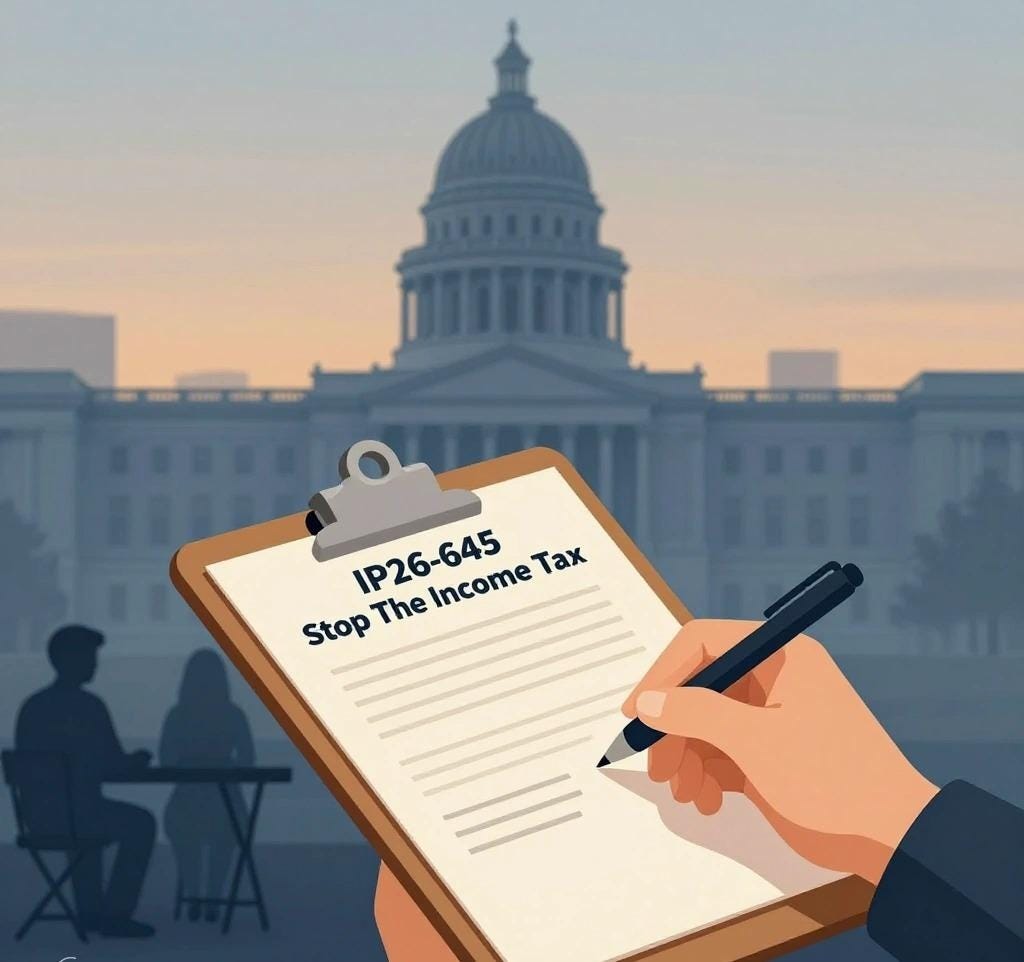
Sign the petition. If you have not signed IP26-645, find a signature gatherer, attend a signing event, or request a sheet directly from Let’s Go Washington at letsgowashington.com. The deadline is July 2. There is no version of this strategy that works without the initiative qualifying for the ballot.
Gather signatures. One signature gathered is worth roughly ten signatures signed. If you can host a table at a community event, at your church, at your business, at your kids’ sports league — do it. Order sheets, get trained, and put in the hours. The 309,000 number gets reached one clipboard at a time.
Pay attention to the court races. The August 4 primary will narrow the field for the five seats. Learn the candidates. Particularly in the two open races (Montoya-Lewis’s and Johnson’s seats) and in the Stephens race, the difference between the candidates is not marginal. Future 42’s scorecards and endorsements will be published in advance of the primary; use them.
Talk to ten people. The single highest-leverage action available to anyone reading this is to explain, in their own words and to people who trust them, what is actually in ESSB 6346 and why it matters. Persuasion at the kitchen-table level is what closes the gap between the politicos’ expectations and the result on the ballot. The piece you are reading right now is one input. You are the next one.
The phrase is old enough to predate every political fight we are still having. The Book of Job: Hitherto shalt thou come, but no further; and here shall thy proud waves be stayed. It is not a war cry. It is the description of a limit — the place where a power that has been advancing meets the boundary it does not get to cross.
On April 19, 1775, Captain John Parker stood with seventy-seven militiamen on Lexington Common as the British regulars approached. He did not march on Boston. He stood on his own ground. Stand your ground. Don’t fire unless fired upon. But if they mean to have a war, let it begin here. That is the posture this moment asks for. We did not pick this fight. The legislature picked it when it used the emergency clause to wall off the referendum. The court picked it when it let them. We are standing on our own common.
This far, no farther.
To the legislature: ESSB 6346 is the line. The emergency clause was the line. Stop walking.
To the court: Quinn’s reasoning has a stopping point, and 6346 is past it.
To the voter who has read this far: the people of this state have said no to a state income tax ten times now. The legislature heard us nine of those times. The eleventh rejection is on the ballot this November, and the court that will decide whether the eleventh survives is on the same ballot. Both levers. Both November.
Significant victory changes the herd.
Let’s go.
This far, no farther.
No posts
Comments
Nothing yet. Say the first thing.
Sign in to join the conversation.