
0:00
-13:32
I wrench the door open – and squeeze inside before the gale slams it shut again. I stand there, dripping, in the space which we call the ‘porch’. It’s a tiny antechamber, just big enough to keep the heat in and the weather out. We hang up all our wet weather gear in here, having nowhere else to let it dry, so transiting the porch is a bit like going through the back of the wardrobe to Narnia. Only damper and smellier.
‘Honey, ah’m home!’
No reply from my beloved. When I’ve divested myself of my waterproofs, I open the inner door to find her hunched over the radio set, frowning and twiddling the controls. At length, she sighs and sits back, peels off the headphones with a yawn.
‘Conspiracy theorists are loving this,’ she says. ‘Another day of wild speculation.’
‘What’s the latest?’
‘Oof. Take your pick. AI’s become conscious and is taking over the world. Under the guise of fake space weather.’
‘Riiight.’
‘Not convinced, eh? In that case, it’s the Freemasons, the Elders of Zion and the Templars conspiring to overthrow democracy and bring in a New World Order … Then again, it could be aliens, bent on destroying our civilisation so they can use Earth for their own nefarious purposes. Meanwhile for true believers, it’s the End of Days, and the prelude to Armageddon.’
She’s finding it exhausting, panning this stream of nonsense for specks of information and occasional nuggets of real insight. The week since radio silence was broken has quickly turned from excitement to exasperation.
Maya never really listened to shortwave, back when it was a ‘thing’, she admits. There was no real reason to: her expedition experience prior to this project was limited. For my Pacific trips, on the other hand, and Borneo, a set like this one, only bigger, with heavy batteries and not as fancy, was a vital means of communication.
We’ve lost so much in the years since then: most official services have switched to satellite, where there’s no fiddling to get a signal, looking up schedules, knowing which wavelengths work best at which times of the day, accepting the quirks and surprises of atmospheric conditions. None of the whole recondite body of knowledge and experience once needed to navigate the airwaves effectively. None of the communal atmosphere: knowing that any conversation you had over the air was public, and others could chip in with comments, advice or offers to help.
Instead, there’s convenience and simplicity. Or there was, until three weeks ago.
With its steep hills and narrow valleys, Poynduc is a tricky area for radio reception. We’re encircled by highlands – and for more than half the circumference of that circle, there’s thousands of kilometres of ocean between us and the nearest transmitter.
The repeater station on Maatsuyker greatly improved matters. But it seems to be down, and I’m betting it’ll stay that way until air travel is safe again. The only safe way onto the remote island with its three-hundred-metre cliffs is by helicopter.
It’s frustrating as hell. The Tassie authorities are probably broadcasting vital emergency information, stuff we need to know. If so, in our isolated location, on the other side of the mountains, we’re getting none of it. Instead, we get signals bounced between the ocean and the ionosphere all the way across the wide Southern Ocean. We strain our rudimentary Spanish to learn about food distribution issues in Buenos Aires.
We pick up the BBC World Service for a few precious minutes. Aid distribution networks are severely disrupted throughout Asia, we hear. There have been food riots in several European cities.
On the whole, though, hams and pirate radio are more use to us than the official stations – despite the eccentrics and their wacky theories.
A frustrating few days later, Maya strikes gold. She finds Narelle, over in Esperance, WA. Chatty and excitable, with a rough chain-smoker’s voice and a big, soft heart, she sounds a right character. The two of them hit it off.
I listen in on one of their ‘ragchewing’ sessions, and Maya introduces me. I learn that Narelle is seventy-two – exactly twice Maya’s age. She’s got family in Perth and in Kalgoorlie, where her two sons work in mining. Three grandkids, and another on the way.
‘… and I’ve been hearing a lot about you, hon! Your ears been burning, have they?’
‘Yes, they have. That explains it then. About how I’m a dutiful, hardworking husband, I expect? A delight to share a little home in the wilderness with?’
Maya just shakes her head and turns away. A throaty chuckle from the radio.
‘That’s right, hon! An’ that’s all you need to know about the matter. Now I hope you’re lookin’ after my girl Maya, out there in the middle o’ bloody nowhere?’
‘I am, Narelle, don’t you worry. Treating her like the princess she is.’
‘Ha! You’re a cheeky one, alright. She said you was. You remind me of my George, bless him. He was a Scotsman, too. Only he talked like one, not like you. He was from Aberdeen, and most people round ’ere couldn’t understand a bloody word he said.’
‘Ah, right. Well you’ll have to blame my parents for my accent. And a Surrey grammar school in my formative years.’
‘I see, I see … I expect it’s about time for you to go and catch the tea, hon. Don’t let me keep you. She says you’re a good fisherman, at least.’
‘A marine biologist has to be good for something, Narelle. Though I feel like a gamekeeper turned poacher.’
‘Never you mind about that, young man. Go out there an’ catch my girl a nice flathead.’
‘I’ll do my best.’
‘Better do better than that, hon.’
And with that, I’m dismissed. To hear is to obey, m’lady.
It occurs to me after the event that this short exchange of banter is my first conversation in a month, with anyone other than Maya. And you guys, I guess. Though conversations in my head don’t really count – no offence.
What I mean to say is, I don’t talk to you out loud, do I?
Do I?
Anyway, you don’t talk back. Not yet.
Thanks to daily chats with her new best friend, Maya puts together a picture of worldwide disruption. The massive solar storm lasted two weeks! Long enough to sweep the entire globe fourteen times over. Population centres and infrastructure in the higher latitudes copped the worst of it. Equatorial regions got off relatively lightly: Brazil, Kenya, Indonesia and so on. So the Northern Territory and Far North Queensland aren’t doing too badly – except for the lack of satellite services, of course, which affects everyone.
Over all, it sounds grim. The world’s been plunged right back into the nineteen-eighties, with the big difference that now there’s twice the global population to feed. None of the systems we’ve come to rely on – from mobile phones to satnav to internet banking – are working properly. No AI either, of course. People will have to think for themselves again. The horror …
Narelle doesn’t know much about the local situation here in Tassie, but she promises to find out. Maya gives her Annie’s details, in the hope that she can make contact, and find out what plans are being made to resupply us – or, as looks increasingly likely, to extract us.
Mind you, we’re starting to worry less about the logistics of leaving our little sanctuary – and more about what we’ll find when we get out.
Another thing I’m worried about, though I haven’t shared this with Maya yet, is my discomfort at knowing that we’re broadcasting our position and predicament to the world. There’ll be all kinds of shady characters making the most of the desperate situation – and our isolation at once protects us from casual attention, and makes us vulnerable to planned predation.
Even if our tiny research station isn’t worthy of looters’ attention, there’s the airstrip. Sooner or later, someone’s going to remember those white shipping containers lined up alongside the runway, and wonder what’s inside them.
The weather’s gone to shit again. Or rather, gone back to the usual weather you’d expect from midwinter on the southwestern tip of Tassie.
Front after front comes through, with gale-force winds and relentless rain. For several days, I can’t get out to my favourite spot to fish. I should have anticipated this, in my optimistic calculations. That’s the trouble with doing your planning during an atypical stretch of fine weather.
Unable to bring in regular fish, I try to make myself useful in other ways, gathering edible seaweeds which my loving spouse pronounces ‘Not too flavoursome.’
I spend a whole day trying to knot a net that might trap a wallaby, pademelon or potoroo. We just can’t bring ourselves to resort to snares, so it’ll have to be a net trap.
It proves harder than I thought. It’s not like I can look up a tutorial on YouTube, and it turns out my knowledge of the subject was conceptual rather than practical. I waste a lot of good fishing line and turn the interior of our Pod into more of an obstacle course than it already was.
Narelle’s updates on her personal situation are getting more concerning day by day. There’s no food in the supermarkets, she tells us, little to learn from the couple of community radio stations still broadcasting news bulletins, and most worrying of all, no replenishment of stock in the local pharmacy. Instead, she has to queue at the hospital for hours, to get the medications she needs for her heart condition. She has some support from a neighbour, also getting on in years, but she’s really hanging out for her older son to come and fetch her back to Kalgoorlie. What’s taking him so long?
Meanwhile, there have been riots and looting in Perth, and food trucks are starting to travel in convoys with police protection.
I mean, really? Four weeks now without internet, and ‘civilisation’ is starting to unravel at the edges. Most of the scarcity is panic buying, hoarding and profiteering, Narelle reckons. There would be plenty for weeks yet, months, if everyone calmed down.
Call me naive, but I thought we were better than this.
What’s coming out of Tassie is mostly rumour. Our island seems to have been hit hardest of all the Australian states and territories. Hardly surprising: the southerly latitude, the small population mostly on the north and south coasts, the dependence on air and sea transport, the relatively harsh winter conditions …
In the end, despite her own troubles, Narelle comes up with the goods. Bless you, Narelle.
She’s made contact with Annie; we don’t know exactly how. The main thing is, the news is good. Very good. Hell, it’s excellent.
We’re to relocate to the airstrip as soon as possible, Narelle informs us. We’re going to be evacuated! It will probably be a four-seater light aircraft, with a pilot and a copilot, so essential personal belongings only, please.
Annie can’t guarantee a time or even a day, in the absence of a multi-day forecast. All depends on getting a suitable weather window. They only need two to three hours: it’s a fifty-minute flight. Hence, we’re to stand by for a quick turnaround.
We should switch on the radio transceiver at the airstrip immediately on our arrival and await a call. The crew will notify us on CTAF as soon as they clear the mountains and have line-of-sight to the airstrip. That’ll give us twenty minutes’ notice, no more. We’ll need to monitor the radio constantly during operational hours – dawn to dusk.
The key to the office is under the doormat.
We get packing.
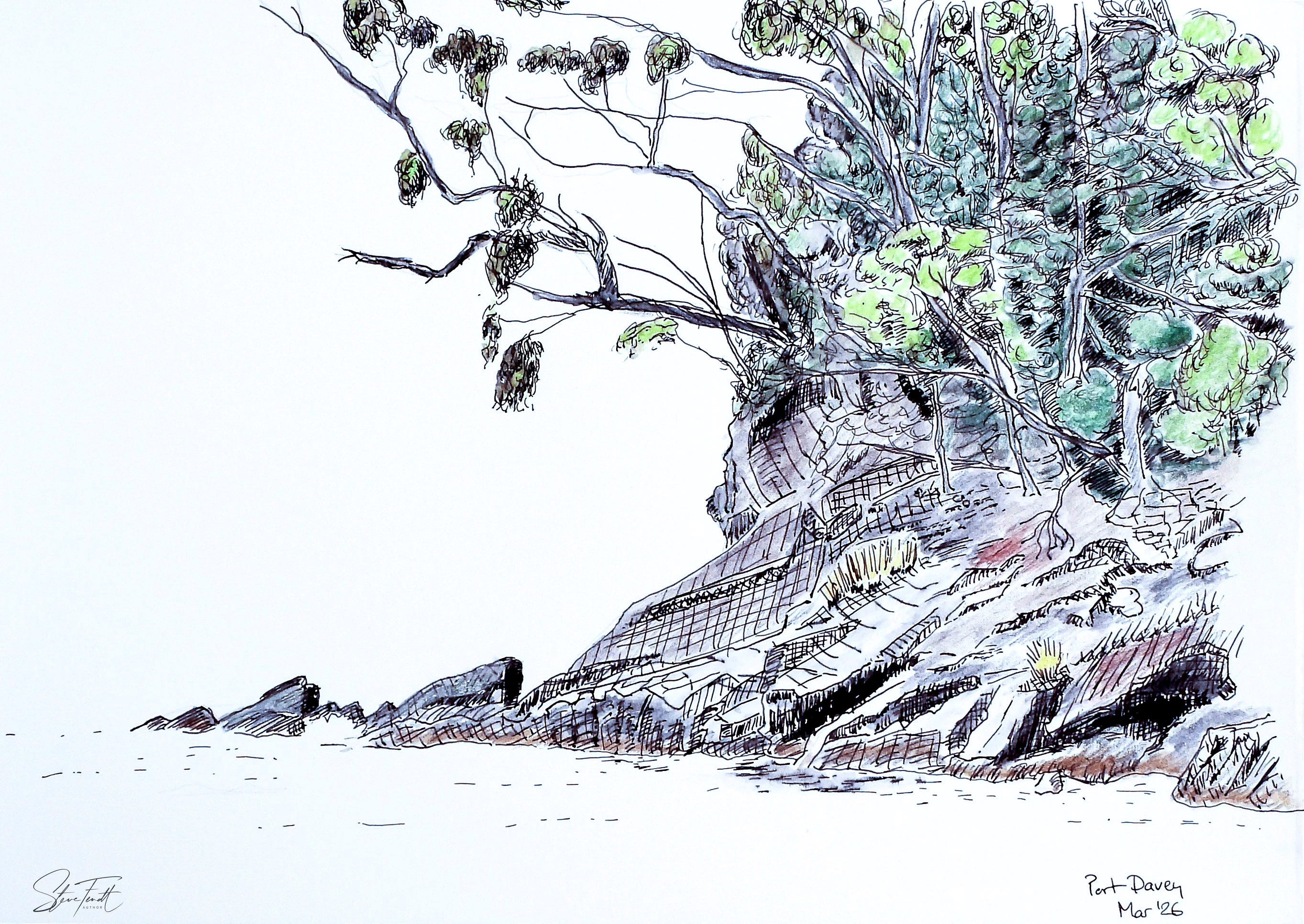
Title artwork ‘Chaotic Headland’: pen and watercolour pencil on Bristol paper. This undercut bank, topped by thick, tangled vegetation, is typical of the Poynduc / Port Davey shoreline.
Comments
Nothing yet. Say the first thing.
Sign in to join the conversation.