
0:00
-10:17
‘Mitch, Mitch. You’re catastrophising again,’ says Maya, having at least heard me out.
That was predictable.
‘Annie won’t have forgotten us. Not a chance. If the air route isn’t viable, she’ll organise something else. She’ll charter a boat from Hobart or Kettering or Strahan – or Devonport. Whatever it takes. As soon as the radio’s back up, she’ll be in touch to let us know what the plan is.’
Annie is our liaison in the Marine Biology school. She and her small team have handled the logistics for this trip – and they’ve been brilliant at it. Starting with the loan of the Pod: a self-contained, self-levelling, insulated accommodation and operations base that can be delivered by helicopter or boat to anywhere between Antarctica and a tropical atoll. It has negligible impact on the sensitive ecosystems it’s designed to operate in and a tiny footprint. Its nifty, state-of-the-art biodigester turns the shit from our dunny into odourless cooking gas. Its sturdy, self-levelling feet require nothing more than rocks or firm gravel, or at a pinch, timber beams to sit on. It will keep its occupants safe and comfortable in anything from an Arctic blizzard to a bushfire. It’s polar bear-proof, allegedly.
Maya’s right. There’s no chance Annie will leave us in the lurch. None at all.
All the same …
‘We need a plan for the worst-case scenario,’ I insist. ‘And the worst case I can think of … is that a plane doesn’t come, a boat doesn’t come, and the comms blackout continues. We don’t know what’s going on out there,’ I wave vaguely to the east, beyond the mountains, ‘but we can bet that everyone’s got a lot of disruption to deal with. Maybe real hardship.’
That sharp double crease appears between Maya’s brows. The one that either means she’s thinking hard – or she’s really, really pissed off with me.
‘Okay, so tell me what you’d like to do, Mitch.’
I think for a moment.
‘Inventory our supplies, make a plan for rationing, take time out every day for food gathering.’
‘You mean, you want my blessing to go fishing?’
‘Ha ha. But sure, why not? I can fish. I can gather seafood: mussels, clams and scallops. We’ve got the lobster traps. I can dive for abalone. There’s bull kelp and other edible seaweeds. There’s bush tucker – lomandra shoots, warrigal greens. Maybe even some escapees from Win Clayton’s old veggie garden still growing in the bush. Even if a boat does come, it can’t hurt to diversify our diet for a few weeks, right?’
‘Where does this leave our project schedule, Mitch?’
‘Maya, I’ve always thought of you as the level-headed, pragmatic one in this relationship …’
‘But?’
‘But you aren’t facing facts. Our project is screwed. At least in the short term. There’s no point going through the motions. What’s happening out there – if it’s only half as drastic as we’re imagining – it’s gonna mean different priorities for everyone. Everyone. Including the uni and our other sponsors.’
‘So these last three months have been for nothing? And the years of planning and preparation? All the cajoling, the grant applications, the proposals, knockbacks, revisions and concessions? That’s what you’re saying?’
‘No. At least, I hope not. But after this is over, we need to regroup and rethink. See what’s possible in light of the new circumstances.’
It was this project that brought us together in the first place. It’s turned us from casual friends who surfed with the same crowd and met up for coffee once a week, to colleagues, then partners, then a married couple planning a lifetime together. Believe me, my love, I understand how difficult it is to let go.
I take a deep breath.
‘And the other thing I think we should do … is to formulate a plan to walk out of here,’ I hold up a hand to forestall her protest, ‘just in case we have to, okay? Targets for each day’s walk, what we need to pack. What we have to leave behind. When we have to go. There’s no point in hanging on here until we’ve already run out of food.’
Silence. I try to read her expression, hoping we’re not going to have a row. At last, she nods.
‘Alright. That makes sense.’
Relieved to have something practical to do, I’ve gone through our stores, and done some calculations. We’ve got fishing rods, a couple of lobster rings - and plenty of braided fishing line to spare. With that, I think I can make a gill net, or a net to trap marsupials.
Depending on how many fish and crustaceans I can catch, how much in the way of molluscs, seaweed and bush tucker we can forage, whether we can trap a wallaby or a pademelon – Maya draws the line at a wombat – we have food left for five or six weeks, maintaining a healthy diet of two-and-a-half thousand calories per person per day.
That means we need to be ready to break camp in four weeks, unless someone comes. The walk should take six days, but we’ll allow eight for bad weather, boggy terrain and difficult river crossings.
So all of our high-energy, low-weight food that doesn’t need cooking has to be reserved for the walk out. We’ll need four thousand calories each per day while we’re on the trail, and even then, we’ll probably lose weight.
We have backpacks, though they’re not the well padded, high-capacity rucksacks we’d like for a tough, long-distance bushwalk. We have breathable waterproofs and thermal base layer garments. We have solid boots. We can make hiking poles.
What we don’t have is a tent. We never even considered the possibility of needing one on this trip. We can’t risk losing too much body heat at night … but we also can’t carry excess weight.
We’ll just have to make do with a small tarp, some of that braided line and our space blankets.
‘It ain’t gonna be a walk in the park,’ I conclude. Let it not be said that I’m a man who’ll turn down the opportunity for a cliché.
‘Technically speaking, it is,’ she points out. ‘A national park. But I know what you mean. So it’s just as well we’re not really going to have to do it, then.’
What do you think, my imaginary friends? Which of us is right? I mean, you actually know what’s going on out there … Will we soon be laughing about all this on social media, agreeing that it really wasn’t that bad?
Our daily schedule has changed, and work is taking a back seat for the time being. If anything, though, the new regime is more gruelling than the old.
For Maya, there’s long hours in the cramped Pod at the radio, monitoring the emergency channels on VHF and shortwave, and cycling through the whole bandwidth for any other traffic at all. Tedious and unrewarding work, but vital.
For me, there’s the ‘daily commute’ to good fishing spots. Our nearest beach below the Pod is hopeless, because of the dark, tannic water and the lack of nutrients. Also, if we harvest seafood from the estuary, we run a risk of paralytic shellfish poisoning. Which is about as much fun as it sounds.
So I make the decision to go further out, towards the bay’s entrance, where the flow is better and the water more saline. That, unfortunately, means more paddling and more exposure to rough weather.
After a couple of fruitless days paddling all around the bay, wondering if this is a waste of time and resources and Maya was right after all, I find a good spot down towards Whalers Point where Clyde Clayton used to manhandle big acetylene cylinders up the cliff, to fuel the light beacon he’d built.
The beacon’s still operational: solar-powered now. Without it, in the days before GPS and chartplotters, entering Poynduc at night would have been a risky enterprise indeed.
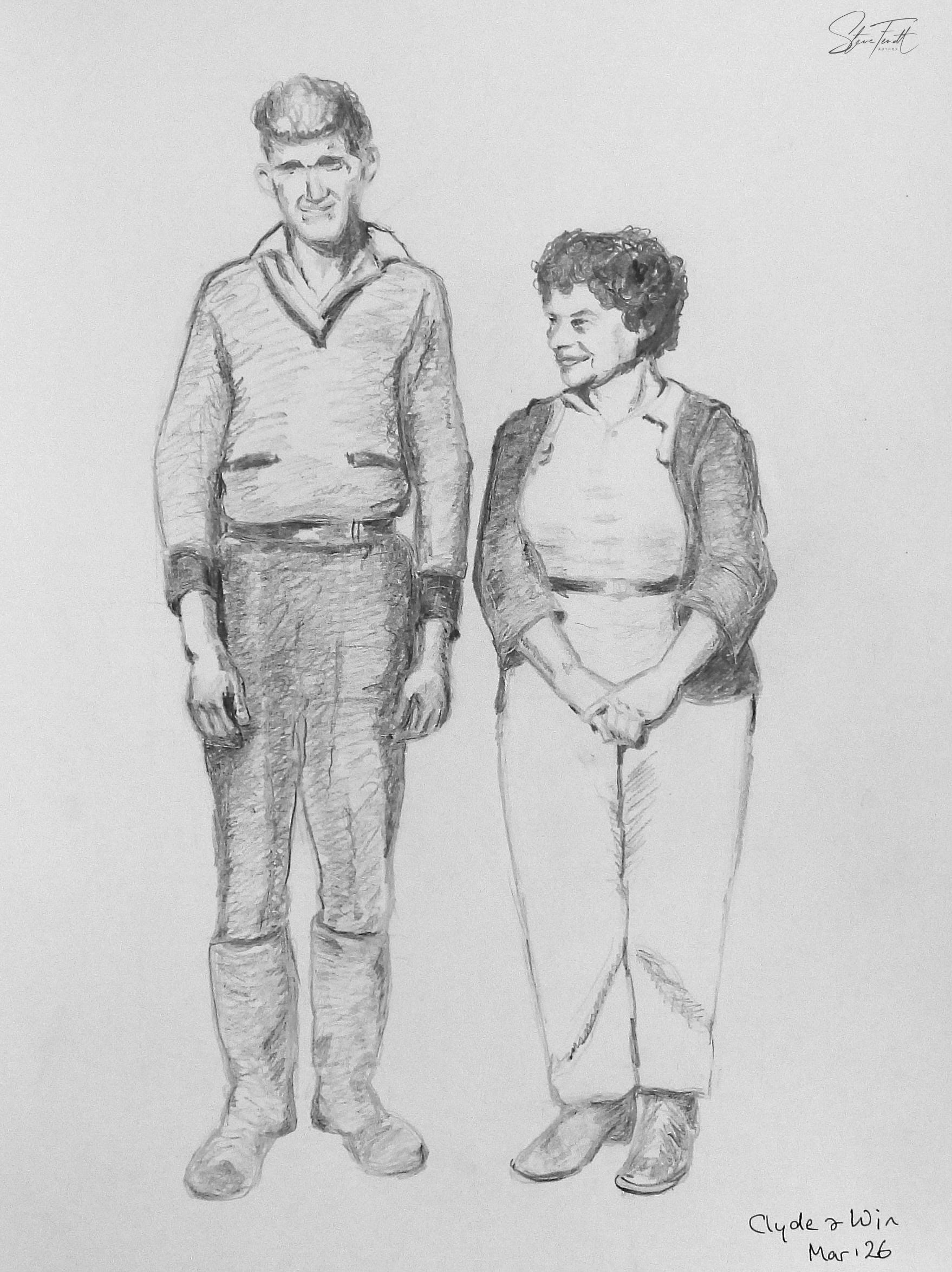
I often think of the Claytons. They lived here for decades, and lived well, despite the hardships. So it can be done. Their kindly ghosts seem to accompany me on my journeys around Poynduc: Clyde, tall and lean, with a strong chin and handsome face; Win, a head shorter, but with shoulders as broad, her curly asymmetric hairdo like the wind-sculpted bushes of the clifftops, sister of Deny King, the legendary miner and bushman who …
But I digress. The important thing is that the rocks that guard this little, sandy cove harbour plentiful sea life, there’s a narrow beach to pull out on – and there’s not too much swell to contend with in getting here.
The fish are soon showing interest in my juicy sandworms. I start to feel that this isn’t just a theoretical exercise. Don’t tell Maya, but I’m thoroughly enjoying the afternoon’s fishing.
I return home with a nice bag of whiting and flathead, enough for several good meals, feeling rather proud of myself. But my bounty doesn’t get the reception I’m hoping for from an admiring spouse.
Maya’s staring at the radio set, headphones on, fiddling with the tuning. She barely acknowledges my greeting – or my fish. After a little while, though, she looks up and smiles.
‘A voice!’ she mouths. A voice on the radio!
‘Wonderful. What’re they saying?’ Could this be the beginning of the end of the nightmare?
‘No idea. It’s very faint, and in some foreign language.’ She listens some more, screws up her nose. ‘Maybe Portuguese?’
Title artwork ‘Clyde & Win’: pencil sketch inspired by a photograph of Clyde and Winsome Clayton, at Claytons Corner, Poynduc / Port Davey. Their house is much as they left it, fifty years ago, and is now maintained by the Parks and Wildlife Service, Tasmania.
The other long-term residents of Poynduc were the Willsons, and Win’s family, the Kings. Deny and Margaret King’s heritage-listed home stands on Moth Creek, a short walk from the airstrip Deny built. As it is private property and still used by the King family, it does not feature in this story.
Comments
Nothing yet. Say the first thing.
Sign in to join the conversation.