
On Thursday, August 13, Jenny Schuetz speaks at SITE Santa Fe as part of Homewise’s Livability Speaker Series. Her talk, which is free and open to the public, is called “Who Gets to Live in Santa Fe?”
Schuetz was an economist at the Federal Reserve Board, spent years as a senior fellow at Brookings Metro, and wrote Fixer-Upper: How to Repair America’s Broken Housing Systems. Her argument is that America’s housing crisis is many-headed, and that policy keeps failing because it treats all problems as one. She now leads the housing portfolio at Arnold Ventures.
We talked by Zoom about the fee-in-lieu increase now before the Santa Fe City Council, why taxing the land can get vacant properties back into use, how to think about building in wildfire-prone areas, and the tradeoff between building green and building close.
This conversation has been edited for length and clarity. (If you’re reading this post via email and it’s truncated, click the article’s title, or “read in app,” or the three gray dots to read the entire thing.)

Stephanie Nakhleh: You’ve argued that America doesn’t have one housing problem but two: not enough homes in high-demand places, and incomes at the bottom not keeping up with the cost of living. Santa Fe and Los Alamos are both small, expensive, and gaining people, and Santa Fe has a large low-wage workforce. How would you describe Santa Fe’s problem in those terms?
Jenny Schuetz: Santa Fe has both of the problems. Santa Fe is similar to several smaller towns that have a hospitality-focused economy or a lot of tourism—places that have a lot of lower-wage workers who need to be close to where they work. At the same time, those towns are often in high demand because they have open space and mountain views and are not very crowded. That creates this tension: the characteristics of the place that make it in high demand also make it hard to build housing, and hard to get long-term residents comfortable with more workforce housing.
I don’t know Santa Fe’s topography that well, but a lot of the mountain towns are really constrained in the land where you can build. If there’s a valley between mountains, the valley is where you can build. Often in places in the West, there’s public ownership of a lot of the land outside of town, and it may not have water and infrastructure to support housing.1 These are not trivial problems to solve.
The housing supply constraint on the rules side is really a political problem. It’s persuading people with political power to allow development at different price points and rents. The political problem exists almost everywhere. But you’re compounding that with these limitations: how do you keep the character of the place while providing a place for people to work?
Santa Fe has required affordable units in new for-sale housing since the late 1990s and in new rental projects since 2005, a policy called “inclusionary zoning.” Since 2016, rental developers here have been able to pay a fee instead, and almost all of them do. You’ve studied these programs nationally. How well do they work?
The primary takeaway is that most [inclusionary zoning programs] haven’t produced that many affordable units.2 If the goal is to create below-market-rate housing, it doesn’t create a lot. It’s created much less than things like the low-income housing tax credit program, and it’s often very, very expensive per family housed.
If you have fees in lieu of development, you can use that either to build affordable housing someplace where maybe land is cheaper, and you could actually build more units, or to have a dedicated affordable housing developer build, or you could take those fees and use them to pay for vouchers or direct support for households. So in some ways, having fees in lieu of requiring on-site development may work better for actually helping more households. But it is then being very explicit that this is essentially a tax on new development.
One thing that’s really important to remember about inclusionary zoning is that it is, by design, a pro-cyclical program: it only creates new affordable units when there’s very strong demand for market-rate units, and it pencils out to build the market-rate units plus the IZ set-aside. This is a really difficult environment for real estate right now, because we have very high interest rates and high costs for a lot of construction materials, which are set on global markets. So the downside of inclusionary zoning is that when interest rates are high and developers aren’t building, we’re also not getting any affordable units. That’s essentially how the program is designed. In some ways it would be better for a public entity or nonprofit to be able to buy land and do development in a down cycle when it’s cheaper, rather than competing with the private sector when the markets are really tight.
Mayor Michael Garcia is sponsoring a large increase in Santa Fe’s fee-in-lieu. Garcia has said he doesn’t think the increase will drive developers away, and that if it does, he isn’t concerned: “Trying to pander to developers is what put us in this position in the first place,” he said, and added that if the fee is a deal breaker, “I don't know if we need that developer developing in our community because they are putting profit over people.” That view is common in progressive cities. As an economist, what do you find happens to a housing market when policymakers treat developers as predators rather than partners?
There’s a balance between asking developers to contribute to the cost of services that genuinely may go up if more people are living nearby, and recognizing that much of the demand for public services is driven by people who are already in the community. We often try to avoid asking people who currently live in the community to pay more for services, even if those costs are going up.
It’s nice to be able to ask developers to pay for extending the water and sewer lines if they’re building a new subdivision. That’s not crazy. It actually does require an increase in the infrastructure, and paying the marginal cost makes sense. But very often what we see are things like, we want the developers to pay money to rehab one of the community parks that’s already there. Well, why aren’t people who live in the community now being asked to pay a little bit more in property taxes or user fees of some kind to pay for that?
What this does is shift the burden onto newcomers who aren’t there yet, which makes the new housing more expensive. That’s necessarily going to push up the gate of who’s able to move into the community. I understand that from a political perspective, asking your existing homeowners to pay more in property taxes is not usually very popular. But being straightforward with people—the cost of water and sewer goes up sometimes, or you want to upgrade your parks and your schools because they’re old and they need a rehab—everybody’s going to benefit from that. So everybody needs to contribute to it.
Something I learned as a planning commissioner is that developers have to prove to a bank that they’ll make a profit or they don’t get the loan. So expecting developers to forego profit simply ignores how housing works.
It’s a really important point. Developers are mostly not building with their own money. They are borrowing money from banks, and they’re often getting money from investors for the equity side. Lenders and equity investors can put their money anywhere, so developers are competing all across the country, including in areas that aren’t real estate, to get the funds to build. If one city makes it uncertain to build, it’s going to take a long time to finish and start recuperating the rents. An investor or a lender might look at that and say, why would I put money in an uncertain place where I’m not going to get paid back for 10 years, when I can go to Texas where they’re building things and in three years I’m going to start recouping the cost? That’s something local officials often forget—that they really are competing with other places for new development and economic activity.
You wrote a piece for Brookings in 2020 arguing that housing affordability requires aligning three things: zoning, taxes, and subsidies. That article is a big reason I’m a Georgist now. How do those three legs depend on each other?
A lot of it is really about aligning the financial incentives for building on property, particularly underutilized property, with the rules that allow you to do that.
We think about zoning as being a constraint on what can be built. It’s usually used to limit density or certain kinds of development, so in places where land values are high and a developer or property owner could build something on their property, zoning can block them from doing that. But what we know is that even if you remove the constraint, that isn’t always enough. A classic example is a surface parking lot downtown. Wouldn’t it be better to have a new apartment building, an office building, or some shops on that site? Even if you take away zoning as a constraint, the owner of the property might think, well, if I wait longer I’ll get more money. Or, we’re going into a period of uncertainty, and I want to sit and wait before I decide what to do with that.
If we use taxes more proactively, focused on the value of the land rather than the value of the structure, we can encourage people who are sitting on high-value land that doesn’t have much on it to build faster. The way property taxes typically work, the tax is assessed on both the structure that sits on the land and the value of the land. What that means is, if you upgrade your structure, if you rehab your house, you actually pay more in property taxes. But we could shift to saying it’s based on the value of the land, so if you have high-value land and you build something on it that brings in more revenue, that’s actually to your benefit. It encourages development a little earlier in the cycle. So those two things are complementary: allow more development on things like surface parking lots, and tax the owner of the lot so they’re incentivized to build something rather than sit on it for a long time.
Then the subsidy piece is really recognizing this tension between the market building more housing if we let it, and the fact that there are people who just don’t have enough money to pay for it. We use things like inclusionary zoning to try to create some below-market housing for poor people, but it doesn’t create a lot of housing compared to the number of people who really need assistance. A better way to think about this is to allow development to happen and use some of the extra proceeds—additional property taxes or sales taxes—to support the income of low-income families who need a place to live. A locally funded voucher program, cash rental assistance, even short-term emergency rental assistance. Those are ways of directly giving money to people with low incomes that they can spend on rent, and it’s a much more efficient way to help them than trying to squeeze a couple of units out of a new market-rate development.
The tax leg seems like the hardest one. If I walked through the grocery store and asked people about a land value tax, they’d say, “What are you talking about?” Do you see a political route for it?
The places that have shown more interest—usually not in a straight land value tax, but in a split-rate tax, where you apply a higher base tax rate to the land than to the structure—are interestingly not the places with really expensive land. They are places like the city of Detroit and a number of the Pennsylvania communities that have had a lot of vacancy, and they see it as a way to deal with the vacant land issue. If you own a piece of land that has maybe a dilapidated house and there’s nobody on it, they’re trying to use the higher tax on land to encourage the owner to rehab the house, or to sell it, and to do something that reduces vacancy and blight. The city of Detroit actually came pretty close to adopting a split-rate tax a couple of years ago. They would have needed the permission of the Michigan Legislature, and I believe it did not get through there.
Local governments’ ability to set taxes depends on what the state allows them to do. If the state allows it, local governments can experiment. Otherwise, they would have to get state permission or oversight first. But it’s coming up in interesting places, and for local governments that are interested in how to incentivize development, particularly of good locations that are underbuilt, thinking about a split-rate tax would make a lot of sense.
On wildfire risk and housing, you’ve argued that we should build where it’s safe rather than push development into risk-prone areas. Santa Fe and Los Alamos both sit in the wildland-urban interface, with watershed problems and real evacuation constraints, and Los Alamos is a major job center for the region. We can’t shut down cities or tell every landowner to turn their land back into grass and walk away. What does “build where it’s safe” mean in a place like this?
The general rules of thumb are: don’t build new stuff in the risky areas, and build more stuff in the relatively safer areas. “Relative” is doing a lot of work here. Places that already have job centers, houses, infrastructure, and people living there—we are not going to abandon those anytime soon. But there’s a big difference between that and building a subdivision that requires clear-cutting of forest, or putting in roads and water infrastructure that aren’t there now. That’s both more expensive to build, and you are then taking up open space that probably would have been part of the buffer zone.
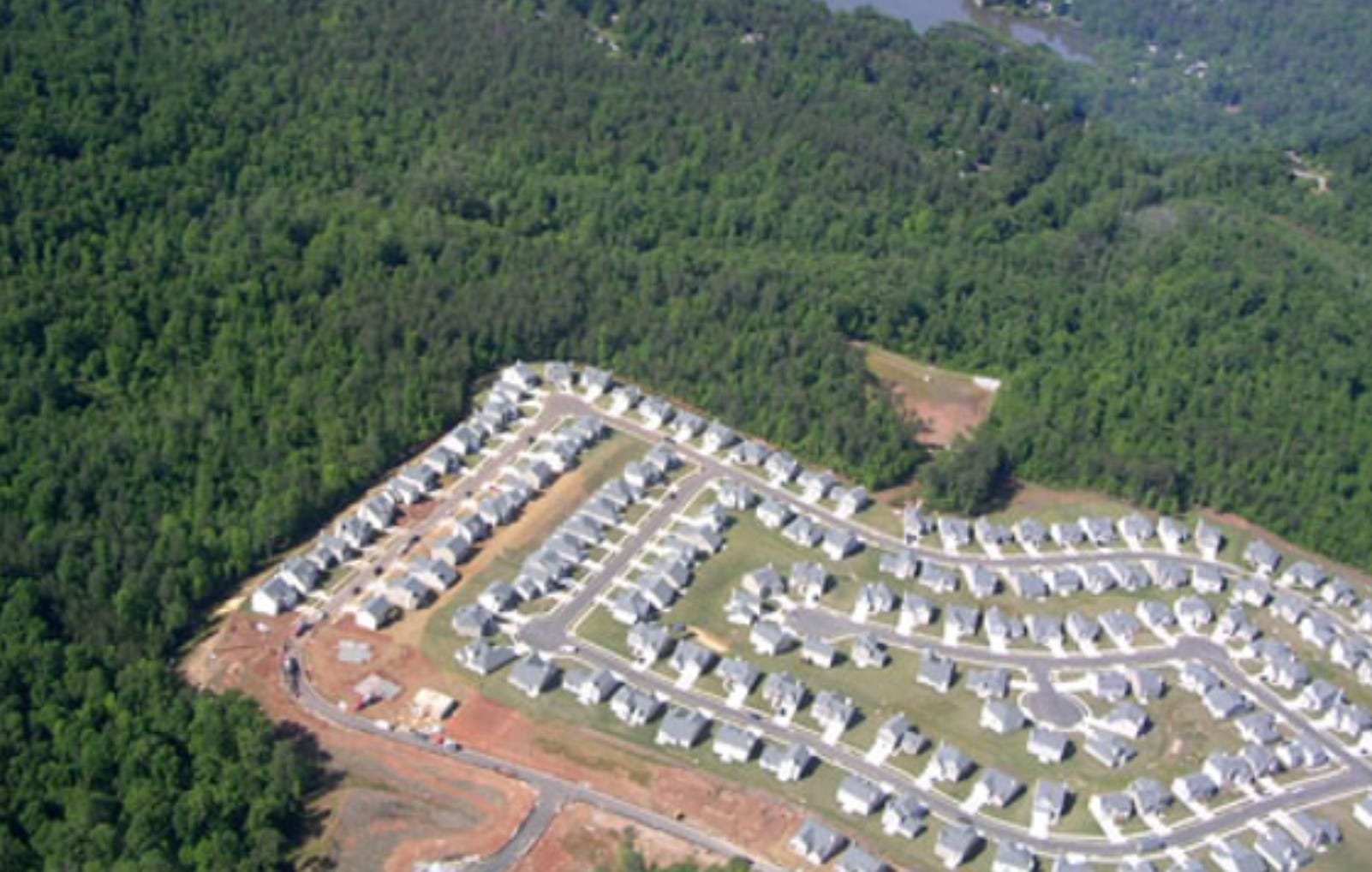
For areas that are already built out, adding more housing there has the lowest additional climate impact. Most of the West is going to have to grapple with both water shortage and exposure to fire. One of the things that we know is that newer housing is generally built to a higher code and is more resilient, more energy efficient than older homes. So in places where there’s a lot of old housing, replacing it with new housing is going to make housing safer and people safer, and generally also bring down the demand on your utilities and your water. In places that are growing, add smaller homes that use less land and try to do as much as possible in the infill areas.
The downtown of a city is the part least likely to burn in a wildfire. It’s the stuff that’s adjacent to open space, adjacent to the canyons [that’s most at risk]. We really want to minimize expanding further into that, and keeping a buffer between the existing built-out environment and the dry brush is probably one of the better things we can do.
Insurance is becoming a real constraint here. The state has debated how much of a backstop it should provide, because so many people are losing coverage. How should cities think about that?
This is not something that cities individually can solve, because it really is a statewide issue. The states are the ones who underwrite the FAIR plans as insurers of last resort, and they also set the rules on what insurance companies can charge. Once again, California is the cautionary tale. They tried very hard to keep premiums from rising too fast for existing homeowners, but they effectively made it impossible for insurance companies to bring in revenues to cover the costs. They have such huge payouts from natural disasters that insurers exited the California market. That’s not helpful to anyone. You wind up with fewer and fewer insurance companies, and often it’s the big national companies that exit first, so you wind up with less well-capitalized companies staying in the market.
State insurance commissioners need to think about what insurers have to charge everybody to stay in business in the state, and what risk the state explicitly wants to take on itself in a FAIR plan. There’s also a big asymmetry between how we treat fire risk and flood risk. Flood risk is all borne by the federal government through the National Flood Insurance Program. We don’t have an equivalent for fire, and we don’t have an equivalent for wind damage, which is the other really expensive thing, so those get bundled into your primary homeowners insurance. People who work on insurance markets full time are thinking about whether it’s worth having a national wildfire insurance program that could socialize the risk across the whole country, not just the high-risk states. Ultimately, some of this is going to have to be solved at the national level so that you get adequate risk pooling.
When I raise housing and climate risk with people I know, the answer is usually to mandate mini-splits, solar panels, LEED certification, etc. My concern is that building costs already push housing out to the periphery, to cheaper land. And mandates would only make housing costlier, which would push it even further away. Hour-long commutes have a real climate impact. In Los Alamos, most of the workforce commutes in from elsewhere in the region. How do you think about that trade-off?
It’s worth pulling apart the resilience side—making homes better suited to withstand wildfires and high temperatures—from the emissions side, because the solutions are a little bit different.
In general, I don’t love putting a lot of mandates on new construction while exempting older construction, because we already have pretty big differences in quality, in resilience, in energy efficiency between old housing and new housing. New housing, even if it’s not built to extra-high standards, is just going to be safer, more efficient, and higher quality.
When we put too many mandates on new construction that consumers don’t want to pay for, then we choke off construction altogether. Builders will tell you there are some features that households know are going to save them money on their electric bill and that they’re willing to pay for, or some that they value because the house is more comfortable. We don’t build new housing now that doesn’t have air conditioning. Fifty years ago, lots of homes got built without air conditioning, and now people just won’t buy that. So that gets priced in. But requiring features that consumers don’t really value just isn’t going to be feasible for builders, and so they build less. Some of what we’ve seen across states is that builders are going to go to places where there are lower requirements for them to build. In effect, you’re pushing people toward places with lower standards of construction. Is that actually reaching the environmental goals that a lot of people say that they want?
There’s not an easy answer to this. It’s particularly hard to solve at the local level, because you wind up with different rules and different incentives for developers in every jurisdiction. We would be better suited to having more national consensus around building codes that promote safety in particular regions of the country relative to the climate risks that they face, and having more consistency and certainty for developers about the rules for particular geographies and climate risks. An individual local government trying to enforce something that is out of whack with consumer preferences and the rest of the country is going to be really hard to maintain.
Santa Fe regulates how buildings look more aggressively than almost any American city. Is that kind of aesthetic control a cost driver, or is it a proxy fight about something else?
Yes, and yes. Strict design codes can be really expensive in and of themselves. Often the materials have to be expensive, and that limits the choices you have. Sometimes they’re also just proxy fights.
The worst of all possible worlds is when you require very specific design criteria and then also have discretionary design review, which gives the neighbors lots of chances to say no. That’s what makes discretionary review such a powerful tool for NIMBYs—they can constantly ask for tweaks, right? “It’s too big. I don’t like the windows. I don’t like the landscaping. Can you do this?” That back-and-forth is incredibly expensive, and it really is just giving people veto power over aesthetics.
Communities with a distinctive architectural style may want things in harmony with that. Often it can be written into code in ways that leave some flexibility and imagination up to architects, and that’s usually better. It’s hard to legislate aesthetics that make everybody happy, because we have different preferences. Some people think everything should look like it was built in the 1920s. Some people like contemporary architecture. My preferences shouldn’t necessarily rule everybody’s.
Final question: If Santa Fe decided it actually did want teachers and line cooks and young families to live here, what should policymakers look at first?
I really do think the very first thing is to look at your process and figure out how to make it shorter, streamlined, and synced up, because that’s something the local government can do, and they can get it in place fairly quickly. That allows projects that don’t quite pencil now to start penciling out.
The second thing is to look at what structures you don’t allow now, and just expand the envelope a little bit. If you allow single-family homes on half-acre lots, allow smaller minimum lot sizes. If you don’t allow townhouses, allow townhouses. Just look at the things that are prohibited and make sure that you have a little bit more variation built in. In general, very few parts of the U.S. are going to build 50-story apartment towers, because the deals just don’t pencil—construction costs are too high. But anything that you can allow between a single-family detached house and a six-story apartment building, that’s really the sweet spot.
The missing middle—a perfect place to end. I appreciate your time, and I look forward to seeing you on Thursday at the Homewise Livability talk
No posts
Comments
Nothing yet. Say the first thing.
Sign in to join the conversation.