

“Sulfonylurea” is a word you're probably only familiar with if you’re:
A) a farmer, or
B) a doctor who was practicing medicine 40 years ago.
Old doctors know about sulfonylureas because they were some of the first drugs developed to treat diabetes.1
Farmers know about sulfonylureas because they’re the most heavily used herbicides in the world today.
Maybe you already see the problem.
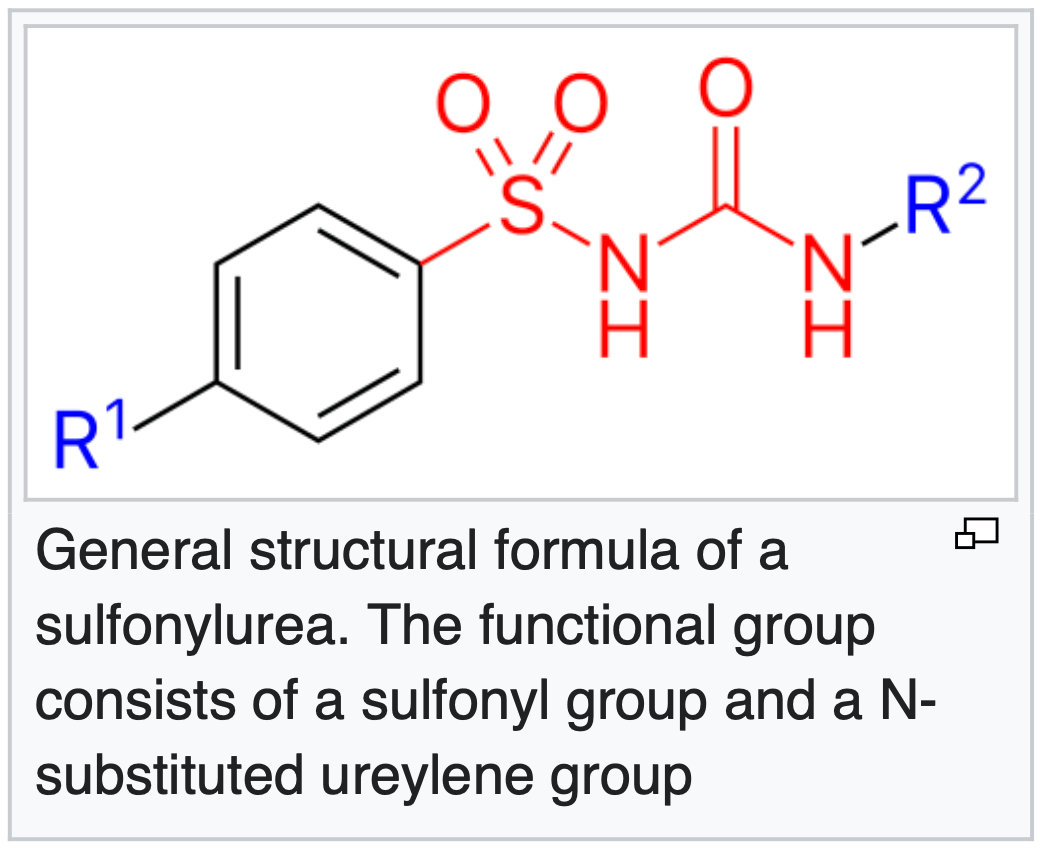
There are at least two dozen different chemicals on the market with the general structure shown above, and they're used on practically everything: corn, wheat, rice, soy, sugarcane, etc.
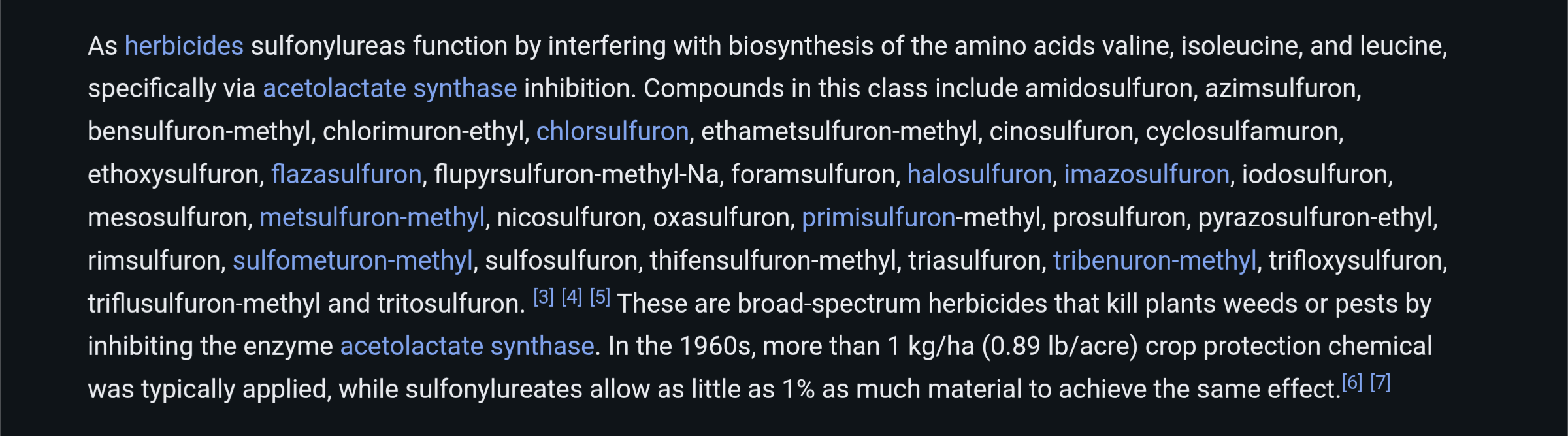
Sulfonylurea herbicides were invented in the mid-’70s, and came into use starting in the early ‘80s. Usage ramped up slowly at first, then exponentially: by 2011, sulfonylurea use had hit more than 2 million kg/year worldwide, and it’s only grown since then.
Their introduction transformed agriculture to a degree that’s hard to overstate, because—in addition to being about a hundred times more potent than herbicides in use at the time—they were also substantially more selective.
See, in the old days, weedkillers were used in commercial agriculture in much the same way you’d use them in your garden at home: walking around with a spray tank and spot-treating any interlopers you spot among the rows of crops. Sulfonylureas were a revolution because many food crops have some natural resistance to them: enzymes that metabolize the chemical once it’s absorbed, breaking it down into compounds that don’t have the same herbicidal effect. Most weeds, on the other hand, don’t have those enzymes—so they just up and die.
Suddenly, with the invention of sulfonylureas, we went from having to spot-treat weeds to being able to spray down the entire field and kill just the weeds, sparing the crops.
And the reason this was such a game changer is that walking around with a tank and sprayer, blasting weeds one by one, isn’t that much less work than pulling the weeds by hand. It’s also more expensive, since you have to buy the chemicals. That was the other key advantage of sulfonylureas: when a few milligrams of the stuff is all it takes to kill a plant, you can afford to spray the whole acre, even if 90% of it is going to waste by landing on plants that it won’t kill.2
All this set the mold for “no-till” agriculture, i.e. relying on chemical rather than physical means to keep fields weed-free. Since then, this style of farming has pretty much taken over the world, because it means one person with the right equipment can do the work that previously might have taken fifty. Who wants to traipse around pulling or spraying weeds by hand when you can just drag a 30-row sprayer behind your tractor and be done with the field before lunch?
If you read my piece on Roundup, AKA glyphosate, maybe you’ve noticed the parallels in how sulfonylureas and glyphosate are used. That’s no coincidence: the development of roundup was, in a lot of ways, an effort to replicate the zero-to-one success story of sulfonylureas. The two even have similar mechanisms of action: they kill plants by inhibiting the production of certain amino acids.
Sulfonylureas work by shutting down an enzyme called acetolactate synthase, preventing the synthesis of the branched chain amino acids—things like valine and leucine. Glyphosate inhibits an enzyme called EPSP synthase, which is essential for the production of the aromatic amino acids, e.g. tryptophan and tyrosine.
In practice, the only major difference in how they work is that, where many food plants are naturally resistant to sulfonylureas, practically the only things naturally resistant to glyphosate are:
Organisms that don't make aromatic amino acids on their own, like Homo sapiens, and
A weird strain of Agrobacterium that the guys at Monsanto fished out of the drain, which can make aromatic amino acids even in the presence of glyphosate because it has a mutant version of the enzyme that the herbicide targets.
Hack that mutant gene into your crops, and you’ve effectively recreated the sulfonylurea paradigm: spray the whole field with roundup and only the weeds die, leaving behind eerily pristine rows of corn. The debut of “roundup ready” crops in the late ‘90s was an especially big deal to everyone who had already converted to no-till farming, because sulfonylurea-resistant weeds were already becoming a huge problem. It was a big deal for Monsanto, too: now, not only did they get to sell two different classes of herbicide3, they also got to sell the seeds that the new one could be used on safely.
“Safely”, in this case, of course means safe for the plant, for yields, and for the farmer’s bottom line. But for the people eating those plants?
And this is the crux of my issue with glyphosate, sulfonylureas, and “no-till” agriculture in general: Unlike insecticides or fungicides, which only have to sit on the surface of the plant to work (and thus can theoretically be washed off), an herbicide can’t kill weeds unless the weeds absorb it. This means that, when you spray a whole field of food crops with poison, you necessarily end up putting poison in the food at concentrations sufficient to harm living things. So you don’t do that unless you’ve got some clever reason why the poison won’t harm you, right?
With Roundup, it’s that we’re effectively naturally immune to it—we don't have the enzyme glyphosate targets. Unfortunately, plenty of our gut bacteria do.4
But that's not the problem with sulfonylureas. Even though many of your gut bacteria also make branched-chain amino acids (and thus rely on acetolactate synthase), remember that crops protect themselves from the toxic effects of sulfonylureas by breaking them down, detoxifying them—so they ought to be inactivated well before they enter your body, or else they’d have killed the plant.
So what’s the problem?
The problem is that, although the resulting metabolites don't have the same herbicidal activity as their “parent” compounds, they’re not necessarily inert. To the extent that humans are different from plants (which is to say: quite a lot, at least for most people) a chemical that’s harmless to a plant might be bad for a human in weird ways. And in the specific case of sulfonylureas, there are some very good reasons to suspect that this is so.
See, well before they found use in agriculture, sulfonylureas were pharmaceuticals. Back in the ‘60s, drugs like tolbutamide were among the first small-molecule therapies for diabetes. They work by triggering the pancreas to squirt out insulin, which lowers your blood sugar.
But sulfonylureas aren’t used much in medicine anymore, because—while it’s helpful in the short term to be able to mash the “release insulin” button just by taking a pill—artificially yo-yoing your insulin levels over long periods of time can have some negative consequences. If you take them constantly, you can get tolerance. Insulin resistance.
And this is worrisome, because the fundamental problem in diabetes, whether it’s type 1 or type 2, is that the calories in the food you eat aren’t getting turned into energy the way they should. The primary symptom is high blood sugar, but this isn’t just a consequence of eating too much sugar—it’s that the sugar doesn’t have anywhere to go, thanks to a breakdown in insulin signaling.
See, your pancreas’s job is to monitor the level of sugar in your bloodstream, and when it rises, release insulin—the chemical signal that passes the message to your cells: “Hey, there’s sugar in the bloodstream; you should take that up and put it to use.” Muscle cells use that glucose for energy, breaking it down to produce ATP, while fat cells convert it into lipids and bank it up.
In type 1 diabetes, the problem is that—for whatever reason—your pancreas is busted and can’t make insulin, so the blood sugar signal never gets sent. This is why injectable insulin, the first major drug developed for diabetes, works like gangbusters in type 1: it effectively solves the core problem, as long as you remember to take your shots with meals.
But type 2 diabetes is a different beast, and an altogether more complicated one. Here, the pancreas releases insulin in response to meals, but the insulin doesn’t seem to work as well. This is the key feature of type 2: insulin resistance—meaning the cells of your muscles, liver, etc. don’t take up as much blood sugar as they should in response to a given amount of insulin. So sugar just hangs out in the bloodstream, and your cells—basically unaware that there’s an abundance of calories just waiting to be had—go into low-power mode. Convinced that you’re starving at a cellular level, you end up in this paradoxical state of too many calories and not enough energy.
The popular conception is that this works something like a drug-tolerance effect. If you drink enough coffee for long enough, your body learns to ignore it. Your neurons express more adenosine receptors, dampening the effects of the caffeine until eventually you can enjoy a nice cuppa at bedtime without hurting the quality of your sleep. Likewise, the thinking goes, if you eat too much sugar for too long, you get insulin resistance.5
And the same way the caffeine addict can still get a boost from coffee the next day (provided the barista doesn’t start reaching for the panic button under the counter when you say “octuple espresso, please”), people with type 2 diabetes can still benefit from treatment with insulin…but it’s not a solution-to-the-problem kind of benefit; it’s just one tool in the toolbox for managing the disease.
But the insulin-resistance-as-sugar-tolerance analogy has some assumptions baked in that don’t sit quite right. Glucose isn’t a drug like caffeine; it’s one of the fundamental currencies of energy in biology. Putting it to use properly is as essential as processes in the human body can get.
So how do we enter the maladaptive state of insulin resistance?
…is “Too many calories in, not enough calories out”—and it’s true that we live in a time of unprecedented caloric abundance and hyper-palatable food. As a society, we’re sedentary in a way historically reserved for lounging emperors and double amputees.
You could argue that sustained excess like this is such an evolutionary edge-case that the body can’t handle it. Physical inactivity is one of the main lifestyle factors associated with insulin resistance and diabetes. So maybe, the thinking goes, your cells factor in the demand on them when establishing their set-point for how much sugar to take up from the bloodstream. After a while under low demand they lose the sense of what’s optimal.
Convinced that you’re starving, at a cellular level, you end up in this paradoxical state: too many calories but not enough energy.
But this would require the human body to be an uncharacteristically shoddy piece of work on evolution’s part, because in someone with T2D, the cells clearly aren’t meeting the demands on them with the amount of sugar they take up. You can tell, because starting somebody with type 2 diabetes on insulin often yields huge improvements in their energy levels—both physical and mental.
So while calorie-dense foods and physical inactivity are tightly correlated with insulin resistance and diabetes, we should be wary of the intuition-trap that correlations like this can present. After all: if you snuck into someone’s house and randomly slipped drugs into half their food which scrambled the signals that let their body turn that food into energy…would you be surprised to find them overeating, or having a hard time getting up off the couch?
Because that is effectively what’s been happening to us.
Some things I should clarify:
“Sulfonylurea” is a broad chemical class, and just because two compounds are in the same chemical class doesn’t necessarily mean they’ll have the same effects on the body. Structure is function, both in chemistry and biology, but the ways in which that fact manifests are often hard to predict; the addition or subtraction of just a few atoms can magnify, eliminate, or even invert a chemical’s effect. To give a popular example, “substituted phenethylamines” is a class that includes everything from sudafed to MDMA to potent psychedelics like 2C-P. All three will keep you awake, and at least two will clear your sinuses, but only that last one will melt your psyche into the shadow of a stormcloud on the sea.
None of the sulfonylureas used as herbicides are identical to the ones used as diabetes drugs. And, given point 1 above, they might not have the same insulin-releasing activity as their pharmaceutical cousins.
So we can’t say for sure that agricultural use of sulfonylureas ought to mess with insulin signaling.
What we can say for sure is that we don’t know whether the agricultural use of sulfonylureas messes with insulin signaling.
I can hear you asking “what do you mean, we don’t know? Surely these chemicals were tested for safety before being licensed for application to food crops. They'd have noticed if it gave a bunch of mice diabetes.”
And I imagine they were—although I have dug pretty deep into the literature, and haven’t found any reports of such tests. The closest thing I can find is this case series from Greece, where some doctors noticed the weird coincidence of T2D in three patients with healthy BMIs, no risk factors, and no family history of diabetes…all three of whom were farmers that used sulfonylureas in their work.
But the reason I can say with certainty that we don’t know whether agricultural use of sulfonylureas messes with insulin signaling is that we’re not eating the chemicals themselves. We’re eating the plant metabolites—the breakdown products—and in many cases, we still don’t know what those metabolites are.
See, the enzymes responsible for the metabolism of sulfonylureas mostly belong to a family called the cytochrome P450s, or CYPs. This is an extraordinarily diverse class of enzyme—all variations on a gene that probably existed in the Last Universal Common Ancestor, as evidenced by the fact that they can be found in everything from bacteria to plants to humans. And although they mostly serve the same general purpose—helping their respective owners degrade and eliminate toxins by sticking an oxygen onto them—each organism has its own versions, which bind different molecules and modify them at different spots. Humans, for instance, have some 57 different versions of CYP in our genomes, with names like CYP1A2 (which metabolizes tylenol but also turns certain unsaturated fatty acids into immune-signaling molecules), or CYP3A4 (breaks down most benzos, but is famously susceptible to blockage by chemicals in certain citrus fruits), or CYP2D6 (deactivates SSRIs and amphetamines, but also transforms codeine into morphine, enhancing its potency by about 10x). To further complicate things, chemical cues can induce a cell to produce more or less of a given CYP enzyme. This induction is used to great effect in agriculture, by combining sulfonylureas with other chemicals referred to as safeners, which cause the crop to ramp up production of the appropriate CYP enzyme.
So maybe it’s not so hard to believe that we don’t even have a list of all the chemicals that might end up in your body as a result of sulfonylureas’ use on food crops (much less an understanding of those chemicals’ effects on our biology), is it? Consider what a massive undertaking it would be just to identify them: Take each of the dozens of chemicals listed in the screenshot at the top of this post and multiply it by the number of food crops it’s approved for use on (ideally, the number of varietials, since apparently sweet corn and feed corn have different enough CYPs to change their profiles). Multiply that by the number of safeners approved for that [crop] x [herbicide] combo. Now run that many dedicated metabolomics projects to figure out what each of those chemicals turns into when the plants metabolize them.
From the handful of [crop] x [herbicide] combos where that’s been done, we know that one sulfonylurea can turn into three or four different metabolites in a given plant—so your full list would likely be several hundred compounds long, if not several thousand. Now, synthesize or purify a few grams of each of those compounds and feed it to a few cages of mice at the relevant doses for three months to figure out which ones cause problems. Oh, but first you’ve got to invent USDA-organic rodent chow, because otherwise your control group will be eating a random smattering of your test compounds. And really, if you’re going to all that trouble, you should check which of those plant CYP metabolites are subject to further metabolism by human CYPs, because those aren’t the same as mouse CYPs. So you’ll want to add all those metabolites to the mouse test list, and figure out some way to prevent the mouse CYPs from doing things that the human versions wouldn’t.
It would take a Manhattan Project.
Earlier, I threw out a number: 2 million kg of sulfonylureas got used as herbicides in 2011. That’s about 250mg for every person on Earth at the time.
Now consider that, when sulfonylureas are used as diabetes drugs, the newer ones like glimepiride are dosed in the range of 1-2 milligrams. That’s how much it takes to make a major impact on a person’s insulin signaling.
In the subtitle of the post I said “this is good news”, because it almost seems too good to be true, as far as theories go. From our vantage point in the present moment, where there's a Wikipedia page on sulfonylureas that has an “Agricultural Use” subheading right next to the “Pharmaceutical Use” one, the idea seems so colossally obvious that to have missed it ‘til now would require implausible levels of incompetence on the part of everyone involved. It’s easy to forget that—until very recently—information like this has been siloed to such an extent that, by the time someone with the requisite knowledge to flag sulfonylurea herbicides as “potentially a really bad idea?” got wind of it, the project could already have had too much inertia to be halted by a hypothetical safety concern.
But something big is responsible for the absolute pandemic of metabolic dysfunction that’s hit the USA over the past 50 years. It tracks pretty well with the rise of cheap, processed foods. But “processed foods” is such an aggregate proxy. The fraction of an average person’s daily calories that comes from ingredients like “enriched, bleached wheat flour”. Is it the enriching? The bleaching? The seed oils, the soy lecithin, the corn syrup?
But step back, and follow the money: why did corn syrup suddenly get so cheap that Coca Cola was willing to pull elaborate hijinks to smooth over the recipe transition from cane sugar to HFCS?
The answer is the agriculture, the new no-till paradigm—and the first big break in that direction was the development of sulfonylurea herbicides.
So it does not seem unreasonable to ask: What if sugar itself is not the culprit here? What if it has something to do with the analogues of known insulinergic drugs that we recently started spraying on the crops?
Call me crazy. Or call your congressman.
Because given:
1) the difficulty involved in answering that question in the lab,
2) the scope and stakes of the current obesity crisis, and
3) the plausibility of the notion that it could have a simple, singular cause…
the reasonable thing to do is to rescind the approvals for these chemicals, at least for use on food and feed. Phase Them Out; that’s the slogan, nice and chantable. If it’s done right, we will know within a few years whether or not that was the problem. And hey, if there’s no improvement in the average American’s metabolic health, phase ‘em back in!
This will not be simple, no matter how simple the idea behind it is. It will require advance notice, to allow for a massive restructuring of the agriculture industry, if we don’t want to just replace sulfonylureas with new and different poisons. It will take subsidies and jobs programs to muster the manpower to grow the food without them. It will take amnesty clauses for all parties involved, to dissolve industry resistance. It will take bailouts, paying the chemical companies for material they don't produce. This is fine, or at least no more ridiculous than the current scheme of paying farmers for grain they don't plant. It will require taking a leaf out of China’s book, turning away shipments of sugar that test positive for prohibited compounds.
But it can be done. We’ve currently got grain in such abundance that we can take the hit to productivity without anyone starving. The political will is there: The president’s palanquin was carried to victory this last election in part by people like RFK Jr. and Casey Means—the perpetual nominee for surgeon general—whose whole shtick is specifically that our highest priority should be figuring out what is going on with metabolic syndrome. And we have the technology: In California, the combination of gas taxes and EV credits was enough to turn Teslas from a fringe phenomenon into a substantial fraction of vehicles on the road; we can apply the same pressures to convert the nation’s sprayer-tractors into laser-tractors, computer-vision equipped to fight the war on weeds with greater tactical precision than we ever could have achieved with crude chemical means.
Because if not for this, then for what?
The process of directing energy—taking it in as calories and turning it into useful work—is as fundamental as it gets. It is pretty much the whole business of being a living thing. If we cannot be bothered to figure out what is going wrong with our ability to do that—if we do not have what it takes to run this Great American Experiment as a proper experiment, with a crossover control arm—for the sake of our people’s capacity to be strong in arm and sharp of mind?
Then folks, we as a society are COOKED.
Phase ‘em out!
—🖖🏼💩
Younger doctors often don’t know about them because they’re not used much anymore—in the long-term, they tend to cause weight gain and can even make the underlying diabetes worse, which is why they’ve mostly been phased out in favor of drugs like metformin.
Of course we just started stacking them rather than reducing the use of the old one when the newer option came around.
For more on this, see The Thousand Secret Ways #1, linked above.
Glycemic index is another concept that gets a lot of play in current explanations of the disease: idea being that the rate at which sugar enters the bloodstream is just as important as the amount of sugar, and this is thought to be why high intake of refined sugars and processed foods are among the biggest risk factors for T2D.
Comments
Nothing yet. Say the first thing.
Sign in to join the conversation.