
When Are We Going to Stop Treating the Green Industrial Complex Like the Fourth Branch of Government?
By Stephen Heins, The Word Merchant, Sheboygan, Wisconsin
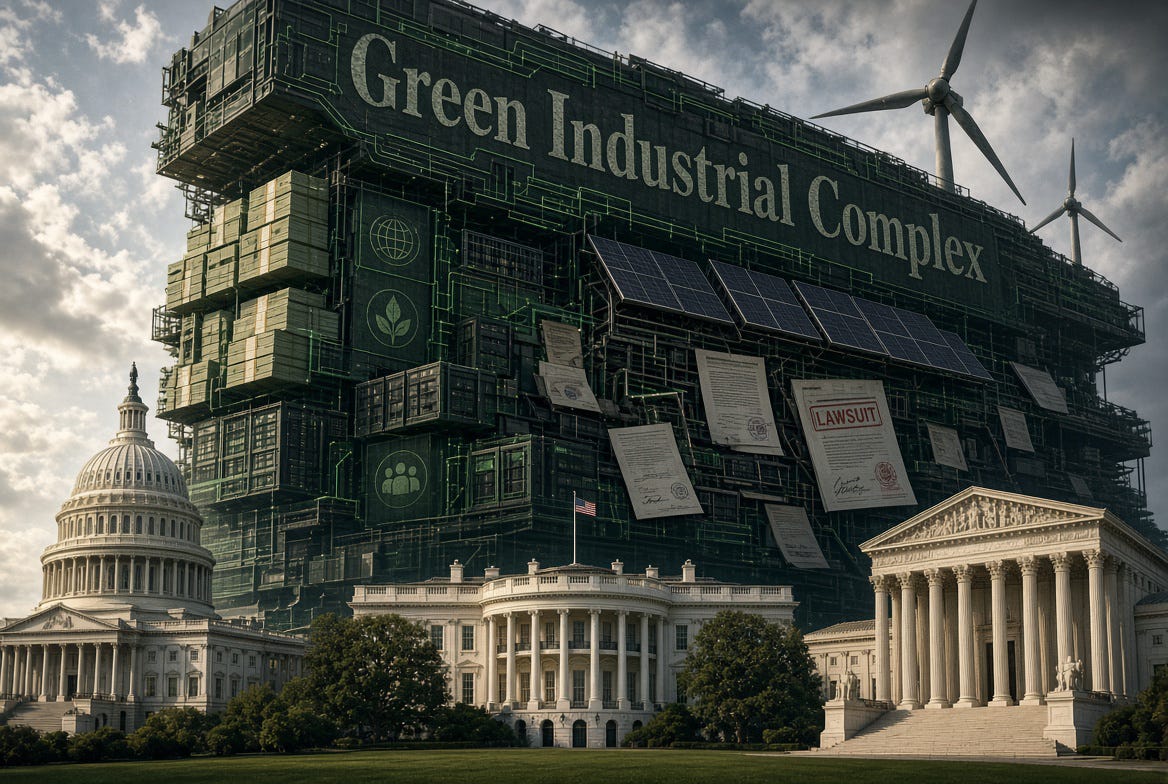
President Dwight Eisenhower warned us in 1961 about the military-industrial complex and the danger of “the disastrous rise of misplaced power.” Bjørn Lomborg later applied the same clear-eyed skepticism to what he called the climate-industrial complex.
Today that complex has grown into something larger and more entrenched: a Green Industrial Complex of environmental NGOs, foundation money, renewable-energy interests, government litigators, revolving-door bureaucrats, and compliant media. It operates with the influence of a fourth branch of government—unelected, largely unaccountable, and determined to reshape American energy policy whether the voters like it or not.
This is not a conspiracy theory. It is a matter of budgets, grants, lawsuits, and personnel. The Nature Conservancy recently reported more than $2 billion in total support and revenue for fiscal 2025. The Environmental Defense Fund took in roughly $437 million. Sierra Club revenues sit in the $170 million range.
These organizations and their allies employ armies of lawyers, lobbyists, and communicators. They green-mail state and federal agencies into submission, draft green model regulations, and pour tens of millions into political spending that tilts almost exclusively one direction. Meanwhile, groups that question the orthodoxy—Heartland Institute, CO2 Coalition, CFACT—operate on budgets that would not cover the catering at a green-group gala, and they receive zero direct federal grants.
The most vivid recent example is found within the Inflation Reduction Act’s Greenhouse Gas Reduction Fund. Roughly $20 billion was steered to a handful of nonprofits, some newly formed or lightly capitalized, many with personnel ties to the prior administration.
Money was obligated and parked in ways that made ordinary oversight difficult. When the new EPA leadership under Lee Zeldin moved to terminate the grants due to documented concerns about conflicts of interest, self-dealing, and reduced accountability, the recipients fought back in court. As of mid-August 2026, the funds remain contested and largely frozen while appeals continue.
Whatever the final legal outcome, the episode reveals the deeper problem: vast sums of public money flowing to private environmental organizations that then claim a quasi-official role in setting energy and climate policy.
This is how a special interest becomes a fourth branch. It does not need to win elections. It shapes the energy regulatory agenda, funds the litigation that enforces it, staffs the agencies that implement it, and supplies the narrative that media outlets repeat. Career officials move from EPA or DOE into well-paid positions at the same NGOs that just received the grants. Foundations and donor-advised funds amplify the pressure.
The result is an energy policy that treats intermittent renewables as moral imperatives rather than energy technologies that must compete on cost, reliability, and scalability. Nuclear is sidelined. Natural gas is treated as a temporary embarrassment. Coal is spoken of as if it were a moral failing rather than a dispatchable resource that still keeps the lights on for millions in the U.S. and billions globally.
The human cost is real and measurable. Higher electricity prices hit working families and small business the hardest. Manufacturing centers in places like Wisconsin lose competitive ground. Developing countries, especially in Africa, are lectured about net-zero timelines while hundreds of millions still lack reliable power for hospitals, schools, and clean cooking. 4 million people die from internal air pollution annually.
Women and children bear the heaviest burden of energy poverty—indoor smoke, hours spent gathering fuel, limited opportunity. The Green Industrial Complex rarely centers those facts. It prefers apocalyptic timelines and subsidy-driven industrial policy that enriches its own network. The EU has doubled down on its failing Net Zero mandates.
I have spent more than twenty-six years arguing for what I call energy humanism and practical environmentalism: abundant, reliable, low-cost energy as the foundation of human flourishing and economic fairness. That means a genuine “Best of the Above” approach—nuclear and SMRs, natural gas, coal with modern controls like coal scrubbers where it makes sense, and competitive renewables that stand on their own economic feet.
It means treating Africans as equal partners capable of building their own power systems, not as children who must accept Western green orthodoxy. It means measuring success by whether ordinary people can heat their homes, run factories, improve health care and raise families without energy rationing or ruinous bills.
The Green Industrial Complex has no such accountability. It answers to donors, foundations, and its own institutional interests. It does not face voters in Sheboygan, the Bakken, the Marcellus, the Permian or the industrial Midwest. When its preferred policies raise costs or reduce reliability, the costs fall on ordinary citizens and small businesses while the Green Industrial Complex moves on to the next grant cycle or lawsuit.
We can respect genuine conservation and practical environmental improvement without surrendering democratic control of energy policy. Land stewardship, cleaner air, and technological progress are worthy goals. Turning a well-funded advocacy network into an unelected fourth branch is not. Congress writes the laws. The executive enforces them.
The courts interpret them. Special interests lobby. That is the constitutional design. Treating the Green Industrial Complex as something more—something above ordinary politics and beyond ordinary scrutiny—is a quiet but becoming louder abandonment of self-government.
It is time to call this arrangement what it is and to restore proper legislative energy boundaries. Demand transparency on the environmental revolving door. Require rigorous cost-benefit analysis instead of moral grandstanding. Insist that energy policy serve human prosperity first. The environmental complex will not voluntarily reduce its influence. Citizens and their elected representatives must insist that it remain what it has always been: one more interest group among many, not a permanent shadow government.
This Energy Humanist Thinks:
• Plentiful energy is a human right in practice, not a slogan.
• Reliability and affordability are not negotiable for working families or developing nations.
• Subsidies and mandates that cannot survive open competition are policy failures, not moral victories.
• Accountability runs through elections, not foundation boardrooms.
######
https://www.gofundme.com/f/support-stephens-energy-mission
Stephen Heins
The Word Merchant
Sheboygan, Wisconsin
steve@heins.net
920-917-8644
Comments
Nothing yet. Say the first thing.
Sign in to join the conversation.