
How Much Longer Can China Be Trusted for Carbon Emission Information?
By Stephen Heins, The Word Merchant, Sheboygan, Wisconsin
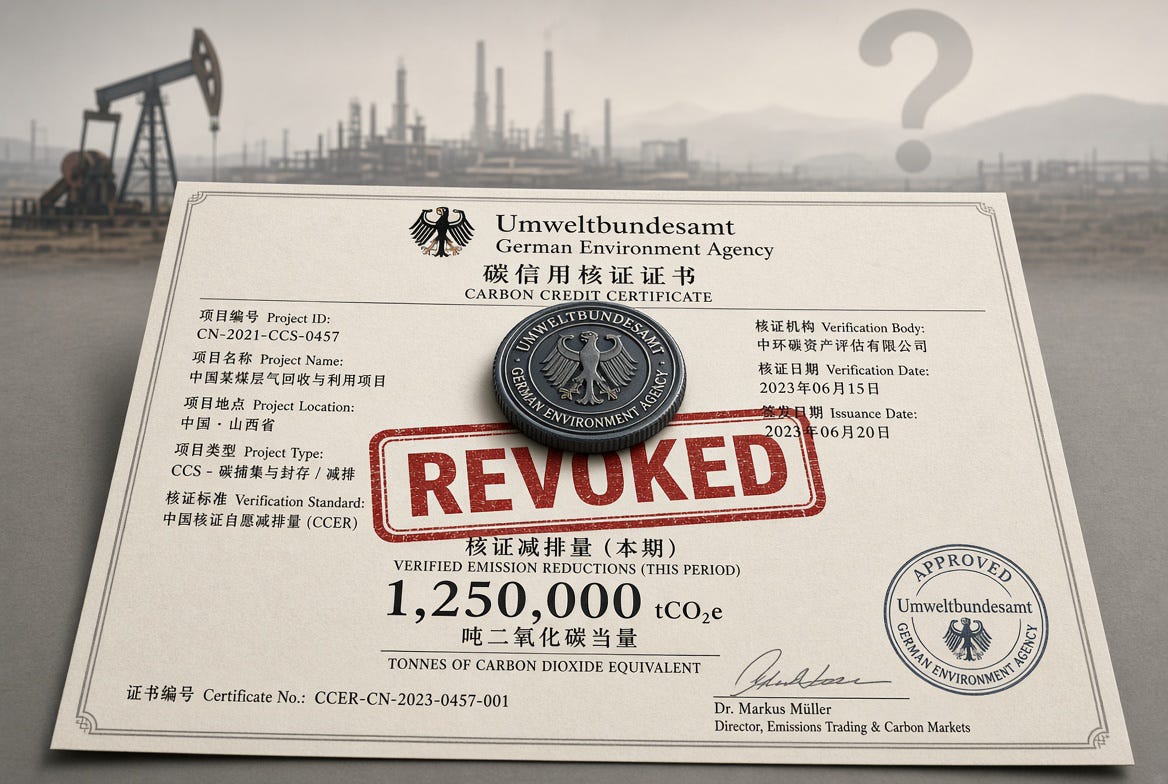
German authorities just revoked carbon credits for 30 Chinese projects that claimed to reduce carbon emissions from fossil-fuel extraction. Bloomberg reported the details this week. The projects were found suspicious, overstated, or outright fake. One of them had been purchased by an ExxonMobil unit. The total claimed savings: 2.1 million tons of CO₂—roughly the yearly exhaust of half a million cars.
Energy companies that bought the voided credits now have to make up the shortfall. No big penalties for the buyers, the Germans say, because they acted in good faith under the rules as written.
This is not a minor accounting error. It is the latest chapter in an energy scandal that first broke into public view in 2024 under Germany’s Upstream Emissions Reduction scheme. That program let oil and fuel companies buy certificates for projects supposed to reduce emissions before crude even reached the refinery—mainly by capturing gas that would otherwise be flared or vented.
Most of the projects sat in China. Auditors in Europe stamped the paperwork. German officials, short-staffed and relying on remote reviews, approved them. Companies paid China. Credits were claimed against European climate targets. Then, the inevitable cracks appeared.
International investigators ultimately found projects that did not seem to exist when their reporters and analysts checked coordinates, satellite images, and drone footage. Some sites even lacked the equipment the documents promised. Others looked like older facilities dressed up as new ones—eligible only if they were additional.
A Chinese consultancy, Beijing Karbon, kept turning up in the paperwork through layers of shell companies. An auditor who also worked on the development side of the same projects raised obvious questions about conflict of interest.
Finally, police raided European verification firms. A criminal probe into their individuals was later closed for lack of evidence. The companies themselves largely walked away. Credits were withdrawn. The system is now being shut down.
China is not the only place where carbon-credit schemes have produced more paper than progress. But the pattern here is hard to ignore.
Beijing talks a green game on the international stage while continuing to build larger coal capacity at home and abroad. In the meantime, absolute carbon emissions continue to rise at an alarming rate, even as intensity targets and carefully worded pledges are waved in front of Western audiences.
Official global statistics on energy, environment, and growth have long been treated with caution by serious energy analysts. When the same system that produces those numbers also supplies the carbon credits Europe was using to meet its own targets, the EU’s trust problem doubly compounds.
In practice, these carbon credits have often become a transfer of money for claims that are almost impossible to verify and easy to inflate. The German case shows what happens when verification is outsourced: on-site checks are rare, if not nonexistent; verification is nearly impossible; trust issues are historical; and the incentive to produce plausible carbon emissions documents is strong.
Nonetheless, European governments ran the scheme. It is worth noting that the program is called the Emissions Trading Scheme (EU-ETS).
Private auditors signed off, and Chinese project developers supplied the sites—the result: millions of tons of claimed reductions that authorities later deemed untrustworthy.
This is not abstract. Real money was wrongly moved. Companies bought credits to meet legal obligations designed to force lower emissions in the transport fuel chain.
So, when the emission credits evaporated, the atmospheric benefit that was supposed to have been purchased disappeared with them.
Unsurprisingly, the atmosphere does not care about paperwork and never did. It only cares about molecules. If the projects never delivered the emission reductions, the EU’s claimed progress was just an accounting fiction of biblical proportions.
Energy humanists, me included, have been saying this for years. There has never been a measurement and verification process for carbon emissions that satisfies any accounting protocol.
In reality, abundant, affordable energy is the foundation of modern health, mobility, and prosperity, and chimeric offsets that fail basic scrutiny do not deliver on any of those promises.
They create the appearance of action while the hard work of building better systems—nuclear, natural gas, coal with modern scrubbing, efficient infrastructure, real technology that works without permanent subsidy—gets delayed, distorted, or never started.
No doubt, China understands power and industrial capacity, and it has demonstrated the ability to scale manufacturing and infrastructure at remarkable speed. Certainly, that same capacity can produce impressive-looking project documents.
Finally, the question is whether outsiders should continue writing checks based on those documents, especially when measurement and verification is impossible.
In the end, trust is not a renewable resource. It is earned by consistent, trustworthy performance. So, when a major supplier of carbon credits has a documented pattern of projects that do not hold up under scrutiny, buyers and policymakers have every right to demand higher standards or to walk away. They are fools if they don’t.
The same skepticism should apply more broadly, where official Chinese data on emissions, energy use, and environmental outcomes has repeatedly required later revision or independent challenge.
Consequently, any arrangements that rest on those data inherit the same risk: Belt-and-Road green projects, climate-related lending, and joint ventures all carry the same verification problem.
No doubt, Europe’s own climate architecture has encouraged this dynamic, while ambitious targets plus limited domestic options created demand for cheap external credits: China supplied them.
Closing the UER program is a start. Treating future international emission credits with the utmost skepticism would be better.
Common sense from the heartland still applies: If a deal looks too good and the documentation cannot be checked on the ground, assume systematic and permanent risk.
Ultimately, China’s industrial information is not a fact; its willingness to sell the world carefully packaged environmental claims and carbon credits is. The question is: how long can the market keep buying both the claims and the financing packages built on them? It simply is not a choice.
The German revocation is a data point, not the whole story. It is a clear one. Paper reductions of carbon emissions that vanish under investigation do not reduce atmospheric carbon concentrations. They only reduce the credibility of the EU-ETS systems that produced them.
Energy humanism for 8 billion people starts and ends with that distinction, demands proven energy sanity and an end to energy poverty.
######
https://www.gofundme.com/f/support-stephens-energy-mission
Stephen Heins
The Word Merchant
Sheboygan, Wisconsin
steve@heins.net
920-917-8644
Comments
Nothing yet. Say the first thing.
Sign in to join the conversation.