
Good morning! I hope this finds you well. Thank you for reading this edition of my newsletter. If you’re not currently subscribed, click the button below to receive my weekly reflections.
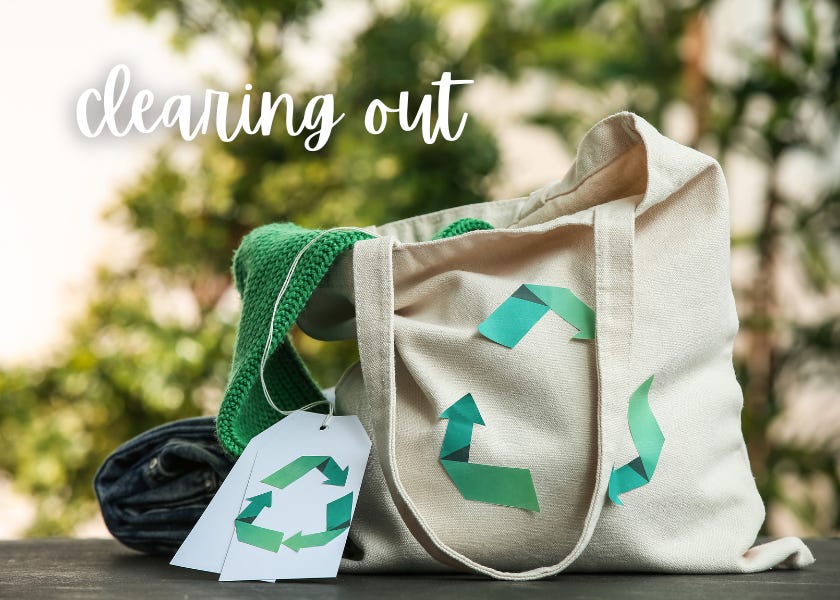
Our house is in the midst of a major spring clean. For some reason, I have a postpartum nesting instinct. Having two kids has made me realise how much stuff we have that we don’t need, use, or even want. And so, we’ve been clearing out. There’s been a somewhat ruthless approach so far, but there’s one thing that I’ve been struggling to let go of… my clothes.
I can always seem to justify hanging on to something, just in case I might want it for some random occasion that isn’t particularly likely to occur in the immediate or even distant future. It was good that one time, I say to myself, and so I hang on to it in the hopes that it will feel that good again at some other point. Even if it doesn’t quite fit me anymore, I hang it back up in the wardrobe. Y’know, just in case my body goes back to the way it was long ago.
While it’s good to clear the unused and unloved things out of our closets and dusty storage cupboards, some things are certainly worth hanging on to. You can’t, nor shouldn’t, get rid of everything and start over. And so, I decided to make a list of the types of items I wanted to keep and added a somewhat arbitrary number to each. I’d keep 2 pairs of boots (one tall, one short), 3 hats (two for winter and one for summer), 3 blazers, 6 sweaters, etc. You get the idea.
At the moment, these numbers remain guesswork. I haven’t sat down with all my clothes out on the bed (as perhaps the likes of Marie Kondo would suggest). But I have found that each time I get clothes out of the dryer, I separate the pile into items that ‘spark joy’ (abiding by Kondo’s famous instruction) and those that don’t. The things that don’t spark joy are immediately tossed into a bin bag in preparation for a charity shop collection that has already been scheduled for two weeks from now.
In the ruthless slimming down of my wardrobe, I realised that the most basic (and therefore most flexible) items are the things that are most likely to stay. A solid black T-shirt is more likely to be worn than a bold printed one that I only feel an affinity for very occasionally. It is good to hang on to the basics.
Available for iOS and Android
Matthew 6:9-15
In today’s passage, Jesus continues his instructions on prayer by teaching a sequence of prayers that we today know together as the Lord’s Prayer. It has a somewhat similar intention to clearing out one’s wardrobe and sticking with just the basics. Jesus has just spoken about the way the religious leaders at the time used unnecessarily long prayers to present themselves as more righteous. And so, in the verses for today, he presents the crowd with some simple lines as all that they need.
Much ink has been spilt over the particularities of the individual phrases found in the Lord’s Prayer, so I won’t dwell on them. I am much more interested today in the brevity and simplicity of this prayer. Even though many complex theological ideas are expressed within it, we know that this was easy to remember and engage with. The words still carry such significance that congregations in churches across the globe will repeat them every Sunday.
And it’s not just that the words are significant; they cover a multitude of experiences. It doesn’t matter what kind of day, week, or month you’ve had. We still need ‘daily bread’ and to be led away from temptation. We always need to forgive and be forgiven. Like the plain black T-shirt that goes with everything else in my wardrobe, these words can be used at any time in any place.
I am challenged this morning to go back to this ancient prayer of Jesus and say that instead of my usual more extemporaneous thoughts and musings. It’s not that saying long prayers for the things on our hearts and minds is bad. But, as I discussed last week, God knows what we mean and what we need even when we can’t find the words.
For example, when a plane I’m on hits particularly bad turbulence, I often recite the Lord’s Prayer under my breath. In that moment, I’m not asking for my sins to be forgiven (although that never hurts as a request!) I’m instead praying that we make it through the turbulence, preferably without either of the people beside me being sick. I don’t know if my recitation of these words from Matthew 6 makes all that much difference to the plane’s ultimately successful landing, but it does make me feel a lot better. God knows that I need peace in that moment above all else, even though I didn’t ask for it explicitly.
So, as you clear out your mind today of all the things that might be racing through it, perhaps pray the words from Matthew 6. You might find that having the words already given to you helps you switch gears a bit. Imagine how your prayer life may differ if you incorporated pieces of liturgy, ancient prayers, poems, or even music. Sometimes using the words that others have written can open our imaginations and yet also shut out the noise.
Clear-outs are worthwhile endeavours, but don’t forget to hang on to the things that have, and will, stand the test of time.
Thanks for reading Stephanie Addenbrooke Bean's Substack! This post is public so feel free to share it.
I hope this was helpful, or at least provoked some interesting thoughts. Please feel free to send it along to someone and encourage them today. If you want to connect with me in other ways, you can follow me on Instagram.
With much love and gratitude,
Stephanie
No posts
Comments
Nothing yet. Say the first thing.
Sign in to join the conversation.