
Over the last two years, AI has experienced significant acceleration: more spending, more infrastructure, more capability. Last week, four separate developments suggested that this acceleration may be slowing.

Companies are second-guessing their aggressive AI spending as the technology weighs on margins. AI was pitched as a way for businesses to cut costs through productivity gains, but many organizations are now facing ballooning IT bills instead. Uber reportedly spent its entire 2026 AI budget in four months, and its leadership acknowledged there isn’t yet a proven link between heavy AI adoption and useful customer-facing products.
“If you’re not actually able to draw a direct line to how [many] useful features and functionality you’re shipping to your users, that trade becomes harder to justify,” Uber COO Andrew Macdonald said.
However, a recent study from Gartner predicts that costs for GenAI providers could decrease by over 90% and be one-hundred times more efficient by 2030.
“These cost improvements will be driven by a combination of semiconductor and infrastructure efficiency improvements, model design innovations, higher chip utilization, increased use of inference-specialized silicon, and application of edge devices for specific use cases,” said Will Sommer, Sr. Director Analyst at Gartner.
The gap between AI spending and AI value is what we’ve addressed before: organizations that deploy a technology without training their people to use it well end up with a cost without capability. If companies, who have far more resources than most schools and training providers, are struggling to show return on AI investment, that’s an indication that “adopting AI” and “using AI effectively” are very different.
On June 2, President Trump signed an executive order titled "Promoting Advanced Artificial Intelligence Innovation and Security," directing federal agencies to establish a framework for the secure deployment of frontier AI models. The order asks AI companies to voluntarily submit their most powerful models for government testing up to 30 days before public release, directs federal agencies to develop benchmarks for assessing AI models' cyber capabilities, and for them to create an AI cybersecurity clearinghouse.

“Advanced A.I. capabilities make our nation stronger, but also introduce new national security considerations that require coordinated action across executive departments and agencies,” the order said.
The order represents a shift toward federal oversight of AI after a long stretch of hands-off policy, and reporting suggests financial services concerns about AI-enabled hacking and the potential fallout for markets played a significant role in pushing it forward. The order also directs the Department of Justice to treat AI-assisted hacking and unauthorized access as a high-priority enforcement area.
This is likely the beginning, not the end, of AI oversight conversations. Just as pharmaceutical products undergo extensive review processes before reaching the public, it’s reasonable to expect that new AI models will face increasing scrutiny over time. For educational institutions and workforce organizations building AI literacy programs, this is a good moment to make sure your curriculum includes not just how to use AI tools, but how to think about AI governance, security, and responsible deployment. Your students and trainees will be entering a workforce where these questions are becoming standard business considerations versus abstract policy debates.
Even as some companies reconsider their AI spending, the largest players are doubling down. Google raised its capital expenditure forecast and now anticipates total 2026 capital expenditures between $175 billion and $190 billion, with combined 2025-2026 spending potentially exceeding $270 billion, all of it earmarked for data centers and computational infrastructure. The company executed an $84.75 billion equity raise, including a $10 billion private placement from Berkshire Hathaway, to fund the buildout.
Google has also committed over $500 million toward water, wastewater, and water reuse infrastructure in the communities where it builds data centers, working with local utility partners to help update public water systems. That commitment isn’t incidental, it strives directly to address what could be a significant challenge.
According to a recent Gallup survey, 71% of Americans would oppose a data center project built near their homes, including 55% who would "strongly" oppose. This is a dramatic shift from just nine months ago, when the public was evenly split. As of March, more than $64 billion worth of data center projects had been blocked or delayed nationwide due to local opposition since May 2024.
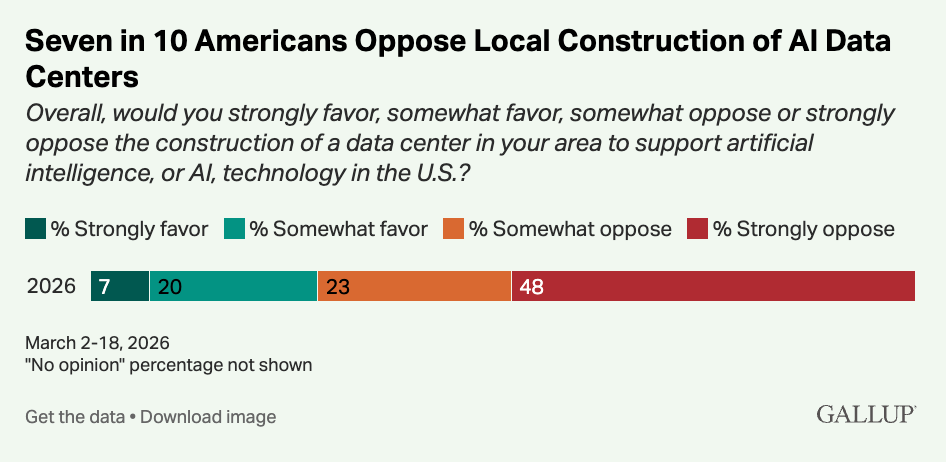
In Hilliard, Ohio, a midterm battleground, residents have become furious over a data center built near a playground and elementary school. Data centers and AI are becoming a defining issue in the 2026 elections, with candidates from Virginia to Wisconsin running campaigns centered on opposing data center development.
Interestingly, two-thirds of respondents support building data centers somewhere in their area, just not in their backyards. 55% of participants cited the economic benefits and increased job opportunities, and specifically, 13% mentioned increased tax revenue, housing and infrastructure development, and general economic benefits.
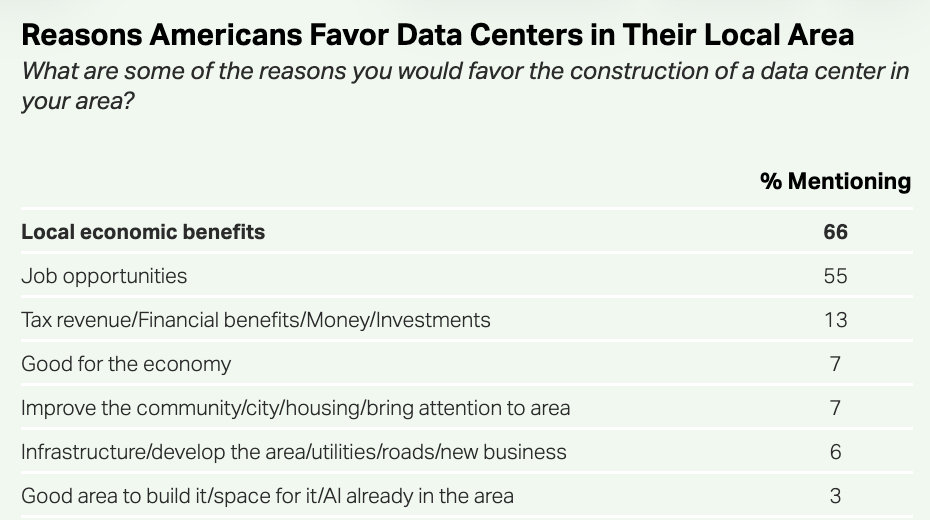
The AI infrastructure buildout is enormous, expensive, and increasingly controversial, yet the basic question of whether businesses and organizations are getting value from AI development and implementation remains unresolved. Federal oversight is starting to catch up, and the public is pushing back on the impact of this technology in their communities.
Building AI-ready talent pipelines goes well beyond developing technical skills. It also involves preparing people to operate in an environment where AI deployment raises questions about its efficacy and costs, increased regulatory attention, and real and perceived community impacts. The students and workers entering this landscape will need to understand AI capability alongside AI governance, infrastructure realities, and the social and political dynamics around where and how the infrastructure required to support technology gets built.
For our STEMCONNECTOR community of practice, including educators, employers, workforce organizations, and policymakers, we all need to consider whether our programs are preparing people for all aspects of the bigger picture, or just for skills required for the technology itself.
No posts
Comments
Nothing yet. Say the first thing.
Sign in to join the conversation.