
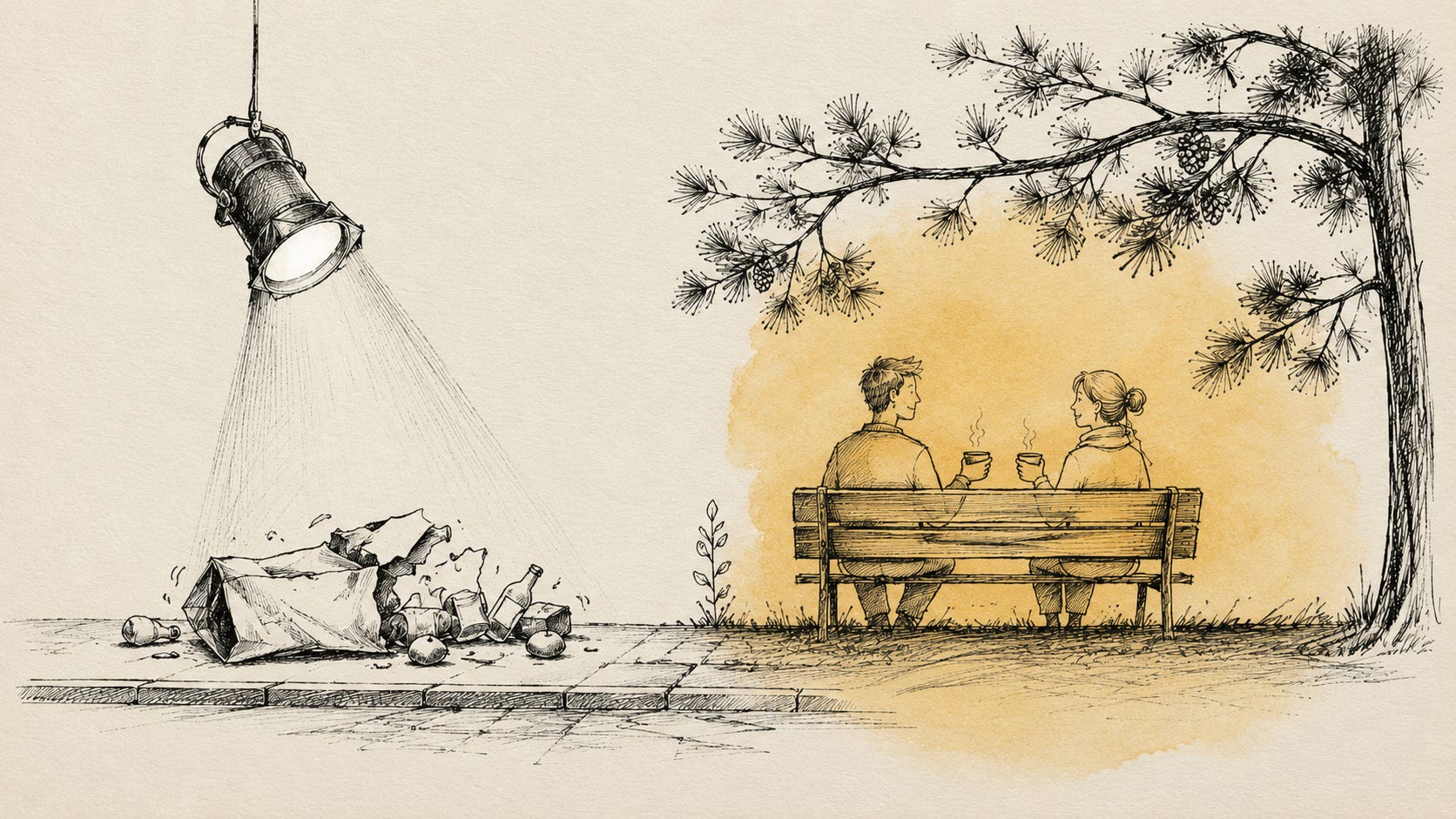
It’s so annoying when you’re having a bad day, isn’t it?
A parking ticket, your grocery bag rips right as you’re crossing the street—scattering your entire haul across the pavement—your computer saves your last document with a fatal error, and to top it off, a microscopic splinter pierces your finger. Thank goodness someone had the brilliance to invent ice cream cakes. And social media, with its infinite news feeds.
And above all, coffee. Yes, coffee! That dark, strong potion whispering mysteriously from the depths of its foam: “Here lies the key to all your problems… though I’m not entirely sure which cup holds it. So drink another one, maybe you’ll hit the winning batch.”
Having a bad day is, without a doubt, traumatizing. Nobody asks for it. There isn’t a soul alive who wakes up in the morning, stretches lazily, and says: “Aaaah! What a glorious day for everything to go completely haywire!”
But isn’t it strange when it happens anyway? It feels as if someone is actually sitting at a master control panel, deliberately throwing hysterical clerks, pigeons with digestive issues, and rusty nails into your path just to deflate your tires. But hold on a second—when on earth did we sign a contract to star in a real-life version of The Truman Show? Because I certainly don’t recall receiving a paycheck for it.
Sometimes these phenomena genuinely scare me. On one hand, you wait for some cosmic alignment—for Mercury to enter the house of Leo and Mars to exit Aries (I have zero clue what these astrological real estate transactions mean, but they sound intriguing). A magical window lasting a day or two, during which a tiny gnome hidden among your neurons shouts: “Ha-ha! Twelve years of non-stop success start now!” And indeed, for a couple of days, flowers seem to smile a bit warmer, there’s less dust on the streets, and—you won’t believe it—the green light at the intersection seems to last four seconds longer. But that happens rarely.
On the other hand, the rest of the time, when it comes to unfavorable alignments… Good Lord, it’s as if the planets have lost their minds. Didn’t they have neat, orderly orbits around the sun? What’s with this total chaos? How do they manage to pull off so many random twists that the trolleybus breaks down precisely when you’re in the biggest rush?
I often catch myself living with the absolute conviction that the entire universe is conspiring against me. Yesterday, my pen leaked all its ink into my bag. Libra in conjunction with Mercury is to blame—I’m 100% sure of it. How wonderful to finally find who’s responsible! Now I can sleep peacefully, dig my spoon into the ice cream cake, and keep scrolling to find where Facebook’s wall finally ends.
Remember that scene in The Truman Show when, out of nowhere, a studio spotlight falls straight out of his world’s artificial sky? The main character stares at it for a long time, utterly baffled as to how a light fixture could just drop from the heavens. Yet, it’s the exact detail that makes him start questioning everything.
That’s precisely how a spotlight fell on me… not quite on my head, but close enough, when I rediscovered an idea that shook me up. I briefly mentioned it in Wednesday’s podcast episode, but I feel I need to repeat it to myself until it fully sinks into my system.
Long ago, back when I thought like an Australopithecus, I was fascinated by the idea of humans evolving from apes. I’d look at those hunched-over Pithecanthropus figures and feel rather proud to have landed a pretty sweet spot on the evolutionary ladder. I mean, my poor ancestors were bashing each other with bananas and fearing fire, while I, a privileged child of history, could play Mortal Kombat on an Intel Pentium 2 PC. I viewed Darwin’s theory with an almost religious reverence: Yep, the strongest wins the race. Obviously. Game Over!
For years I believed this, because everything around me fit that narrative like a glove. In school, teachers warned us that “competition is fierce.” In high school, they drilled into us that “university spots are limited and you have to fight for your place.” On my very first day of college, the professor greeted us grimly: “Watch out, tuition-paying students are breathing down your necks, and professional life is a jungle!” And my parents? What else could they say? “You have to study, son, because the world is… well, it is what it is.”
We’ve been programmed our entire lives to see the other person as a potential rival, an enemy, someone trying to steal our spot. The “survival of the fittest” theory soaked into us like oil spilled on a brand-new pair of pants bought from the mall. You’re not strong? You’re destined for extinction.
And so, a new species emerged: Homo I-Can’t-Do-Anything-us. Or the victim-human. You don’t have power? Bad luck, see you in another galaxy.
And now… the second spotlight falls out of nowhere.
Hold on a minute! I’ve heard a different story. I’ve heard that human beings were created to be creators. I’ve met wonderful people who care for others without asking for a single thing in return. I know individuals who sacrifice their time and health just so complete strangers can be okay. People who stand as living proof of a scandalously simple idea: humans are built to live in cooperation and love.
I did a little digging through history and found something fascinating. This harsh concept of “survival of the fittest” didn’t even belong to Darwin in the way it was sold to us. The idea that the future belongs solely to the strong was heavily pushed by Herbert Spencer—the father of what we call today “Social Darwinism.” A Victorian aristocrat drinking tea from gold-rimmed cups served on silver trays, conveniently convinced that his wealth and status were simply “the natural result of evolution.”
And to top it all off: Charles Darwin himself explicitly wrote that, in higher species (and especially in humans), empathy, altruism, and cooperation are the primary evolutionary advantages that ensured the survival of new generations. Not the clenched fist, but the extended hand.
Let’s Exit the Set
So, is it clear now? To me, it’s becoming clearer every day. We’ve been living an illusion. Having a bad day is nothing more than the reflex of a constant state of tension—a low-simmering fear that makes us see every minor inconvenience as a threat to our safety.
Thank God the trolleybus broke down! Maybe I wasn’t supposed to get there after all.
Got a microscopic splinter in your finger? A gentle alarm reminding you to be more present and attentive.
Pigeons messing up your favorite hat? Wonderful, how amazing it must be to fly!
I am a human among humans—what a massive gift to be surrounded by so many hearts capable of receiving and giving love.
Finally, I invite you to try a simple exercise for the upcoming weekend:
Pick an incident: Recall just one annoying event from recent days (you’ll surely find one out of the dozens available).
Shift the frame: Look at it from a different angle. Is there a subtle lesson hiding in there? Or was it just a meaningless, trivial occurrence?
Add a touch of humor: Try viewing it with amusement, grace, and relaxation. How could it turn into a scene from a Laurel and Hardy comedy?
The moment you can laugh at your little daily disaster, you gently step out of the victim role. You walk right off the soundstage where Episode 4583 of “Fear and Indignation” is playing on a continuous loop.
And the absolute best part? Once you leave the set, you’ll inspire those around you to do the exact same thing.
Thank you for choosing to live courageously, for being an inspiration, and in doing so, making this world a little bit better!
Warmly,
Ștefan
P.S. — Speaking of unexpected plot twists and computer glitches: as I was finishing the audio version of this newsletter, my screen froze completely and I had to start from scratch. A gentle, cosmic reminder to practice what I preach!
If you feel like the noise of the world is constantly trying to dilute your sense of meaning, I warmly invite you to step into a quiet oasis. My book, “DARE! A Practical Guide to Breaking Free”, was written precisely for moments like these—a warm, honest handbook to help you break away from gray routine, rediscover your courage, and anchor your mind in hope and gratitude, even when the sky feels like it’s falling.
You can find the English edition on Amazon here:
Thank you for being here, for reading, and for choosing to cultivate light in a world that so deeply needs it.
No posts
Comments
Nothing yet. Say the first thing.
Sign in to join the conversation.