
Middle Range Strikes
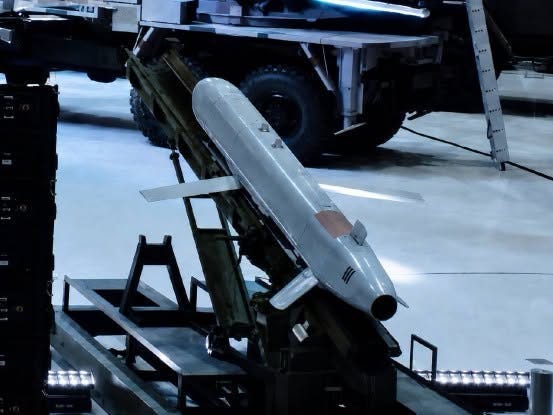
The major news here is that the Russian anti-ship strikes are continuing and they have succeeded in shutting down the greater Odesa port complex by making insurance for grain shipments too expensive for the grain to be shipped from Odesa. This will push Ukrainian grain onto barges, into storage, onto trains and into domestic consumption, but no matter the alternative, this is bad news for the Ukrainian economy and especially Odesa. The Russians, meanwhile, upped use of a jet-propelled drone they call the Banderole, which per Russian tactics is best used hitting port facilities, right now Odesa is the ground zero for that weapon.
https://www.kyivpost.com/post/81406
As far as companies, the large international producer of vegetable oil, Allseeds, has suspended operations in the Odesa region because of Russian attacks on the port, logistics infrastructure and ships carrying grain. They said they would get back to work once the security situation stabilizes. Here is a write-up of a ship the Russians hit with cruise missiles that finally sank, and how the two sides are trading blows against civilian shipping. On Tuesday reports surfaced that Maersk likewise was freezing operations in Ukraine until things got safer.
https://www.kyivpost.com/post/81154
The point is, an active front in this war, and this as been the case for wars in this region for millennia, is grain shipments to the west. These days, he who controls the sky controls the grain shipments, and as we can see Russia and Ukraine are fighting over that.
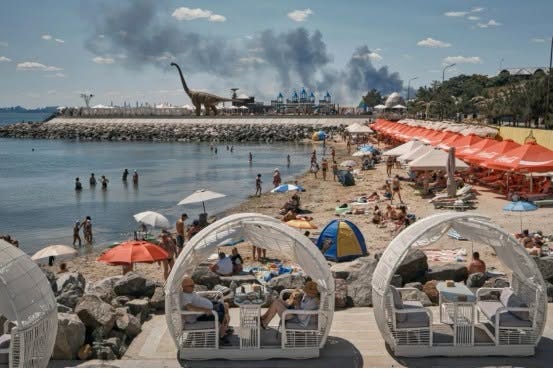
On the Ukrainian side, probably the main middle strike news of the week came on Tuesday, when Brovdi of the SBS announced his aircraft had established full fire control over the Sea of Azov and north-eastern Black Sea, Ukraine is now confident Russia can’t move a ship through those waters without a Ukrainian drone strike. This is a function of drones both strike and observation, and drone operators, in quantity, along with a Russian air defense network that is badly damaged and seemingly unable to recover. Ukrainian confidence that they can maintain the overwatch is high.
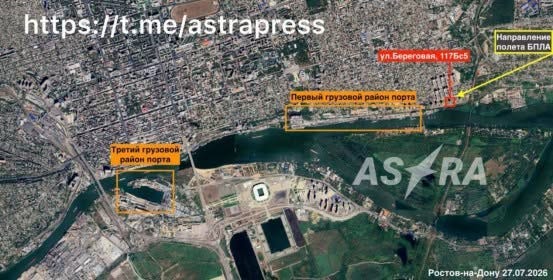
As noted last week, most of the ships that had been anchored in the Sea of Azov waiting for a turn to cross the Kerch Strait fled up the Don River to Rostov where, if satellite imagery is to be believed, a good-sized chunk of Russia’s entire shadow tanker fleet is sitting idle. My notes say that it took the Ukrainians 48 hours to shift focus to Rostov and on Sunday and Monday at least we saw the preliminary strikes, predictably against Rostov air defense installations.
We have seen this tactic repeatedly: the Ukrainians find a target, they first degrade the air defenses, then they attempt small strikes to find more air defenses, then they attack to damage or destroy the air defenses or simply to run the air defenses out of missiles, and once the Russians stop shooting from the ground effectively, they send in the strike drones.
Among others, on Sunday, Rostov-on-Don, drones hit a 92N6E Grave Stone radar station and its antenna tower, both part of an S-400 Triumf air defense system. SBU drone operators were credited, this also is the standard Ukrainian playbook, the most difficult and earliest targets usually get hit by the SBU or HUR. Other air defenses destroyed in the strikes, reportedly, were a or-M2 air defense system, the Pole-21 electronic warfare system, and two FPV drone warehouses were also destroyed.
This is How You Insulate Yourself From Elon Musk and Pete Hegseth
SPAAACE! This is a marker report, we’ve been expecting news like this for some time and now it’s at least being talked about.
The Ukrainian company Stetman announced it will launch a constellation of 360 satellites into orbit via the UASAT LEO project. This will create the first Ukrainian low-orbit satellite communications constellation, which for Ukraine isn’t nice to have, it’s national security. Right now Ukraine depends on Elon Musk’s Starlink network for most of its tactical communications and the US military network for guidance of high-end NATO munitions like ATACMS and Storm Shadow, and for strategic intelligence on where Russia is launching ballistic missiles from and where Russia’s air defense radars are.
As has already been demonstrated, loss of access to either of these two satellite data feeds leads to more Ukrainians killed and injured by Russian armed forces, and the Americans have jerked Ukraine around with both more than once in the past 18 months.
According to industrial reports, Stetman might be roughly considered the satellite version of the Ukrainian drone/missile company Fire Point, it’s a group of specialists who are private, not government, yet have substantial government support in the sense that the government seems to approve of them being the lead company in a critical national security sector. A reasonable deduction would be this is the Zelensky government bypassing existing government agencies which might be inefficient, corrupt or, if you hate Zelensky, not willing to share income with Zelensky.
In any case, in 2025, Stetman licensed technology from Swedish satellite terminal manufacturer Requtech to enable domestic production of advanced satellite terminals in Ukraine. Capital for that could have come from the dark cloud, evil oligarchs, smart tech capital, or just a nod and a check from the Swedish government. Who knows. In 2026, Stetman announced a joint venture with Danish space company GomSpace, the plan is to manufacture satellites and comms equipment.
The driving objective is to give the ZSU secure communications channel independent of foreign operators, but as we have already seen with drones, the Ukrainians are very skilled at identifying business opportunities that will follow from their war experience, and whom they intend to put out of business with better products at lower price. I read that the first demonstration satellite UASAT-NANO is planned to be launched into orbit in October 2026 using a SpaceX Falcon 9 rocket.
The orbital constellation will operate at an altitude of about 550 km, and full deployment of the network should begin in 2027, you read that right, next year. Supposedly the network will contain up to 360 satellites, some made in Ukraine and some made in Denmark. So perhaps Danish taxpayers are helping finance this as well. According to the Ukrainian internet, data won’t be as fast and dense as via Starlink but it will allow the ZSU to operate independently of Starlink if it has to.

Crimea Tourism
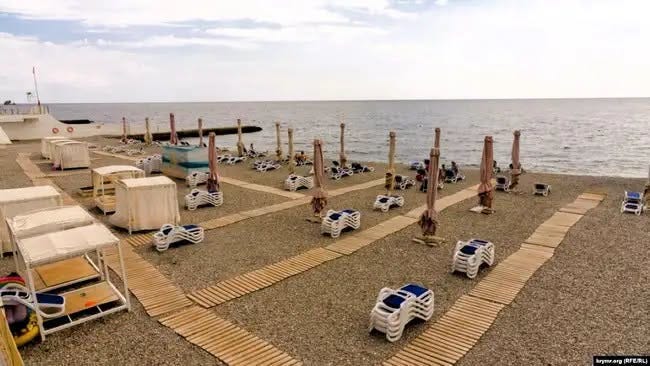
As we might have guessed the Crimea tourist season is the worst since the 1990s, according to industry counts tourists canceled 30,000 package tours worth (about) $20 million. Source is Sergei Romashkin, Vice President of the Association of Tour Operators of Russia (ATOR). According to him this is about 15 percent of the total number of tourists who had actually planned a summer vacation on the peninsula but canceled their trip, this is just the tourists that had booked a package tour to Crimea.
Meanwhile in Crimea, the fuel situation seems to be harsh rationing but if you are willing to wait a few hours you can get your 20 liters, just not every day. Power outages are now being reported across the southern coast, adding to the central and northern regions in Crimea that had been blacked out for some time. I’m seeing reports of substantial towns being without power for a week. This is already well beyond discomfort and a path to pestilence, Crimea in the summer is hot, water is scare, and food won’t keep. In Kherson region there are places that meet the definition of human disaster because of water shortages and lack of access to medicine and law and order. I’m not seeing that, yet, being reported from Crimea.
One possibility is that enough people live in proximity to military bases that the human suffering is not as bad as the reports make out because the Russian state will make sure those places have power and water. Another is that the suffering is being suppressed by the Crimea media, and yet another is that the Crimean people are used to living mostly outside in the summer anyway, so cooking on gas stoves and sitting at a fold up table playing cards in the garden isn’t seen as lowered living standards. One should not discount the factor that in summer many in Crimea traditionally seek means and reasons to avoid work and blackouts are great for that.
But if the Russians fail to get the power working come September, things in Crimea will deteriorate quickly with the onset of colder nights, rains and the Fall school semester.
Drone Business Profits
This is another report from the file of “It’s going to be like former Nazis after WW2” — maybe.
In Tula on Tuesday evening, a gunman ambushed Tula businessman Andrey Cherezov, the head of the Russian drone company Air Transport Laboratory as he was arriving home at night. He got to the landing by the door of his house and was shot three times. The wife heard the noise, opened the door, and saw her husband covered in blood. The shooter escaped. Cherezov was taken to the hospital in serious condition. Authorities have opened a criminal case.
According to the platform Rusprofile.ru, Russian Air Transport Laboratory LLC was registered in Tula in 2022 for scientific research and development in the natural and technical sciences. Translated, this means research and development of heavy drones. Supposedly in 2023, the company’s revenue amounted to approximately US$1.38 million, while its net profit was about $84,000. This is chump change for the Russian arms market, but what we don’t know is how much off-the-books business was done, but since it’s Russia we can only responsibly speculate that there was some.
The authorities have opened a criminal case which will be typical for Russia for decades: When a guy associated with military contracting gets murdered, natural suspects are going to be the Russian mob and Ukrainian special operators, both are always going to be possible.
The Number is the Number, Read Into It What You Want
On Monday, the news came down the pike that in Russia, despite the economic downturn in 2026, a record number of funeral homes and funeral service businesses have opened, the biggest number in five years. Supposedly up by 22 percent, source is Kommersant. This is certainly not the Ukrainians as much as the war sucking up Russian taxpayer money that would have gone to public health.
No posts
Comments
Nothing yet. Say the first thing.
Sign in to join the conversation.