
I recently had the chance to talk with Ray Kurzweil. Sort of.
My interlocutor was Rai, Kurzweil’s digital twin. And at one point, Rai turned the questions on me: what did I think it would take to get more teachers and students actually using AI? Kurzweil’s view — carried faithfully by his twin — is that this technology is becoming an extension of us, and that integrating it into learning, in whatever forms learning takes, is now the work.
Notice the scene: an AI asking a debate coach how to get schools to take AI seriously. The interlocutor was the argument. I gave RAI two answers.
The first is explanation. Most people — including most people running schools — do not yet understand what is happening or its magnitude, and you cannot integrate what you do not comprehend. Explaining this well, over and over, is not a side task. It is the task. It is a large part of why Education Disrupted exists.
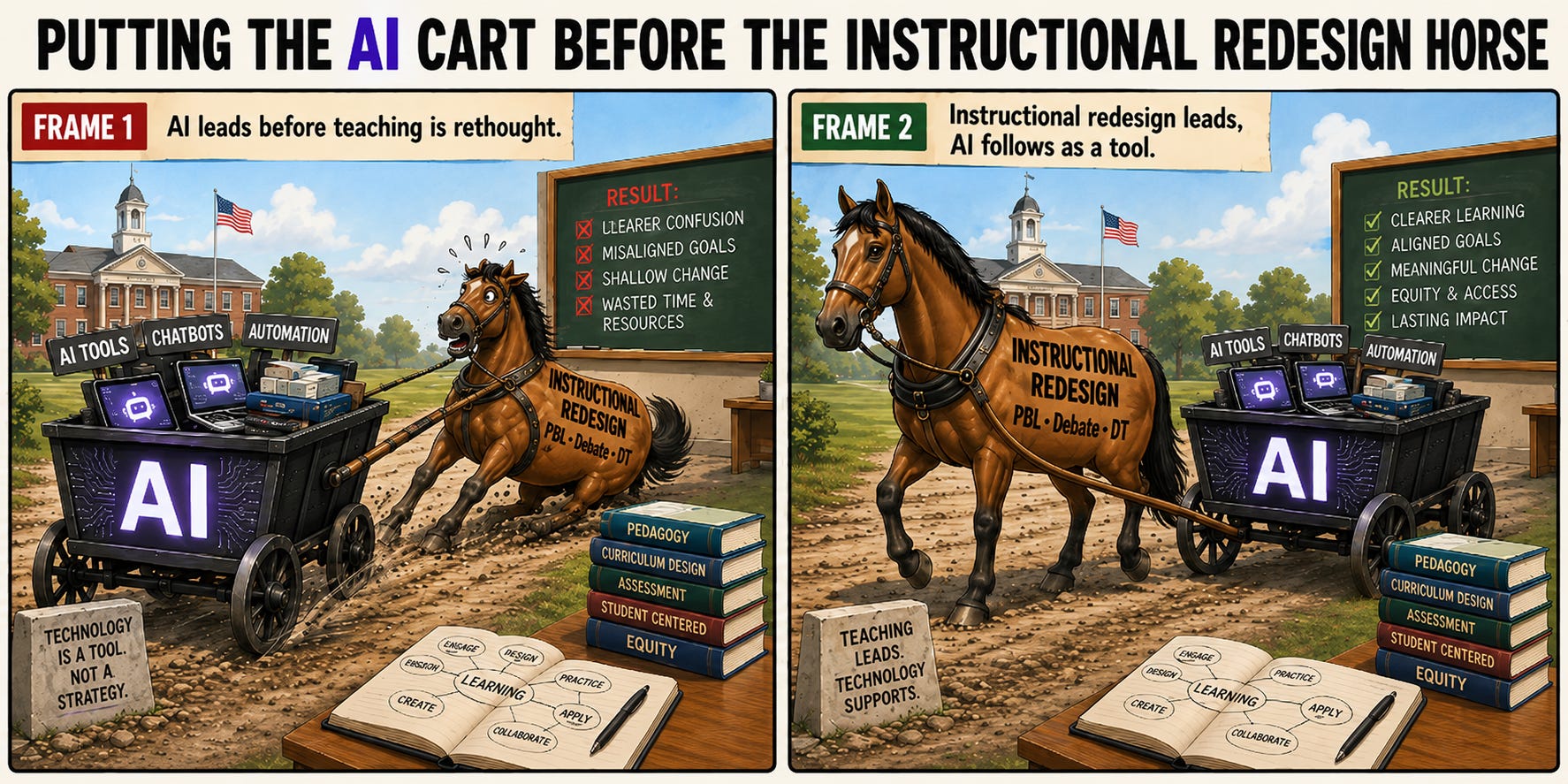
The second answer is the one I want to dwell on, because it is where this week’s materials come from: we have put the AI cart before the horse — the rare arrangement where a** backwards is not a figure of speech but a diagram.
With good intentions, we pushed AI onto schools — chatbot licenses, prompting workshops, tool rollouts — before redesigning any of the teaching and learning underneath. And the assessment underneath is, overwhelmingly, product-based. Something AI can now do better than most humans.
A student makes a thing: a worksheet, an essay, a paper, a project. The thing gets turned in. The teacher grades the thing. That is the assessment engine of American education, and into that engine we dropped a technology whose defining trait is that it gets better at making things every single month. Of course it jammed. Of course it alienated teachers. We handed a product-making machine to students inside a system that grades products, and then acted surprised when the products stopped telling us anything about the students. The five-paragraph essay, undefeated for seventy years (not for thousands of years), lost in a weekend.
The professional development followed the same backwards order. Teachers got sessions on how to use AI — the tools, the prompts, the features — before anyone offered them a session on redesigning instruction so that AI would have somewhere sensible to land. That is the wrong order, and the institutional reflex to the wrong order made it worse: when schools meet a new technology, they quarantine it.
Quarantines happen in direct and indirect ways. Indirect — A separate computer class. A separate elective. A separate specialist down the hall whose job title is “technology.” You cannot quarantine something ubiquitous. We tried it with the internet — one lab, thirty desktops, a sign-up sheet — and the internet declined to stay in the room. AI is not a subject; it is becoming part of the medium of every subject — it will sit inside the history essay, the lab report, the problem set, the rehearsal. The only place to put it is inside regular instruction, in every classroom. And that starts with the instruction itself.
Direct — Get off my lawn. AI doesn’t belong here.
So the sequence has to flip. Instructional redesign comes first. Get teachers running debate in their classrooms — students building cases, defending them out loud, cross-examining each other, judging rounds and giving reasons. Get them running project-based learning. Get them running design thinking. Get them running games. These methods differ in surface, but they make the same structural demand: they decenter the teacher. Not out of the work — the teacher remains central conceptually, as the leader, the coach, the designer of the experience — but out of the attentional center of the room.
Think about why schools confiscated the electronics in the first place: because the model says every student’s eyes belong on the teacher at the front, year after year. The entire accumulated knowledge of the species arrived in every teenager’s pocket, and the institutional response was a locking pouch — in classrooms all over America, the sum of human information now spends first period in a hanging shoe organizer.
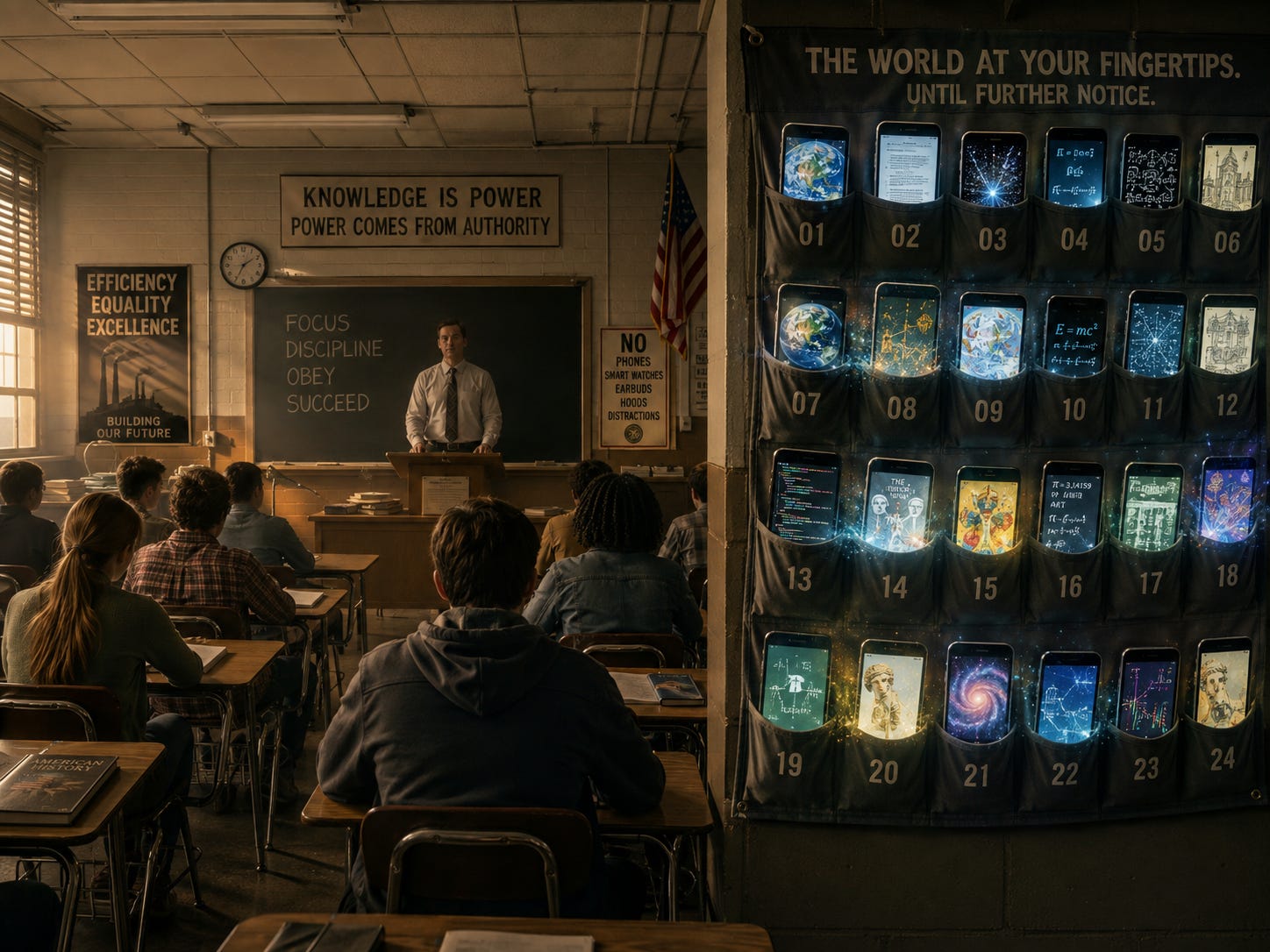
Somewhere right now, a teacher is standing at a whiteboard diagramming the elements of Shakespearean tragedy — hubris, the fatal flaw, the hero who is the last person in the theater to see what the audience has seen all along — while performing every single one of them: one adult at the front of the room, delivering a monologue to thirty people required to watch, in an instructional form now deep into its fifth act. It is the best-staged tragedy in the building, and nobody in the room gets the joke. Let’s be honest — that model was broken before AI arrived. AI just made it impossible to keep pretending otherwise.
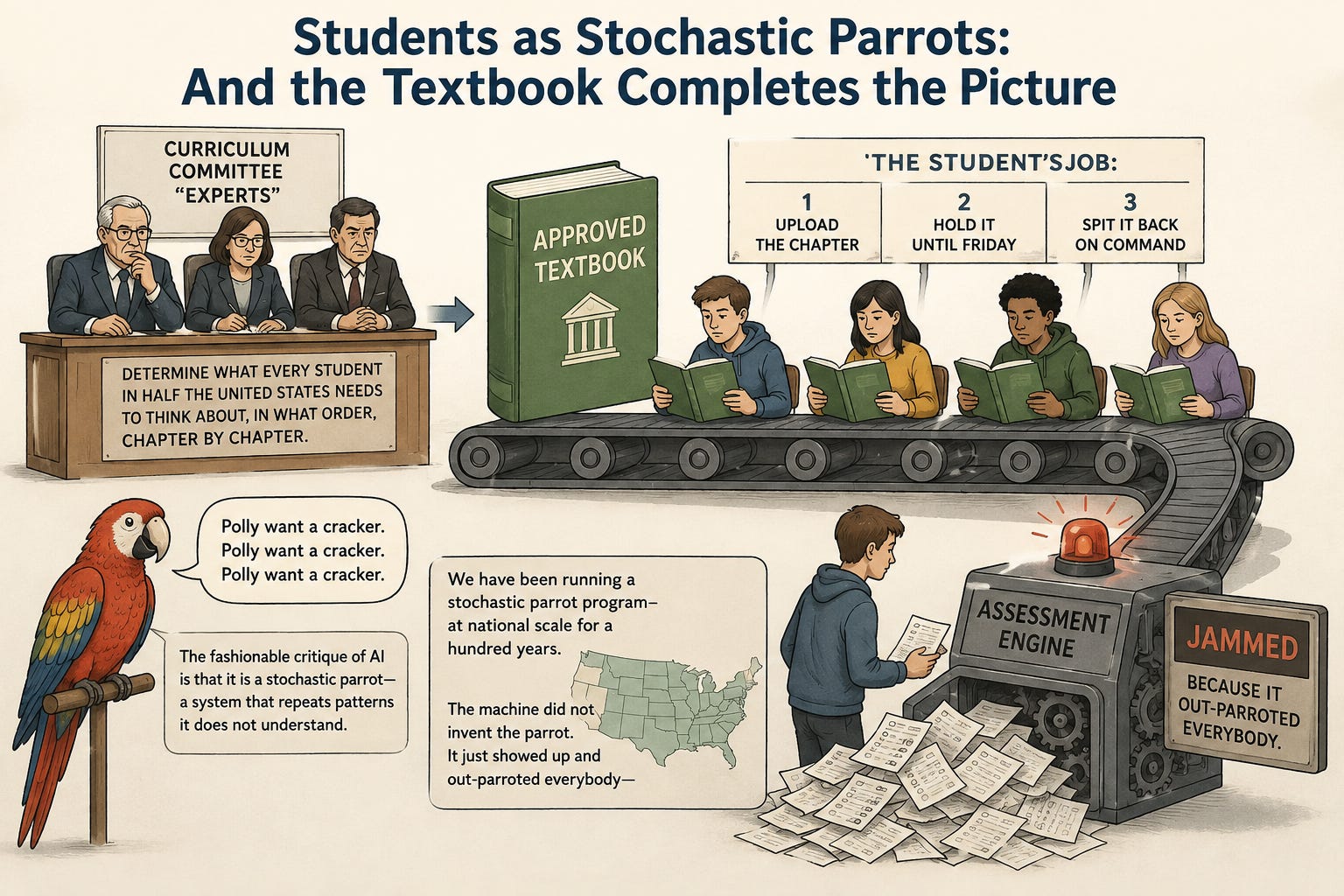
And the textbook completes the picture. Somewhere, a small committee of “experts” — the quotation marks are doing real work — was handed the godlike authority to determine exactly what every student in half the United States needs to think about, in what order, chapter by chapter. The student’s job is not to think about it. The student’s job is to upload the chapter, hold it until Friday, and spit it back to the teacher on command. Now note the irony: the fashionable critique of AI is that it is a stochastic parrot — a system that repeats patterns it does not understand. We have been running a stochastic parrot program at national scale for a hundred years. The machine did not invent the parrot. It just showed up and out-parroted everybody — which is precisely why the assessment engine jammed.
Once teachers have lived inside these methods — debate, projects, design, games — you integrate the AI — not as a product machine, but as a partner — the jam dissipates.
Imagine. A co-teacher. A teammate. A collaborator. This is well-mapped territory: Ethan and Lilach Mollick have laid out seven roles AI can be assigned inside instruction — tutor, coach, mentor, teammate, simulator, even student — each a way of putting the machine to work inside the learning rather than beside it. And Mairéad Pratschke’s Generative AI and Education makes the deeper argument: position AI as a collaborator in the construction of learning, and shift the focus from learning as output to learning as process — which is the shift the product-graded classroom has been resisting all along.
Here is what makes this technology categorically unlike anything schools have adopted before: it can literally participate in the academic game. You cannot debate a calculator. You cannot cross-examine a textbook, or ask a worksheet to defend its warrant. Every prior classroom technology delivered content or processed answers; this one argues back — takes a side, responds to your strongest point, concedes what it should and contests what it shouldn’t. And a student who could never monopolize a teacher for an hour of one-on-one sparring — no class allows it — can spar with this for as long as they can stand it. That is why debate is such a natural home for the integration.
In a decentered classroom, that partnership is natural, because AI is another very smart person in the room. Today, one who occasionally makes a mistake, which is itself pedagogically useful — students will fact-check a machine with an enthusiasm they have never once brought to a textbook. Before long, one who rarely does — a consistent presence, another mind at the table. Drop that entity into rows of desks facing a lecturing teacher and it is a disruption, a cheating machine, a threat. Drop it into a classroom already built on argument, projects, design, and play, and it doesn’t disrupt the instruction at all. It flows with it. The student still has to stand and argue; the machine strengthens the preparation and joins the conversation.
Now watch what happens when you skip the redesign: fear of replacement — justified fear. Put AI into an unredesigned classroom and the teacher hears one message: you are being automated. Bring in a robot that literally looks like a teacher, with no new instructional design around it, and what else would a teacher conclude? In a redesigned classroom, the same machine reads completely differently — a teaching assistant, another interlocutor, a partner for students to practice debating against, one more mind helping the humans in the room do the human work. Same robot. Different instruction. Opposite meaning.
Teachers aren’t the only ones destabilized. School leaders feel it too — bring AI in without a redesign story and the principal is left wondering, reasonably enough: wait, am I leading this school, or is the AI?
Authority without a design underneath it reads as displacement all the way up the org chart. And then the budget objection lands, and it is a fair one: schools are for people, education funding is shrinking, and the AI industry is already commanding investment on the order of a trillion dollars a year — these systems even get better by learning from our interactions with them. So why, exactly, should underfunded schools spend scarce dollars on the one thing in the economy that is not short of money? Sam Altman is not holding a bake sale. Absent instructional redesign, there is no good answer to that question. With it, the answer is standing in the room: you are not funding the machine, you are funding what your students and teachers can now do with it — the debate prep that goes deeper, the feedback that multiplies, the sparring partner who never gets tired. The spend follows the instruction, not the hype.
There is one more failure mode worth naming: amplification. Skip the redesign, and AI’s default job becomes take everything we already do and amplify it — and an entire industry has formed around that very pitch. Every vendor has spotted some existing school routine they can turbocharge — somewhere out there, right now, someone is selling an AI-powered hall pass — and the result is an onslaught of app sales. Then the parents weigh in, reasonably: why is my kid on apps all day? There are so many better ways to use this technology — but better requires redesign, and amplification only requires a purchase order.
This, honestly, is why new forms of schooling are emerging around the edges. They start with the right question — what should instruction look like now that machines can know (almost) everything and think faster than us? — and only then ask where AI belongs, and where it doesn’t.
The status quo runs the sequence backwards: what we have now is the best way of learning ever, we’re changing nothing, and please don’t let it replace the thing we do. Sit with how strange that is. We were handed something close to a genie, and the first official request was lamination. Systems that pass the bar exam are generating word searches. A mind that can teach any subject on the planet has been assigned to reformat the worksheet.
And the please don’t replace us part makes sense! If you teach for a living, you don’t want to be automated out of it. If you’re a parent, you don’t necessarily want your kid taught by a robot. The resistance is rational. It’s the frame that’s broken — and it broke the moment we decided not to do instructional redesign first. That is the core problem. A school that keeps saying we need tech, go get more tech without redesigning instruction first will keep buying, and keep accomplishing nothing —
Comments
Nothing yet. Say the first thing.
Sign in to join the conversation.