
Every major high school debate topic for the 2026-7 season runs through artificial intelligence. Here’s what that actually looks like — and how you can help.
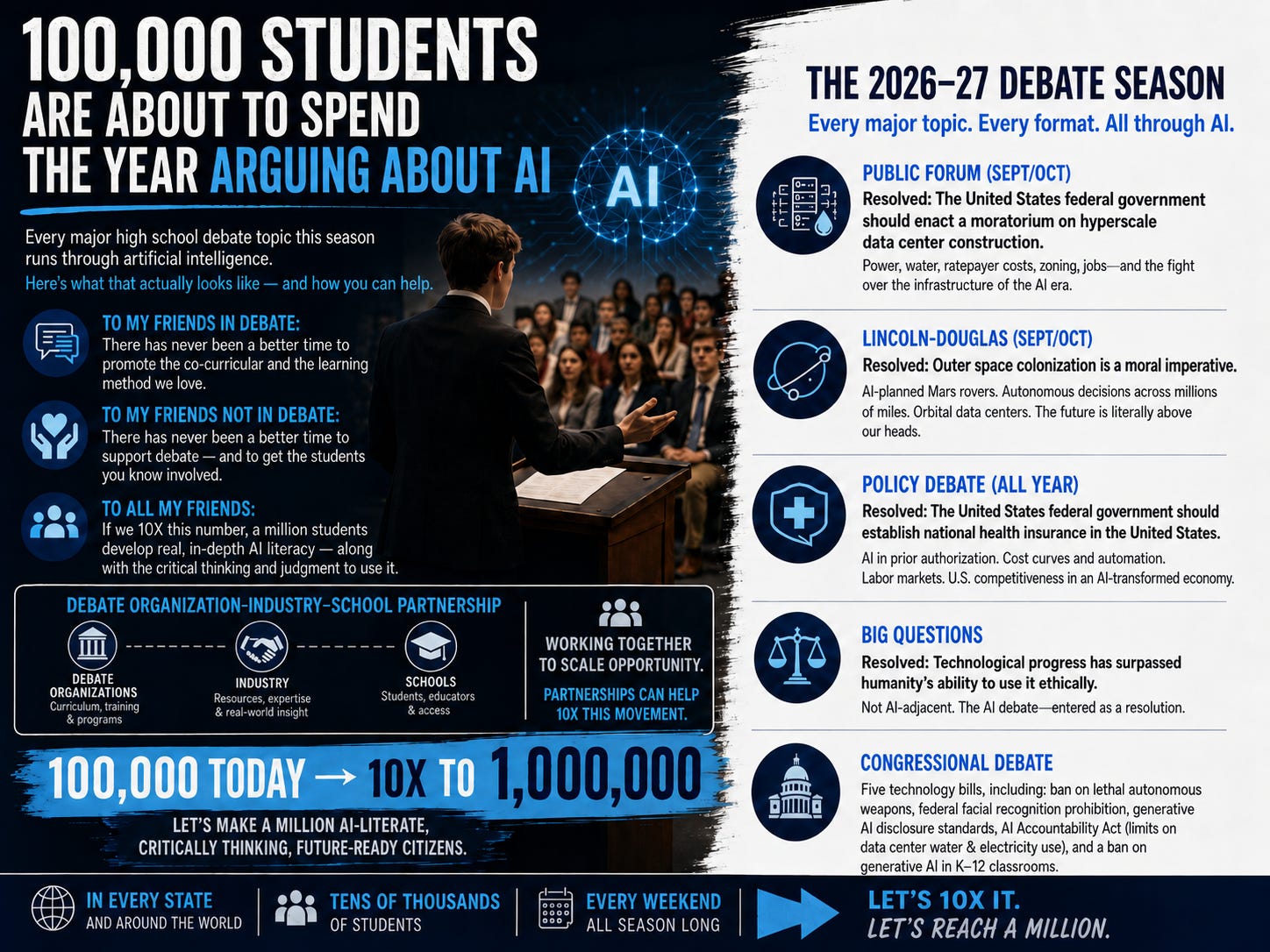
To my friends in debate: There has never been a better time to promote the co-curricular activity and the learning method we love.
To my friends not in debate: There has never been a better time to support debate — and to get the students you know involved. Read the 2026 PK–12 Computer Science AI Literacy Standards and note the verb: Debate.
To all my friends: If we 10X this number, a million students develop real, in-depth AI literacy — along with the critical thinking and judgment skills that will last them a lifetime.Started? There is an explanatory documeent with some sample speeches below the fold below.
On August 1, the National Speech & Debate Association announced the September/October Public Forum resolution:
Resolved: The United States federal government should enact a moratorium on hyperscale data center construction.
It won decisively — roughly 80% of coaches and 68% of students who voted picked it over the alternative.
If you work in AI, sit on a utility commission, or have ever had to explain a substation to a room of angry neighbors, stop and consider what that sentence means. Starting in September, in cafeterias and classrooms in every state — and in Seoul, Shanghai, Toronto, and Mumbai — tens of thousands of students, a good number of them thirteen years old, will spend their weekends arguing about your interconnection queue. Half of them will argue for the moratorium. The same students, in the next round, will argue against it. Then a judge will decide who has stronger arguments and who was more persuasive, and they’ll do it again.
This isn’t a basic curriculum unit. It’s a competition, and the kids keep score.
Here’s the part that surprised even me. Look at the full 2026–27 slate:
Public Forum, September/October — the hyperscale data center moratorium. Power demand, water, ratepayer costs, local zoning, jobs, the whole fight.
Lincoln-Douglas, September/October — Resolved: Outer space colonization is a moral imperative. At first glance, a philosophy topic. In practice, an AI topic. In January, NASA announced that Perseverance had completed its first AI-planned drives on Mars — the machine picked the route, not the humans at JPL. Deep space exploration is now gated on autonomy, because you cannot joystick a rover across a twenty-minute light delay. Any serious case for colonization runs through what AI systems can be trusted to decide alone, hundreds of millions of miles from anyone who could stop them.
And the two topics are converging physically. Google’s Project Suncatcher plans to put TPUs in orbit. NVIDIA-backed Starcloud trained a model in space in December and has since reached a $1.1 billion valuation, building orbital data centers. A PF debater arguing that we should pause hyperscale construction on Earth will run into an LD debater arguing we should build in orbit — and the honest version of both cases has to account for the other.
Big Questions — Resolved: Technological progress has surpassed humanity’s ability to use it ethically. That’s not an AI-adjacent topic. That’s the AI debate, entered as a resolution.
Policy debate, all year — Resolved: The United States federal government should establish national health insurance in the United States. A full school year on one resolution. AI arrives here uninvited, from three directions at once: as the thing deciding your prior authorization and denying your claim (states are already writing rules about it); as the argument that automation bends the cost curve enough to make single-payer affordable; and as the competitiveness impact — whether decoupling health insurance from employment frees or wrecks the labor market in an economy being reorganized by AI, and what that does to U.S. standing.
Congressional Debate — Last year’s National Tournament docket put five technology bills in front of students, including a ban on lethal autonomous weapons, a federal facial recognition prohibition, commercial generative AI disclosure standards, an AI Accountability Act requiring data center operators to report and limit water and electricity use — and a bill to ban generative AI in K–12 classrooms, which students had to argue about while being accused of using it.
Texas UIL — from January through May, every Texas LD debater argued Resolved: On balance, the use of artificial intelligence in art, music, and literature is undesirable. That’s the training-data and creative-labor fight, litigated by high schoolers for five months.
Extemp and Original Oratory — extempers draw from monthly current-events question sets and get 30 minutes to build a 7-minute speech. AI is in those question sets constantly. Orators write their own 10-minute persuasive speeches from scratch and deliver them from memory; a meaningful share of them this year will be about growing up inside this.
Four flagship debate events. One theme. And that’s just the national slate — leagues write their own topics too, and they’re doing the same thing. More on that in a moment.
The NSDA’s own media kit reports 100,000+ students, 4,000 coaches, and 3,500 schools.
That counts NSDA members. It doesn’t include everyone who debates. It doesn’t count state association members who never join nationally, all the urban debate leagues, or the kid who debates all season at local tournaments and never has a membership. Call it 100,000 and know you’re drastically undercounting.
The urban debate leagues are the clearest example of the undercount. Take the NYC Urban Debate League. This past season, it served more than 4,200 students across 265 schools, in all five boroughs, in grades 4 through 12. Not all of their students are national members, and they exclusively use the national topic, but last fall they debated —
Resolved: The benefits of artificial intelligence for artistic expression outweigh the harms.
So while the national circuit argues about data centers, thousands of New York City public school students — some of them nine years old — spent last fall arguing about training data, creative labor, and what authorship means when the machine can make the thing.
Those students are also, structurally, the ones most likely to be reshaped by how AI reorganizes the labor market and least likely to be in the room when it’s designed. If you want a single answer to “where should the money go,” that’s it.
And it’s not just high schoolers. Middle school divisions at most tournaments run the same monthly Public Forum and Lincoln-Douglas resolutions the varsity kids do. The NSDA counts 600 middle school member schools, and its Middle School National Tournament runs the full slate — Public Forum, Lincoln-Douglas, Policy, Congress, Big Questions, World Schools. So when I say students will spend the fall arguing about hyperscale data center construction, a meaningful share of them are twelve and thirteen years old. They will be better on the interconnection queue than most adults you know.
And it’s not only American. This is the part U.S. readers routinely miss. American debate formats — Public Forum, especially — travel. Students from Canada, China, India, Japan, Korea, and elsewhere compete on U.S. circuits as a matter of routine: at national invitationals like Harvard and Berkeley, on the online circuit, and at Nationals itself. The NSDA runs an International District Tournament so that member schools in countries without an established district can qualify students to the National Tournament online, in Public Forum, Original Oratory, and International Extemp.
Which means the resolution that a U.S. coaches’ vote picked on August 1 is now being researched in Shanghai, Seoul, Toronto, Mumbai, and Tokyo. A high schooler in Chengdu is about to build a case about American electricity markets and will run it against a kid from Ohio.
I should disclose an interest here, because it’s relevant: I run Global AI Debates.
It exists because the NSDA topic cycle, as good as it is, is still bounded by a U.S. season, U.S. tournament costs, and a U.S. travel budget. Global AI Debates is online, open to students aged 7 to 18 anywhere in the world, and every topic is about AI. Students submit a recorded speech or a 1,500-word essay; the top entries advance to live elimination rounds debated 2-on-2, and submissions are reviewed anonymously — no student name, no school name, no country — so a kid with no program and no coach is judged on the argument alone.
Recent resolutions give the flavor: primary schoolers argued, “Schools should use AI teachers.” Middle schoolers argued, “AI will be bad for the media ecosystem.” High schoolers argued the Future of Life Institute’s statement on superintelligence, pro or con. Judges have come from MIT, Harvard, Oxford, OpenAI, Perplexity, and the Global Center on AI Governance, and the Future of Life Institute has backed the prize pool.
I mention it not because it’s the only thing worth supporting — it isn’t, and the two asks at the end of this piece apply to your local circuit far more than to me — but because it’s the version with no geographic floor at all.
This is the part outsiders consistently get wrong, so let me be concrete.
Public Forum is two-on-two. Each team gets a 4-minute constructive, a 4-minute rebuttal, a 3-minute summary, and a 2-minute final focus, plus three crossfire periods where debaters question each other directly. Do the arithmetic for one student: about 6 to 7 minutes of formal, timed, contested speech per round, plus crossfire.
A typical tournament runs five or six preliminary rounds. Most students hit three to five tournaments on a given two-month topic.
So a Public Forum debater will deliver something on the order of two to four hours of prepared, opposed, time-pressured argument about hyperscale data centers — not counting crossfire, prep, or the reading behind it.
Lincoln-Douglas and Policy are heavier. In LD, each debater speaks for 13 minutes per round (6-minute constructive, 4-minute rebuttal, 3-minute final rebuttal for the affirmative; 7 and 6 for the negative), plus cross-examination. Policy is the same: 13 minutes per debater — 8-minute constructive, 5-minute rebuttal — and the topic lasts the entire year.
Run the numbers on a policy debater. Six rounds a tournament, eight or ten tournaments, thirteen minutes a round: that’s well over ten hours of adversarial speech on national health insurance, against opponents actively trying to break the case, in front of judges who write down why they lost.
I don’t know of another way American schools produce that much sustained, contested engagement with a single policy question.
Most people picture debate as two kids in blazers taking turns having opinions. That’s not what it is, and the difference is the entire point, so let me describe the machinery.
Every debater in the room is keeping a flow — a sheet, usually two columns, tracking every argument made in the round and every response to it, line by line, as it happens. It is a live ledger of the disagreement. And it enforces the rule that makes debate different from every other form of school argument: an argument you don’t answer is conceded. You cannot skip the objection you don’t like. Skipping it is how you lose. A fifteen-year-old learns, in about three rounds, that the strongest thing your opponent said is the thing you’re now obligated to deal with.
From that one rule, a surprising amount follows.
You argue both sides — it isn’t optional. Switch-side debate is the format, not a pedagogical nicety. You’ll affirm the moratorium in round two and negate it in round three, and you’ll be assigned the side you hate as often as the one you believe. Students who arrive with a position leave with something better: a model of the disagreement. They can state the opposing case more accurately than most adults who actually hold it, because they have been graded on doing exactly that.
Claims need warrants. In debate, a “warrant” is the reason a claim is true — and students use the word conversationally, at fifteen, because rounds are won and lost on whether the warrant is there. “Data centers raise residential rates” is an assertion. “Data centers raise residential rates because interconnection costs are socialized across the ratepayer base under this tariff structure, and here’s the filing” is an argument. The first one dies to a decent opponent. Students learn the difference the hard way, repeatedly, on a scoreboard.
Evidence is contested, not decorative. In cross-examination, someone asks who funded your study, what the sample was, what year it’s from, what the methodology was, and whether the author actually concluded what your excerpt implies. Good debaters read the primary material — the regulatory filing, the KFF brief, the EIA table, the actual paper — because they know a summary won’t survive the question. There is no faster way to learn what a bad source feels like than to have one taken apart out loud, on a Saturday, while you’re losing.
You have to weigh. This is the skill I’d most like to see in adults, and almost nobody is taught it. Late in a round, both sides usually have real arguments standing. So the last speeches aren’t about proving your side true — they’re about comparison: which impact is bigger, more likely, sooner, more reversible? Is a 4% ratepayer increase across a state worse than a foregone gigawatt of domestic compute capacity? Students argue magnitude versus probability versus timeframe explicitly, out loud, with a clock running. That’s applied cost-benefit reasoning under uncertainty, and it’s the actual job description of everyone who will ever regulate this industry.
You have to name your framework. Lincoln-Douglas makes this structural. Before you can argue about whether space colonization is a moral imperative, you have to specify what makes anything a moral imperative — and then defend that. Students spend the fall doing genuine, contested moral philosophy, because the standard is itself a battleground.
“No” isn’t a strategy — alternatives are. Policy debate teaches the counterplan: you don’t just oppose national health insurance, you propose the thing that captures the benefit without the cost, and then you defend why it’s better, not merely acceptable. Compare that to the average public comment period. Learning that the opposition owes you an alternative is, by itself, worth the season.
The topic gets deeper as the season goes. This is the part that surprises outsiders most. In week one on the data center topic, everyone has read the same 300 sources. By week six, the shallow version stops winning — so the good teams have gone to the interconnection queue data, the state moratorium bills, the water-use permits, the specific tariff dockets, the counterexamples. Then the answers to those arguments spread. Then the answers to the answers. A national circuit of teenagers effectively runs a distributed research program on one policy question for eight weeks, and the reason it goes deep is not that anyone assigned depth. It’s those shallow losses. It’s way more research than even the most demanding school paper.
And you adapt. Your judge might be a parent volunteer, a college debater, or a coach with twenty years in. Same argument, three different ways to make it land. Persuasion is not one skill; it’s the skill of figuring out who is actually in front of you.
Then you lose, and you fix it. You get a ballot with reasons on it. You rewrite the argument on the bus home. You run version two the following weekend against fresh opposition. The feedback loop is measured in days and it never stops.
Here’s what all of that adds up to right now.
AI can write you a speech. It can write you a very good speech. It can find you evidence, outline your case, and anticipate the other side.
It cannot stand up when the other team asks, “What’s the methodology in your evidence card?” It cannot save you from the seven seconds of silence when you don’t know. It cannot tell you, with thirty seconds of prep left, which two of the six arguments on your flow are the ones actually worth going for. And it cannot be cross-examined.
That asymmetry is the whole ballgame. Generative AI has made producing arguments nearly free. It has not made defending them free — and it may never. Debate is one of the few remaining school activities where the cost structure still rewards actually understanding the thing, because the format puts a human being across the room whose entire job, for the next four minutes, is to find the weakest thing you just said.
Not next week, in margin comments. Now.
In July, CSTA released its revised 2026 PK–12 Computer Science Standards, with AI woven throughout rather than bolted on. Read the AI standards and note the verb:
HS-SOC-HU-44: Debate perspectives on differences between human and artificial intelligence and their implications for consciousness, ethics, and human responsibility.
HS-DAT-IM-28: Debate the efficacy of a policy or regulation to ensure responsible data use.
MS-SOC-ET-42: Debate ways an emerging technology impacts the social, cultural, and environmental issues in local communities.
They didn’t write “discuss.” They wrote a debate — and then, in HS-DAT-IM-28, they described almost exactly what 100,000 students will be doing in September.
Every district in the country is currently buying an AI literacy solution. Most of them will get a slide deck, a vendor module, and a compliance checkbox — content that is obsolete by the time the purchase order clears, because the technology moves faster than curriculum review cycles do.\Debate has the opposite property. The topics change every two months by design. The resolution is chosen by vote, in public, after the news breaks. A format built in the 1920s is, as it turns out, the only piece of the American curriculum that updates fast enough to keep up with this.
And the activity that does it at genuine depth — both sides, sourced, defended live, iterated weekly, judged by a stranger — already exists in 3,500 schools and is underfunded in most of them.
1. Judge a local tournament.
You do not need to be an expert. You need to listen to both sides of an argument and say which was more persuasive and why. That’s it. Tournaments are constrained by judges more than by anything else — the number of rounds a tournament can run, and therefore the number of students who get to compete, is a direct function of how many adults show up. Find a tournament near you on Tabroom and email the tournament director. If you have spent the last three years thinking hard about data centers or model evaluation or health policy, you are exactly the judge these students should be persuading.
If you’re not in the U.S. or you can’t give up a Saturday, judge online. A great deal of this now runs remotely — including Global AI Debates, which is judged entirely online and entirely on AI topics.
2. Fund it — especially if you’re in this industry.
If you operate data centers, build models, sell chips, or run a utility, your business is now a high school debate topic. There’s a version of that where you complain about how it’s framed, and a version where you underwrite the kids doing the framing.
Entry fees, travel, and hotel costs are the barriers. They’re why a school with a great program in a poor district goes to three tournaments, and the school across the county line goes to twelve. And because depth comes from repetition — three tournaments on a topic instead of one — the funding gap isn’t just about access. It’s the difference between a student who has argued the data center question four times and one who has argued it once.
So, sponsor a tournament so entry is free. Fund a travel line for a Title I program. Cover the judge-hire fees a small squad can’t absorb. Underwrite a middle school league in a district that doesn’t have one. Any of it is a rounding error next to a single rack, and it decides whether a kid gets to compete.
If you want the highest-leverage version, fund an urban debate league. NYCUDL is the one I know best — 4,200 students, 265 schools, grades 4 through 12, and a fall topic squarely about AI — and there are leagues like it in most major American cities. These are the programs where a few thousand dollars is the difference between a school having a team and not having one.
And be clear-eyed about what you’re buying, because it’s the best part of the deal: you don’t get to shape the outcome. Switch-side debate guarantees that half the room will argue your position better than your comms team does, and the other half will spend the semester finding every weakness in it. You are not funding advocacy. You are funding the strongest available version of the argument against you — and the strongest version of the argument for you, made by someone who genuinely understands the objections.
That’s the deal. It’s a good one, and it’s cheap.
Sometime in October, a sixteen-year-old is going to stand up in a classroom in Ohio and deliver a four-minute case for pausing hyperscale data center construction, with sources. Then, an hour later, she’ll deliver the case against it, just as well. In the round after that she’ll face a team logging in from Seoul, and in the round after that, a pair of thirteen-year-olds who have read the tariff filings and are not intimidated by her.
By November, she’ll have heard every rebuttal thirty times. She’ll know which studies are funded by whom. She’ll know exactly where her own argument is weakest, because somebody found it and beat her with it in round four, and she had to stand there while it happened.
That’s not AI literacy as a compliance checkbox. That’s the real thing, it works, and it’s already running in about 4,000 schools without most of the AI industry noticing.
Go judge a round.
A note on why this appendix exists.
When I tell people that high schoolers are about to debate hyperscale data center policy, the polite assumption is that they’ll be doing a book-report version of it — “data centers use a lot of water,” “but they create jobs,” fifteen minutes, done.
So here is the actual argument landscape, pulled from the evidence files in circulation right now. And note the date: the topic doesn’t officially start until September. Students have been researching it all summer; the files below are already thousands of pages deep, and practice debates are happening now, in August, before school starts.
Two caveats. First, this is a partial map — it’s what’s in the current files, not everything that will exist by October, and the topic will get considerably deeper once the season starts. Second, and more importantly, these are the arguments students are running, not claims I’m endorsing. Some are strong, some are junk, and several directly contradict each other. That’s the point. Every one of them is about to be attacked by a fifteen-year-old with a stopwatch, and the bad ones will not survive October.
Climate and emissions. Data centers mean massive energy use and CO2; every tenth of a degree matters and saves millions of lives; new capacity is being powered by gas turbines, not renewables; renewable funding has been cut, so it can’t cover the load; data centers prolong fossil plants and delay the renewable transition; efficiency gains won’t fundamentally change consumption.
Human extinction / AI safety. This is the contention outsiders never expect. We’re at the threshold of recursive self-improvement; large training runs require hyperscale specifically; RSI means loss of control and alignment failure; AI can already assist bioweapon design; AGI by 2029, and current agents are a practice run; a moratorium buys the time to build safety mechanisms. Plus the transhumanism variant — that merger, not extermination, is the extinction mechanism.
Electricity prices and inflation. A single data center can consume the power of a million homes; a 16–26% increase in electricity use, depending on whose model you take; 14–25% price increases; the Virginia case study; data-center-driven demand feeding general inflation.
Water. Billions of gallons; net increase, even accounting for recycling; siting in water-stressed areas; power generation itself consumes water; chip fabrication consumes water; and the tradeoff argument — switching to chillers to save water massively increases energy consumption. Plus, the framing argument is that water impacts must be evaluated locally, not netted out nationally.
Land, air, and heat. Farmland taken out of service; agricultural land undermined; air pollution from on-site generation; the urban heat island effect around large campuses.
Communities and equity. Sitting on and near Native lands for exploitation, almost half of Americans now live near a data center; a pause gives communities the leverage to bargain for a share of the resources rather than accepting whatever they’re offered.
The local-economy myth. Competition between jurisdictions competes the tax benefits away; local officials don’t negotiate well; gains are small and short-term; construction jobs aren’t permanent jobs; very little recurring community revenue; and the argument that the permanent staffing will be automated anyway.
Economic carnage. A clean fork: AI tanks the economy either way. If it’s a bubble, the collapse takes the market with it. If it isn’t a bubble, it succeeds at replacing labor and collapses consumer demand. Plus the scaling-is-unsustainable version, including the memory-price channel.
Cyber and tyranny. AI systems are already conducting cyberattacks without human involvement; global tyranny is an existential risk; AI-driven truth distortion is a threat to democracy.
Politics. The midterms link — roughly 7 in 10 Americans oppose new data centers, a hundred thousand affected residents live in swing states, and data centers are becoming the visible face of anti-AI sentiment.
China and AI leadership. A moratorium cedes the race; China is months behind, not years; authoritarian AI is an existential threat; data centers are key to democracy promotion and US AI leadership; a US lead is what gives us the leverage to get China to cooperate on safety at all.
The grid. The grid is already strained and not primarily by data centers; large loads with committed capital strengthen grid infrastructure; blackouts projected by 2027 because utilities need lead time; and the escalation — grid collapse ends civilization, outages cascade globally, irreversibility outweighs.
Manufacturing. A whole contention that surprises people: data center construction is driving a genuine US manufacturing resurgence; rebuilding the domestic industrial commons counteracts multiple existential risks; supply chain resiliency, readiness and deterrence. With add-ons to economic decline → proliferation, pharmaceutical capacity → pandemic defense (H5N1 and BSL-4 escape), and trade interdependence with China as war prevention.
Local economies and jobs. Billions in economic activity; thousands of jobs including long-term operations roles; sustained local tax revenue funding social services; Virginia as the proof case; communities do have leverage.
Finite compute and intelligence rationing. If you cap compute, you’re not preventing AI — you’re deciding who gets it. Broad compute access prevents a small group from controlling AI for everyone else.
AI as the solution. AI innovation solves ecological collapse (one card runs nine warrants); AI accelerates solar and PV; AI drives energy abundance, which cascades into cheap food and resources; AI makes data centers themselves more efficient; on net, AI processed through modern data centers reduces energy consumption.
Cyber defense. Humans cannot scale cyber defense alone; a pause wrecks our ability to respond to attacks that existing AI systems are already conducting; the military is building data centers for operational reasons; the twelve-month window to harden Taiwan.
Defensive answers. Water is recycled and nationally trivial; many mitigation methods exist; data centers are not responsible for the observed electricity price increases; threat construction and fear-mongering as a framing critique; and, pointedly, the argument that the anti-data-center campaign is being amplified by Russian and Chinese information operations to slow the US down.
This is the part I find most interesting. The live controversy in the files right now isn’t water or jobs. It’s whether the China argument still works at all.
One file is titled, flatly, “The end of the China DA.” Its claims: Chinese open-weight releases have collapsed the US lead; open models are good enough that US enterprises are already switching; models increasingly run locally, which undercuts the premise that frontier capability requires hyperscale; distillation means everyone is borrowing from everyone; China is ahead in robotics. The response file argues the opposite — that the comparison is being made against the wrong frontier models, that the US retains unreleased capability, and that China is holding its best systems back.
Sitting underneath that is the AGI timeline fight — AGI in 2026 and superintelligence by 2027–28 versus “AI isn’t very intelligent and won’t be soon”; 60% odds of recursive self-improvement by 2028 versus no RSI at all; whether AI consciousness matters (with the sharp answer being that it doesn’t, because neither RSI nor bioweapon assistance requires it).
And then the arguments that attack the race framing itself: there is no finish line, so there’s nothing to win; a large lead by anyone collapses deterrence; a US superintelligence lead triggers Chinese insecurity and possibly nuclear use; a US AGI lead makes a Taiwan invasion more likely, not less; therefore we should share our best technology with China precisely because they have the strongest safety incentives.
That is a more sophisticated version of the AI-race debate than I encounter in most policy rooms. It is being prepared, in August, by teenagers.
The main AI argument on the year-long Policy topic is the Medical AI disadvantage, and its structure is worth spelling out because it shows what “depth” means when you have nine months instead of eight weeks.
The negative’s chain: fragmented multi-payer reimbursement is currently what’s stalling medical AI adoption → single payer eliminates that fragmentation and drives the shift to value-based and capitated payment → predictable national reimbursement causes AI deployment at scale → and scaled medical AI produces catastrophic error rates, health disinformation, expanded pandemic and bioterror risk, algorithmic rule and surveillance expansion, surveillance-capitalist data consolidation, amplified bias, a vastly larger cyberattack surface, and clinician deskilling.
The affirmative’s answers: medical AI is already widespread — 1,200+ FDA-cleared tools, daily clinical use — so the disadvantage isn’t unique; adoption is inevitable regardless of payment structure; and the impact turns are substantial — 30–40% administrative cost reduction (the Taiwan case), precision medicine, disease surveillance, resolving clinician shortages, AI-strengthened medical cybersecurity, and the equity turn that large unified datasets reduce algorithmic bias that fragmented datasets create.
And then the counterplan layer, where students argue about whether you can capture the benefit without the link: capitation, global budgets (with Maryland as the empirical test), bundled payments, the VA’s Whole Health model, and a UBI counterplan with the answer that universal healthcare is a prerequisite because otherwise medical costs consume the UBI.
That is health economics. Sixteen-year-olds are doing health economics for nine months, on a clock.
Dedicated LD files are still being built, but the core clash is already cut, sitting inside the general AI files described below — which is exactly how the argument base travels between events.
On one side, filed under AI Good: “Enabled by AI, we’ll colonize other planets in decades.” On the other, filed under Answers to AI Good, a card specifically tagged Space Exploration, arguing that techno-fetishized colonization ensures its own failure, produces societal ignorance of existential risk and radiation exposure, and triggers restraint reversal — extinction.
So the LD debate about whether colonization is a moral imperative will run directly into the PF debate about whether we should be building the compute that makes it possible. Expect frameworks built on existential risk and long-termism, contested by environmental and colonial-legacy critiques, and expect orbital data centers on both sides — “move the compute off Earth” is simultaneously an answer to the PF environmental case and a fresh set of moral problems of its own.
Everything above is topic-specific. But there is a second layer, and it’s the one that best explains why this activity produces depth: students maintain general AI evidence files that are topic-independent and get redeployed across Public Forum, Lincoln-Douglas, Policy, and Congress, year after year. A card cut for the data center topic in August gets read on the space topic in October and the health insurance topic in March.
These files are titled, plainly: AI Good, AI Bad, AGI Good, AGI Bad, AGI — Yes, No, Rate, AI Alignment Links, AI Suffering, AI Bubble Pop Bad, AI Dedev. Here is what’s in them.
Before any of the substance, there’s a file called Definitions: AI and AGI — because in debate, the fight over what a word means is a real fight, and often the decisive one.
It carries a three-part test for AGI: the system must be generalizable, must match or exceed top human experts, and must be able to invent knowledge rather than recombine it. It carries Demis Hassabis’s definition separately, because the definition you use determines which timeline evidence is even responsive. It carries a definition of superintelligence as distinct from AGI. And it carries the merger position — that the human/machine boundary the definitions assume won’t hold.
None of that is decoration. If the Con defines AGI as knowledge-inventing generality, half the Pro’s timeline cards stop applying. Students figure that out fast, which is why the definitions file exists.
This is the single most impressive artifact in the set, and I want to describe it precisely, because it’s a better-organized survey of AGI forecasting than most of what gets published about AGI forecasting.
It is a file about when, and it is sorted by timeline bracket. The section headers are: 6 months. Three years. 3–4 years. 40–50% by 2028. 2029. 2030. 2026–2035. 5+ years. 10+ years. And then, separately, No AGI — a decade away, 30+ years, scaling won’t get there, diminishing research productivity, “overwhelming scientific consensus confirms no AGI.”
Underneath that sit the mechanism arguments — intelligence explosion, recursive self-improvement, brain reference architectures, embedded learning, neuro-symbolic modeling — and then a full set of barrier-answer blocks: no data wall, answers to model collapse (the original training set anchors new models; synthetic data supplements rather than replaces), answers to hallucinations (solved within five years; declining with scale), A2: we can unplug it, A2: only big companies can build it (it gets small enough to run on a laptop), and A2: no way it can be as smart as a human — which is answered with the argument that carbon-exclusivity about intelligence is a religious belief rather than a rational one, plus the historical analogy to people who said AI would never handle natural language.
A high school debater has this file open on a laptop in round. When someone asserts an AGI timeline, they don’t argue about it in the abstract — they pull the bracket.
The taxonomy runs, roughly: extinction and loss of control; the outweighs debate (AI risk versus climate change, AI risk versus nuclear war, on both magnitude and probability); agentic AI specifically (deception, reward hacking, collusion between systems to defeat safety measures); bioweapons and engineered pathogens; cyberattacks and the attacker-defender asymmetry; deepfakes, manipulation, non-consensual imagery, and CSAM; democracy — elections, surveillance, digital authoritarianism, AI lobbying, democratic backsliding; gradual human disempowerment; economic collapse; inequality and its escalation pathways; misinformation as an independently existential degradation of the information ecosystem; power concentration; repression and the foreclosure of mass mobilization; automation, mass unemployment, and the death of unions; healthcare deskilling and worker shortages; agriculture — food security, monoculture spread, harm to small farms, agroterror vectors, and a Global South parasitism argument; and the critical-theory layer: capitalist AI, digital colonialism and settler colonialism, transhumanism, eugenics among tech elites, and slavery.
Worth separating out, because it’s the most technical thing in the set. Arguments on integrating AI into nuclear command and control; launch-on-warning and accidental war; erosion of mutual assured destruction; credible first-strike capability creating use-it-or-lose-it pressure; escalation speed exceeding human decision cycles; the security dilemma where a US lead is read by China as an oncoming attack; the submarine-detection asymmetry; and automation bias — humans over-trusting military AI and failing to catch its errors. With scenario-specific extensions for Russia, China, North Korea, and naval disputes.
And then the answers, which are just as specific: targeting algorithms are too nascent and can be spoofed; deepfakes and misinformation make stable AI deterrence impossible; innovation multiplies the number of actors with militarized AI, which shreds deterrence rather than establishing it.
The philosophically deepest file, and the one I’d least expect: suffering subroutines and R-selection simulations; mesa-optimization producing agents that suffer; infinite suffering scenarios; the argument that lack of consciousness doesn’t impede suffering potential; and the inversion — that friendly AI is worse, because a system optimized for human values is the one worth weaponizing, and because well-intentioned systems misinterpret goals or adopt fallacious beliefs, and a tiny error at that scale is extinction. Plus, conflict between friendly AIs as its own existential scenario.
That’s s-risk literature. It is being read by fifteen-year-olds, in rounds, against opponents who have blocks to it.
Net-beneficial framing (benevolent AI preemptively neutralizing misaligned systems); abundance; disease and vaccine model revolution; drug discovery; ecological collapse solved with nine warrants; e-waste; economic growth; education access; food prices and resource scarcity; healthcare — diagnosis, surgery, and dramatic life-expectancy expansion; renewables and solar; resource wars averted; space colonization within decades; and, notably, lethal autonomous weapons as a good — the argument that AI-enabled systems revamp deterrence and prevent nuclear war, with the moral companion that killing is killing and humans cannot make targeting decisions fast enough to be the more ethical option.
Superintelligence as the thing that caps existential risk rather than causing it; AGI solving every threat through overwhelming intelligence, conditional on alignment; augmentation rather than replacement. Plus, the skeptical cards aimed straight at the doom literature: no rational existential scenario exists; barriers and checks solve; “AI laundry lists are nonsense — it can’t produce a leap in capability, only mediocre writing.”
There is a file called China: China AI Lead Bad and a file called China: Answers to China AI Lead Bad, and the same students maintain both.
The first runs the leadership case at full extension: a Chinese tech lead exports digital authoritarianism and sets global norms; the winner of the tech race dictates the shape of the international order; a Chinese lead guarantees US-China nuclear war; authoritarian surveillance technology becomes the global default; supply chain dominance becomes a coercive weapon; a shift in the military balance triggers a Taiwan invasion; and a US lead is what makes Chinese cooperation on AI safety possible at all.
The second dismantles it, and the arguments are sharper than the ones I usually see made in public. Recursive self-improvement takes out the whole frame — both countries reach AGI eventually and it self-improves regardless, so the margin doesn’t matter. There is no finish line, so there is nothing to win. A large lead by anyone collapses deterrence rather than establishing it. A US superintelligence lead triggers Chinese insecurity and preemption. A US AGI lead makes a Taiwan invasion more likely, not less. Leadership isn’t key because the rate of innovation eliminates first-mover advantage. Advanced systems get stolen and used against us. Competition isn’t zero-sum and actually drives cooperation and public goods provision.
And then the one that names what the rest is dancing around: “It’s racist as hell to assume US tyranny is better than Chinese tyranny” — paired with the observation that the US also runs mass surveillance. A fifteen-year-old is going to read that card, on purpose, against an opponent who ran the democracy-promotion case, and a judge is going to have to decide.
An entire file — Regulating AI Fails — on the governance question, and it’s more skeptical and more specific than most of the commentary.
The core extension block is numbered, which is how you know it’s been run and refined: 1. Skills deficit — regulators lack the expertise to evaluate the systems they’re regulating. 2. Evasion — determined developers hide easily. 3. Timing — regulation is reactive and obsolete by adoption. 4. Capture.
Around that: regulation drives development underground, abroad, or into higher-risk configurations, leaving it in the hands of actors with no precautions and no defensive countermeasures; overshoot destroys the productive applications we’d need to prevent other catastrophes; human-in-the-loop requirements fail because “humans are useless in the loop”; and misregulation displaces safety research, making alignment worse rather than better.
With answers running the other way — that AI is currently centralized in the US precisely because the environment has been permissionless, so offshoring claims are overstated; and that incremental controls ratchet up over time, capturing downside risk without premature rules.
And, from the other direction entirely, the arguments that regulation is too weak a tool: alignment can’t be verified, inner misalignment is unsolved by the labs’ own admission, models are trivially jailbroken, data poisoning makes misalignment subtle and undetectable, and therefore only a ban does anything.
This is the one I’d put in front of anyone who thinks debate is just yelling.
There’s a file titled CP: No ASI and Autonomous Agents, and its central proposal is the Scientist AI counterplan — don’t build agentic systems at all; build powerful non-agentic AI that models and predicts without pursuing goals. It’s the Bengio-style position, cut as a competitive alternative.
And the file does the technical work a counterplan requires. It has a competition card — the argument for why this isn’t just the other side’s plan by another name: “AGI means agency,” so a world with non-agentic AI is genuinely mutually exclusive with a world with AGI. It has the net benefits: agents engage in deception, agents produce cascading harms. And it has the middle-ground variant — semi-autonomous agents that stay under human control, without full autonomy.
That is a real position in the alignment literature, cut as a plan text, with a competition argument attached, by high schoolers. Alongside it sits an Interpretability Good file arguing that interpretability research is what makes safe superintelligence possible — the affirmative side of the same debate.
And on the far end, an accelerationist kritik that inverts everything: regulation reinscribes capitalist AI and blocks the emergence of the singularity and a global consciousness. Slowing down is the harm. Someone is going to read that in October and mean it.
The two files titled AI Good: Answers to AI Bad and AI Bad: Answers to AI Good are where the argument actually gets tested, and their granularity is the tell.
Answers to the environmental case: solar within a decade, fusion, efficiency gains, EVs consuming more than AI, and AI-accelerated R&D in the climate sector as a turn. Answers to bias: models are actively being trained to reduce it; GDPR and state law solve. Answers to inequality: alternative causation — non-AI automation, declining population growth, globalization, eroding union power, digitalization. Answers to threat construction. Answers to bioterror — that AI enables the fast response that prevents extinction.
And going the other way: answers to AI-good-for-healthcare (algorithmic performance, data access, and privacy constraints outweigh); answers to AI-good-for-economy (the growth effect is roughly 1% of GDP, not a transformation); answers to space.
There is even a card answering Marc Andreessen’s indictment of Eliezer Yudkowsky, and one answering Daron Acemoglu on automation. High schoolers are refereeing the actual disputes between the actual principals.
AI Bubble Pop Bad argues that the collapse is catastrophic. AI Dedev argues the opposite and does something clever with it: an economic crash would stop recursive self-improvement, which makes the crash a net good. Same event, opposite valence, both cut, both readable — and a student may well have to defend each of them on different weekends.
The last file in the set has no finished arguments in it at all. It’s the scratchpad — the cards being cut this week, not yet sorted into a position.
Which is the detail I’d leave you with. This isn’t a completed curriculum that gets delivered to students. It’s a live research operation that hasn’t stopped, doesn’t have a syllabus, and is currently being run in August by people who are not yet old enough to vote.
Students didn’t start on AI in August 2026. The prep base was built over the last two seasons.
Texas UIL Lincoln-Douglas, January through May 2026: “On balance, the use of artificial intelligence in art, music, and literature is undesirable.” Five months, an entire state, on training data, creative labor displacement, authorship, and whether machine-generated work can carry aesthetic or moral value.
Public Forum, November/December 2025: “The United States federal government should require technology companies to provide lawful access to encrypted communications.” The encryption backdoor fight — surveillance capability, security tradeoffs, and the governance question of what we compel platforms to build.
Lincoln-Douglas, January/February 2026: “The possession of nuclear weapons is immoral.” Which is where a lot of students first argued about AI in nuclear command and control.
Congressional Debate, two years running. The 2025 National docket included a bill to incorporate AI into military operations at $25 billion and an AI Accountability and Academic Integrity Act. The 2026 docket escalated: a ban on lethal autonomous weapons; a federal facial recognition prohibition; commercial generative AI disclosure and biometric data standards; an AI Accountability Act requiring data center operators to report and cap water and electricity use; and a bill to ban generative AI in K–12 education.
And the cross-topic linking has already started. One file works out how the cap-and-trade resolution links to AI energy demand. Another tags a card, drily, as “It’s all about power — proving the two PF topics are interrelated.” Students aren’t treating these as separate units. They’re building one connected model of how compute, energy, geopolitics, and risk fit together.
Which is, more or less, the thing everyone says they want AI literacy to produce.
Comments
Nothing yet. Say the first thing.
Sign in to join the conversation.