
I first came to China in December 2011.
And since then, many things have changed. There are new tall buildings. In Pudong, the tallest building didn’t even exist in December 2011. And we now have robots. I saw one when I was giving a new coach a tour of the Bund. We also have these little robots in the hotel, and they’re in other parts of China, especially Shenzhen. I think we’ve all seen the Unitree videos.
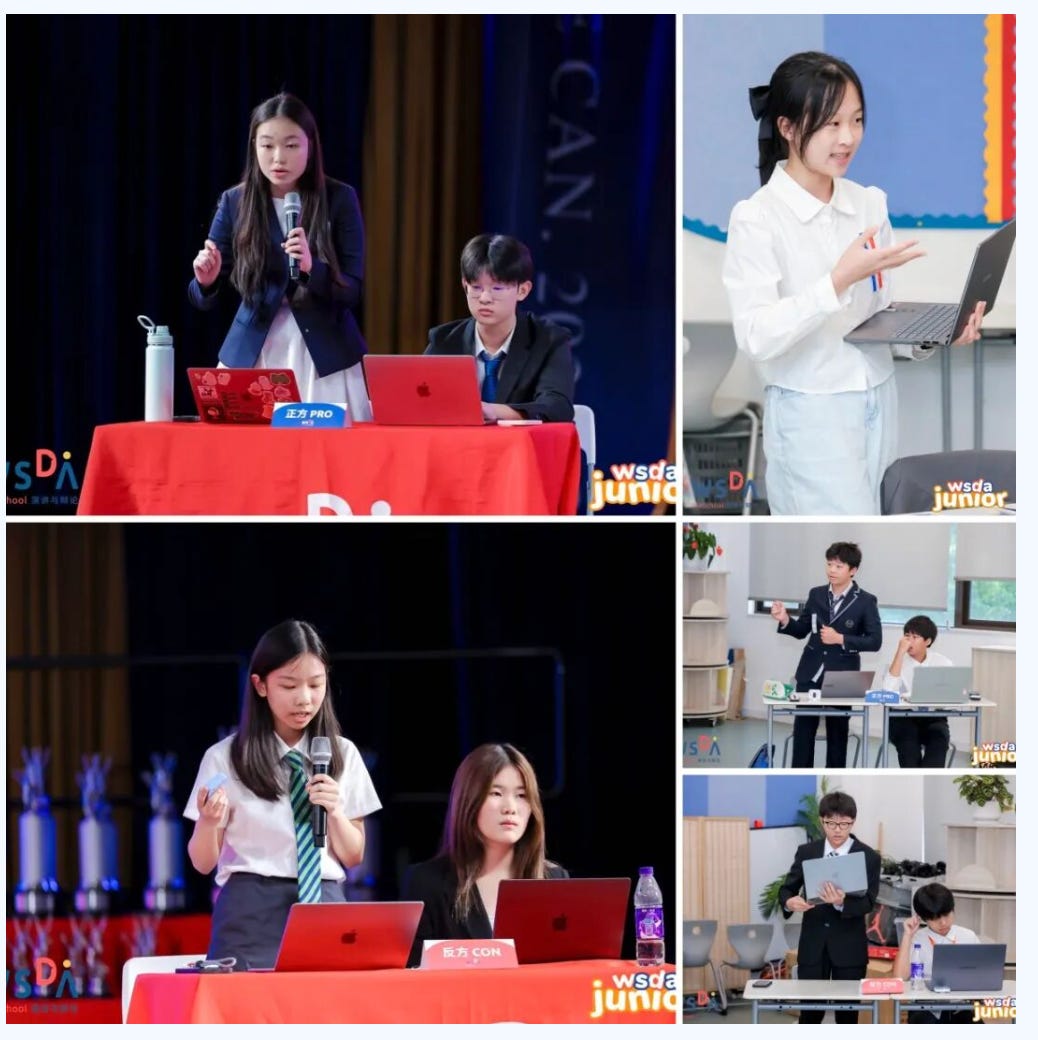
But beyond this technological change — of course, since I arrived, we now have the WSDA as an institution, which has probably served more than a hundred thousand students. We have Enreach Education. We have these wonderful Dipont schools, including the one that you are at today in Kunshan that is launching a comprehensive debate program for all students in grades 8-12. There are three others in Hangzhou, Wuxi, and Chengdu, and none of these existed when I was here for the first time.
It’s a testament to the vision of Benson, Dipont’s founder — of providing the educational opportunities students would need to succeed in the era they live in. Not the one he might have wished they lived in, but the one they actually live in.
Now in addition to those changes, I’ve had some changes as well. My kids have grown older. My older son has graduated from college and started his first job. My younger son will be a sophomore at NYU this year.
So over that time, my kids grew up, so I had some time to spend this summer. I spent it at three camps — of course, here in Kunshan, and in Wuxi, and in Hangzhou.
And I hadn’t taught at a camp since 2007. I ran camps, I even owned one — but that’s a different thing. Teaching is a craft and it can be tiring.
When we started the first camp, realized very early on that almost all the instructors were half my age or younger.
In the first session in Wuxi, I taught with Nico, who’s less than half my age. He was very appreciative of the age gap — he called me a debate sensei, which I thought was very, very nice.
But then I taught with Zaiqi, and he referred to me as a living fossil. I’ve come to learn in China this is a compliment, but I initially interpreted it as a living pile of bones. And when I posted on my social media that I’d been called a living pile of bones, somebody said, “Well, that’s better than a dead pile of bones.”
And the age gap between me and the students was even greater — maybe they were around twenty percent of my age. So, it took a lot of energy to teach every day from nine to five. But the students bring a lot of energy, and I kind of live off that.
A friend of mine who lives in China — I told her I really enjoyed working at this camp, and she said, “That’s because you steal the students’ energy. The young people’s energy.” And I’ll admit to that. But the best thing about their energy is that it’s renewable. It just keeps going.
And they bring that energy to all sorts of new things — things we never would have debated about a few years ago. Right now, the debate topic for high school and middle school is basically how to encourage people to have more children: childcare subsidies versus free childcare centers. And when I first came to China, there was still a one-child policy. So that’s shifted completely.
They’re also debating whether we should have cashless societies — with one student pointing out that money is too heavy to carry, and I was thinking, “Wow, her parents give her a lot of pocket money.”
And we’ve been debating whether AI will lead to fewer jobs or more jobs, and whether we all want to be cyborgs. They just take all these questions and And they just engage them as if they are just another debate topic from my debate era. Because AI to them is just something that’s here. It’s part of life.
For adults, AI can be scary. Everyone can be apprehensive about what the future will bring. Being scared is one reaction — my great-grandparents were afraid to fly on airplanes. But these kids just take AI and use it to become wizards — to help improve their arguments, their research, their ideas. They embrace it as another tool, another relationship.
And I think they’ll look back on us just as we look back on our ancestors. And they’ll kinda feel sorry for us.
They’ll feel sorry for us because we had to commute an hour to work every day just to sit at a desk and bang on a keyboard with our fingers — typing out one letter, one word at a time, one line of code at a time. And we got carpal tunnel syndrome for it. Instead of just talking to the computer and creating anything we want.

So, there are opportunities ahead, and there are challenges, as we look forward to the next fifteen years. But I’m positive, and I’m really excited.
First, I’m energized by all the students’ excitement — their desire to learn, their desire to question, their desire to engage.
Second, I’m encouraged by all the young teachers who are going to carry this organization and these ideas forward, help this next generation understand, and demonstrate what debate can be.
Third, I’m excited about the skills they’re learning here in speech and debate. To articulate their point. To work with others. To come up with creative ideas and creative arguments. I really think these are the skills that are going to define the future. How we interact with each other as humans cannot be overtaken by a machine, and this will be essential.
And fourth, I’m excited about Dipont itself. Benson had the vision to bring debate to China and to recruit Jeff to bring me here. He had the vision to start these schools. He had the vision to start Enreach. And he has the vision to support all these young people in the era they live in.
And I think everyone sitting here is very fortunate that Benson, supported by Jeff and so many people like Joe, has thought about and provided the type of education that all of these students will need. And that excites me.
Fifteen years ago, the question was how to bring debate to China. That question got answered. The question now is what education even is when the machine can do the homework. And everybody in this room is going to help answer that one.
As Jeff said, we have to admit that we really have no idea exactly what students need to know to succeed in this new world. There are no AI-proof jobs. But what we can do is help students become Trailblazers — students who can build a new world and thrive in any world that gets created. I do think experience with speech & debate will be critical in that regard.
And the last thing I want to say is about people, and our relationships, and how robots can’t replace that.
The one thing that does stay the same is our relationships with one another. I’m always very excited to come to China — to see Jeff, who I’ve known for fifteen years; and Joe Zhao, who I’ve known just as long; and Olivia and Dennis, who I’ve known almost as long; and many of the coaches, some from America, that I’ve gotten to know better, such as Cale and Kate.
Those human relationships. And getting to talk to the younger people — not just the coaches, but the people who perform the roles of head teacher and dorm manager. What their education is like: some of them educated in America, but most enrolling in Chinese universities, and what that is like. Their hopes and their dreams and what they wish for.
And hopefully when I come back next year, I’ll get to see some of them again. And if not — just like the others who may have gone on to take on other careers or opportunities — I’ll track them down on my WeChat. Because WeChat, like AI, is an enabler. It’s an enabler of who we are.
My friends have started asking me when I’m going to retire. It’s a fair question. I’m the living fossil.
But the truth is I have more energy now than I’ve ever had. And it isn’t mine — I stole it. From these students. The ones who think money is too heavy to carry. The ones arguing about whether we should all be cyborgs. The ones who pick up AI and just use it.
Their energy is renewable. It keeps going. And as long as they keep bringing it, I’m going to keep showing up to take some.
So I’m excited. The world these students are walking into is the most interesting one anybody has ever been handed — and I want to be in the room to see they flourish with it.
Comments
Nothing yet. Say the first thing.
Sign in to join the conversation.