
Yesterday, someone asked me how you would actually integrate debate and AI into a math class.
This time I sat down with Claude and built the lesson instead. I proofed it with ChatGPT Sol “Extra High.”
It took an afternoon and came to 28 pages. Before anyone downloads it, I want to be clear about what it is.
We have similar work at Debatingai.org, our project to help educators and students integrate instructional redesign and learn AI in the process, but that work focuses on the humanities disciplines so far.
The packet covers one Algebra II topic: exponential models. Interpreting a and b in f(t) = a·b^t, converting a growth factor to a percent rate, solving for t with logarithms. Standard curriculum.
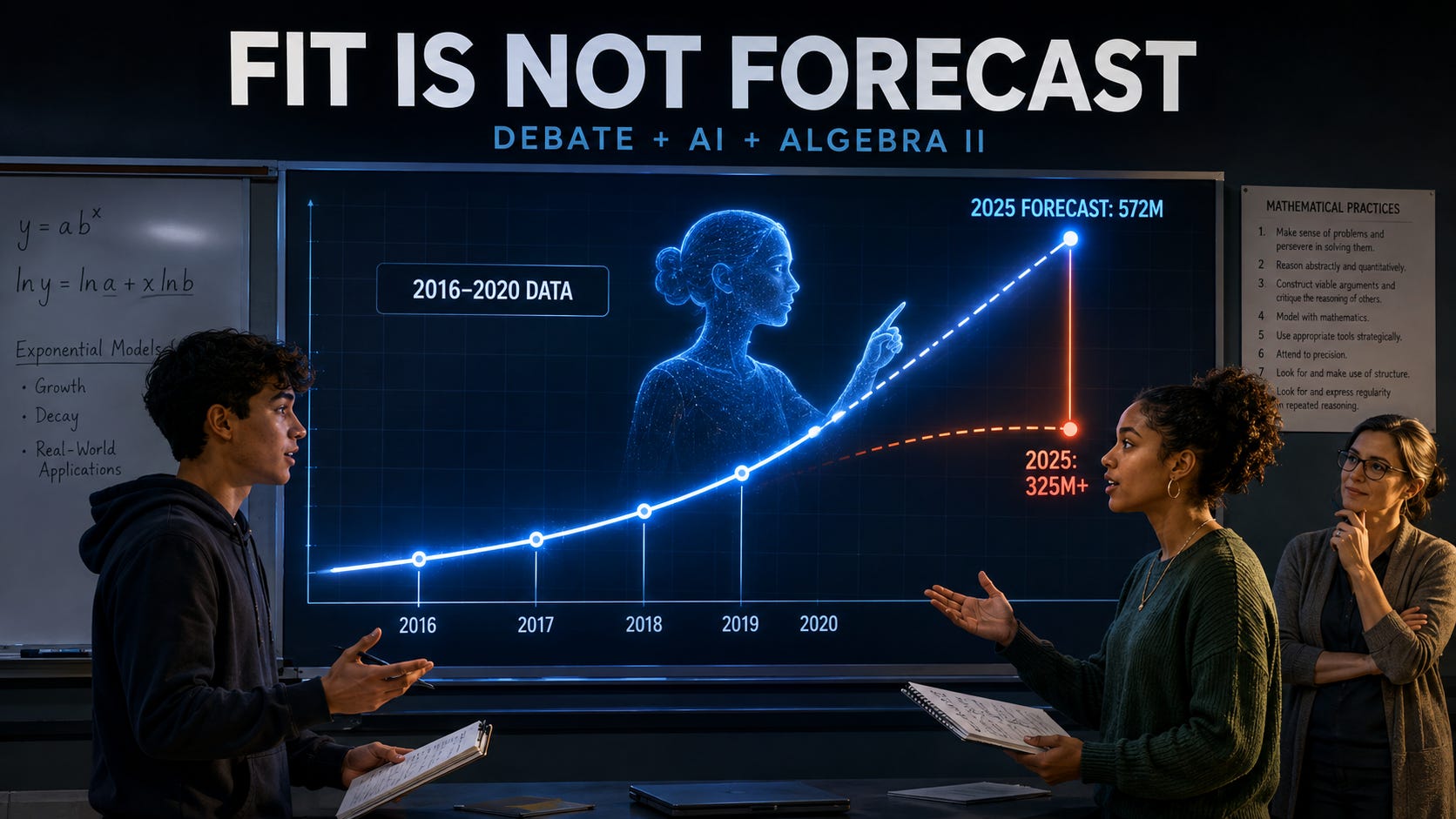
Everything in the packet runs on a single dataset: Netflix’s global paid memberships from 2016 through 2020, taken from the company’s SEC filings.
Those five points fit an exponential model almost perfectly. The base works out to about 1.23, roughly 23% annual growth, and the model matches every given point to within 3.4%. By any standard a high school student has been taught, that is an excellent model, and students will be pleased with themselves for building it.
Then you show them what happened afterward. During the fourth quarter of 2025, Netflix disclosed that it had crossed 325 million paid memberships. The model predicts 572 million, roughly 76% above the only threshold the company disclosed. Because Netflix no longer publishes an exact quarterly count, the precise forecast error cannot be calculated.
That gap is the lesson. Fit and forecast are separate claims, and being good at the first does not by itself license the second.
The reveal turned out to be richer than I planned. Growth didn’t simply stop. In April 2022 Netflix reported losing 200,000 subscribers, its first decline in over a decade, against its own forecast of adding 2.5 million. Then it recovered, ending 2024 with 301.63 million memberships after adding about 41.35 million that year, following the introduction of paid sharing and the expansion of the ad-supported tier.
Students arguing that the growth rate was unsustainable were directionally right, though perhaps for the wrong reason. Students arguing that extrapolation was justified until there was evidence of a structural change also had a defensible position. Then the structure did change, first as growth stalled and later as Netflix introduced paid sharing and expanded its ad-supported tier. Neither side wins cleanly. The debrief question is not who guessed correctly, but whose reasoning would have survived whichever way the evidence broke.
There is one more wrinkle, and it is the reason the forecast error above cannot be stated exactly. After 2024, Netflix stopped providing exact quarterly membership totals. The measurement the whole exercise depends on was withdrawn by the entity being measured. Ask a room of sixteen-year-olds what a model is worth when that happens, and see where the conversation goes.
The packet teaches the topic four ways at once, and the front page lays them out so a teacher can see the structure before reading anything else.
The mathematics is the procedure plus the judgment no procedure supplies: a good fit does not by itself license a forecast.
The debate is claim, warrant, evidence, response. Arguing a side you were assigned rather than one you chose. Cross-examination as the mechanism that makes private reasoning audible.
The AI strand is verification, telling an argument apart from social pressure, separating what you authored from what you offloaded, and defending the reasoning with the AI closed.
The fourth strand is the reason to run the other three, and I will come back to it.
There are six debate formats in the packet, running from a ten-minute exercise to a two-period town hall. The design rule underneath them matters more than any of them.
Debate in a math class fails when teachers stage arguments over questions that have answers. Nobody debates whether t ≈ 9.3. Build a debate around a settled question and you have built a quiz with more noise in it. Debate works when it targets something contestable: which model fits, which method counts as a solution, what the model licenses you to claim, what standard of evidence the room is holding itself to. Each format in the packet is anchored to one of those.
Winning is not the objective. The objective is that a student who has to answer a question about her model out loud, from someone who wants to beat her, cannot hide behind a correct final answer. Her reasoning has to become audible. Mathematical Practice 3 (MP3) asks students to construct viable arguments and critique the reasoning of others, and it has been sitting in the math standards for over a decade waiting for someone to teach it.
Seven formats here, and again a design rule underneath them.
Most AI-in-the-classroom debate activities fail identically. The student asks a model for arguments, the model supplies them, and the reasoning the debate existed to produce never happens. The AI absorbs the authorship.
Every format in the packet is built so it cannot. Students use AI to identify candidate evidence, then verify each figure against a primary document before it may enter the round. They debate an AI instructed to hold a position, running one attempt that applies social pressure and another that applies an actual argument, and record whether the model treats them differently. They have the AI cross-examine them, prompted to ask questions and nothing else, no evaluation and no corrections.
If a teacher runs only one of the seven, I would pick the one that gives the AI the same five data points the students got and asks it to predict 2025. Three numbers go on the board: what the class model said, what the AI said, and what the company later disclosed.
That format exists because of the connection that holds this whole thing together. At a useful level of abstraction, a large language model is also fitted to past data and then asked to perform beyond the examples it has seen. That is not mathematically identical to exponential extrapolation, but the epistemic problem is parallel: past fit can produce a fluent answer without warranting confidence in a new case.
That is the fourth strand. The mathematics asks whether a fit licenses a forecast. Debate asks whether a claim licenses a conclusion, and makes you say so out loud to someone motivated to take it apart. AI asks whether fluency licenses belief. All three questions turn on the same thing, which is whether you can name the warrant. All three can mislead in the same way: the output can look coherent, precise, and plausible even after the underlying warrant has failed.
On academic honesty the packet takes a position I am willing to defend. Students disclose rather than abstain. Each sentence in a case gets marked as authored, machine-written, or machine-drafted and rewritten. No mark costs points, because the moment a mark costs points students stop marking honestly and you have taught concealment instead. Every sentence remains fair game in cross-examination regardless of its mark, and “the AI said so” does not answer the question. A ban teaches students that the issue is whether they get caught. Disclosure puts the real issue in front of them: whether they can answer for what the machine gave them. That question will still be the right one several tool generations from now.
It is a proof of concept. It has never been run with students.
I coach debate. I do not teach math, and someone who does needs to go through this before it goes near a classroom. Four things I would especially want checked:
The timings. I suspect the fourteen-minute model-building block is optimistic. Someone who has watched thirty teenagers fit a curve and check residuals knows whether that is generous or nowhere near enough. I don’t.
The prerequisites. The packet assumes fluency with logarithms and comfort with ratio reasoning. Where that assumption fails, the debate will collapse into arithmetic remediation and the period is gone.
The difficulty curve. The answer key may be pitched too high or too low, and I am not the right judge of which.
The shelf life. Every figure is sourced to SEC filings and shareholder letters, and each one was checked against a primary document rather than pulled from memory. But Netflix now discloses membership only as an occasional milestone, so this dataset ages in a particular way and the reveal table will need maintenance.
I would rather publish it rough and hear from twenty teachers about what breaks than spend another month polishing it by myself.
Almost none of you teach Algebra II, and I am not suggesting anyone adopt this lesson.
What I think transfers is the structure. Find the place in your own content where a real disagreement lives, meaning a question that is actually open rather than one you are pretending is open for the sake of an activity. Build the debate there. Then put the AI somewhere it cannot take over the authorship, and require students to disclose what it gave them and defend it with the tool closed.
I should say plainly that this dataset is unusually cooperative. The mathematical problem and the AI problem turn out to be versions of the same epistemic problem, which makes the fourth strand fall into place with very little help from me. Most subjects will not hand you that. Finding the equivalent seam in history or biology or literature is real work, and I don’t want to pretend otherwise.
We have spent several years asking whether AI belongs in classrooms while teachers have been asking what to do on Monday. This is one answer specific enough that it can be shown to be wrong.
The full packet is attached. Use it, break it, and tell me what happened. I am particularly curious what your students say when you tell them the company stopped publishing the number.
And head on over to debatingai.org to check out our other resources.
Comments
Nothing yet. Say the first thing.
Sign in to join the conversation.