
Fair warning: This is an especially wonky post. It’s a guest post about the techno-economics of the power system.
Still here? Good, because this may just be the best wonky post on the techno-economics of the power system that I’ve encountered in years. That’s the reason I invited Ben Haley to cross-post this essay, which was initially published by his firm Evolved Energy Research. I believe this analysis should be required reading for anyone who wants to understand some of the most interesting categories of emerging energy technology — namely, battery storage and all kinds of “distributed energy resources”.
The reason is that nearly all of these exciting new power system resources are “duration-limited”.
Batteries are the canonical example, because everyone knows there’s a limit to how much energy a battery can store. (Ben refers to this as being “energy-limited”, which is one reason for being duration-limited.) A fully charged battery will only last until it runs out of electrochemical potential, at which point it will need to recharge before it can be used again.
As Ben points out in his article, power system operators have decades of experience dealing with another form of energy storage: the water that accumulates behind a dam during periods of rain or snowmelt, which is often stored for months in order to be unleashed during a dry period. But the duration limits on hydropower tend to be seasonal — measured in days, weeks, or even months — while the limits on electrochemical batteries are measured in hours. From an operational standpoint, these constraints are worlds apart.
Plus, it’s not just batteries which are duration-limited. The simplest form of demand-side resource is a connected HVAC system — e.g. a heat pump with a smart themostat. Theoretically these systems can be turned down remotely, at the flick of a switch by a grid operator, for extended periods of time. But energy consumers usually tend to get pretty cranky if their air conditioners stop working for too long. The same principle applies to essentially every other form of “load flexibility”.
Most other forms of distributed generation are also duration-limited. Various forms of diesel and natural gas engines, for example — which have historically been used solely for backup power generation — are increasingly being tapped to supply distributed capacity to the grid. These resources can usually offer much more continuous runtime than batteries, but they’re not unlimited. Small engines are almost never permitted to operate indefinitely, at least not in urban or suburban areas, because of their impact on local air quality. They’re limited to a specified maximum runtime per year.
If the power system is going to take full advantage of all these emerging resources, planners are going to need to pay much, much closer attention to duration limitations. The way that grid operators calculate the amount of peak demand that a resource can effectively address — referred to as “Effective Load Carrying Capacity”, or ELCC — is going to need to become much more sophisticated and dynamic.
As Ben points out, these changes will impact which technology can create (and capture) the most value in the power market, and on what timeline. For example, I’m beginning to be worried that some power markets are relying too heavily on four-hour batteries, which could lead to the need to “de-rate” those assets in future years, as system operators sharpen their pencils.
In any case, Ben’s firm Evolved Energy Research has done the best rigorous analysis I’ve seen on this topic. So without further ado:
The value of energy storage is shifting from how much power batteries can deliver to how long they can keep delivering it.
That’s the difference between power capacity (gigawatts, or GW) and energy capacity (gigawatt-hours, or GWh): a 1 GW battery running at full output for four hours delivers 4 GWh of energy. As more storage comes online, short-duration batteries begin competing for the same narrow peak periods. Once those peaks are covered, their marginal capacity contribution begins to decline. The system no longer primarily needs additional power capacity; it needs sustained energy capacity. This represents a shift in systems from capacity-limited to energy-limited.
This shift matters for evaluating which types and durations of storage provide lasting system value, especially as data center demand reshapes load patterns and solar-plus-storage dominates new builds. This evolution in reliability risk builds on broader changes in net load dynamics — including the growing risk of seasonal and multi-day stress events in renewable-heavy systems, which we have examined previously.
Historically, most power systems powered by resources such as coal, gas, or nuclear had no effective limits on duration. If a gas plant was needed in hour h, there was little concern about whether it could also run in hour h+1. Fuel supply for thermal generators was not the binding constraint in resource adequacy planning, and capacity needs could often be evaluated non-chronologically.
The primary exception has been hydro-dominated systems. Because hydro resources are constrained by water availability and discharge limits, planners in those regions have long accounted for duration explicitly. For example, the Northwest Power and Conservation Council evaluates resource performance across durations using a five-hour sustained-peaking capacity metric. This reflects the fact that persistence, not just peak output, determines reliability value.
Today, the U.S. capacity mix is shifting toward short-duration lithium-ion storage, now principally four-hour configurations. That design makes sense in early markets, where revenue is driven by ancillary services and short peak events. Nearly all systems experience “needle peaks”—one or two hours where load rises well above surrounding hours—and short-duration batteries are well suited to covering them.
But as deployment scales, the question becomes: what happens after the needle peaks are covered?
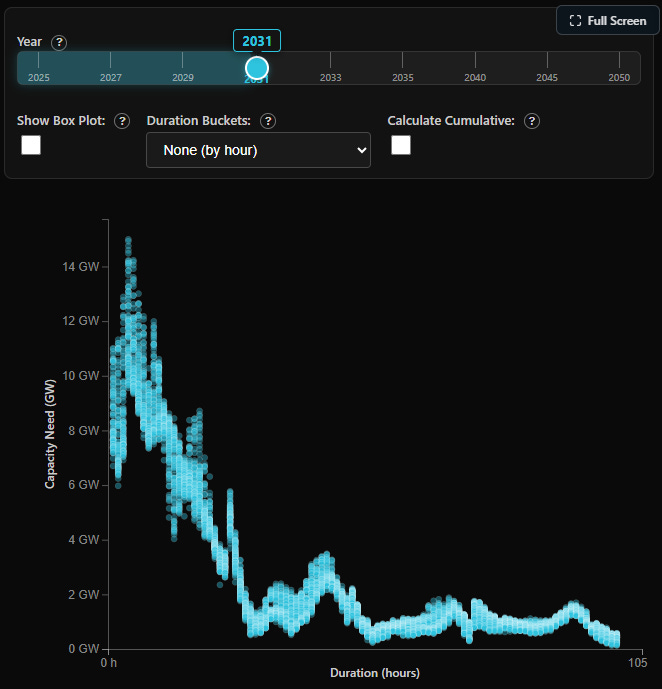
To assess this, we analyzed net load (system load after wind and solar generation) across 100 scenarios for the United States. For each scenario, we calculated the capacity requirement at every discharge duration. In other words, for a given duration, how much dispatchable capacity must persist to satisfy reliability criteria? This analysis produced a duration-ordered capacity requirement curve, showing reliability needs by magnitude and duration. (Note: this analysis is based on three proprietary, complementary tools developed by Evolved Energy Research.)1
Here’s an example of the output from this process: a distribution of the maximum potential capacity contribution of each battery duration, in the year 2031. This result suggests that there will only be around 40-70 gigawatts of opportunity for batteries with just four-hours of duration to qualify as full capacity resources (roughly, across many potential scenarios). Beyond that level, storage systems will need more hours of duration in order to continue providing dependable capacity. We’ve already surpassed 50 gigawatts of battery capacity installed across the US today, nearly all with just 2-4 hours of storage duration.
We can also derive two more structural features of the power system from this analysis.
First, the system requires only a limited quantity of capacity at short durations. There is only so much net load that can be covered by resources discharging for four to six hours.
Second, as duration increases, required capacity of any duration declines but remains meaningful.
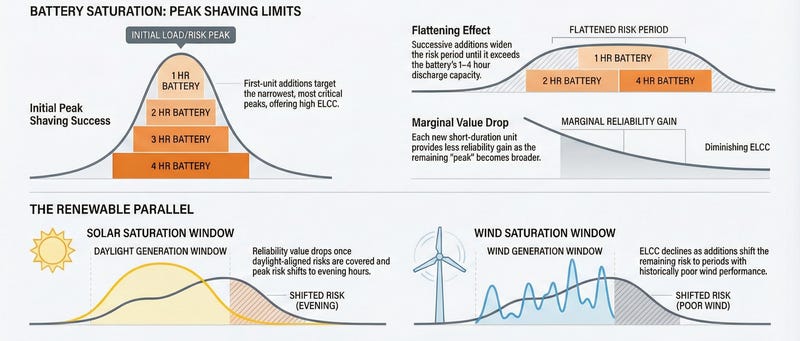
This pattern mirrors what occurred as wind and solar made their way into the power market over the past twenty years. The generation from early renewable projects —particularly solar — happened to coincide with periods of peak demand. But as renewable penetration increased, power markets needed to contend with a new “reliability interval” — a new period in which planners needed to be concerned about meeting peak demand. This period occurs when solar and wind generation is at its lowest.
Short-duration storage follows the same saturation logic. Once short-duration reliability intervals are satisfied by short-duration batteries, additional batteries must either accept lower capacity accreditation or increase duration to access the remaining reliability need.
This analysis was then used to determine which specific categories of storage technology are best positioned to compete, as the need for longer-duration systems increases over time. Once again, this analysis takes a stochastic, scenario-based approach.
Here’s a snapshot of the output from a hundred different scenarios in 2035. Different colored bars represent different categories of storage technology, which we considered based on our best estimates of the cost and performance of these technologies, based on publicly-available information.
[Andy’s note: “Iron-Air” technology is effectively a stand-in for the technology developed by Form Energy, one of our portfolio companies at EIP. I was excited to see so much promise for Form’s multi-day storage solution across a wide range of future scenarios.]
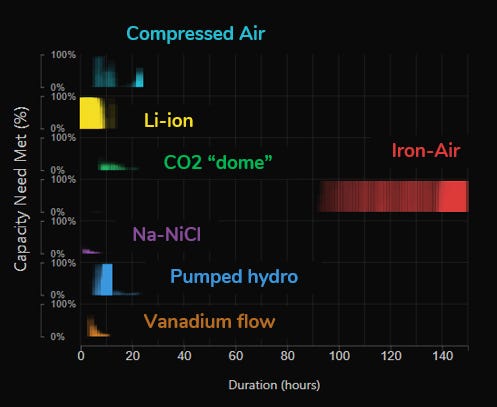
A consistent pattern emerges, despite the fact that renewable deployment materially affects the scale of capacity needs at each duration. Lithium-ion storage occupies the short-duration segments in virtually every run. Over the long term, capacity needs approaching roughly 16 hours are almost always served by storage resources of some type. Beyond 16 hours, we find that storage is typically unable to compete against conventional duration-unlimitedgeneration technologies — e.g. gas power generation.
Interestingly, storage becomes economic again at very long durations, above roughly 90 hours. In our modeling, iron-air batteries (high power cost, low energy cost, low efficiency) is frequently found to be competitive in the 90–150 hour range. Although the absolute capacity requirement for these durations is smaller than for “medium-duration” intervals, multi-day storage can potentially be competitive against other low utilization resources like thermal power plants intended for “peaker” profiles.
One additional interesting result is that a lot of four-hour lithium-ion storage may be built to serve longer-duration peaks, even with reduced capacity accreditation. This is because four-hour storage can earn so much revenue from arbitraging diurnal energy prices, on a daily basis, which allows it to remain competitive despite earning less from capacity payments. This phenomenon tends to occur most often in solar-heavy systems.
The broader implication for storage technology is structural. As storage penetration rises, system reliability needs migrate outward along the duration axis. The binding constraint shifts from instantaneous discharge capability to sustained energy delivery. Planning framed purely in gigawatts obscures this transition. The relevant metric increasingly becomes gigawatt-hours, because once short-duration scarcity intervals are saturated, persistence is what matters most.
The first phase of storage deployment addressed needle peaks. The next phase is governed by the declining marginal capacity value of short-duration assets and by the evolving duration distribution of net load, shaped increasingly by renewables and data centers. Each addition of short-duration capacity accelerates its own obsolescence as a capacity resource. By flattening the peaks it was built to serve, it becomes, in effect, a victim of its own success. As those peaks fade, system risk shifts toward sustained shortfalls and system planners must turn to other resources.
This shift creates an opening for storage technologies seeking to challenge lithium-ion’s dominance in the grid-scale market, as well as for clean firm resources competing against solar-plus-storage products. At the same time, it complicates the idea that load-based flexibility, including datacenter flexibility, can serve as a primary solution to the capacity crunch. Overreliance on short-duration storage and load flexibility to keep pace with rapid load growth may itself introduce reliability risk. In an energy-limited system, endurance rather than peak capacity determines which resources matter.
[Back to Andy: I encourage anyone who appreciated this guest post to pay close attention to Evolved Energy Research, which regularly publishes similarly excellent analysis.]
And please subscribe to Steel For Fuel.
RIO, our supply-side optimization model that evaluates system reliability chronologically at high spatial and temporal resolution (28 zones and 1,400 timesteps); an AI-enabled research agent that expands the representation of emerging storage and competing technologies within the model; and Ensemble, which explores 100 near-optimal system configurations rather than a single least-cost outcome. Together, these tools allow us to capture technology diversity, reveal the system conditions that encourage or discourage deployment, and identify evolving reliability risk with a level of detail traditional planning approaches often miss.
No posts
Comments
Nothing yet. Say the first thing.
Sign in to join the conversation.