
On the surface, it makes good sense to be fearful about investing in the future of electric vehicles in America.
Here’s the narrative of the day:
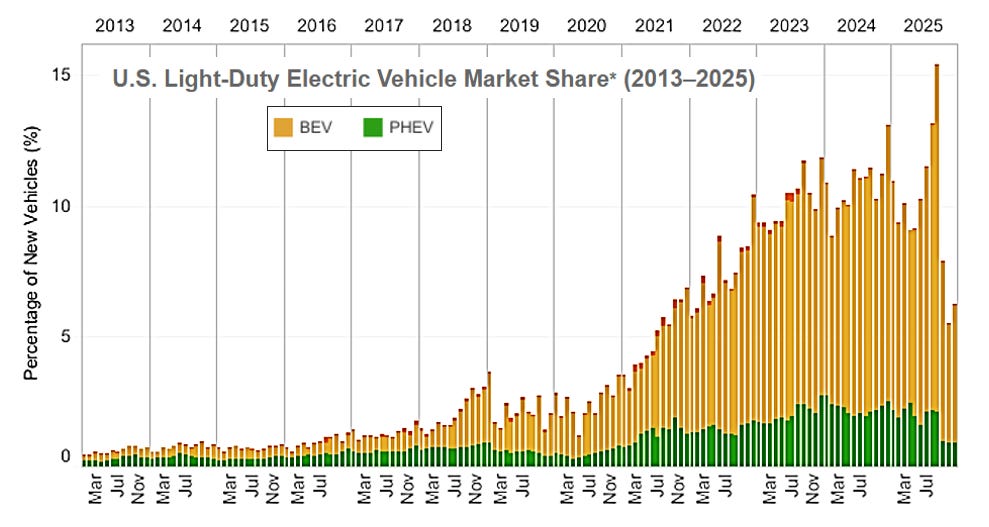
The loss of EV tax credits in President Trump’s “One Big Beautiful Bill” has caused the market share of battery electric vehicles to fall off a cliff. Sales of both fully electric vehicles and plug-in-hybrids are down by about 50% since the tax credits expired.
The timing of this downturn could not have been worse for the budding American EV supply chain. Automakers have spent the past three years investing in new factories to produce batteries and new EV models, supported by incentives from the “Inflation Reduction Act”.
As a result, the ‘Big Three’ American automakers have written off about $53 billion in EV supply chain investments. Honda wrote off another $16 billion.
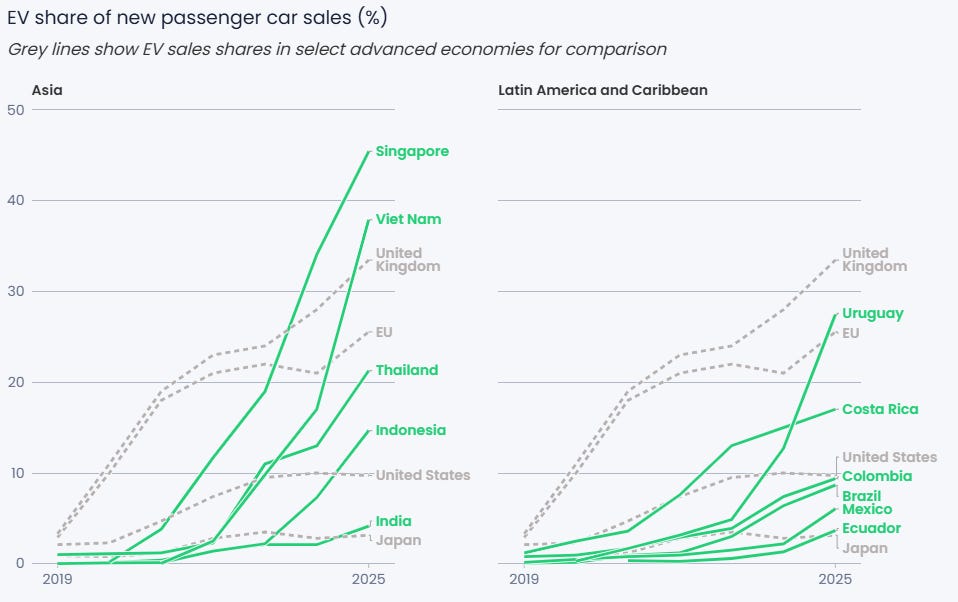
The United States is clearly becoming even more of a global laggard in EV adoption. We’re not just falling behind China and Europe — emerging markets are also beginning to leapfrog American EV adoption. (Thanks to Ember for highlighting this trend.)
So, I understand the impulse to be fearful of investments in either the EV supply chain, or charging infrastructure in America...
…Which makes this the perfect moment to be greedy.
Why?
I’ve said it multiple times on this blog before, but it’s worth repeating: Autonomous vehicles are nearly always electric. And the reason has nothing to do with emissions. As I wrote previously:
Autonomous vehicles are going to be high utilization vehicles. That’s true because they can be, but also because they need to be in order to justify such high capex. This is an ideal scenario for the electric drivetrain, which has lower maintenance and lower energy costs than the internal combustion engine. (In most places.) The more a vehicle is utilized, the more these operational advantages matter when it comes to the total cost of ownership.
Additionally, all of those expensive sensors and chips which need to be packed into an AV also need to be powered, which compounds the efficiency advantage of going electric. It’s just silly to contemplate running 13 cameras, 4 LiDAR units, 6 radar units and multiple GPUs on an internal combustion engine
There’s not much publicly available data on the power requirements of the vehicle autonomy stack. Bloomberg estimated that computing alone could consume about 45% of the energy in an AV. But most other estimates I’ve seen tend to fall in the range of 20-30% for a vehicle with an urban driving profile. That’s roughly in line with the power consumption of a few NVIDIA H100 GPUs, which consume 700 watts each running full tilt.
Everyone knows this is a moment to to be greedy for electrons to power supercomputers in data centers. I’m convinced we’re also going to see a whole lot more demand for electrons to power supercomputers on wheels — autonomous electric vehicles — in very short order.
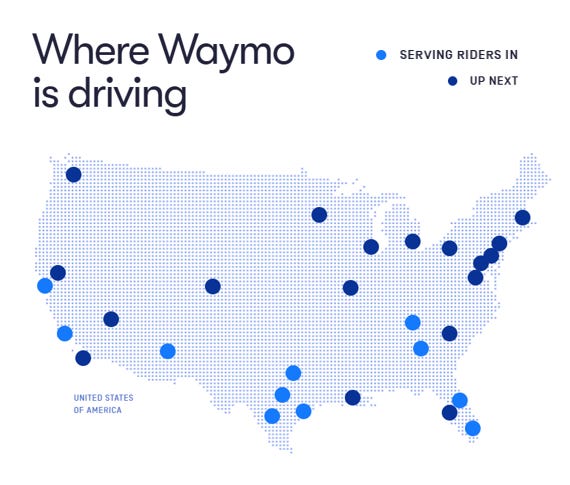
Waymo is on the march. Zoox is beginning to follow in its footsteps, reportedly testing vehicles in ten US cities. Tesla is… still trying.
According to my back-of-the-envelope analysis, the unit economics of autonomous electric vehicles already appear attractive as an alternative to human rideshare drivers, and there is clearly room for improvement on hardware cost. Waymo’s commercial launch relied on relatively pricey Jaguar I-PACE’s and the autonomy stack ought to benefit from continued reduction in processor cost per FLOP.
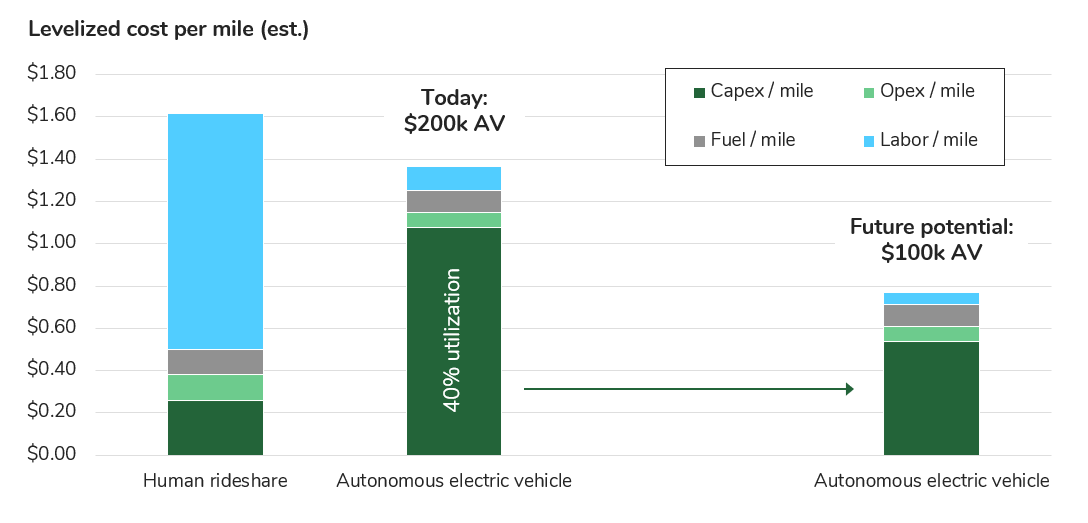
Hence, I’m convinced that autonomous electric vehicles are at an inflection point. We should be preparing for exponential growth for the next decade or more.
And it’s not just passenger vehicles I’m excited about. There’s no reason to believe that the combination of autonomy and electrificiation will stop with “robotaxis”.
Heavy duty trucks, for example, have proven to be a more difficult segment for the electric drive train. Balancing vehicle weight and battery range has been unsurprisingly vexing for a class of vehicle which is required to stop for periodic weigh-ins. Range anxiety is understandable, especially given the need for high-powered charging infrastructure.
So, even though theoretical “total cost of ownership” comparisons have already been favorable for electric semi-trucks in some duty cycles for the past few years, operators have mostly balked at the high sticker prices of the trucks themselves, the additional up-front cost of charger installation, and the risk of an unfamiliar paradigm.
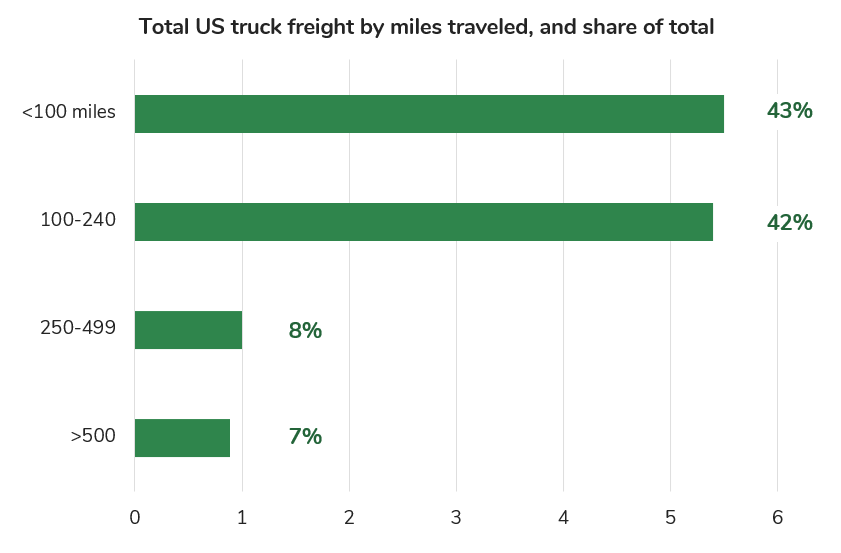
On the other hand, more than 85% of all truck freight in the US travels less than 250 miles to reach its destination. In fact, more than 40% of freight does not even travel 100 miles. These routes are well within the range of current electric semi-truck specifications.
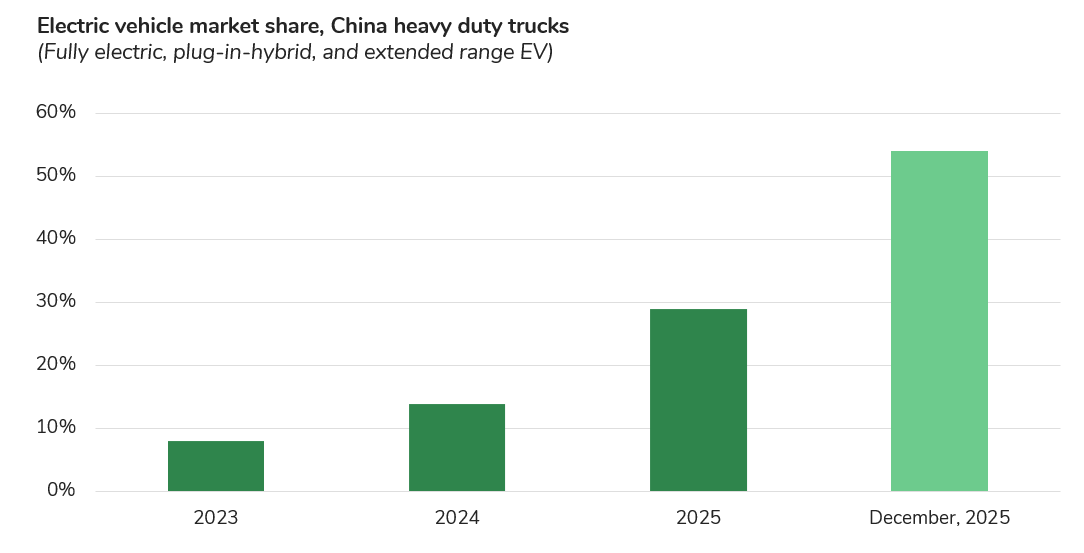
And so, unsurprisingly, China is now proving that electric semi-trucks can be much more than a niche. Trucks with a plug captured nearly a third of the total heavy duty market in China last year, and crossed the 50% threshold as sales surged in the last few months. (And all of this was before the closure of the Straight of Hormuz.)
I believe autonomy is going to be the spark that supercharges this kind of heavy duty vehicle electrification, even in America.
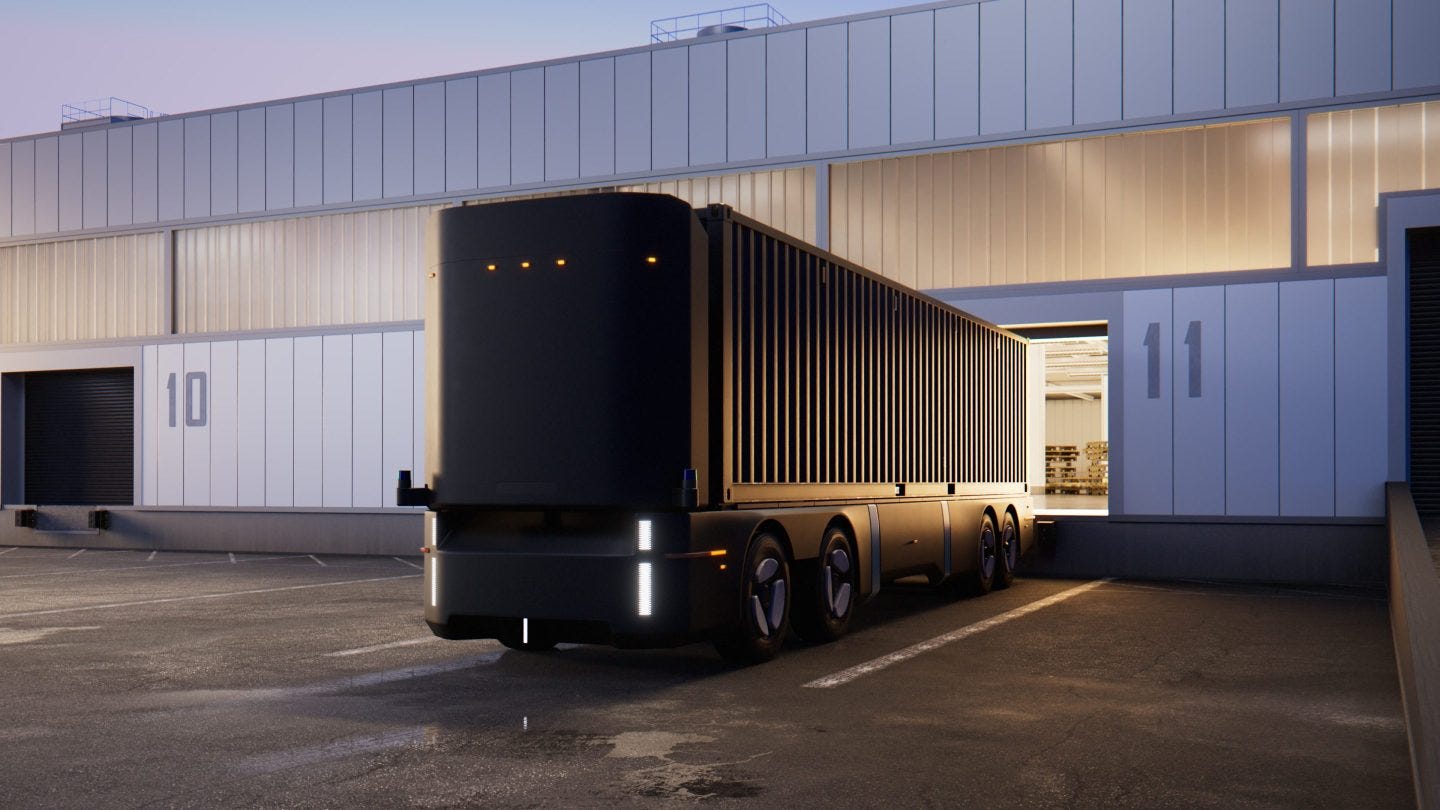
This is one of the reasons I’m excited that I’m finally able to share a new investment by my firm, Energy Impact Partners. That investment is Humble, a company founded by a pair of autonomy OG’s who certainly demonstrate that virtue, but whose vision is strikingly bold: a heavy duty trailer designed from a clean sheet to take full advantage of both autonomy and the electric drivetrain.
This thing has the potential to make electrification the obvious choice for moving the big, heavy things, beginning with short-haul freight. (Thanks to my Partner Anil Achyuta for leading this investment, and sharing this beautiful photo.)
Nobody knows. But we can do some basic math…
In 2024, American passenger vehicles traveled about 2.9 trillion miles. If autonomous, electric “robotaxis” are able to capture just 1% of that aggregate market for mobility, the result would be about a third of a percentage point increase in total US electricity demand.1
That doesn’t sound like a tremendous amount of incremental power demand, particularly relative to demand from hyperscale data centers. Yet assuming that the majority of charging will be done relatively slowly, overnight, my quick analysis suggests that we’d need nearly 4 gigawatts of new EV charging infrastructure deployed across the country.2
Exactly what form that infrastructure will take is still a big question mark, but I expect that a good portion of it will consist of centralized depots where vehicles can be simultaneously cleaned and serviced. This presents an opportunity to build and operate thousands of depots around major metropolitan areas, each one requiring hundreds of kilowatts up to multiple megawatts of power supply. There are already a handful of companies with a head start developing these types of sites (e.g. Terawatt, Voltera).
Add heavy-duty “robo-trucks” into this equation, and the investment opportunity becomes eye-popping pretty quickly.
So I’m feeling pretty greedy about the opportunity to build the future of autonomous, electric vehicle infrastructure. Please reach out if you feel the same — especially if you have a vision for how to capture it…
Given an average efficiency of a little less than half a kWh per mile.
Assuming average speed of 21 miles per hour, and a relatively conservative 40% vehicle utilization factor, the average vehicle would use 98 kWh per day, and need to charge for about 10 hours per day at 10 kW.
No posts
Comments
Nothing yet. Say the first thing.
Sign in to join the conversation.