
55 years ago, the renowned Stanford psychologist Philip Zimbardo conducted a dangerous “experiment” designed to investigate how ordinary people would spontaneously behave after being assigned, virtually overnight, roles of authority (the guard) and subordination (the prisoner). Would their individual personalities and behavior radically change as soon as their social identities were reconstrued?
Several more or less Hollywood-style films have been made about Zimbardo’s “experiment,” including the not especially imaginatively titled Das Experiment (2001), the American film The Experiment (2010), and The Stanford Prison Experiment (2015). The impression one gets from these films, or from older psychology textbooks, is that Zimbardo really proved human personality to be strongly, or even entirely, determined by the social situation and symbolic role assigned to a person by others. The participants given the role of guards supposedly transformed rapidly and spontaneously (without outside encouragement or instructions from the experimenters) into disrespectful aggressors and even sadists, while the prisoners became passive, obedient figures stripped of their self-respect.
More careful researchers of human behavior have, however, long understood that, despite its evocative cinematic appeal, Zimbardo’s “experiment” is in fact devoid of scientific value. His undertaking has never been successfully replicated, its sample was unrepresentative, and Zimbardo himself recently acknowledged, in response to criticism, that it was not really a scientific experiment. It was more an “exploratory investigation,” you see. It’s also significant that two-thirds of the “guards” did not behave aggressively or sadistically at all. Thus, soon after the study was published in the 1970s, Erich Fromm sensibly pointed out that, if the experiment demonstrated anything, it was precisely that people are not simply and immediately transformed into sadists by how others define their identity.
What’s more, new evidence clearly reveals that the participants behaved as they did precisely because of the implicit and explicit instructions given by Zimbardo and his colleagues – an external influence Zimbardo denied. They were told, in effect, that the experiment would not work unless they behaved in particular ways. The expectation of receiving a financial reward after the successful completion of the experiment also could have played an important role in their behavior.

But even if Zimbardo’s study falls apart, did Solomon Asch, a pioneer of social psychology, not demonstrate something similar through his entirely legitimate experiments on conformity and group pressure?
Asch first showed a small group of participants a card bearing a single line, followed by another card containing three lines labelled A, B, and C. They were then asked which of the three lines on the second card was the same length as the line on the first. One line was clearly shorter than the isolated line on the first card, another was clearly longer, and the last one was the same length. We would expect almost everyone to recognize what was the correct answer.

However, Asch instructed his confederates in the experiment – actors whom the genuine participants did not realize were part of the study – to give the correct answer aloud during the opening rounds, but later to insist unanimously on an incorrect one. He wanted to find out whether the unsuspecting participants would succumb to group pressure and give an obviously incorrect answer themselves simply because the actors supported it, even though it should have been perfectly clear that the answer was wrong.
The casual impression many people now have of this experiment is that most of the genuine participants gave in to the example set by the group and conformistically repeated the incorrect answer, even when the first line was plainly much longer or shorter than the line selected by the others.
Sheeple, right? People will support any absurdity, provided someone else says or does it first. They cannot think independently and quickly succumb even to the most foolish opinions and beliefs expressed by others. No wonder the world is supposedly as terrible as it is when society contains no Critical Thinkers™. I remember musing in exactly this way when I first heard about Asch and his experiment sometime in my late teens.
In reality, matters were somewhat more complicated. Asch found that, in most rounds of the experiment, most participants’ responses were correct even when the actors insisted on the wrong one. In the rounds in which the actors deliberately gave incorrect answers, only 37% of the responses were incorrect. A slightly smaller share, 33%, gave the same answer as the actors. A substantial majority (63%) continued to provide correct, independent answers.
And although it’s true that as many as 75% of the subjects answered incorrectly, or conformistically, at least once during the experiment, it is also true that 95% of them gave a correct, independent answer at least once.
It is hardly surprising that these and other nuances reported by Asch are absent from popular culture. What is surprising is that the same nuances are missing from a whole range of both older and newer psychology textbooks. In a 1990 study published in the European Journal of Social Psychology, researchers found that, in the decades following Asch’s experiment, textbooks increasingly emphasized the 37% of incorrect responses while increasingly omitting any mention of the 63% correct answers. Textbooks were also increasingly likely to report that 75% of the subjects conformed at least once, while failing to emphasize that 95% answered independently at least once.
A more recent study, published in Teaching of Psychology in 2015, found a similar pattern in contemporary textbooks. 14 of the 20 textbooks examined mentioned the conformist responses (the 37%) but only one mentioned those remaining independent, the 63%. 16 of the 20 textbooks highlighted the 75% who conformed at least once, while not one mentioned the even larger share (the 95%) who acted independently at least once.
This kind of selective reporting is problematic because it can help create a false and already excessively popular image of human beings as remarkably naive, passive, and obedient. It is also somewhat ironic, since Asch himself presented the results of his experiments as confirmation that the facts – not group pressure – were the decisive force guiding human judgment, and that independence, rather than conformity, had prevailed.
There’s one more famous psychological experiment, similarly mythologized in popular culture, that supposedly demonstrates just how desperately obedient human beings are.
Stanley Milgram, the renowned Yale psychologist, was operating in a completely different and methodologically far more sophisticated league than Zimbardo. Through a series of experiments, Milgram supposedly demonstrated that most people (65% of the participants in his first study) are entirely prone to blind obedience and will obey authority even in situations in which they ought to be skeptical of it.
Most participants supposedly administered extremely powerful electric shocks to an unknown person in another room merely because an authority figure instructed them to do so. They did not stop even when they heard the other person moaning and screaming. Unlike Zimbardo’s experiment, Milgram’s work has been successfully replicated on several occasions, making its findings considerably more robust.
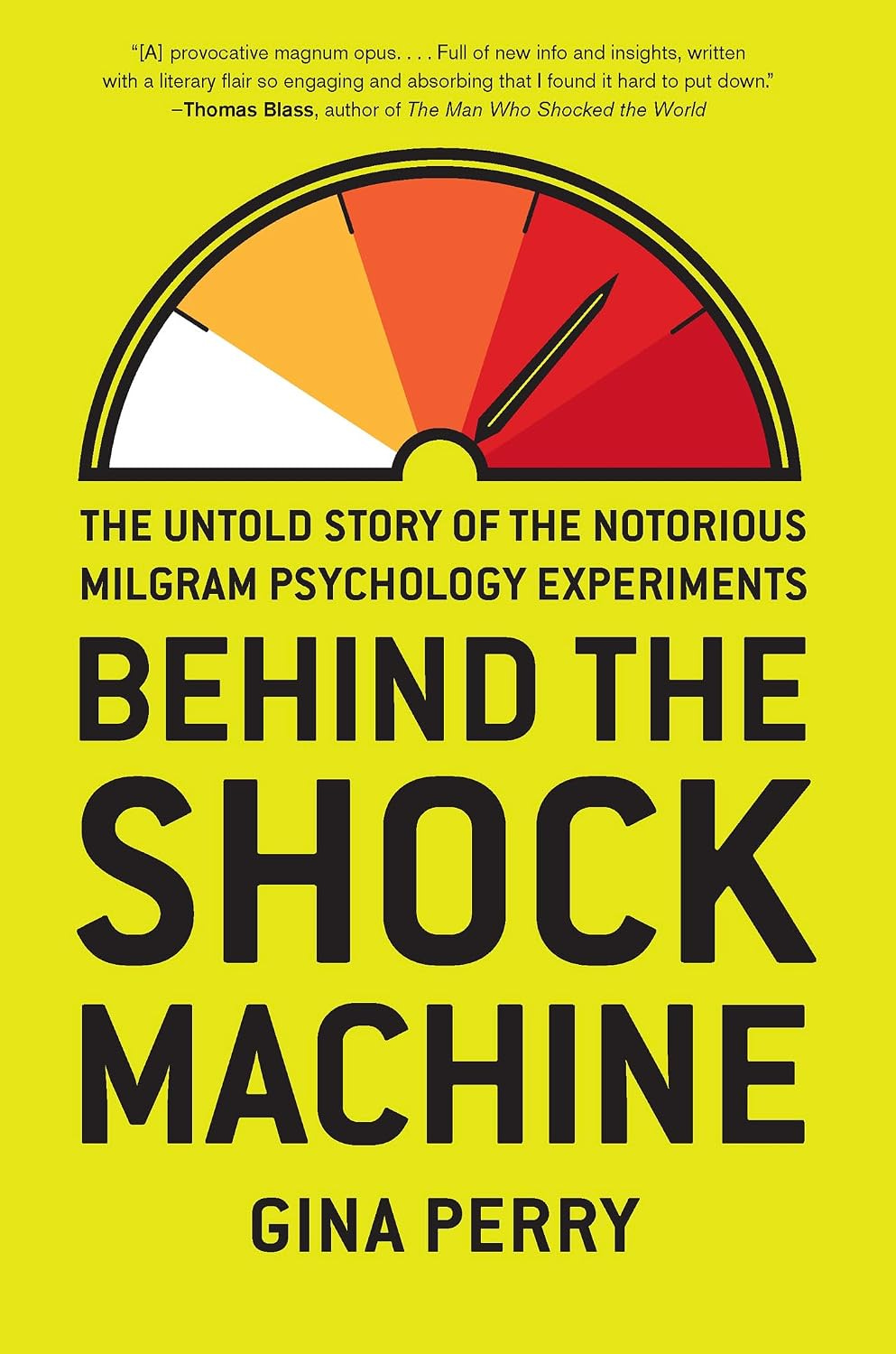
Yet even with Milgram, we must pay attention to nuances conveniently excluded from the story of “people as sheep.” Gina Perry documented several of these nuances in her book Behind the Shock Machine.
First, the figure of 65% obedient subjects came from only the first of 24 different versions of Milgram’s experiment. In some of the remaining versions, the figure was much lower: 10 percent, 20 percent, 30 percent, or 47.5 percent. Second, approximately half of the subjects doubted that the experiment was genuine – that is, they doubted that their actions were actually delivering electric shocks to another person. Among those who were convinced that the shocks were real, the majority (two thirds) refused the experimenter’s commands. Third, the first version of Milgram’s experiment shows, at most, that most people are willing to trust authority when it is presented as science, not that they will trust any form of authority whatsoever. The subjects received a whole series of otherwise credible environmental signals suggesting that the situation was safe. They had been invited into the premises of the prestigious Yale University and were received by a scientist wearing a laboratory coat.
This may still be problematic, of course! But it does not demonstrate, as some people appear to believe, a blind willingness to trust authority in general.
People can sometimes be successfully manipulated. We can be excessively deferential to authority and susceptible to conformity. These tendencies can lead us to behave thoughtlessly and even harmfully. All of that is true. But the general idea that almost all people are typically sheep – apart, of course, from the enlightened person making the accusation – and that Zimbardo, Asch, and Milgram teach us unequivocally just how blindly conformist and dangerously manipulable human beings are is a mythology that is not grounded in reality.
For obvious reasons, you can read this post as a companion piece to my other post on the falsity of the (Marxist) “dominant ideology thesis.” Read it here:
The 'dominant ideology thesis' is an academic conspiracy theory
·
November 27, 2025
Here’s an obvious question that should occur to you if you’re a committed activist. If capitalism is so brutal and oppressive as you say, so extraordinarily unlivable, why aren’t the common folk rebelling against it, staging a revolution?
No posts
Comments
Nothing yet. Say the first thing.
Sign in to join the conversation.