
If you’re like me, you learned about “the culture of honor” explanation for violence from Steven Pinker’s The Better Angels of Our Nature. In fact, Pinker talks about it already in The Blank Slate, but it’s an older idea still. As he himself says, he just popularized it from Nisbett and Cohen’s Culture of Honor: The Psychology of Violence in the South, who took it over from Fischer’s Albion’s Seed. (And so on all the way to earlier thinkers and anthropologists.)
Succinctly put, the thesis states that a peculiar, violence-inducing code of conduct seems to develop where people cannot rely on the state to protect them. Historically, this is most likely in societies built around easily stolen property such as livestock (not fixed assets like land or even somewhat stealable crops). In those settings, a reputation for answering insults or threats with force can deter future aggression. So, people have a strong incentive to invest upfront in being known as ruthless and unforgiving, and reactively violent. The thesis is more or less costly signaling theory applied to lawlessness and herding.
In the book, Pinker uses the famous Nisbett-Cohen psych experiments comparing Northern and Southern American men to illustrate this. Southern participants reacted more strongly when insulted, showing greater stress, dominance, and unwillingness to back down. The canonical experiment was fairly simple: while walking through a narrow hallway, a confederate bumped into the participant and called them an “asshole.”
Here’s how the researchers unpack the results in a bit more detail:
Compared with northerners—who were relatively unaffected by the insult—southerners were (a) more likely to think their masculine reputation was threatened, (b) more upset (as shown by a rise in cortisol levels), (c) more physiologically primed for aggression (as shown by a rise in testosterone levels), (d) more cognitively primed for aggression, and (e) more likely to engage in aggressive and dominant behavior.
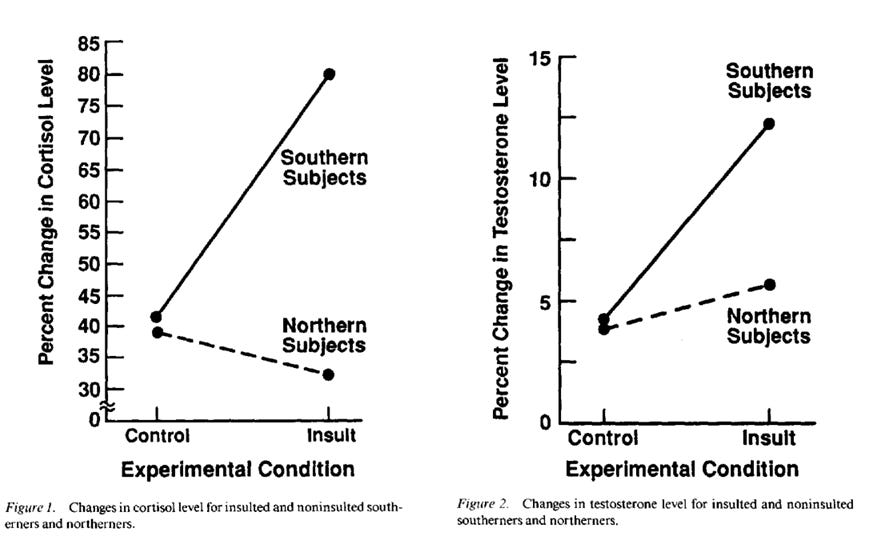
Why Southerners in particular? Partly, because they are presumably more likely to be descendants of people from hilly/rocky parts of Ireland and Scotland where herding predominated (see Albion’s Seed). And partly because the South itself has a longer history of lawlessness and weaker state capacity due to the longer frontier experience. (The idea, of course, is not that the behavior is genetic but that it got transmitted through the generations via cultural evolution and socialization.) So, we can plausibly interpret this as evidence that honor cultures create a conditional readiness for violence, especially when status or reputation is challenged.
As already intimated, the background logic in all of this is that once such a culture is established (presumably for originally ecologically rational, material reasons), it can persist even after its original conditions disappear. This can be so for cultural-evolutionary reasons or just general cultural persistence. To an extent, the tendency might persist to today, as implied by the experiments.
Now, as you can imagine, this seems to be a story that’s too good/neat to be true. And sure enough, there are some important dissenters. For instance, Chu and colleagues find that a certain macro-level extension of the psychological findings doesn’t replicate:
We attempted to replicate and extend the empirical test of the herding-culture-of-honor proposition proposed by Nisbett and Reaves. We find that when differences in white poverty are controlled, there is either no discernible contemporary (1976- 83) relationship between the white male homicide rates and environmental regions or a difference that is inconsistent with the predictions of the theory. The differences reported by Nisbett [and colleagues] are artifacts of unreliable estimates of homicide rates, skewed distributions, and the failure to control for differences in the distribution of white poverty.
Another study by Berthelot and colleagues also found the opposite of a generalized culture-of-violence prediction. In their paper “Scots-Irish Women and the Southern Culture of Violence,” they found that counties scoring higher on that index had lower white female homicide rates, both before and after their controls. So there might not be any Scots-Irish cultural ancestry that simply raises violence among everyone, though it’s still possible (and I’d say quite probable) that men specifically are the ones expected to defend reputation and honor.
Though I’m not happy about it, I think that the culture of honor explanation for violence is probably correct - though only as a very partial account. The original individual-level experiments seem convincing, and there’s a “new” (yet to be published) paper by Cao and colleagues that tests the proposition in many different ways and with the use of different data sources at the world level. As you’ll see, the “effect” size is not impressive at all, so we shouldn’t be overstating anything. But as a potential partial explanation of why violence differs both across the world and within countries, it seems to be quite robust.
The paper begins with information on 1,100+ pre-industrial ethnic groups in the Ethnographic Atlas. For each group, the authors estimate how much of ordinary subsistence came from animals that generally have to be taken out to pasture (and so can get stolen). The average group obtained about 14% of its subsistence from herding. Around a whole third obtained less than 5%, while some at the very upper end of the distribution got more than 50% of sustenance from herding. As you’d predict, high levels of herding appear in several parts of Africa, the Middle East, Central Asia, and northern Europe.
They then connect these historical groups to modern populations on the basis of language as a proxy, and finally match everything to conflict data.
The key finding is that language groups with a stronger historical connection to herding experience more conflict. This is true for events involving the state and for conflicts among non-state actors. A one-standard-deviation (SD) increase in historical herding corresponds to about one-tenth of an SD more conflict. As I said, this is a quite small “effect.” Perhaps more intuitively, they have a separate count model that produces this: an increase of 0.1 in the herding index is associated with about 40% more conflict events.
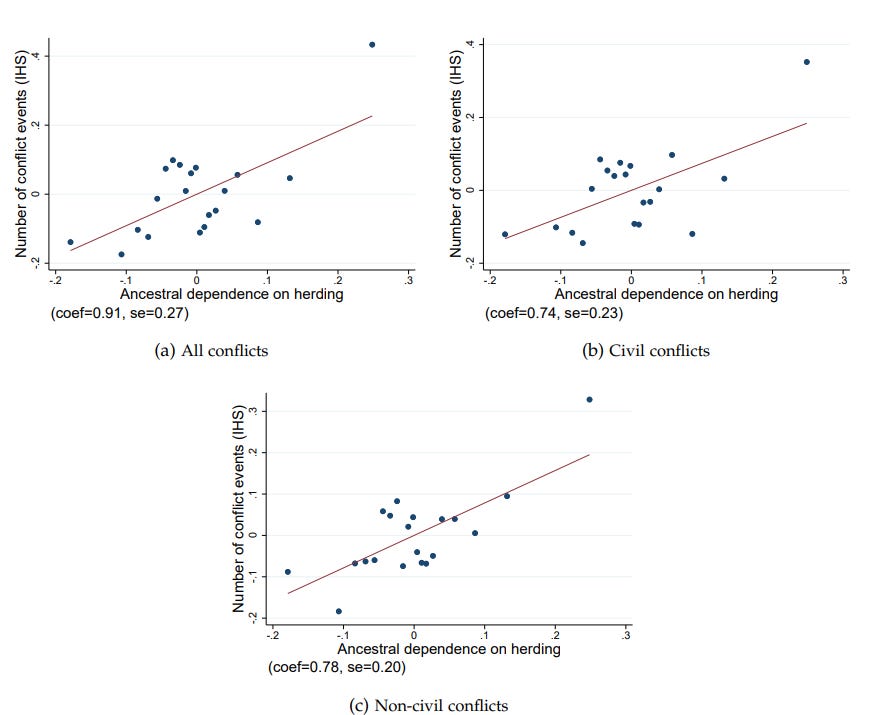
I say “effect” because this is basically a correlation. Obviously, they have loads of controls, and reverse causality is somewhat ruled out because of the significant time delay between the measures. Regardless of the controls they throw at the result (settlement patterns, terrain, development, religion, urbanization, kinship patterns, and so on), the original link persists. They also separately focus solely on Africa and use a more fine-grained conflicts dataset, where they find the same correlation (11-14% of an SD).
But the paper is much more impressive than this.
The central question with respect to the culture of honor is why the extra violence occurs. If the mechanism is revenge, as is argued by the theory, the difference between historically pastoral and non-pastoral groups should be most visible primarily after some earlier injury has created a reason to retaliate. And this is exactly what we see.
Following a year with no conflict, the historical herding measure has almost no relationship with violence, but following a year in which conflict did occur, the relationship becomes larger and statistically significant! More detailed estimates show that the difference is greatest soon after an event and then declines, just as you’d expect. (In the monthly analysis, it becomes negligible after about 4 months, and in an analysis using 10-day intervals, most of it has disappeared after roughly 40 days.) Next, using African data, they specifically look at revenge-related conflict events. They find that events that aren’t described in retaliatory terms show virtually no relationship with herding, while revenge-coded ones do.
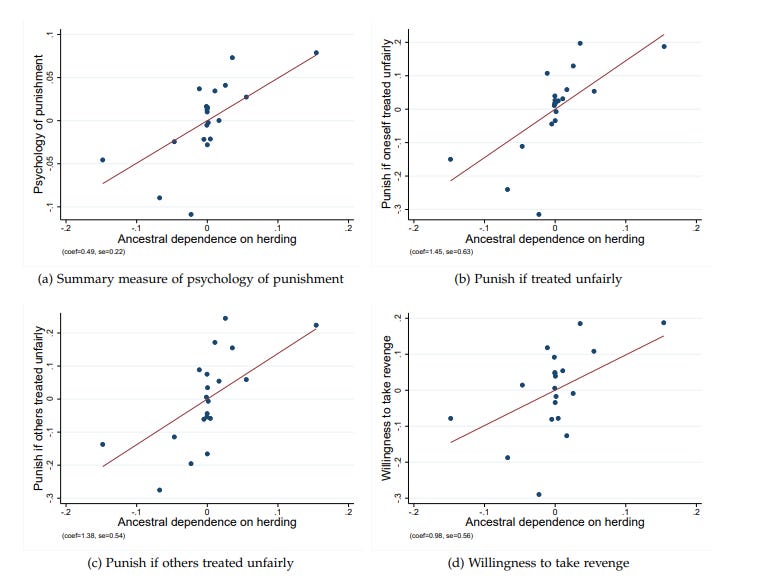
Then they turn away from conflict records and look for evidence of the proposed attitudes themselves, using the Global Preferences Survey. The survey asks whether people are prepared to punish someone who treats them unfairly, or if they would seek revenge after serious injustice, and so on. And again, regions with greater ancestral herding score higher on the measure derived from these questions. A one-SD increase in the regional herding measure is associated with 7.3% of an SD more negative reciprocity. See the binned scatters below.
There’s still more! They have a historical folklore catalogue covering more than 1,100 societies that shows if traditional stories contain themes connected to violence, toughness, and revenge. Of course, groups with more herding history turn out to have a higher share of these themes in their recorded stories. (“Effect” size around 15% of an SD.) A smaller historical dataset gives us information on whether violence was considered acceptable. This is just 60 societies but the link is again there and is of comparable size to everything that has come before.
Crazy what they were able to do with cleverly linking already existing data together. To my mind, this is overwhelming enough to make me update in favor of the culture of honor thesis as one small piece in the puzzle about violence.
No posts
Comments
Nothing yet. Say the first thing.
Sign in to join the conversation.