
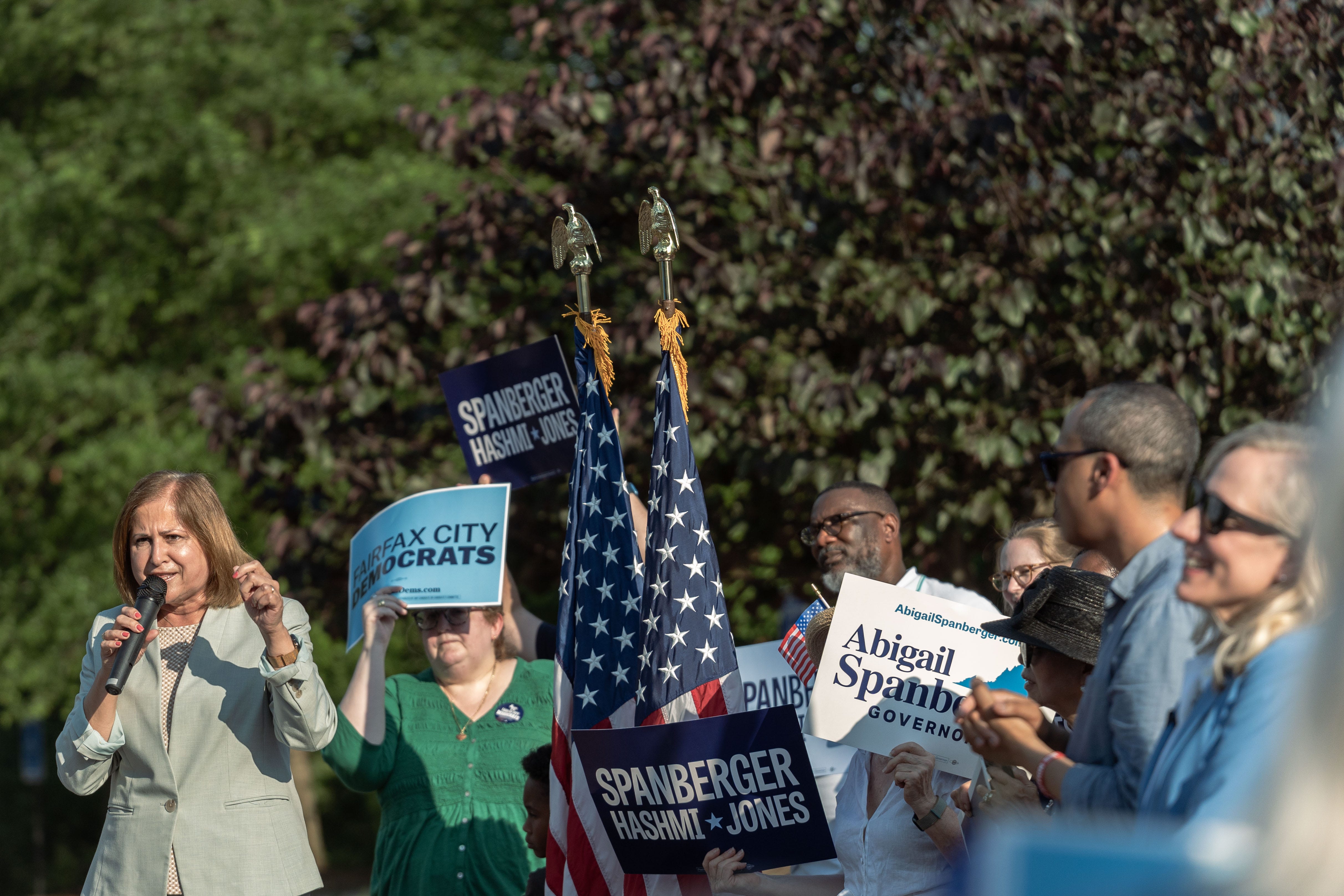
In 2025, States Win supported 17 candidates in Virginia, helping Democrats deliver a historic set of victories that reshaped the state’s political landscape. The election flipped 13 seats from red to blue, securing a Democratic trifecta and building one of the most diverse governing coalitions in the country.
Voters elected a record number of women, many of them historic firsts. Governor Abigail Spanberger is the first woman governor of the Commonwealth, Lieutenant Governor Ghazala Hashmi is the first Muslim woman in statewide office in U.S. history, and States Win alumna May Nivar is the first Chinese-American elected to the General Assembly. There are also now a record number of women in the House of Delegates, with more women serving than all Republicans.
Now these ground-breakers are prepared to make history once again.
The last time Democrats held full control of the legislature and the governorship, they made history by becoming the first state in the South to abolish the death penalty, passed some of the most notable gun safety reforms in the region, and set a path to 100% clean electricity by 2045.
Which is why all eyes are on Virginia’s latest Democratic trifecta to see how far the Commonwealth can go in delivering progress.
In the first legislative session, nearly 2,400 bills were introduced (over 1,500 in the House of Delegates and more than 800 in the State Senate). Governor Spanberger has until April 13 to act on the legislation that cleared the General Assembly, and most laws will take effect on July 1.
So what did this trifecta deliver, and what does it signal about where Virginia is headed next?
Here are five takeaways from this year’s legislative session.
The Virginia legislature advanced several critical constitutional amendments this session. In Virginia, amending the constitution is a multi-step process. Lawmakers have to pass the same amendment in two separate legislative sessions, with an election in between. Then voters get the final say on the ballot.
Here’s an overview of the amendments that the legislature moved forward this session:
Protecting abortion access: After the tragic Dobbs decision overturning Roe v. Wade, Virginia became the only state in the South with broad access to abortion. This amendment would enshrine reproductive rights in the state constitution, making it more difficult to reverse in the future. Every Republican lawmaker has opposed it, and GOP leaders have backed restrictions like near-total bans or a 15-week limit without exceptions for fetal anomalies.
Marriage equality: Another amendment would remove a 2006 ban on same-sex marriage from Virginia’s constitution. That language hasn’t been enforceable since Obergefell v. Hodges, but it’s still written into state law. Supporters want to remove it in case the Supreme Court revisits marriage equality in the future – something Justice Clarence Thomas has suggested.
Expanding voting rights: A third amendment would automatically restore voting rights to people with felony convictions once they’ve completed their sentences. Right now, Virginia is one of the few states where people can permanently lose their voting rights unless the governor restores them, a process critics say is inconsistent and unclear.
New maps for Congress: This amendment would allow the Virginia legislature to temporarily redraw Congressional maps for the 2026 midterms, before returning to a regular redistricting cycle after the U.S. Census in 2030. Using the proposed maps would allow Virginia to help counteract President Trump’s egregious power-grab, as GOP-controlled states have attempted to gerrymander Republicans into maintaining control of the U.S. House. (More on this important amendment below.)
Over the course of the last year, President Trump has strong-armed states with GOP-controlled legislatures to perform mid-year redistricting that would gerrymander Republicans into holding the U.S. House.
In response to this unprecedented power grab, Virginia joined other states in fighting back. The state legislature passed an amendment which allows Virginians to vote on whether or not the General Assembly can redistrict once before the midterms, and then return to “Virginia’s standard redistricting process…after the 2030 census.”
This amendment, currently up for a popular vote, would level the playing field for the 2026 election while protecting the state’s bipartisan redistricting process for the future.
States Win alumni are speaking out in support of the amendment. Delegate Kathy Tran said, “We must be clear-eyed about what is at stake when districts are rigged in other states: Virginians’ voices are diminished in Washington on issues that directly affect our communities, like protecting federal workers and funding for Medicaid, SNAP, and public education.”
Delegate Michael Feggans, a U.S. Air Force veteran, said his time serving made him care even more deeply about the democratic process. “I also took an oath to defend the Constitution. That oath didn’t end just when I took off the uniform,” he said.
Data centers are a growing political flashpoint in many states, and Virginia is the prime example. In fact, a recent POLITICO poll found that nearly half of Americans expect the rapid expansion of data centers to become a campaign issue in their communities within the next five years.
Virginia is the state with the highest concentration of data centers in the country, and they took center stage during the most recent legislative session.
Lawmakers introduced dozens of bills aimed at regulating data centers across the Commonwealth. Among them, States Win alumnus Senator Kannan Srinivasan introduced SB 553, which would require greater transparency around how much water data centers draw from local utilities. The bill passed both chambers and is now under consideration by Governor Spanberger.
States Win alumna Senator Danica Roem sponsored SB 94, which requires data centers to submit a site assessment report in order to rezone. She described the legislation as a first step toward stronger guardrails on where data centers can be located and how they impact surrounding communities. But Senator Roem described the bill as “the bare minimum” and vowed to push for stronger action.
The General Assembly ended the 2026 session without passing a biennial budget, with negotiations still stalled in part over data center tax policy. Senate President Pro Tempore Louise Lucas has made clear she will not advance a budget to the governor without addressing tax exemptions for data centers, which are currently set to expire in 2035.
According to a Climate Power and Blue Rose Research study, 48% of voters say the burdens data centers place on communities outweigh the benefits, compared to just 22% who say the benefits outweigh the downsides.
This is not the last time Virginia, or the country, will grapple with the political consequences of the data center boom.
While federal immigration policy is largely outside the control of state legislatures, Virginia Democrats used their new trifecta to draw a clear line: state and local resources should not be used to carry out federal immigration enforcement, and communities should not be put at greater risk because of it.
Within hours of taking office on January 17, Governor Abigail Spanberger rescinded former Governor Glenn Youngkin’s executive order pushing Virginia State Police and the Department of Corrections to enter into 287(g) agreements with U.S. Immigration and Customs Enforcement. Those agreements effectively deputize state and local officers to carry out aspects of federal immigration enforcement, including identifying and detaining noncitizens.
Ending those agreements was a clear policy shift after years of Republican leadership in Richmond. It also came at a moment when immigration enforcement is escalating nationwide under President Donald Trump’s renewed push for mass deportations.
Lawmakers also moved forward policies to prohibit immigration enforcement at courthouses, aiming to ensure that people can access the legal system without fear. They also backed legislation to restrict new 287(g) agreements, reinforcing that Virginia agencies should not be pulled into federal deportation efforts.
At the same time, legislators passed measures like House Bill 1161, introduced by States Win alumna Delegate Kathy Tran, to set clearer limits on how state and local agencies share sensitive personal data. The bill creates guardrails around when information can be shared with other governments, including federal agencies, with the goal of protecting residents’ privacy and preventing that data from being used to target immigrant communities.
While Trump’s war in Iran drives up gas prices, Democrats in Virginia have worked hard to make life more affordable for their communities.
Union wins: In what’s being called the biggest win for workers in the Commonwealth in decades, the Virginia General Assembly passed House Bill 1263, introduced by States Win Alumna Delegate Kathy Tran. This bill expands collective bargaining for roughly 574,000 public sector workers, ensuring that more state and local employees have a real voice in negotiating their pay, benefits, and working conditions. The bill was backed by a broad coalition of labor and advocacy groups, including the Virginia AFL-CIO, SEIU, the Virginia Education Association, and the Virginia NAACP.
Minimum wage increases: More than 421,000 workers in the Commonwealth are set to see a pay increase after the General Assembly voted to raise the minimum wage incrementally to $15 by January 1, 2028.
Housing justice: Lawmakers also took steps to reduce housing instability. Legislation like HB15 and SB48 strengthen protections for renters by extending the time tenants have to pay overdue rent before facing eviction. According to Princeton University’s Eviction Lab, there were over 135,000 eviction filings in Virginia in the past twelve months. These changes are designed to keep more families housed and prevent short-term financial setbacks from turning into long-term displacement.
Virginia’s Democratic trifecta shows how much progress can be made when we take back power. At States Win, we are working to build power across the country and create more Democratic trifectas this fall. You can read more about our state legislative candidates and our work on our website.
Comments
Nothing yet. Say the first thing.
Sign in to join the conversation.