
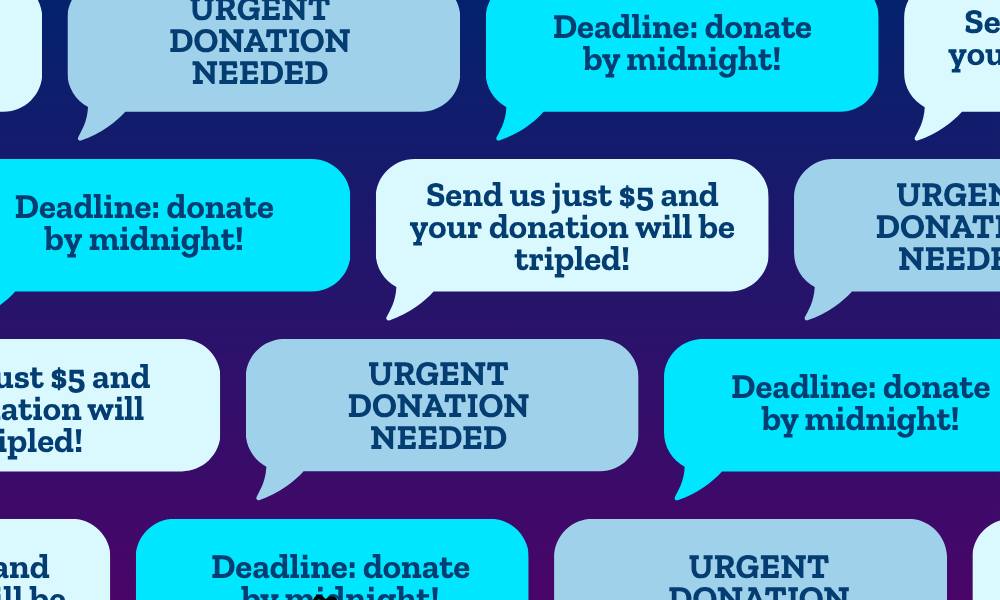
We’ve all gotten the texts:
RUSH US A DONATION, or democracy ends at midnight!
Send just $5, and your donation will be TRIPLED!
I’m FAMOUS NAME, and I’m asking you personally: can you give $12 now?
The sheer volume of these texts has annoyed most of us at some point. But perhaps it’s also made you wonder: Does my $5 really matter to a multi-million dollar campaign?
Chipping in $5 or $15 seems to only guarantee that you’ll receive even more texts. And what is $10 compared to the millions of dollars of dark money being spent through corporate PACs? Can a single small dollar donation even make a dent in federal campaign budgets where just one poll can cost $40,000?
In fact, the barrage of campaign texting is a symptom of a much larger issue. Federal campaigns have become bloated behemoths operating in a convoluted and often opaque legal environment. These campaigns cost an incredible amount of money, and there is little transparency over where the money comes from or where it goes.
This all leads to a grim reality on the campaign trail. Candidates must spend 25-30 hours a week on “fundraising call time” – personally calling people who can afford to give thousands after they hang up the phone. This is true even for incumbents running relatively safe reelection campaigns. That’s right, rather than attending to constituents or passing meaningful legislation, sitting members of Congress must sit at a desk with a finance staffer, calling through a list of major donors every single day.
A few numbers may give you a better idea of the scale of this problem. A candidate running in a competitive Congressional race will raise between $4 million on the very low end to more than $8 million in one cycle alone. If they win, they are rewarded with a two-year term filled with even more fundraising.
In one recent example, Will Rollins raised more than $12 million to lose to Ken Calvert for a second time in California’s 41st Congressional District. And that contest didn’t even make the top 5 most expensive races in 2024.
Sophisticated readers may already know that the legal limit that any single donor may give to a candidate is just $3,500 per election. That means the millions of dollars raised by candidates themselves must be reported to the Federal Elections Commission along with the amount, name, occupation, and city of every individual donor. In the industry, these donations are referred to as “hard side” money.
This is where the aptly nicknamed “dark money” comes into play. Dark money funds flow through entities like Super PACs, and insiders refer to it and other independent expenditures (IEs) as the “soft side.” Thanks to Citizens United v. Federal Election Commission, soft side money generally has few or no restrictions. Wealthy individuals, corporations, and other groups can donate and spend essentially unlimited amounts of money in service of getting “their” candidate elected.
In 2024, the big money problem was the worst it’s ever been. According to a New York Times analysis on general money in the 2024 cycle, billionaires contributed a staggering 19% of the money in federal races, despite being only 0.00034% of the US population.
How do I know all this? I was the young person tasked with raising the massive budget that federal candidates need to run viable campaigns. Any way that money can be raised for a Congressional candidate, I’ve done: general campaign committees, victory funds, joint fundraising agreements, legal/recount funds… I was even a volunteer fundraiser for House Majority PAC (a Super PAC closely aligned with House Democratic leadership).
The money I fought for tooth and nail went largely to overpaid political consultants, who have power and get paid precisely because there is no longevity in a political campaign. These consultants are the powerbrokers who disseminate the knowledge and connections that make or break a campaign.
Everyone I’ve ever discussed this with is appalled. I’m not alone – a recent Pew study showed that more than eight-in-ten Americans say that the cost of political campaigns makes it hard for good people to run for office. Many even wrote in an open-ended answer that money is the biggest problem in politics.
The Supreme Court has made it clear that they have little interest in placing limits on contributions or expenditures at the federal level, and it seems unlikely that Congress will regulate itself voluntarily. But states define their own campaign finance laws for statewide and state legislative offices, and they can vary widely.
In Virginia, there are no limits; while Minnesota has a $1,000 limit per “election segment.” In Alaska, a certain percentage of contributions need to come from Alaskans. The variations go on and on.
Montana recently tried to counter the infamous Citizens United decision via a very popular ballot initiative, and despite being held up by Montana’s Attorney General and Supreme Court, it will go to voters this November. States continue to be the best path forward for meaningful campaign finance laws and enforcement.
Overall, with a few exceptions, states have lower limits than the federal limit, and there are far fewer IE (soft money) players in the state legislative game. It’s also worth noting that soft money is powerful only because it is large, not because it is efficient at being helpful to the candidate.
With lower limits and smaller campaign budgets, state legislative races offer an environment that favors grassroots donors. Small dollar donors tend to be much more diverse than large donors in terms of gender, ethnicity, and income, and are actually more representative of America. Lower limits also mean races that are more competitive, as incumbents have less of an advantage.
But state legislative candidates face an uphill battle. They have smaller constituencies, don’t get the news coverage Congress does, and don’t necessarily have the moneyed connections that many Congressional candidates do.
One example is States Win alumna and current candidate Catelin Drey, running for reelection to the state Senate in Iowa. States Win volunteers raised more than $18,000 in small-dollar contributions, made more than 23,000 calls to Iowa voters, and secured 413 vote plans for Drey in just three weeks. She went on to win by 797 votes and end the GOP supermajority in the chamber.
Small dollars have the biggest effect going straight to individual candidates, rather than going to caucuses or parties. Caucuses are invested in all kinds of activity, but donating to a highly strategic candidate means your money goes directly towards a seat that could change the power balance in chambers this cycle.
The next time you get one of those texts begging for $5 by midnight, check the sender and do the math. Your $25 to a federal campaign is a rounding error for a $10 million budget in an environment dominated by billionaires, and it will disappear into a budget so large that nobody will ever notice it arrived.
State legislative races are a completely different game. Your donation is a real share of a really tough campaign. It goes to a candidate who is knocking on doors in their own neighborhood, running because they actually want to serve the people they live next to.
And the stakes couldn’t be higher: these are the races that decide who holds the majority, who draws the maps after 2030, and whether a state passes laws that protect abortion access, healthcare access, voting rights, and more – or strips them away.
States Win is building slates of candidates in exactly these races: the ones where a few thousand dollars and a few hundred volunteers can change a chamber. Your money actually matters here, and I promise we won’t text you about it at midnight.
Comments
Nothing yet. Say the first thing.
Sign in to join the conversation.