
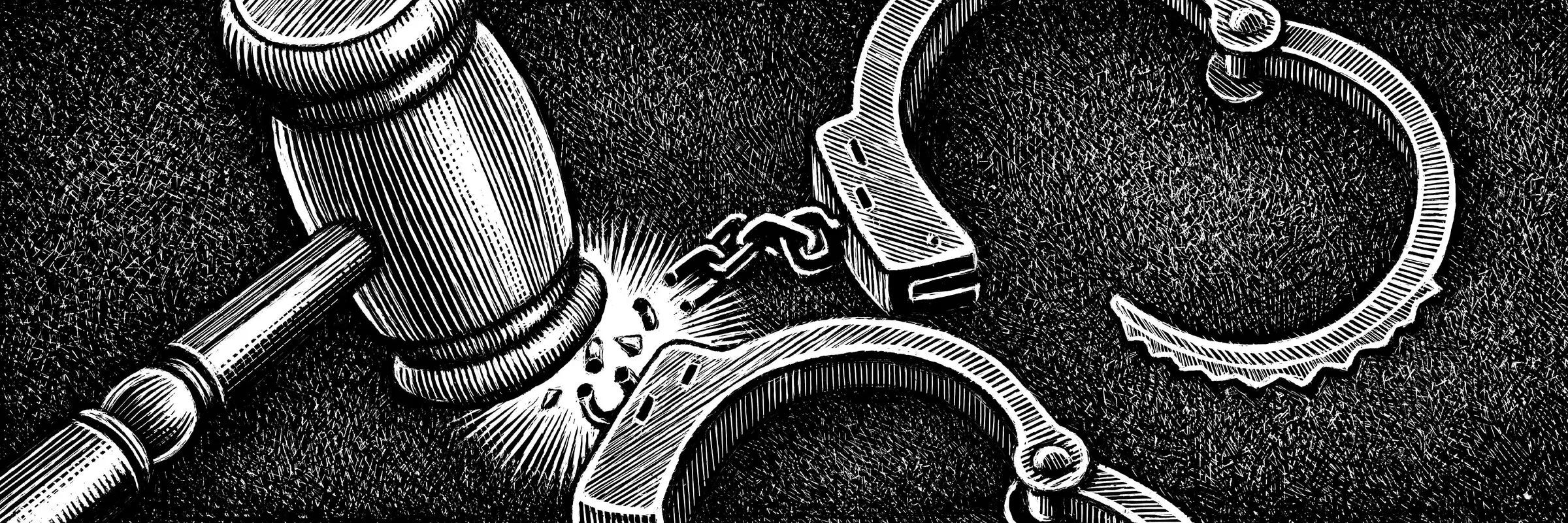
This week, I’m handing the State Court Report newsletter essay over to our managing editor, Kathrina Szymborski Wolfkot, who looks at how states are addressing criminal convictions that rely on “junk science.”
— Alicia Bannon
If you are convicted based on evidence later exposed as junk science — bite marks, hair microscopy, or an outdated shaken baby syndrome diagnosis, for example — what recourse do you have?
The U.S. Supreme Court has long held that prosecutors violate due process when they obtain a conviction using evidence they know is false. But the Court has never extended that principle to evidence that nobody knew was faulty at the time — evidence that was good science by the standards of the day, until it wasn’t. The justices two years ago declined a petition asking them to resolve the question; the petitioner in that case, Charles McCrory, is now entering his fifth decade behind bars for a murder conviction based largely on bite mark testimony that the testifying expert himself later recanted.
The Court’s silence has left this issue up to the states, and outcomes have varied widely.
Last month, the Hawaii Supreme Court entered the fray. It held that Daniel Granillo’s 1990 conviction for kidnapping and sexual assault, based in substantial part on now-discredited hair and fiber evidence, violated his state constitutional due process right to a fair trial. The court ruled that convictions obtained using such evidence should be evaluated using the same standard as those based on knowingly false evidence — a lower burden for the defendant than the “newly discovered” evidence test used by the intermediate appellate court.
Acknowledging that later-discredited scientific evidence presented “an unanswered question, ” the court determined that the state’s knowledge (or lack thereof) of falsity was inconsequential. “Granillo is not less wrongly convicted because everyone in 1990 acted in good faith, ” Justice Todd Eddins wrote for the majority. “Conditioning relief on knowledge would shield an entire category of constitutional violations.”
While the Hawaii decision rested on constitutional grounds, legislatures in seven states — first Texas in 2013, followed by California, Connecticut, Michigan, Nevada, Oregon, and Wyoming — have enacted statutes that let a court order a new trial when the science underlying a conviction has been disproven. But critics say that some of these “junk science” laws are not operating as intended. In Texas, for example, no one facing execution has won relief in the 13 years since the law’s passage. This outcome is statistically improbable: Nationwide, one-third of people exonerated while on death row were convicted based on at least one form of junk science.
This failure came into focus in late 2024 when Robert Roberson, sentenced to death in 2003 for his daughter Nikki’s death based largely on shaken baby syndrome testimony, came within days of being executed. In a last-ditch effort to halt the execution, Texas legislators took the extraordinary step of subpoenaing him to testify about potential changes to the junk science law — on a date after his scheduled execution. The move set up a separation-of-powers showdown pitting the legislature against the executive branch, which was tasked with carrying out the execution. Roberson’s execution was rescheduled and then paused again in fall 2025; the case is pending before a Texas lower court.
In other states, people convicted based on junk science can pursue relief using habeas corpus, the process through which incarcerated people challenge their convictions as unconstitutional. Because the U.S. Constitution doesn’t guarantee correct outcomes — only fair process — the U.S. Supreme Court has never recognized innocence as a stand-alone ground for post-conviction relief. But some states do.
In June, the Louisiana Supreme Court had its first chance to apply the state’s 2021 law governing post-conviction claims of factual innocence. The court unanimously affirmed that Jimmie Duncan’s 1998 murder conviction, which relied on discredited bite mark analysis and pediatric forensic pathology, must be vacated.
When the U.S. Supreme Court declined to take up the question of how to address convictions based on junk science, Justice Sonia Sotomayor observed that “hundreds if not thousands of innocent people may currently be incarcerated despite a modern consensus that the central piece of evidence at their trials lacked any scientific basis.” She called on states to “create an efficient avenue for innocent people convicted based on forensic science that the scientific community has now largely repudiated.” Slowly and unevenly, states are answering the call.
No posts
Comments
Nothing yet. Say the first thing.
Sign in to join the conversation.