

Hi, I’m Brenda Scott, and this is my family:
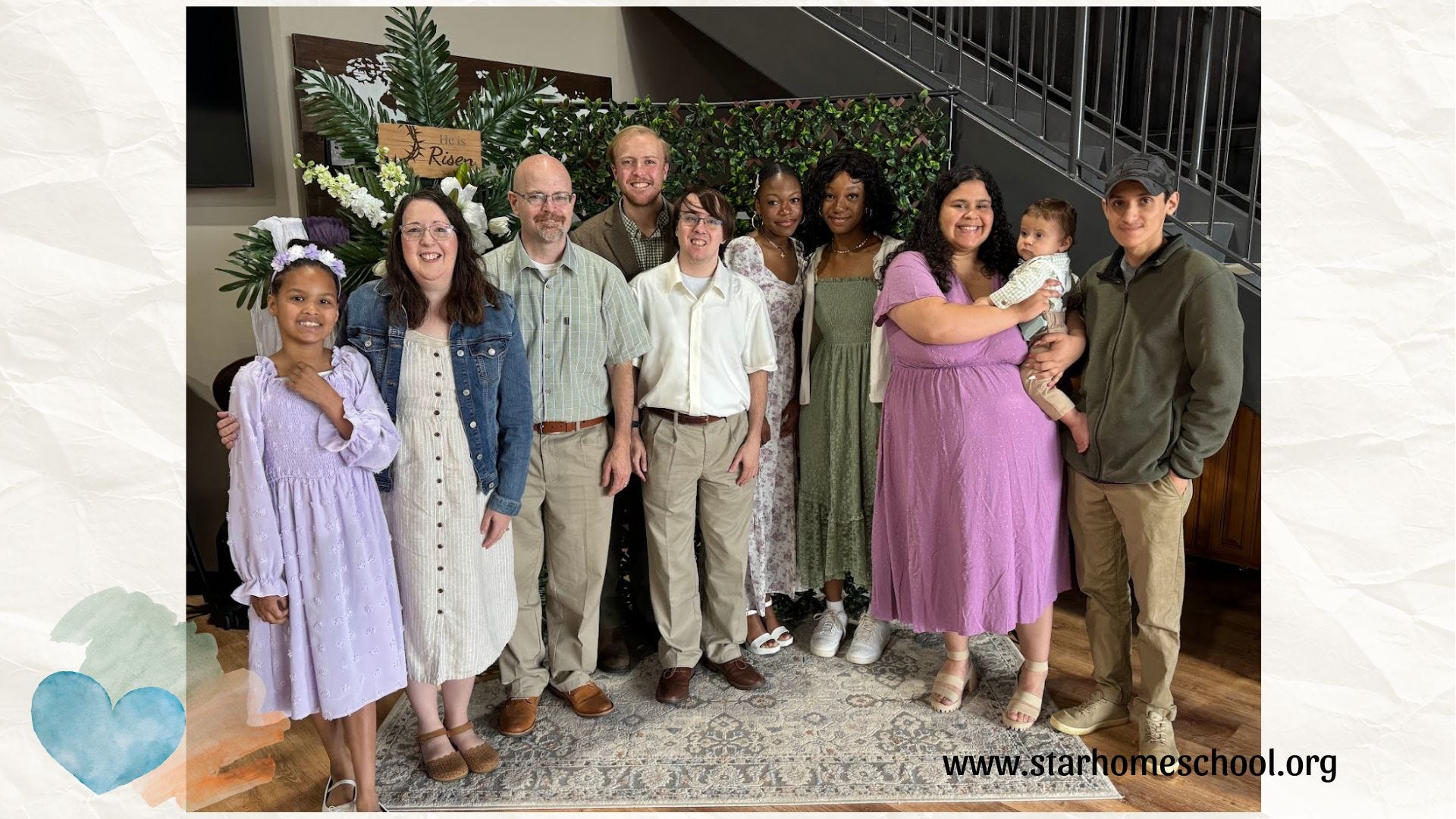
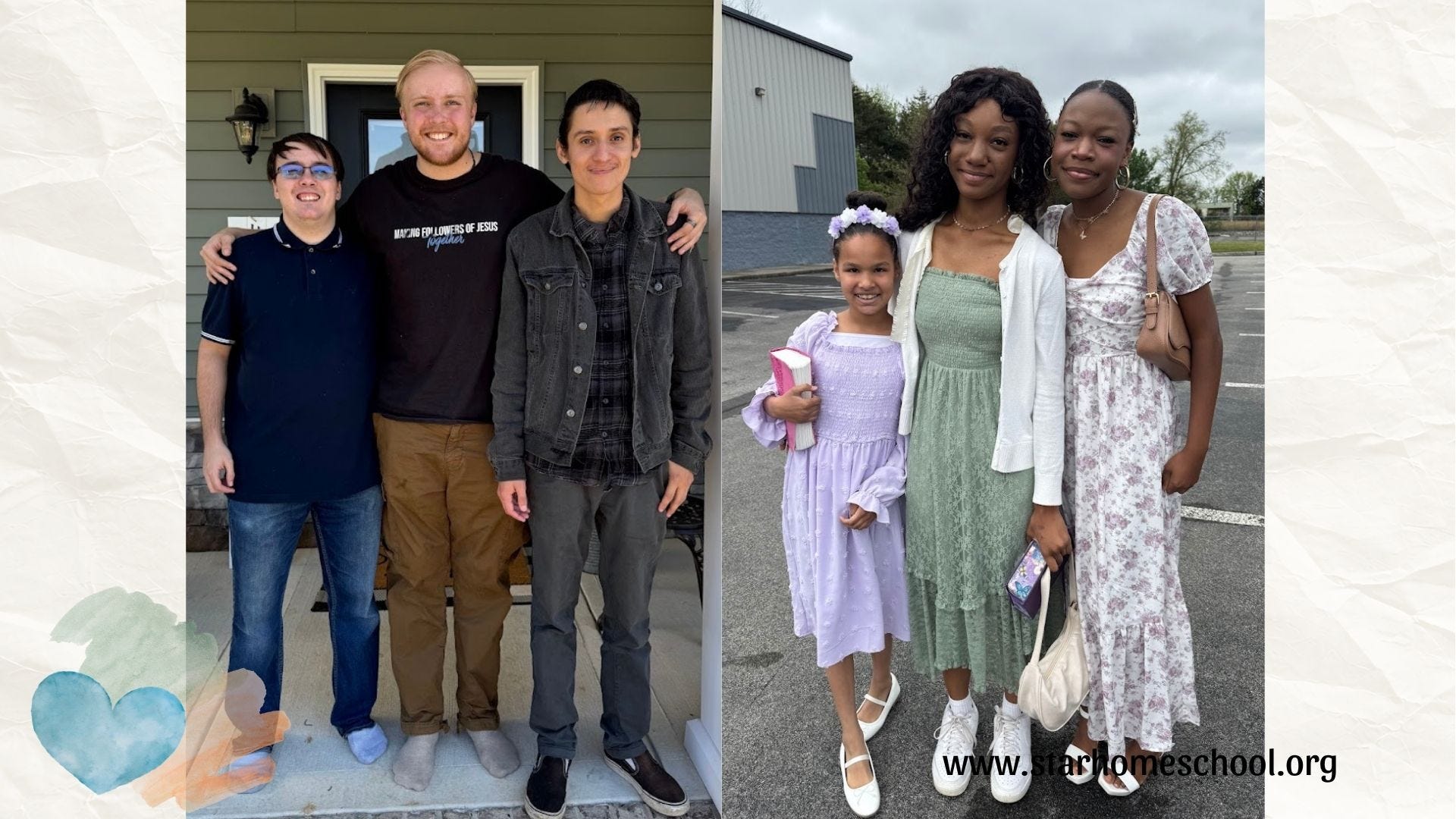
We had 2 biological sons and then adopted one son and three daughters. We also fostered eleven different kiddos who stayed with us for a season and eventually left. One of our sons is married and they have a baby boy who will turn one this summer. God is good! Here are our three boys and our three girls:
We have faced a myriad of health issues, learning disabilities, and have had multiple children fight homeschooling. I have been homeschooling for twenty-two years now, and today I’m going to share some things I have learned.
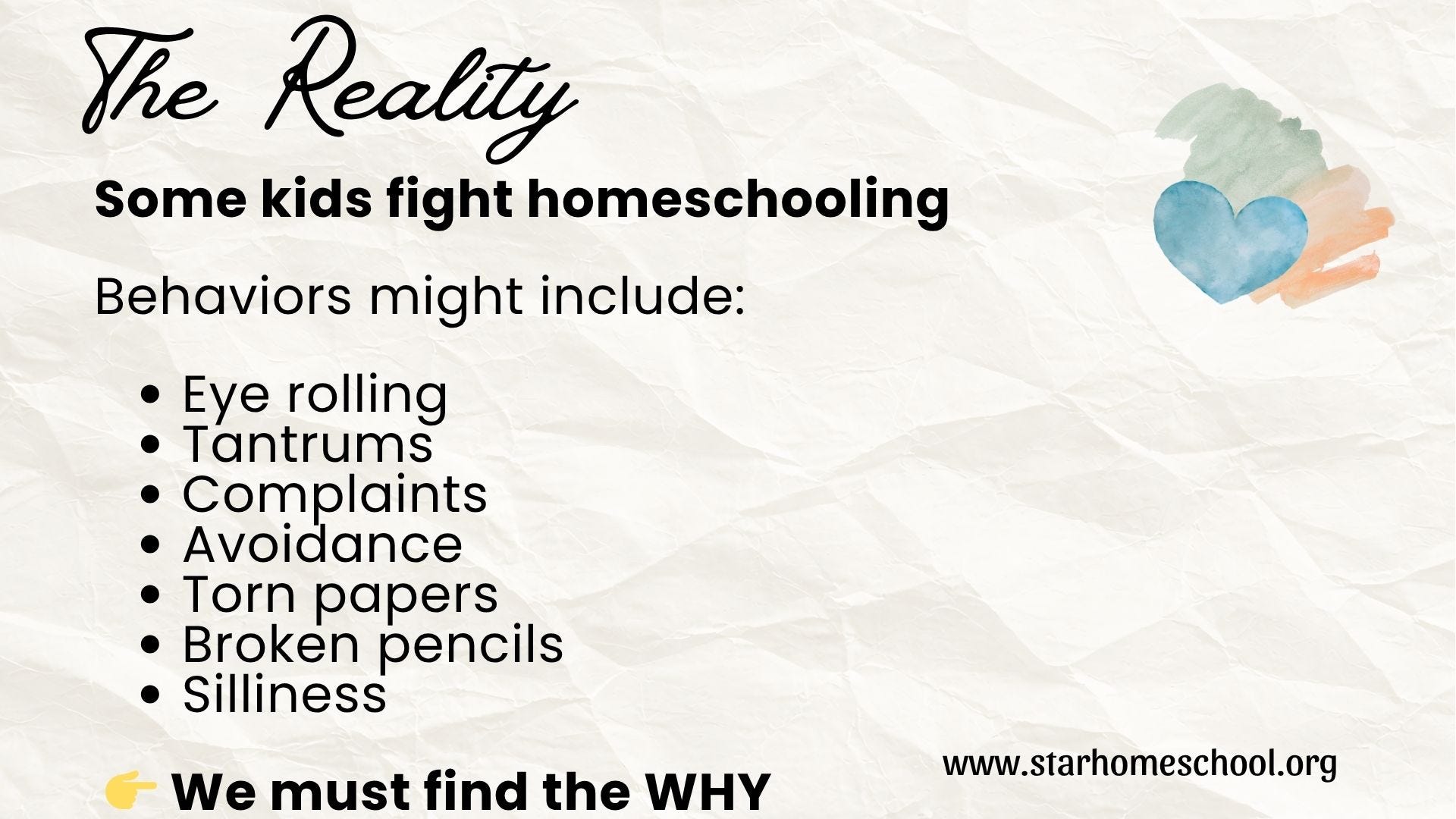
We had to really become detectives and sleuth out WHY our kids are fighting homeschooling in order to help them.
Today I’m going to talk about some of the reasons we discovered, and then some of the tricks we learned along the way.
If you are dealing with behavioral issues, learning disabilities, eye rolling, tantrums, complaints, crumpled up papers, broken pencils, holes in math pages that were erased too hard, and you find yourself wondering if it might be easier to just give up on homeschooling, this message is the right one for you.
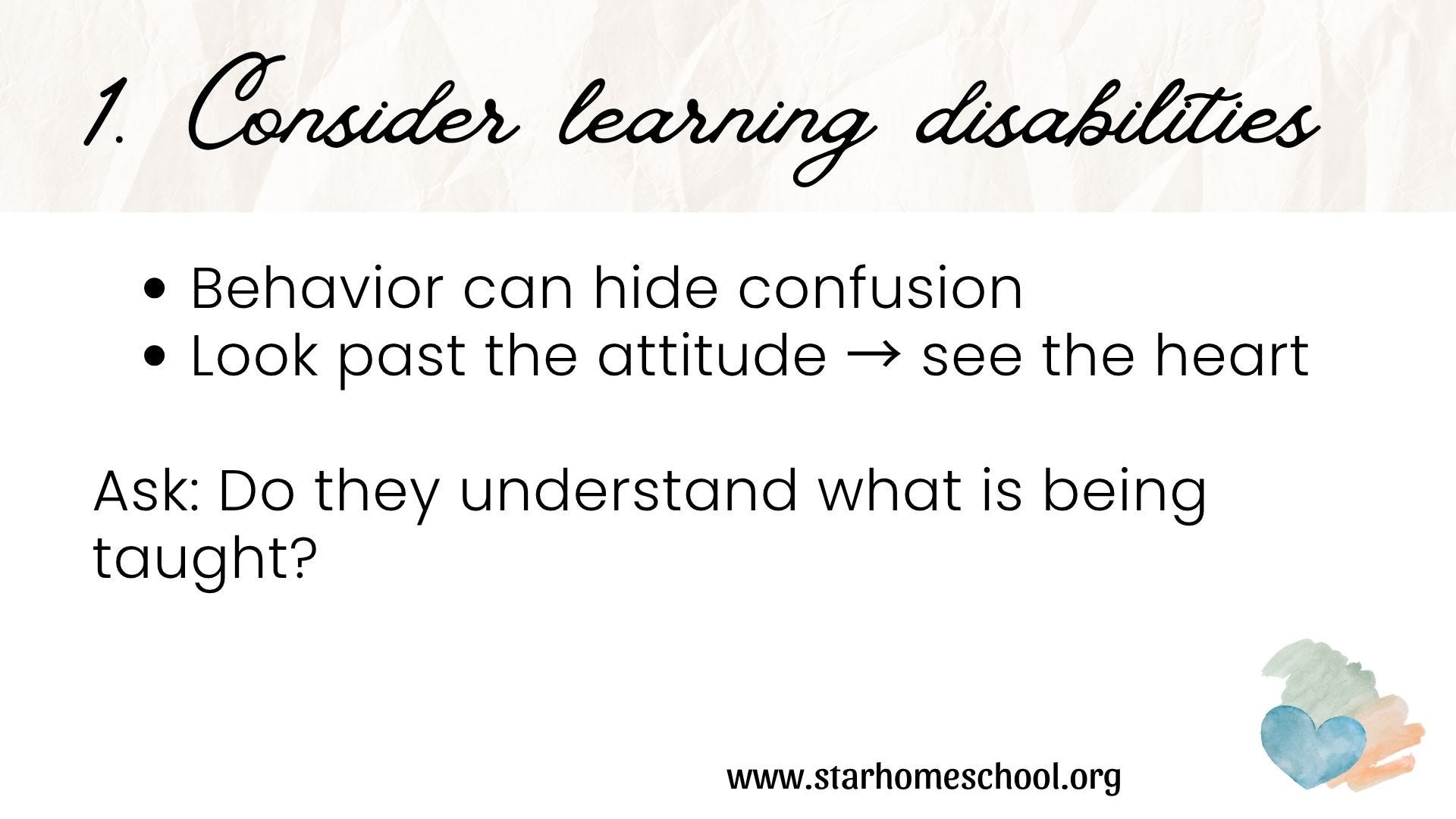
-SO many kids use attitude to hide the fact that they don’t understand.
-Some kids use silliness.
-Some are just plain grumpy.
Step back and pay attention to the heart of your child. The outer behaviors are sometimes so loud that it’s hard to see what is really going on.
Take time out to pray for your child, that God would help you discern whether or not your child is struggling in some area.
Learning disabilities can be addressed in so many great ways. Here are some things that have worked for us over the years:
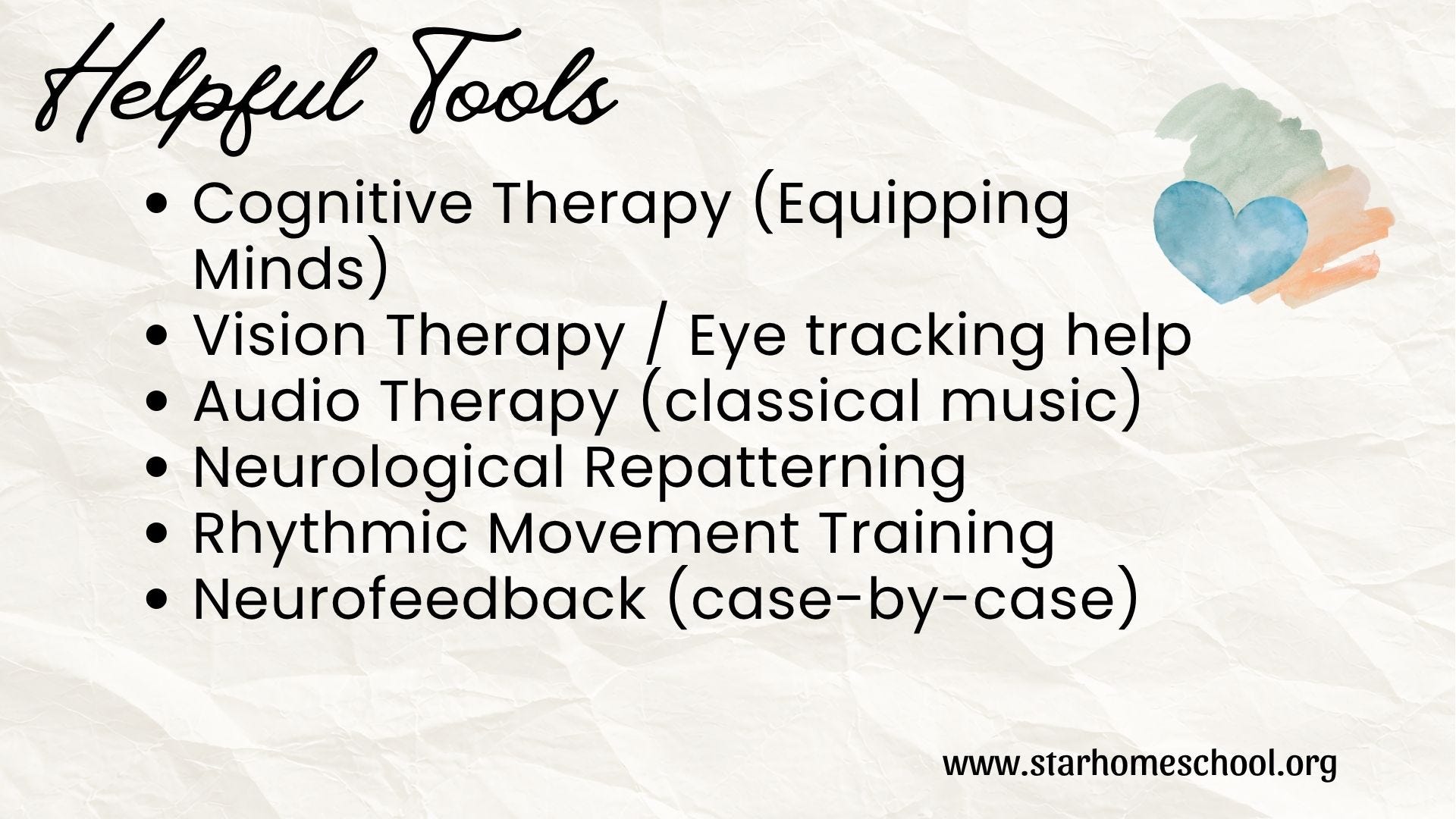
Cognitive Therapy:
-VA, working memory, letter sounds, problem solving, multiplication facts, handwriting
-Equipping Minds, Carol Brown
-Vision therapy w/doctor for eye tracking
-Eye Q Advantage
-Child may skip lines
-Audio Therapy:
-Carol Brown, Equipping Minds
-Three hours per day
-Also, playlists
-"Brain” playlist
-Yoto Player, Make Your Own Card
Neurological Repatterning
-Crawling and exercises to copy what a baby would do inside and outside the womb while their brain is developing
Rhythmic Movement Training: We have used Rhythmic Movement Training with one of our kids. It is easier, and gives quicker results than the similar Neurological Repatterning, which I did for many years with our children.
Neurofeedback: We have found success with neurofeedback for behavioral issues, and it can sometimes be helpful for learning struggles. Neurofeedback helped with one of our children’s behaviors, it was not useful for another child’s cognitive struggles. Cognitive therapy has been a better fit for that child. Each child is a unique human being and different things will work for each one. I just want to share everything we have tried. Neurofeedback is a bit expensive, and possibly more of a “last resort” option for many families
Learning Disability Assessments
Resources
Equipping Minds (Cognitive Therapy—we’ve used)
Lifelong Learning (Cognitive Therapy in Lynchburg, VA—we’ve used)
Rhythmic Movement Training International (we’ve used)
Motion 360 Therapy (in TN)
Ochs Labs LENS Neurofeedback (we’ve used)
Brainmaster Traditional Neurofeedback (we’ve used—we prefer this over LENS because one child had a negative reaction to LENS and moods became worse. LENS might work deeper/faster and that child’s brain was sensitive to it. I think traditional neurofeedback is gentler).
Focus on Lovely Things
Suggestions for Dyslexia
Audiobooks while following text
Decodable readers
Short lessons (15–25 min)
Resources for Dyslexia
Strong Minds (local to TN!)
All About Spelling (we’ve used)
All About Reading (we’ve used)
Logic of English (we’ve used)
The Barton Method (we’ve used)
Suggestions for Dysgraphia
Oral narrations instead of written answers
Dictation to parent
Typing
Shortened written output
Wide-lined paper / pencil grips
Resources for Dysgraphia
Google Docs Voice to Text (we’ve used)
Tell stories verbally with Story Starters by Karen Andreola (we’ve used)
First Language Lessons for grammar done orally instead of in writing (we’ve used)
Resources

-A child who does not feel well will not have the energy to learn.
-Some children (like one of mine) are so stoic and able to cover up low energy or a general feeling of being unwell.
-Health issues may come out in attitude or behaviors instead.
-This can be so difficult to uncover
-some health issues are not seen in a typical well-child visit
We have found these techniques useful:
-Avoiding a particular food for a season to see if health concerns and/or behaviors improved.
-Seeing a naturopath to find out if the child has underlying food sensitivities or allergies.
-Trying a gut-healing diet like the GAPS Diet, the SCD Diet, or Whole 30. Our family was on the GAPS Diet for three years. It was amazing for all of us!
-Starting our child on a probiotic and some fish oil.
-I took a one-year course in nutrition, but I am not a doctor–so please consult your doctor about this. In my nutrition education, the four things that seemed to help nearly every disease were: fish oil, probiotics, vitamin C and fresh beet juice.
-Other superfoods to introduce to your child include homemade chicken broth, and fermented foods like sauerkraut.
-Avoid food coloring and sugar to see if that changes a child’s behaviors.
-Again, consult your doctor about any supplements, because I cannot give medical advice.
-Does your child always seem to have a stuffy nose? Does he wake up groggy or get sleepy after meals?
-Do you notice big attitudes during times of low blood sugar? We had one foster child who had to have a snack right when he woke up, or he would be super grumpy and mean to everyone around him. Once he got a snack, his attitude improved. String cheese was our go-to snack for him every morning, because it has some protein in it.
Think of foods like firewood in this way:
-Proteins and fats are the large logs that keep the fire burning for hours. They give energy that lasts.
-Carbs are the kindling--they are necessary to get the fire going, but they don’t last.
-Sweets are the paper--they flame up and burn out quickly.
Make sure your child is getting a variety of healthy foods.
If you have a really picky child who won’t eat their veggies, think about using recipes that hide vegetables in the food. There were two cookbooks that came out when my kids were little called Sneaky Chef and Deceptively Delicious & they had recipes with hidden vegetables in them.
Consider all of these possibilities and adjust things or find a professional to help.
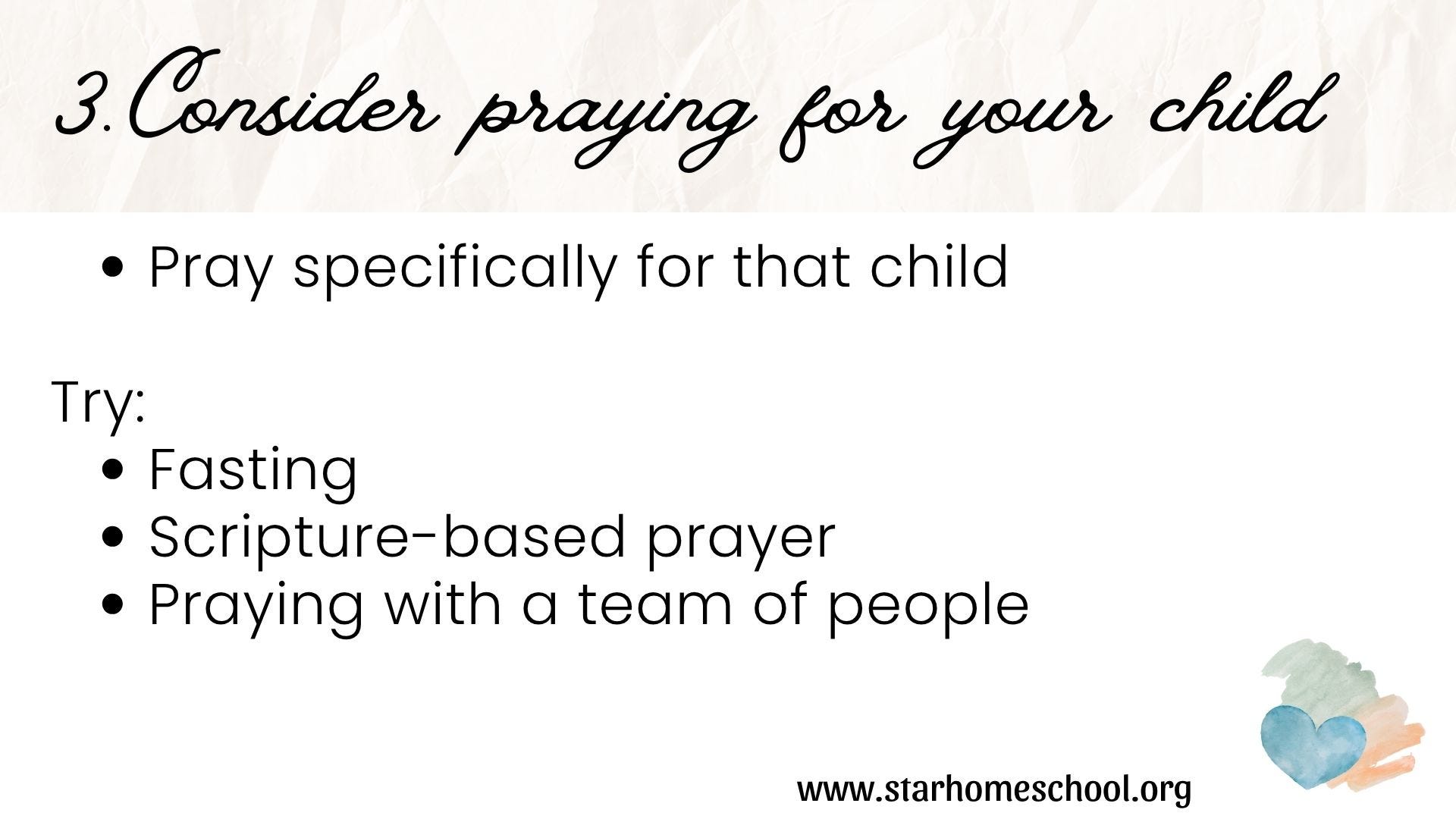
I’m sure you pray for your child.
What I am talking about is intense, focused prayer for the specific child you are struggling with.
Stormie O’Martin’s book The Power of a Praying Parent is helpful because it is full of specific prayers and lots of Scripture.
You can also make prayer cards using specific passages of Scripture.
Have you thought of fasting and praying for this child?
Sometimes the child who is challenging us the most is the hardest one to pray for.
But, the Bible even tells us to pray for our enemies–how much more would God want us praying for the child He gifted us with who we don’t understand?
Also, this may be a bit uncomfortable for some people, but have you considered the possibility of spiritual warfare?
I am not saying that every child who fights homeschooling is demon-possessed or influenced by demons.
I think Christian parents dealing with spiritual warfare will sense it.
Possibly, they have faced experiences that let them know the struggle is for sure spiritual.
We knew our battle with one of our children was not only against flesh and blood.
It is helpful to find a team of people to pray over your child against spiritual warfare.
The cool thing about praying is that this doesn’t require buying anything. If you have a relationship with the One True God through His Son, Jesus Christ, you can go to Him anytime and intercede for your child.
More Resources
Spiritual Interventions with Dr. David Appleby (we’ve used)
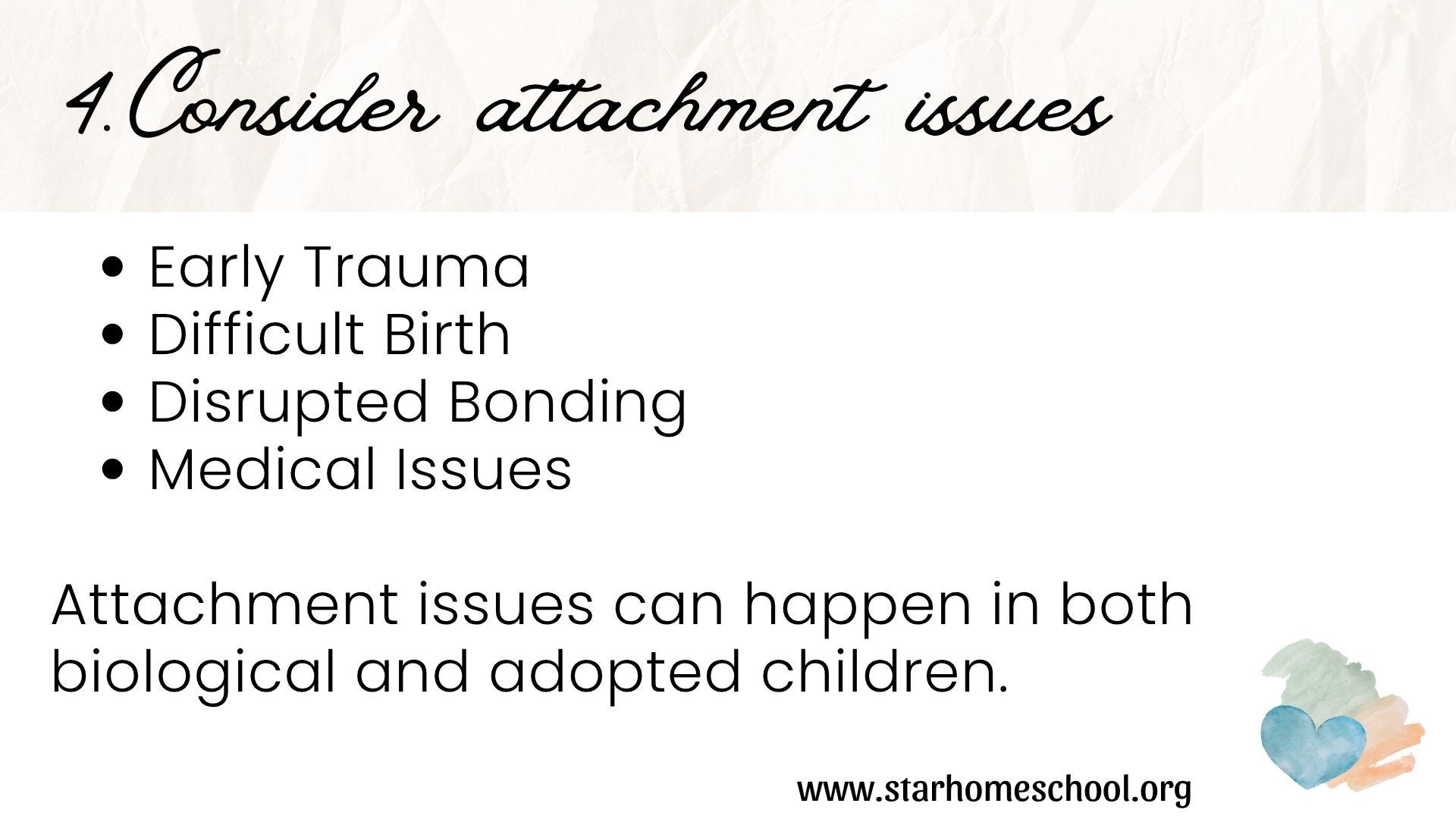
We adopted three of our kids, so we are keenly aware of attachment issues like RAD (Reactive Attachment Disorder).
Did you know that biological kids can have attachment issues, too?
Often, these children had a rough birth, or health issues as a baby, or mom had health issues or trauma during the pregnancy, or the child faced some kind of early trauma. Any situation that disrupted a baby’s Need Cycle or made a baby feel unsafe, or that the adults in their life simply couldn’t meet their needs could potentially lead to attachment issues.
Sometimes attachment issues will cause a child to fight you when you pull out the school books because the child struggles to respect you as an authority figure because they are not attached.
It’s not a matter of more discipline or a stricter approach. It is a matter of more love, more compassion, and a focus on healing the relationship.
My husband and I have sat through countless hours of training on attachment issues in adoption and foster care classes, adoption camps, retreats, intensives, etc., but we are not experts. We still struggle through day-to-day life with RAD, and it’s hard, because the kind of parenting that is required is not what we often FEEL like doing after a child with RAD has displayed their behaviors.
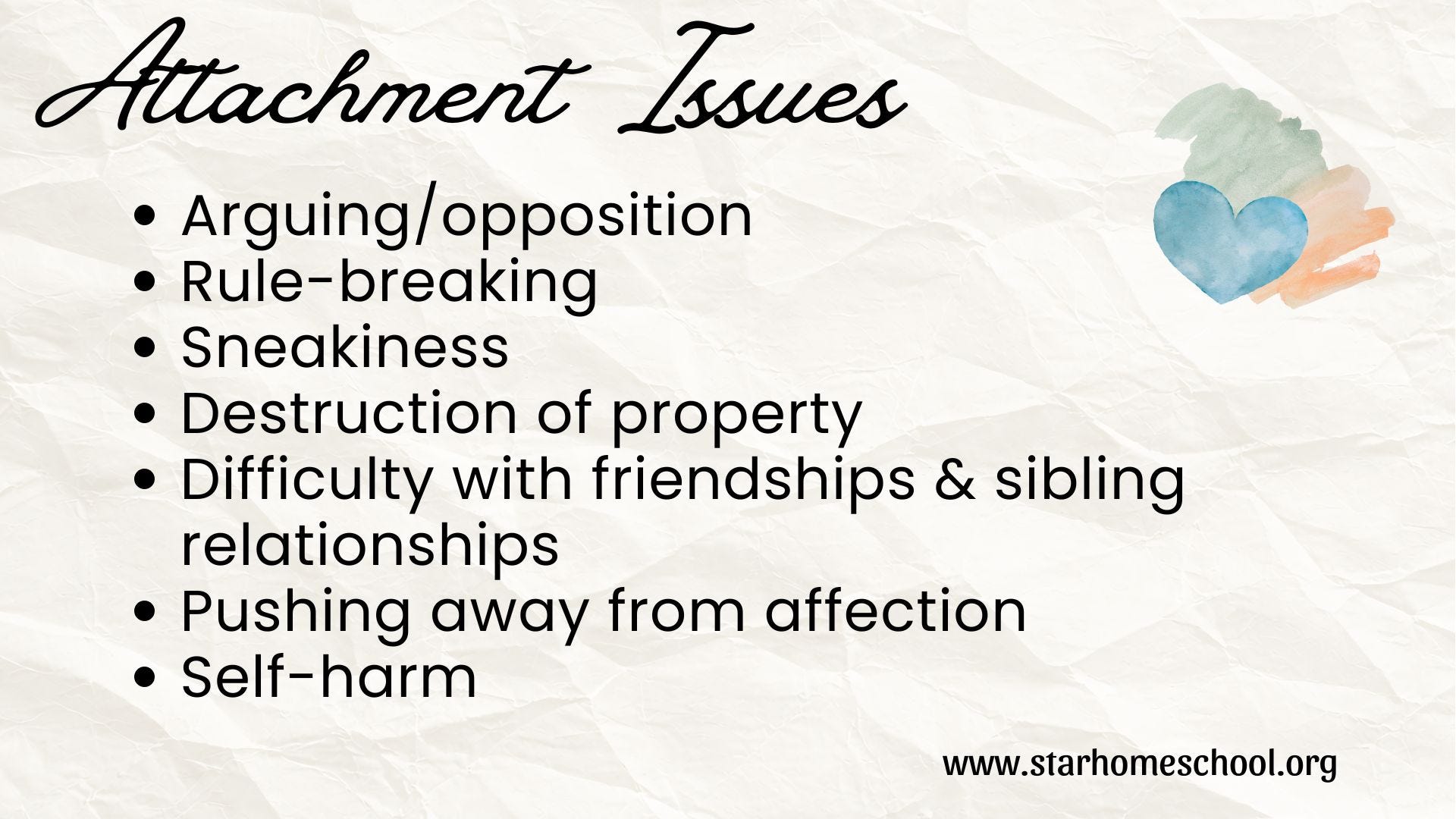
Some of the things on this list are normal.
I say, what we face with RAD is like normal behaviors, times 25...Or some days, times 100.
By arguing/opposition, I mean, everything is an argument. Every little detail.
By rule-breaking, I mean, the child will constantly put his or her toe over the line, and with a smirk.
By sneakiness, I mean, you’ll feel like you might need cameras all over your house and alarms on doors, because you can’t even trust the child to go around the corner without adult supervision.
Destruction of property may be overt and obvious, like holes in doors or walls. It may be more subtle, like holes picked in clothes, and pencils chewed up. There is a fine-line between a fidgety child and one who is ruining things on purpose.
Difficulty with friendships and sibling relationships: kids with attachment issues just aren’t very friendly, and they don’t put others first. They might say rude things, destroy other people’s property, and they lack social boundaries necessary for good relationships.
Pushing away from affection: they don’t want hugs, they turn stiff.
Self-harm: picking, poking, or worse
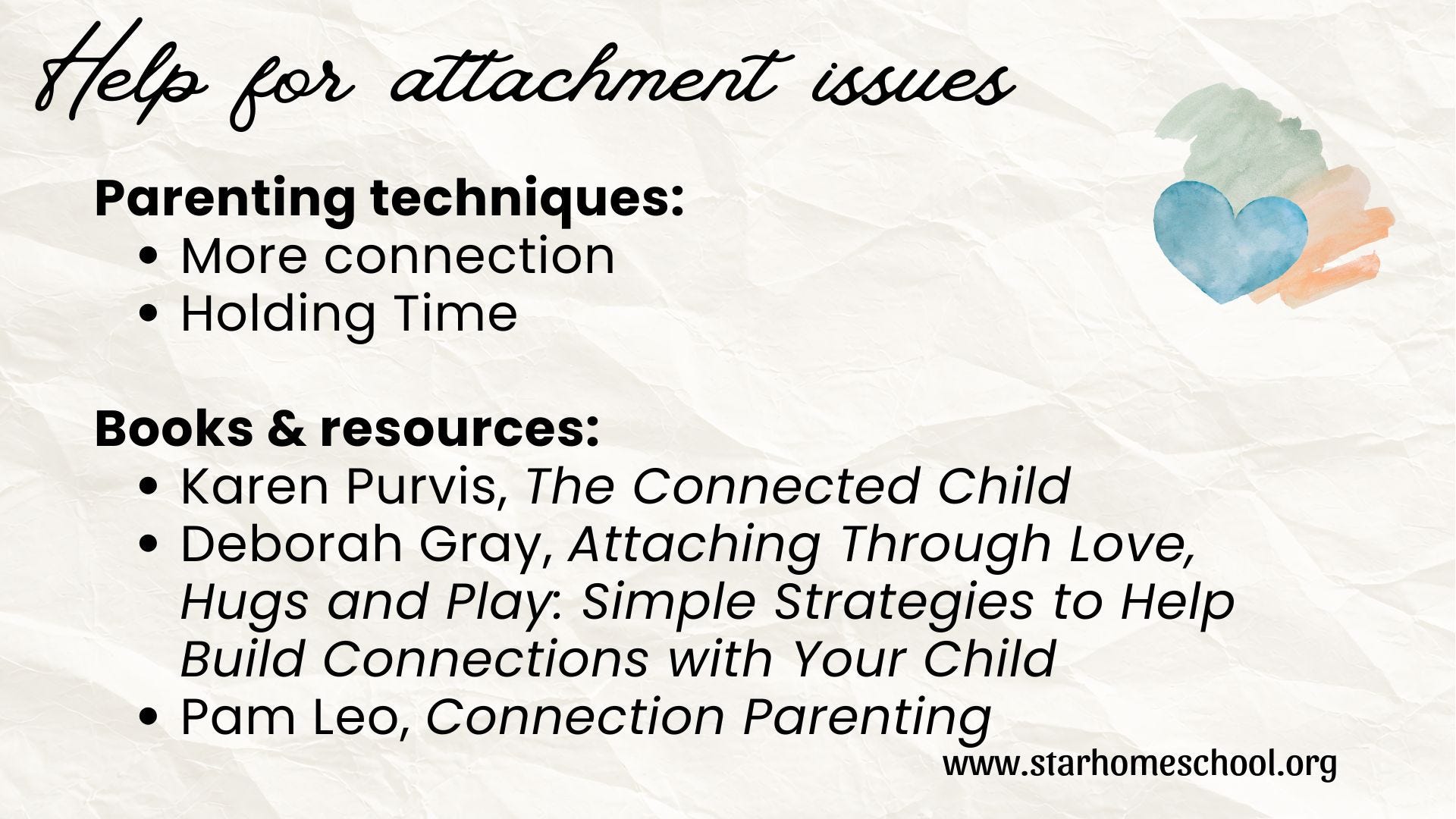
There are a couple of great books I recommend in order to address attachment issues:
The Connected Child by Karen Purvis (The late Dr. Karen Purvis’ work is the gold standard in attachment therapy. It’s amazing! If you can get ahold of her video training, you will be blessed to watch how sweet she was with the children she worked with.) See her on YouTube here.
Attaching Through Love, Hugs and Play: Simple Strategies to Help Build Connections with Your Child by Deborah D. Gray (We’ve seen Deborah Gray speak and share her techniques at multiple adoption conferences. She is delightful and gentle and I really appreciate her approach!)
Connection Parenting: Parenting through Connection instead of Coercion, through Love instead of Fear by Pam Leo (I saw Pam Leo speak at the Wild + Free Conference in Franklin, TN a couple of years ago. Her descriptions of parenting interactions were so loving and gentle. I really liked her and her ideas!)
Also, therapy with horses or other animals is helpful. One of the very best treatment centers for RAD in the country uses golden retrievers. One of the really good attachment therapists in OR had a mini pony in her office. There is something about animals that helps kids, although, you want to first make sure the child will be safe with animals and not hurt them.
If your child has attachment issues, they may be the child you want to send away to school or a multi-day program the most. I encourage you: don’t.
This is the child who needs to spend the most time with you. If you have an opportunity to spend more time with this child while he or she is still under the age of eleven, please do so!
Eleven is not a magical age, and please still do whatever you can to build relationship bonds with your child if he or she is over the age of eleven. I mentioned the age eleven because this is typically when children start pushing away from their parents and trying to prove that they are independent.
Attachment is easier before this age, but it is not impossible at later ages.
Resources
Shangri-La Therapeutic Academy of Riding (Equestrian Therapy in TN)
Making Sense of Your
PastWorth through the Halo Project (for teens/parents—we’ve used)Making Sense of Your
PastWorth through Hope Alight (for teens/parents)Anchored: A Bible Study on Self-Worth by Cindy R. Lee (the author of Making Sense of Your Worth)
Suggestions
If you’re looking for counseling, try EMDR or Splankna for trauma, with a Christian, Biblically-based counselor, not play therapy. Play therapy seems to make RAD worse, in our experience. Make sure you can be in the room with your child at all times. A child with attachment issues should not be sent to a counseling room without a parent.
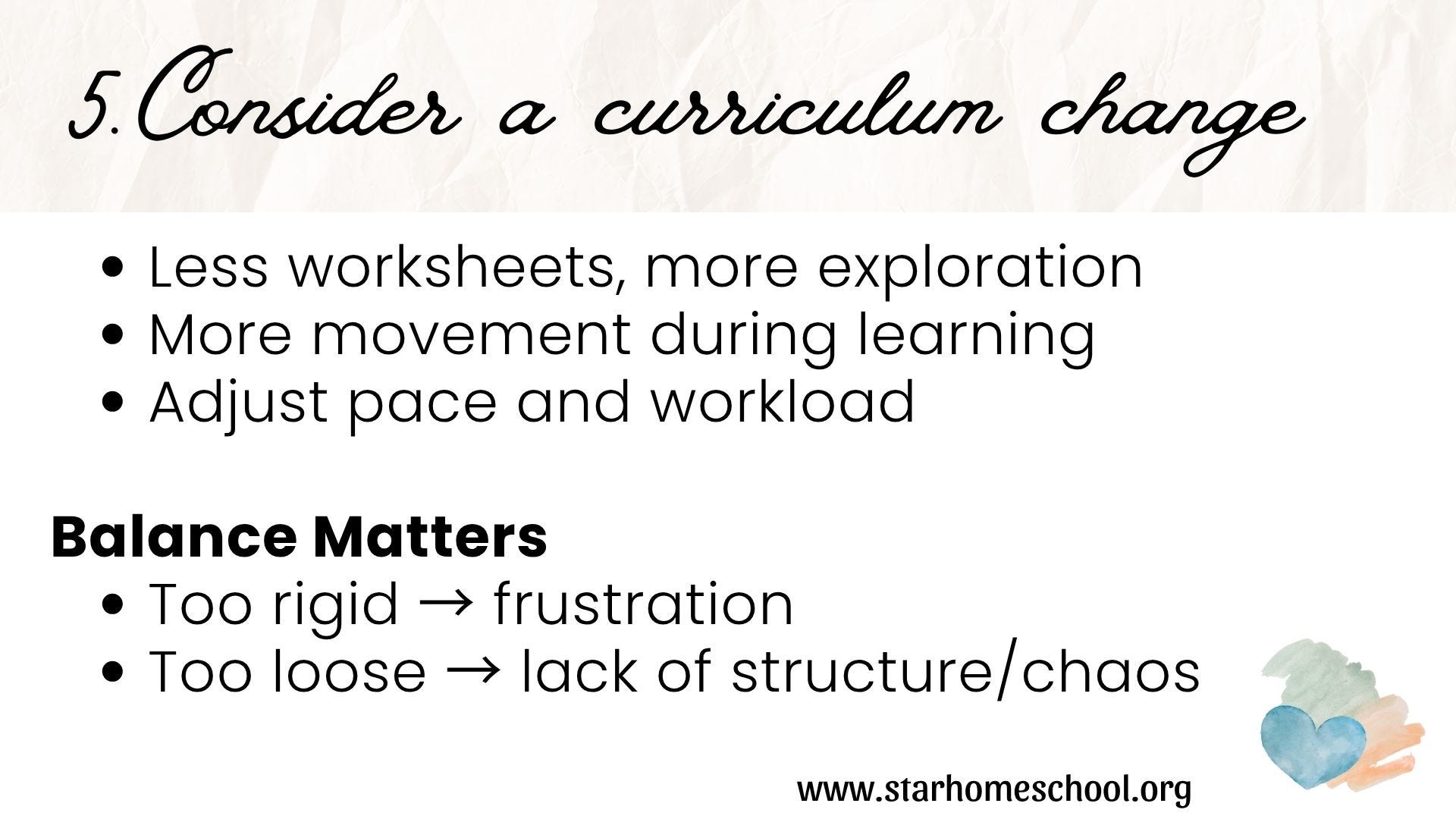
Perhaps your child is fighting the curriculum and not you?
Maybe the child needs less bookwork, less worksheets, and more time to explore outdoors or to focus on a subject they are interested in?
Maybe your child needs more physical activity during the day.
Perhaps skipping, marching, or jumping while skip counting or memorizing other facts?
This can be particularly challenging if you are participating in a school program (like a private school, public school or hybrid program) where all of the curriculum is assigned and you need to follow a lesson plan.
If your child is fighting the curriculum, perhaps a change of pace and reducing the load will help.
On the flip side of a curriculum that is too rigid is the possibility that the curriculum is too loose.
Is your child craving a structured school day and a few handwriting worksheets to make it feel “official”?
Consider what the curriculum looks like and what might be best for this particular student.
Pray that God would guide you in determining exactly what your child needs.
Need more structure/rigid:
Rod and Staff Grammar (we’ve used)
Logic of English (we’ve used)
Need more flexible:
STAR Homeschool (we’re using daily)
Simply Charlotte Mason (we’ve used a few items)
Ambleside Online (we’ve used)
Life of Fred for Math (we’ve used)
Need more hands-on:
Math U See (we’ve used)
Lakeshore Learning Math File Folder Games (we’re using daily)
All About Spelling (we’ve used)
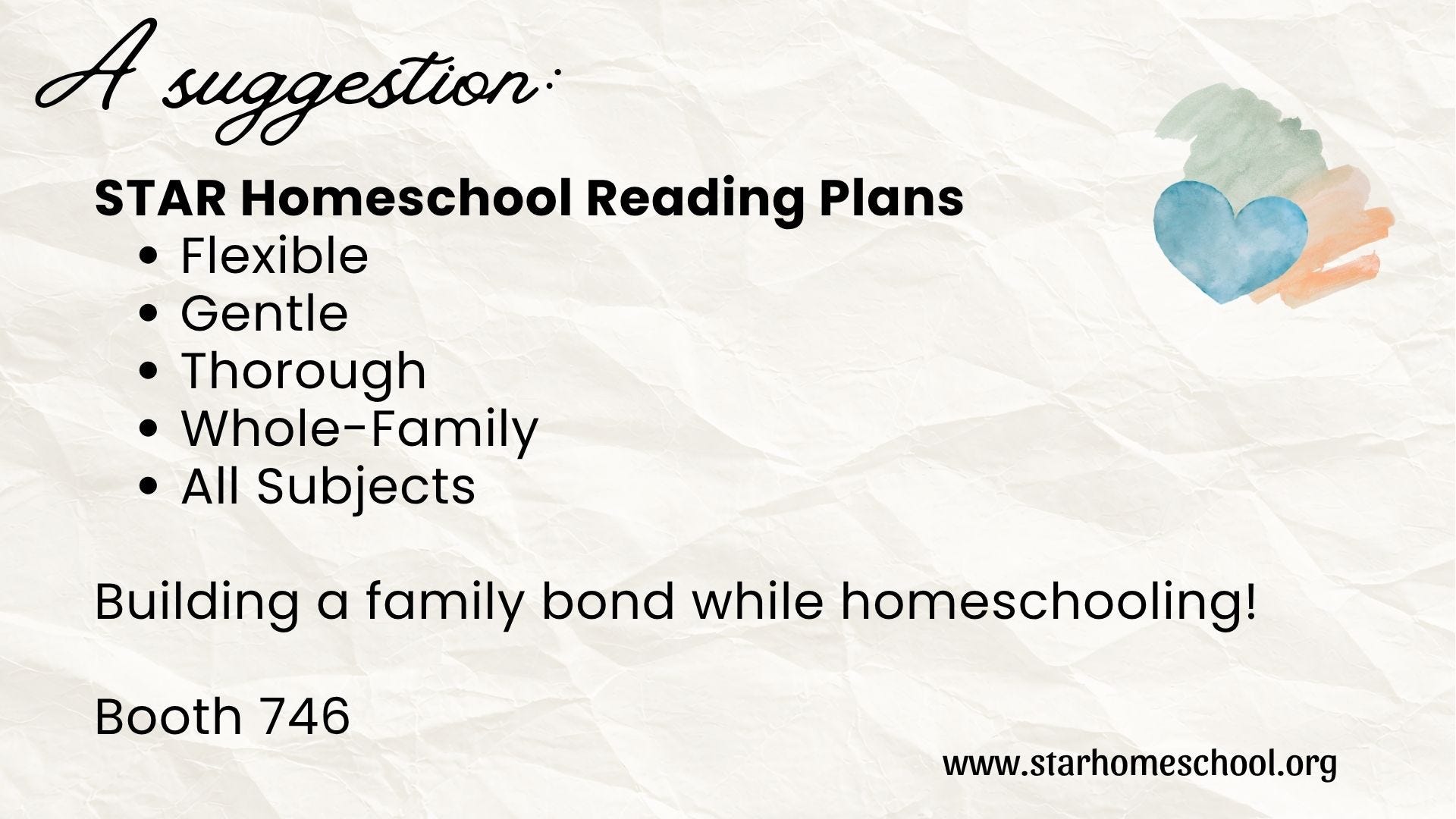
With all of our kids’ learning struggles in mind, I created homeschool reading plans that work for the whole family. I’ve tried so many different curriculums, and then I came up with this idea of whole-family homeschooling.
Whole-Family Homeschooling
Created for Whole-Family Learning
One of the most beautiful things about homeschooling is the opportunity to gather the whole family together around the table, on a rug, or on comfy couches and study a subject together. It’s a different picture from public school, where every grade is studying a different period of history, a different science subject and different authors altogether. So many homeschool programs tend to mimic public school in this way, and the family’s learning is disjointed. It takes more time for a homeschooling mom to keep up on what each child is doing, and there is no discussion amongst siblings about the topics they are learning together.
While it may not be possible to study math and language arts all together (unless your children are very close in age), there are still several subjects that can be taught in this way. These reading plans are designed so that the following subjects can be learned together as a family:
Handicrafts
Bible
Hymns
Apologetics*
Literature*
History*
Geography*
Nature Study
Science*
Composer
Artist
Poet
Character
Life Skills
*Middle and High School students have additional reading with bigger concepts than their younger siblings might be able to grasp, of course, in the subjects with the asterisks beside them.
The reason this works for children who fight homeschooling is:
We’re working on building a family bond while we homeschool. We’re all interacting with the same characters, stories, and scenes. We’re creating memories together, and discussing big concepts together. It’s beautiful!
We’re using a flexible reading schedule that can be adjusted to fit each child’s needs
If you’ve ever dreamt of having a curriculum that would work for your whole family and could be tailored to fit your family perfectly, come stop by my booth: 746, and take a look at what I’ve got.
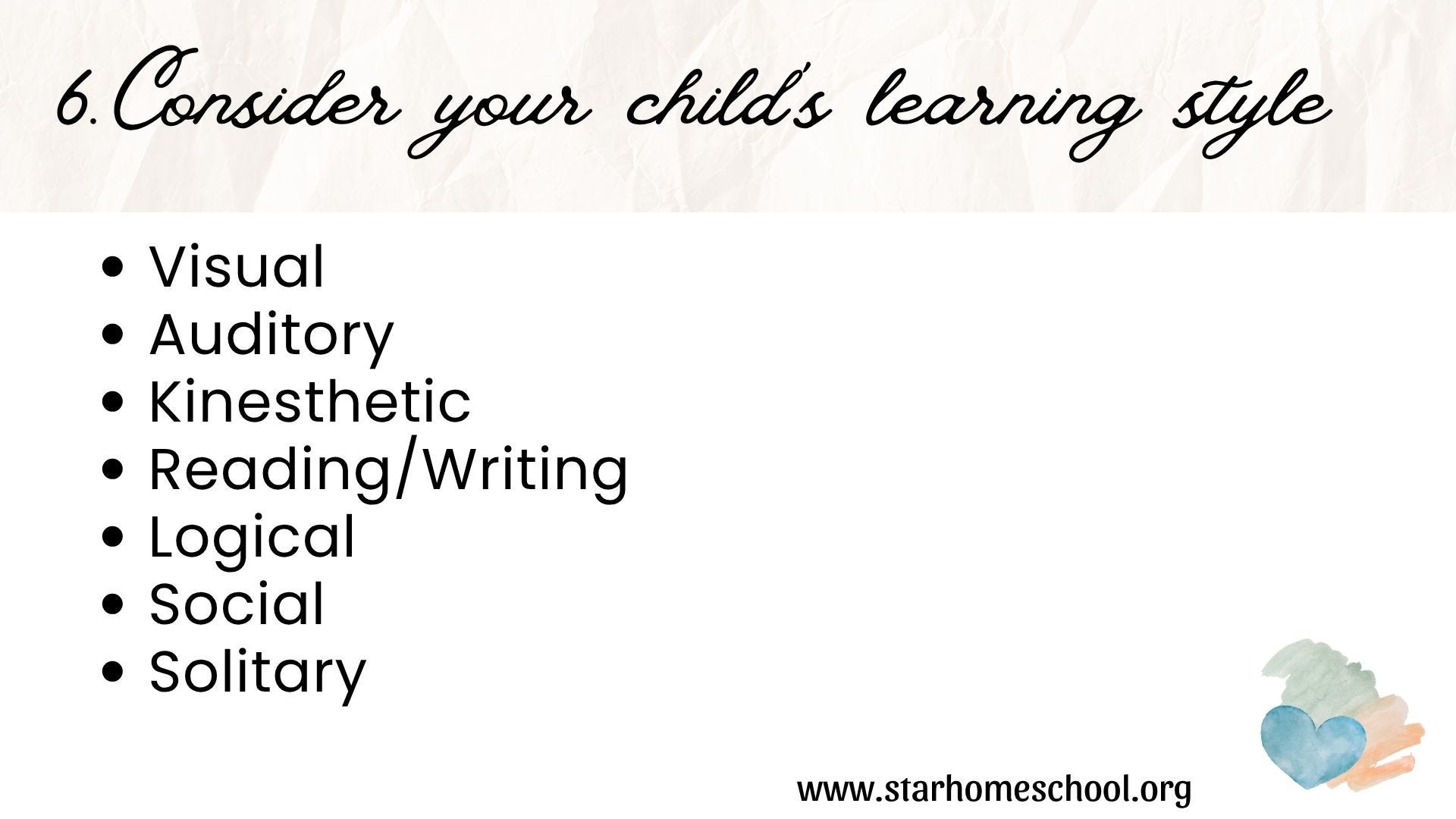
Have you ever had a child roll her eyes when you sit down to read a book? I have. It’s really difficult, because I consider myself a Charlotte-Mason mom. I love sitting down with my kids and reading a good book. I’ve learned, though, that a couple of my kids have auditory processing issues. One would argue, complain, or roll her eyes every time we read. Another would get distracted, fidget with other things, and then whatever I read would just go over that child’s head. Those same two kids are extremely fast at reading chapter books on their own. Like, crazy fast, where we didn’t even believe they were really retaining the content. When we’ve quizzed those kids, they really did absorb the book by reading that fast. But, they really struggled with grasping the content of an audio book or of me reading aloud.
We had another child, who had dyslexia and didn’t read until 9 years old, who THRIVED on audio books. She listened to every YWAM biography story she could get her hands on, and now she wants to be a brain surgeon because of Ben Carson’s story. She LOVES biology, dissecting animals, and quizzes. Every child is so different.
It’s important to pay attention to our kids and to figure out what their learning styles are instead of forcing them into a box. There’s an article on HLSDA to help you determine your child’s learning style, and then Cathy Duffy has a Learning Styles Questionnaire.
If your child is not an auditory learner, it doesn’t mean you have to give up on reading aloud altogether. Some tricks I have learned are:
Keep the time short
Let the child read a portion of the day’s reading
Let the child follow along in their own copy of the book
If your child is a tactile learner, or kinesthetic learner, you may need more hands on materials.
Resources
I don’t want to add any guilt to you, mama!!
I know it’s easy to blame ourselves and think “It’s all my fault,” or wonder what things would be like “If I had only known ___.” Please, don’t go there. This is not meant to point fingers at you.
I think self-reflection (with grace, not guilt) is good for all of us once in a while.
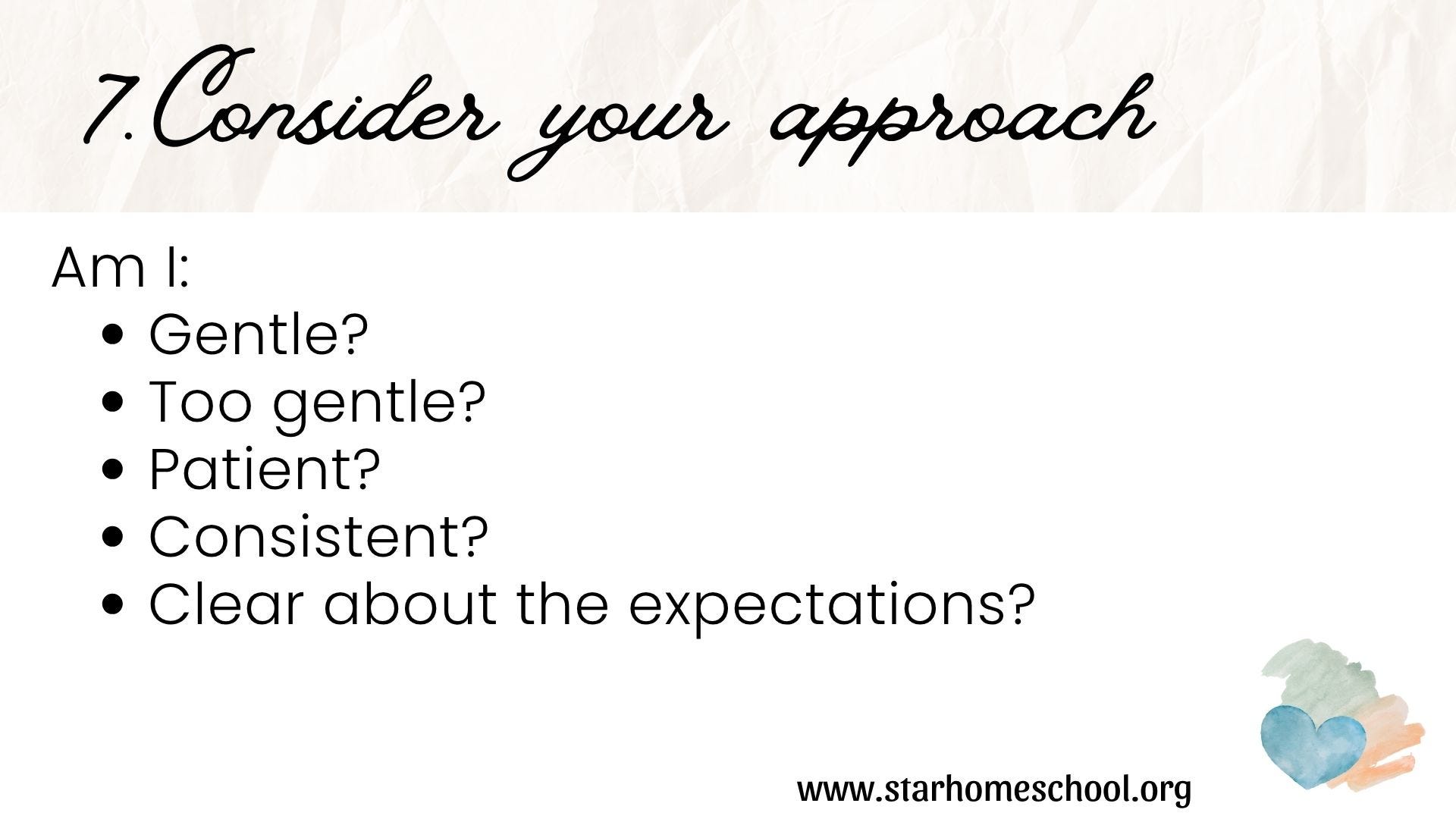
For example, when I am homeschooling am I being:
gentle?
fun?
loving?
enjoyable to be around?
Or maybe, am I being a little too strict? A little too hurried?
Distracted? Frustrated? Worried about getting through the workbook before summer hits?
Thinking about things going on in the world instead of the disciples right in front of me? Speaking of which, I shared this on social media in 2021, because I aspire to be this:

I can’t say that I have pulled out my guitar anytime recently (to play all of the four or five chords I’ve memorized) 😉 and it’s definitely easy to let current news impact our day with our kids. Let this picture stick with us, mamas. Our sweet children need us to be strong, gentle and loving for them, no matter what is going on in the world.
Do I take time to play games with my kids? To read aloud and snuggle with them? To listen to them? (I know this is hard. Especially with a child who talks a lot, or even with one who barely speaks.).
Am I being my very best self with my kids during the day? (This takes moment-by-moment leaning on God and praying for His strength).
Am I offering up the gifts God has given me in this beautiful ministry of motherhood and home education?
Or, am I creating any kind of stumbling block or hindrance in my child’s ability to learn?
The book The Call of the Wild and Free: Reclaiming the Wonder in Your Child’s Education, A New Way to Homeschool by Ainsley Arment was particularly helpful to me and I wished I had read it years earlier.
Again, don’t dwell in guilt. Let’s pick up and move on–where can we go from here? Pray. Set some goals and write them down. Now write down a couple of manageable action steps to accomplish these goals. I like to write my goals in a planner and always seem to actually accomplish goals when I work with a particular type of planner (Full Focus Planner).
Planners can be pricey, though. You don’t have to use a planner to write your goals in, you can use a scrap of paper or a spiral notebook or a notes app on your phone. Just make sure to look at your goals on a regular basis and keep checking off action steps.
In the hard times (and all times), it really helps me to memorize Scripture with my kids (try Hide ‘Em In Your Heart and Seeds Family Worship) and play hymns and classical hymns (I have played Jeff Bjorck’s piano hymns in my home, especially on difficult days, for about 17 years).
We have a chalkboard, and I cannot tell you how many times or for how many months Galatians 6:9 has been on it:
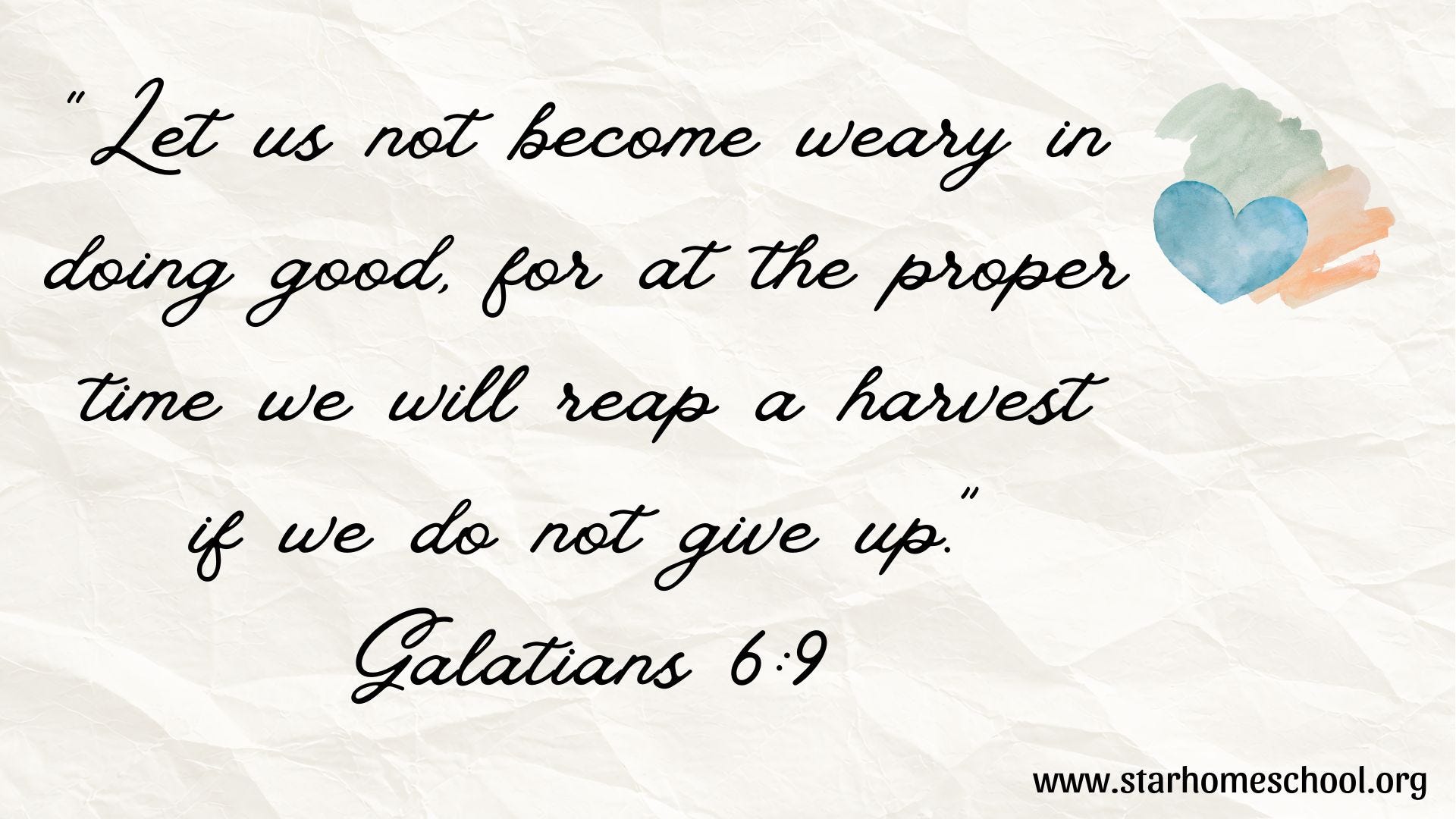
I have needed that verse. I quoted it at one of our son’s graduations. It has become a life verse for me.
Books:
Resources
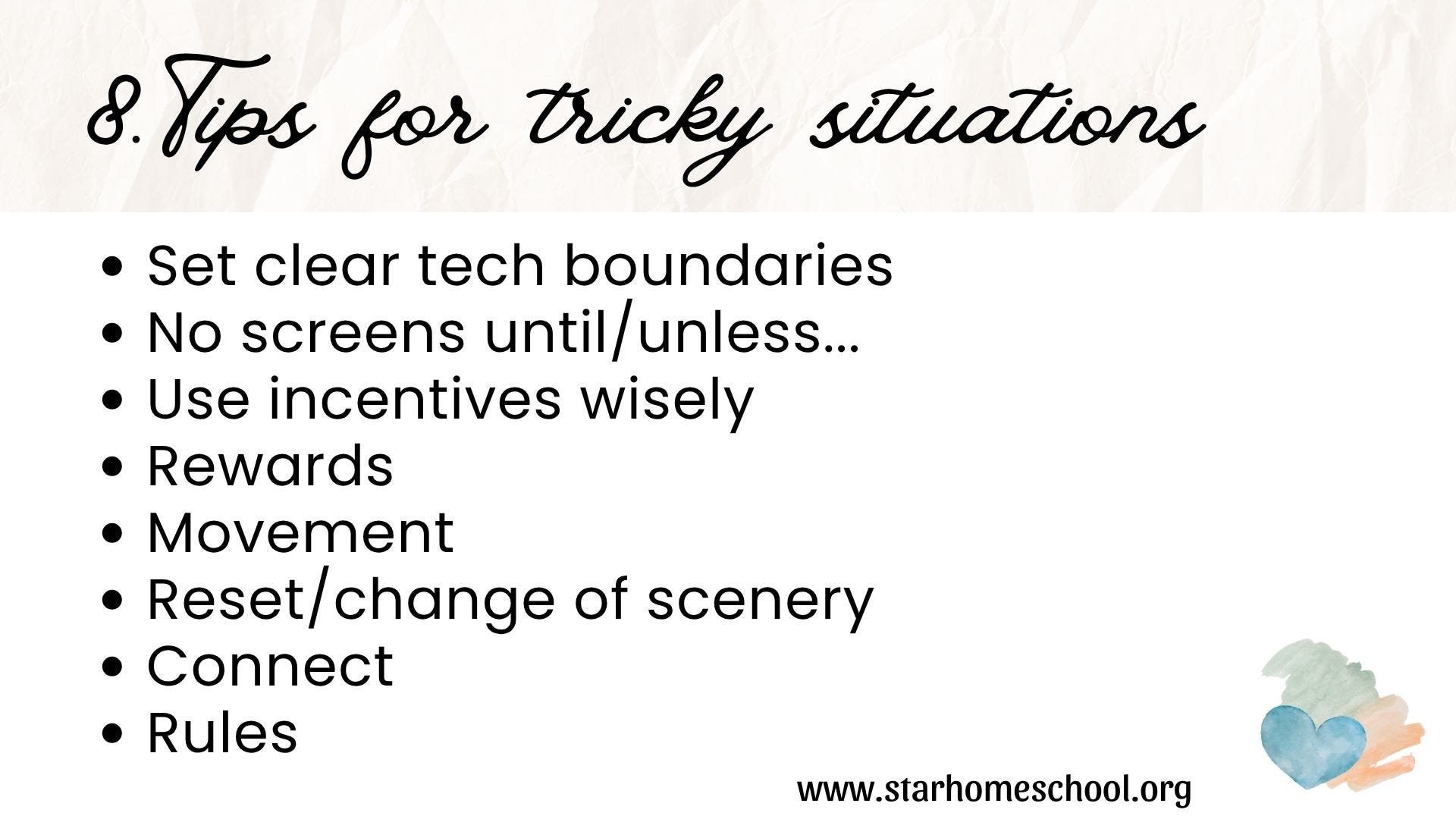
If you have kids who are close in age, but with very different behaviors & who maybe shouldn’t have the same freedoms (for their safety & the safety of others), creating a family level system may be useful. This was one of ours (we adjusted it several times over the years):
Our kids who have phones (16 and 18 years old) come to us to ask for their phones, and they first say:
My room is clean
I did my chores
I did my math
and then “can I use my phone?”
One daughter also has to take a peanut M&M everyday for OIT (oral immunotherapy), so she will also say “I did my OIT.” (peanut M&Ms are awful in her mind, since she’s been afraid of peanuts since she was 3, so we have to use an incentive).
Comments
Nothing yet. Say the first thing.
Sign in to join the conversation.