
So I’m in France—a very nice place to be, writing on a train from Paris to Lyon. Yesterday (Well, by now that’s last week), I had a lovely day in Paris. I’ve been to Paris many times, and often seem to end up with just a day there. When I was younger, I would schedule my travel to arrive in the morning and leave at night, giving me a day to explore without having to pay for an hotel. This time, I was hosted by a lovely woman, Viviane, who will translate our upcoming French Witch Camp. She is the assistant director of a school, and they provide her with an apartment on site in a suburb of Paris.
Her school is a trade school, where they teach things like auto mechanics, motorcycle maintenance, iron-work and machinist training. But the school is on break now, and it’s very quiet and peaceful—a good place to land after a long flight and sleep, which I did most of the first day.
On the second day, however, I awoke with energy determined to do something Parisien. It was a Monday—not the best day to have only one day in Paris, as most of the Museums are closed. But I decided to go to the Museum of Man, la Musée de l’Homme, the anthropology Museum, as there was something there I vaguely remembered I’d always wanted to see, although I couldn’t remember what. Also it was open—a good quality in a museum! And not so crowded that you have to buy tickets online or discover that they aren’t available.
The Museum of Man is in Trocadero, a park across from the Eifel Tower, with great views of the tower. I wasn’t interested in fighting the crowds to try and go up. I’d been up on my first trip to Paris, when I was nineteen and nubile, and at the top, a little round man in spectacles and pomaded hair had asked me to marry him. That sort of thing used to happen to me a lot when I was nineteen, and it’s a relief to be beyond that stage of life now.
The plaza beside the Museum was crowded with tourists of every age, heritage and costume, and all seemed almost manic-ly happy as they snapped photos of each other or posed for selfies. They were styling, or raising one hand high to look like they were dangling the tower from their thumb and forefinger, or trying to position the tower to look like it was growing out their heads, and everyone seemed to be having such a good time that I began to think I should take a selfie of my own.

The Museum is in a beautiful, classic building but inside it is impressively up-to date, with lots of interactive features. I was glad, because I could sit down periodically and play with the screens. I was also impressed with their content, their take on gender—very clear on showing that it is socially constructed, probably get them cancelled if they were in the U.S! But after I made my way through the bottom floor of skulls and evolutions, refreshed myself with an iced latte and sandwich in the café with a wonderful view of the tower, I headed up to the gallery on prehistoric art.
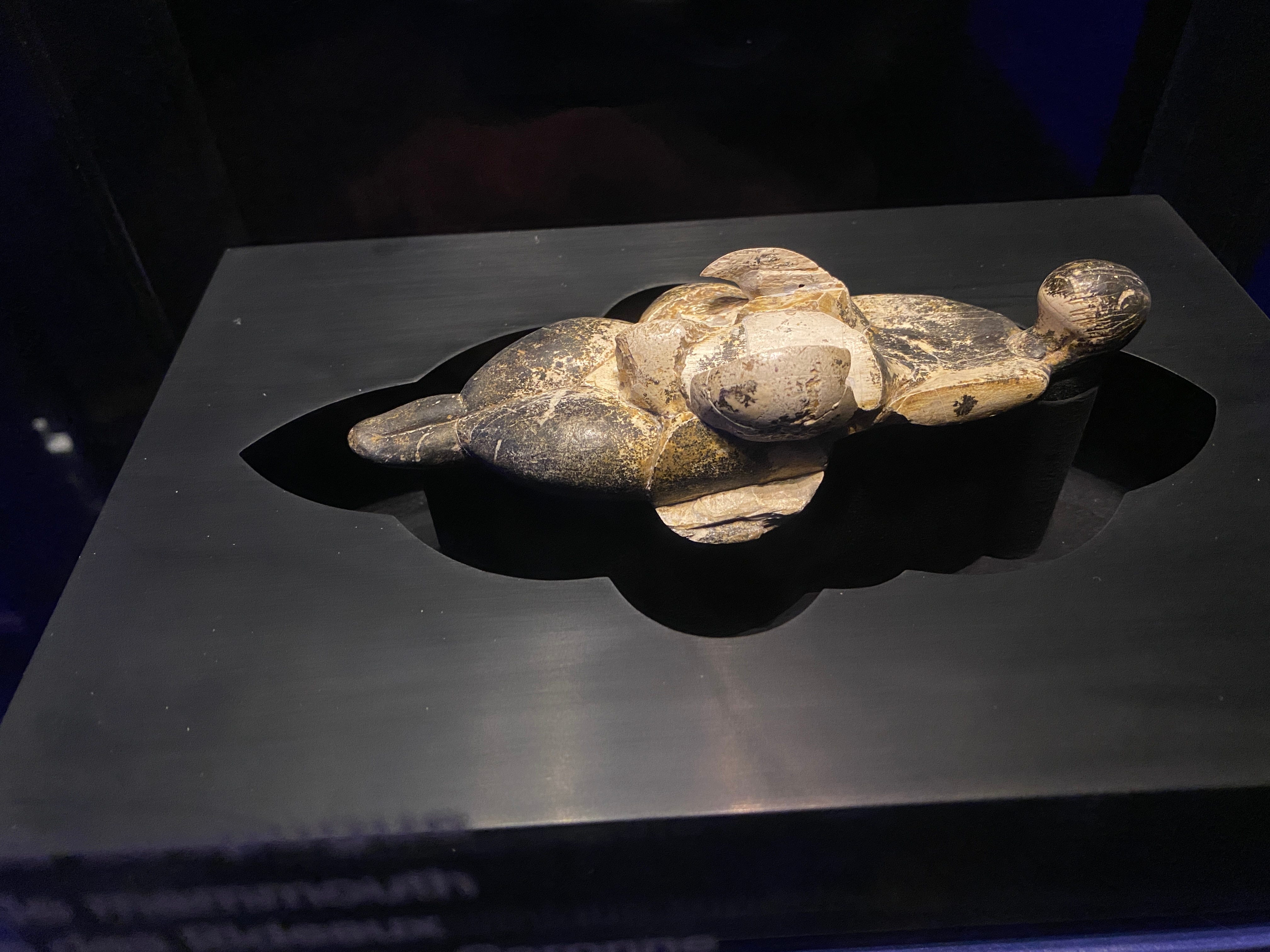
And there she was—the thing I’d always wanted to see and hadn’t until that moment remembered: The Venus of Lespugue. Carved by someone 25,000 years ago, she lies in a glass case now, on her back, as if she needs a bit of rest. I’ve seen dozens of reproductions--for years, I’ve had a reproduction on my altar. But this was the real thing.
I stood there in awe. A small piece of ivory, carved from what? The tusk of a mammoth, maybe, an animal that no longer exists. Made by human hands so very long ago.
I’m always amazed by the extent of paleolithic time. It stretches so far back. The distance between now and the pyramids is like a blink: when they were raised, the Venus was already 20,000 years old.
And yet someone had carved her with intention and skill, formed her abstracted curves, made choices about forms and volumes just as any modern artist would have, and created a form so pure, beautiful and abstract it could easily be a contemporary sculpture. What were they thinking, 25,000 years ago? What did she really represent? How could they have imagined that 25000 years later, someone would use a replica of their sculpture as an object of worship, to reflect on the great powers of fertility and creativity inherent in the body, in nature, in the ability to procreate life?
The replicas are complete, white and smooth. The original is broken, darkened in many places, perhaps placed on her back to relieve the strains and stresses that might go with being upright. Yet you can still feel the care with which that head was polished and so elegantly placed on the neck. The greatest volume is in the breasts, not the belly—is it possible that she was designed to honor the forces that nourish and sustain, not just those that bring forth life. Was her creator a solitary genius, or was she perhaps one of a whole artistic tradition with this semi-abstract vocabulary? Maybe she was an amulet for nursing mothers, to help the milk to flow? Maybe she was carved by a nursing mother, feeling her own breasts swollen and heavy, in those spare moments while the baby slept?
At this time when we seem to mostly worship the powers of aggression, accumulation and destruction, when we’re bombarded with propaganda telling us strength equals the ability to kill, that care and nurturing are for losers and empathy is weakness, it’s good to look at this image of a different sort of power, the power to nourish, the strength inherent in breasts and rounded bellies and limbs, the great, creative power inherent in humans, even in our early days, to create symbols that can still move us tens of thousands of years later.
She looks like she’s sleeping. But I believe she is ready to wake.
Comments
Nothing yet. Say the first thing.
Sign in to join the conversation.