
Yesterday, December 29, CMS released details of the $50 billion Rural Health Transformation Program.
If you only read the headlines, it sounded like salvation for struggling rural hospitals facing deep Medicaid cuts. The administration framed it as a historic investment, putting local hospitals, clinics, and health workers back in control of their communities’ healthcare.
Then you read the details.
The funding is recalculated annually. States must demonstrate compliance with “Make America Healthy Again” policies, including nutrition education requirements, fitness participation measures, and restrictions on certain SNAP purchases. CMS retains the authority to claw back funds if states fail to deliver on promised policies.
My husband Brian, a retired healthcare general counsel and the most patient person I know when it comes to my weekend policy reading, looked over my shoulder and said what we have both been thinking all year:
“The gap keeps getting wider.”
That sentence captures 2025 perfectly.
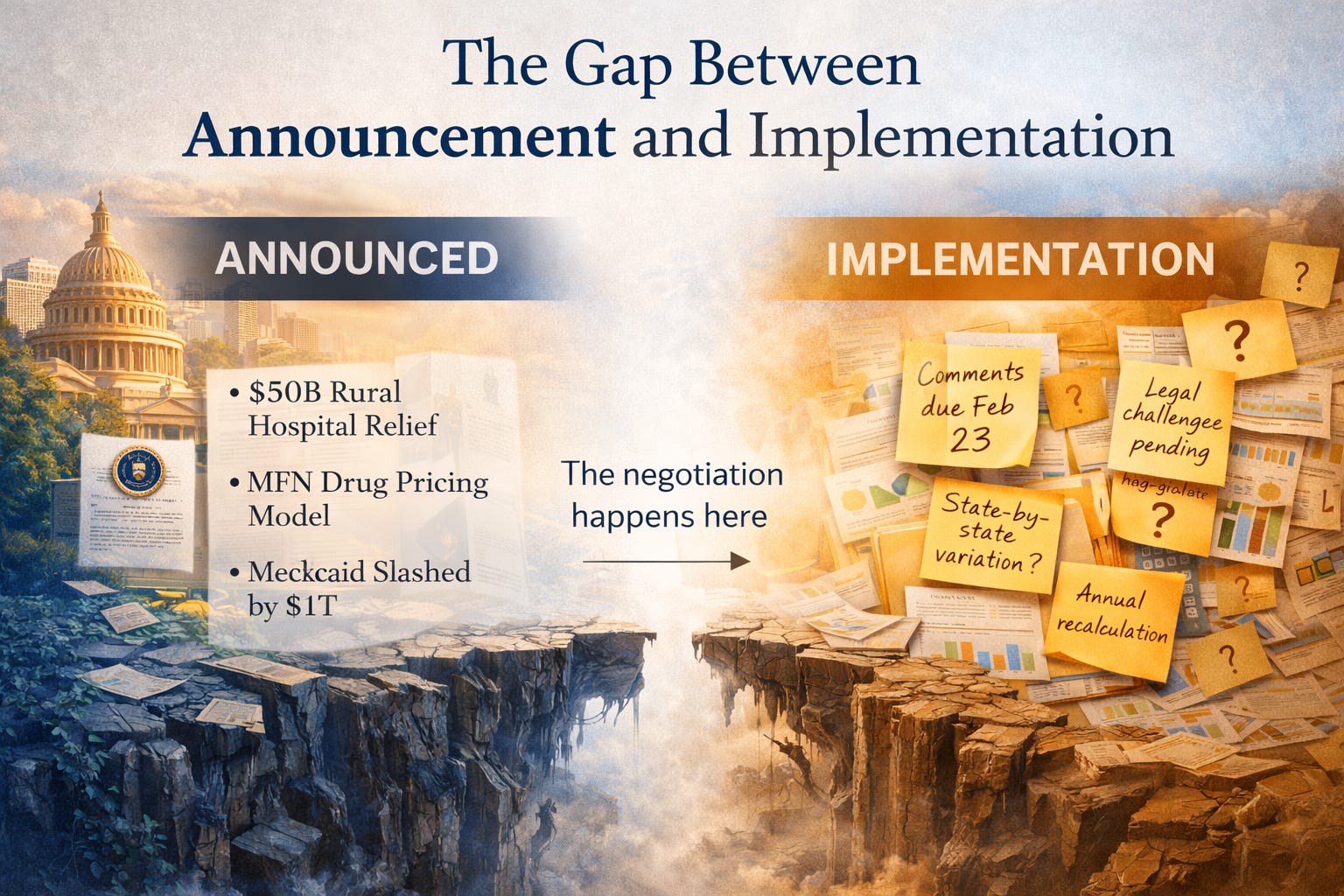
This was the year healthcare policy became less about the policies themselves and more about the space between announcement and implementation.
September is when the pattern crystallized.
On September 18 and 19, the CDC’s Advisory Committee on Immunization Practices met to set vaccine recommendations for the respiratory virus season. What is usually a low-profile technical meeting suddenly became front-page news.
ACIP shifted COVID vaccine guidance away from universal recommendations toward shared clinical decision-making for adults under 65 without high-risk conditions. Around the same time, FDA approvals narrowed eligibility to older adults and those with specific risk factors, a significant change from prior years.
The announcement immediately raised operational questions. Would insurers still cover vaccines for healthy adults under 65? Could pharmacists continue administering vaccines without prescriptions? Would state laws need to change?
By early October, most states had clarified that access would continue, though with added complexity. Professional associations and insurers issued guidance confirming coverage and access through at least 2026.
But that month taught healthcare negotiators something new.
The space between policy announcement and operational clarity had become a negotiation variable in its own right.
Employers renegotiating health benefits faced new uncertainty around coverage obligations. Healthcare systems had to manage state-by-state variation in access rules. Insurance contracts suddenly needed provisions for what happens when recommendations change midyear.
December brought the pattern into sharp relief.
On December 19, CMS announced GLOBE and GUARD, two Most Favored Nation drug pricing models for Medicare Parts B and D, along with GENEROUS for Medicaid. The promise was lower drug costs through international price benchmarking.
The details told a different story. Public comments are due February 23, 2026. Implementation would not begin until October 2026 at the earliest, and only if the models survive legal challenge. Some manufacturers announced voluntary participation, while mandatory rebate provisions immediately drew industry opposition.
Days later, ACA premium tax credits expired. Under current projections, premiums in some markets could more than double for millions of enrollees. States scrambled to offer partial relief, but many consumers will still face higher costs starting January 1.
Then came the rollout of rural hospital funding, with compliance conditions attached.
Each development arrived with fanfare and uncertainty built in.
I have taught healthcare negotiation for years. In 2025, I found myself teaching a different skill set.
First: Map the gap explicitly.
When CMS announces a pricing model in December, opens comments in February, and targets implementation months later, that window of uncertainty matters. Healthcare organizations negotiating pharmaceutical contracts now need provisions that account for multiple futures: if the policy takes effect, if courts intervene, or if timelines slip.
This is not excessive caution. It is recognition that the gap is now a standard feature of the negotiation landscape.
Second: Understand that everyone’s BATNA is unstable.
Best alternatives shifted repeatedly in 2025.
Rural hospitals initially viewed federal relief as an alternative to accepting unfavorable payer contracts. Then, legislation was passed promising funding. Later details revealed that some states may not meet policy compliance requirements. The outside option changed more than once in a single year.
Pharmaceutical manufacturers negotiated, knowing that pricing rules might change, while also recognizing that courts had blocked similar efforts before. Healthcare systems negotiated employment and supply contracts as agency staffing cuts altered regulatory timelines.
Negotiation in this environment is less about optimizing outcomes and more about managing probability.
Third: Pay attention to compliance mechanisms.
This is where the negotiation implications deepen.
The rural hospital program is not a one-time grant. It establishes ongoing oversight, annual recalculation, and continuous engagement between states and CMS. That creates a multi-year negotiation framework where leverage can shift with political and administrative priorities.
Healthcare organizations negotiating with state agencies now operate within layered negotiations that extend well beyond the immediate table.
By December, my legal training was doing more work than it had in January.
When new drug pricing models are announced, the question is not just cost impact. It is a statutory authority, litigation risk, and historical precedent. A similar MFN model proposed in 2020 was blocked by federal courts, and legal challenges are already forming around the current versions.
Healthcare leaders forecasting 2026 budgets are negotiating in a world where drug costs could change dramatically or not at all.
That uncertainty itself becomes part of the negotiation.
The calendar may turn, but the pattern will not reset.
We begin 2026 with higher ACA premiums in many markets, rural hospital funding tied to policy compliance, drug pricing models in comment periods, and vaccine recommendations still evolving at the state level.
This is not the healthcare system any of us trained for. It is the one we are negotiating now.
The leaders who will thrive in 2026 are not waiting for certainty. They are building agreements that can flex when announcements collide with the realities of implementation.
They are tracking not only what gets announced, but how it might actually unfold.
In 2025, the space between announcement and implementation became the most important negotiation variable in healthcare.
That gap is not closing in 2026.
What implementation gap is reshaping your negotiations as the new year begins?
No posts
Comments
Nothing yet. Say the first thing.
Sign in to join the conversation.