
I. BEAUTY’S BAROQUE MOMENT
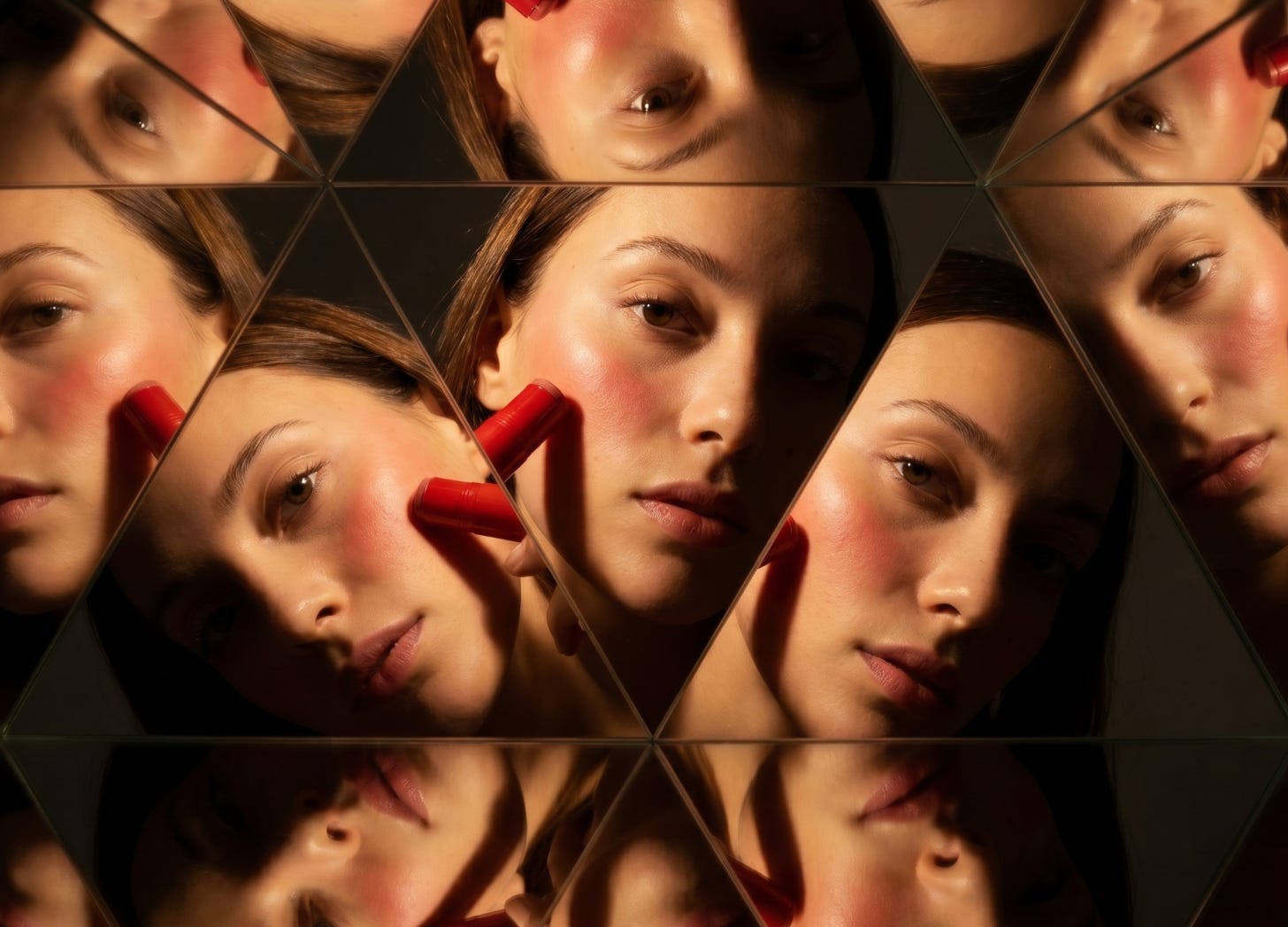
Beauty is in its Baroque era: ornate, excessive, emotionally charged. There is more of everything, and much of it is genuinely thrilling. But Baroque periods share a common fate: the abundance that dazzles eventually overwhelms.
That is where beauty finds itself now. An industry whose original promise was clarity – this is how to look, this is how to feel, this is who to be – has produced, at the height of its powers, not confidence but confusion, not pleasure but anxiety. Beauty has never been more accessible, or more impossible to navigate. There are endless entry points, but very little orientation once you get inside. Endless claims and interpretations. Forty-seven foundations. Peptides, ceramides, niacinamide – you need a degree in biochemistry to read a moisturiser label. A ChangeUp survey of 1,600+ beauty shoppers found 69% say shopping for beauty is overwhelming. A BeautyMatter/Vitabiotics study found 72% of women need help deciphering scientific terms on packaging.
The category is not cooling because desire has disappeared. If anything, beauty remains one of the most culturally and commercially charged spaces in consumer life. What is changing is the mood around it. After years of rapid growth, momentum is softening. The issue is overstimulation and oversaturation. Consumers are not stepping away from beauty. They are stepping more carefully through it.
What follows is our read on three forces reshaping the landscape, and three worlds beauty could move towards next. Think of them as creative territories: places to stand, argue and build from.
II. THE FRACTURE LINES
Authenticity Trap
“Be yourself. But optimise yourself.” This is beauty’s favourite contradiction, and it’s written right there in the language.
On one hand, the messaging speaks fluent acceptance: “embrace your skin,” “beauty in every texture,” “you are enough.” On the other, the products sitting underneath that messaging are called “skin-perfecting” and “pore-blurring” and “correcting” – vocabulary that only makes sense if something is wrong in the first place. The positive language says there’s nothing to fix. The product assumes there is. Both coexist on the same shelf, in the same brand, sometimes on the same label.
If we look closer, the contradictions multiply. Real beauty as demonstrated by a genetically exceptional 22-year-old in studio lighting. Clean beauty doesn’t describe an ingredient standard – it describes a moral position that casts everything outside it as suspect. And no-makeup makeup: six products and 40 minutes for the privilege of looking effortless. Effortless, of course, has never required so much effort.
Consumers have started to notice. De-influencing, scepticism, and routine fatigue all point to a beauty culture that is becoming harder to trust at face value. People are not rejecting beauty so much as becoming more selective about what earns their belief.
McKinsey’s 2025 State of Beauty report notes consumers are “skeptical of hype and laser-focused on whether products deliver.” The #deinfluencing hashtag on TikTok has amassed over 12 billion views (TikTok, 2025) – creators are building followings precisely by telling people what not to buy, walking through returns and honest product failures.
Meanwhile, Jellyfish’s Social Agents data shows a marked rise in beauty content tagged “in-house” or “no talent” – faces blurred or absent, just hands applying a product, no voices.
The response from the industry is already visible. Brands are migrating spend away from celebrity-scale influencers toward what some are calling genuinfluencers – credentialled experts, dermatologists, formulation chemists, professional makeup artists whose authority comes from knowledge rather than reach.
Spring POV: The communications challenge is no longer simply to create desire – it’s everywhere. What feels scarce now is trust, and rarer still, relief. The brands that matter will be the ones that offer a cleaner emotional contract: less pressure, a clearer reason to believe. On influencer strategy specifically, we see a structural shift ahead – not the death of influence, but its professionalisation. The creator who can explain why something works will outlast the one who simply shows that it exists. Expertise is becoming the new aesthetic.
The Body as Medium
More and more, beauty is being defined not by glamour but by health.
Almost half of consumers now define beauty as “looking healthy” (Euromonitor, Voice of the Consumer: Beauty Survey 2025). Skin is expected to look luminous, yes, but also regulated, rested, functional. Longevity culture, biohacking, wearable diagnostics – the body has become something tracked, interpreted, and optimised.
The expected moves are underway: ingestible beauty projected to reach $12.55 billion by 2030 (Source: The Business Research Company (TBRC), Nutricosmetics Global Market Report.) Personalised skincare via DNA and microbiome mapping moving from niche to mainstream. At-home diagnostics built into point-of-sale.
The unexpected moves are where it gets interesting.
Soorty’s Collagen Denim infuses jeans with collagen peptides from upcycled fish scales. Popilush manufactures shapewear from oyster collagen-infused yarn that cools body temperature by 15% and blocks 99% of UV. Lemme Glow puts collagen and vitamin C in lollipops. Watkins Wine puts marine collagen in rosé. Incora Health is building smart earrings that track menstrual cycles and stress via light sensors on the earlobe. The “beauty product” as a discrete object is quietly dissolving into something more ambient – care and enhancement woven into everything the body touches.
The language also tells the story. Products are no longer “anti-ageing” – the term has been retired across most markets. They’re “longevity-focused.” Not “skin-brightening” but “targeting cellular senescence.” Not “repairing” but “regenerative.”
There’s a tension here worth sitting with. The more beauty becomes functional, the more credibility it gains. But it also risks losing the ritual, the play, the fantasy, the low-level irrationality that made it culturally magnetic in the first place. A DNA-optimised serum may be more effective. But no one ever fell in love with a protocol.
Spring POV: The most compelling space is where function meets sensory pleasure – where science and technology are present but don’t flatten the experience, and instead deepen the relationship with the customer. Efficacy that arrives with texture, delight, and a reason to care beyond the result.
Beauty’s Geography Shifts
For decades, beauty innovation flowed from Paris, New York, occasionally Tokyo. That geography is on the move.
Consumers today are drawn to a mosaic of cultural perspectives – each offering its own distinct blend of heritage, craft, and identity-driven beauty.
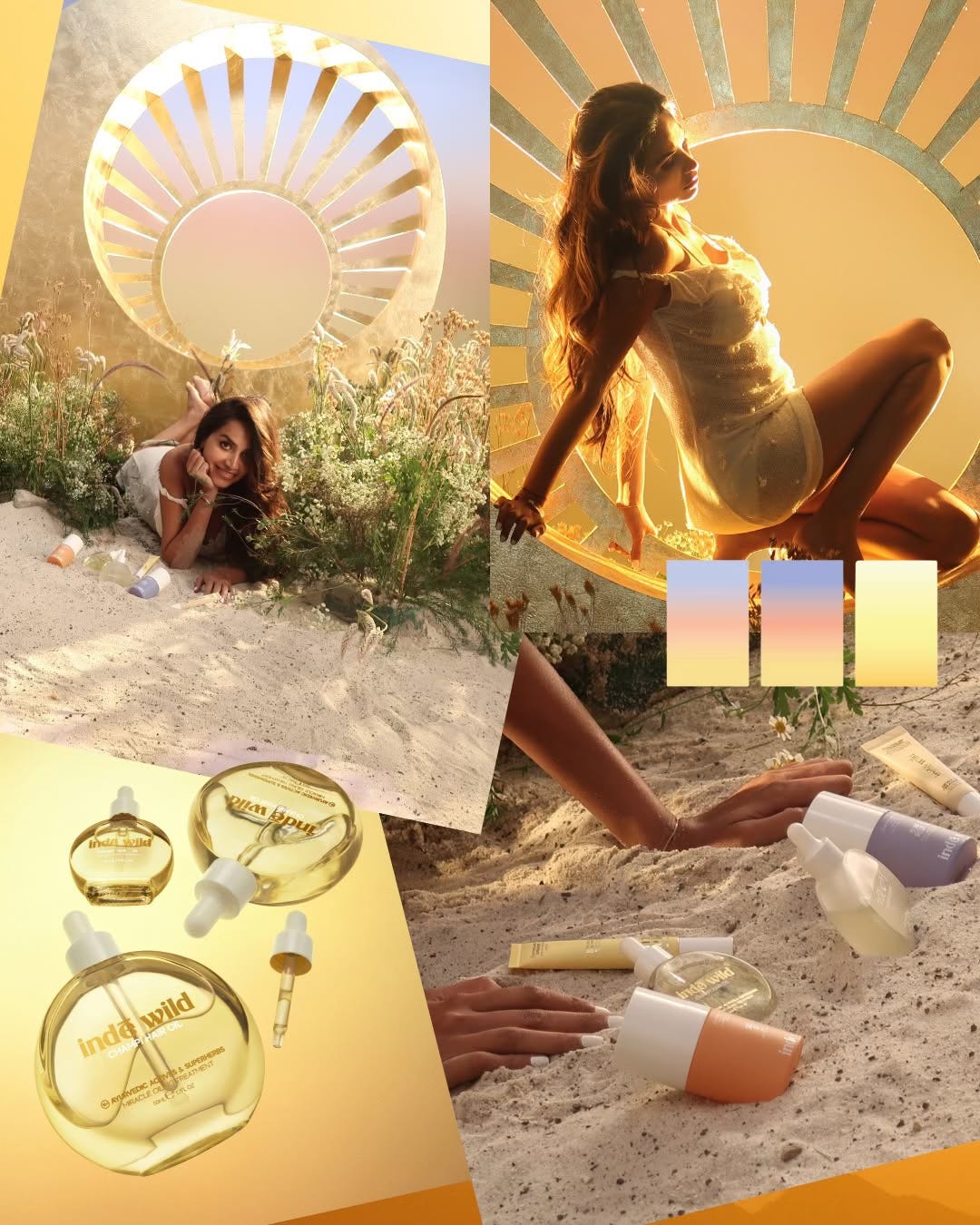
The category is becoming polycentric. South Korea continues to shape skincare expectations around texture, innovation, and speed. Middle Eastern fragrance culture – oud traditions, bakhoor rituals, kohl as both spiritual and aesthetic practice – is reshaping how the world thinks about scent layering, ritual, and intensity. Japanese beauty still exerts quiet influence through discipline, refinement, and restraint. India is building with a different logic altogether: climate-aware formulation, heritage systems updated through modern clinical language, and trust built through community and lived relevance rather than celebrity.
Scandinavian beauty has matured well beyond its minimalist reputation. Johanna Augustin, CEO of Swedish creative agency Pond Design, argues it is now "less about 'minimalism' in the traditional sense and more about a cultural approach to beauty – rooted in a mindset: clarity, honesty and a deep respect for nature and wellbeing." (Cosmetics Business, February 2026). Brands like Mantle, Estrid, and Scandy are gaining global traction through that directness.
Taiwan is emerging as a quiet force: dermatological skincare, scalp care, and precision formulation built on the island’s deep biotech manufacturing heritage. Eric Chen, founder of Taiwanese scalp care brand Aromase, notes: “Taiwan’s beauty industry has quietly evolved from an OEM manufacturing powerhouse into a creative ecosystem driven by biotech, dermatology, and sustainability.” (Cosmetics Business, February 2026)
Spring POV: Beauty is moving from being inspired by culture to being authored by it. In a landscape saturated with generic beauty messaging, AI-generated content, and borrowed aesthetics, consumers are gravitating toward specificity and provenance – and the more localised and rooted a brand is, the more credible it feels. Cultural rootedness works as a differentiator precisely because it cannot be faked: it offers a genuine sense of origin, not a vague moodboard version of somewhere. If your brand comes from a place – geographically, philosophically, culturally – that is not a detail to dilute. Specificity beats universality every time.
III. THREE WORLDS: WHAT BEAUTY COULD BECOME
These forces – the trust deficit, the biological turn, the polycentric shift – pull in different directions. But they do point toward futures that are already partially here.
We like to play with scenarios because they make strategy less abstract. None of these will arrive in pure form. But elements of each are already here, and the more interesting question is where brands choose to place themselves within the blend.
WORLD ONE: THE CATHEDRAL OF LESS
Overwhelm reaches its limit. Editing becomes a form of care.
Beauty shifts from abundance to selection. Fewer products. Fewer claims. More philosophy. Stores carry 200 SKUs instead of 2,000. Spaces feel closer to private libraries than department stores: quieter, tightly edited, highly subjective, and all the more powerful for it.
The metric shifts from volume per shelf to depth of relationship per customer: how well does a brand know its consumer, how confidently can it edit on their behalf, how much searching does it eliminate?
In this world, brands stop pretending to be for everyone. Everybody takes ideological positions: do you believe ageing should be prevented or inhabited? Is beauty about expression, maintenance, ritual, social fluency? Consumers choose between philosophies, not just formulations.
What this opens up:
Declare a point of view.
Edit brutally. Fewer products, deeper stories, higher conviction per SKU.
Rethink the store as a place that builds trust and creates a memory.
Invest in people. One brilliant advisor outperforms a wall of testers.
“Every brand needs to answer a question it currently avoids: what do you believe beauty is for?” – Spring Studios Strategy Team
WORLD TWO: THE IDENTITY ATELIER
Beauty embraces what it has always been: identity technology.
The proposition becomes fluency in versioning: mood, role, platform, occasion, audience. The self becomes modular, and beauty becomes one of the fastest ways to shift its outline.
This is already visible in beauty cultures where transformation is not treated as a betrayal of authenticity, but as one of its forms. Digital life only accelerates the pattern. Aesthetic codes become more fluid and more referential. Beauty moves from correction to composition.
Colour cosmetics experience a renaissance – bold, expressive, unapologetically maximal. “Chaotic beauty” displaces the uniformity. The makeup artist becomes a cultural figure again, not as celebrity but as auteur.
Fragrance becomes the most shape-shifting medium beauty has – intimate, emotional, layered daily into new combinations.
This is also the world where strangeness has commercial value. Provocation, theatricality, the deliberately “off” campaigns are becoming strategic tools for creating aesthetic arrest and curiosity.
What this opens up:
Encourage individual taste through bolder aesthetics, palyful materiality, and elastic textures
Position products as creative tools.
Shift the language to artistic: composition, palette, character.
Invest in fragrance as identity layer: intimate, emotional, most shape-shifting medium beauty has.
Court the strange. The campaign that makes people stop will outperform the one that makes them simply nod.
Design for multiplicity. Products that invite recombination rather than prescribe a single use.
“Beauty is having an identity crisis because we are having an identity crisis.” – Spring Studios Strategy Team
WORLD THREE: THE CULTURE HOUSE
The Western beauty model shares the stage. What replaces it is a network of culturally authored beauty systems, each with its own logic, rituals, and definitions of what beautiful even means.
There is no longer one centre, but many. Beauty authored by the cultures it comes from.
Ancestral ingredients entering the global market on their own terms. Heritage traditions redefining entire product categories. Formulation philosophies shaped by climate, community, spiritual practice, or inherited resourcefulness rather than imported ideals.
The brands with the longest future here are rooted in genuine cultural specificity. They will be the ones with real authorship, telling stories that only they can tell, from places that only they come from.
What this opens up:
If your brand has cultural, geographical, philosphical roots, lead with them. Specificity is more compelling than universality and is much harder to copy.
Partner with cultures rather than borrowing from them. Co-creation with local founders and communities produces work with texture.
Rethink “global” as a network of specific stories rather than one story told everywhere.
“The most powerful thing a beauty brand can be right now is specific. Not inclusive in the vague, everyone-welcome sense. Specific in origin, in philosophy, in point of view.” - Spring Studios Strategy Team
IV. FINAL WORD
Beauty has become one of consumer culture’s most prolific meaning machines, producing stories, symbols, and self-mythologies at such speed that meaning itself starts to blur.
Which leaves a simpler question underneath all of it: what do you believe beauty is for?
If it is transformation, say that. If it is armour, say that. If it is play, seduction, joy, discipline, escape – say it plainly, and say it from wherever you actually stand, not hiding behind the language of universality or empowerment-by-default.
Because the moment a brand answers that question clearly, it stops sounding like the category and starts sounding like itself.
Dialled by Spring is our periodic dispatch from the frontier of culture, creativity, and strategy.
No posts
Comments
Nothing yet. Say the first thing.
Sign in to join the conversation.