
We’re excited to share a guest post from Wes Franklin—a thoughtful voice working at the intersection of freshwater science and storytelling.
Larry and I first met Wes this past November in Cuatro Ciénegas during the Desert Fishes Council meeting. It’s the kind of place—and gathering—that reminds you how much care, curiosity, and persistence it takes to understand and protect these systems. Wes stood out immediately for the way he pays attention: not just to the species themselves, but to the subtle dynamics of place that shape their survival.
In this piece, he brings that lens to the Loach Minnow—a small but remarkably specialized fish navigating the fast, cobble-lined currents of the Gila River Basin. It’s a story about adaptation, persistence, and the quiet complexity of streams that, at first glance, might seem unassuming.
And a quick note to anyone reading: if you have a spring story—whether grounded in science, memory, or place—we’d love to hear it. If it feels like a fit, send it our way. Wes’s story begins in the shallow, fast-moving riffles where these fish have learned to hold their ground. We’re grateful to share his film and words below.
Loach Minnow are an endangered, small-bodied fish species endemic to the clear, shallow streams of the Gila River Basin in eastern Arizona and western New Mexico. One of their strongest remaining strongholds is Aravaipa Creek, located in the Aravaipa Canyon Wilderness of southeastern Arizona. Here, they share the stream with seven other native fish species, including two that are also endangered. Loach Minnow occupy the shallow riffles of Aravaipa, making their homes among the cobbles where swift currents shape their daily lives.
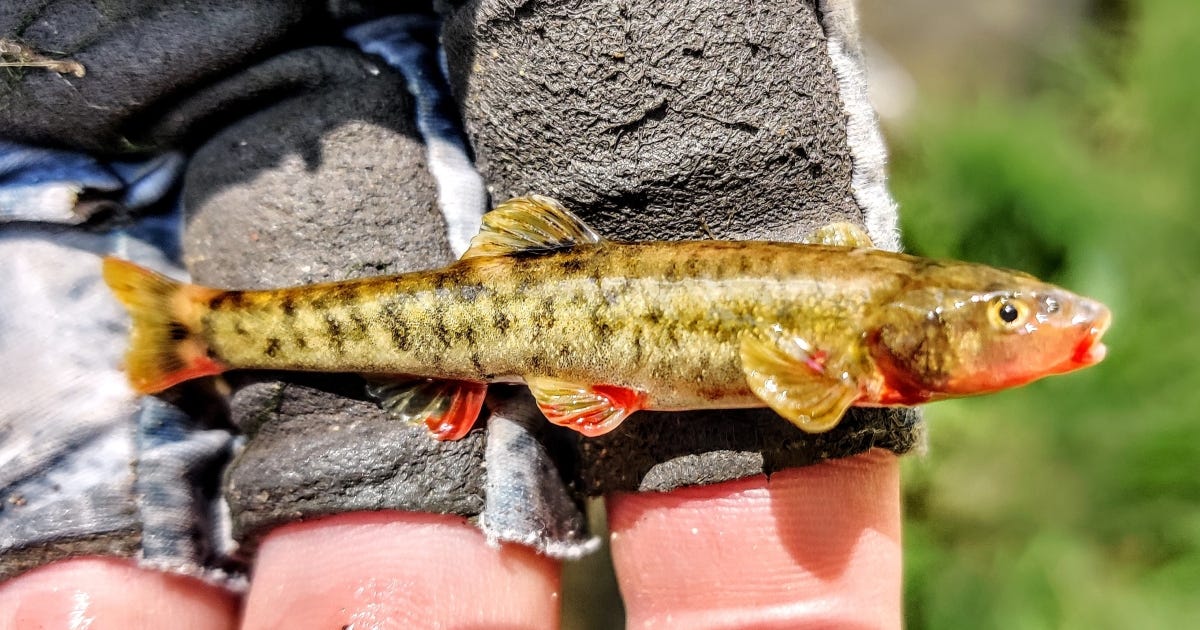
Masters of their specialized environment, Loach Minnow possess several unique adaptations that allow them to thrive in fast-flowing water. Their fan-like pectoral fins, similar to those of darters and sculpins, enable them to use the currents to their advantage and maintain position among the cobbles. A modified swim bladder and flattened ventral surface help them stay low in the water column, often resting directly on the cobbles. Unlike many fish of the American Southwest that rely on broadcast spawning, Loach Minnow build nests within the cobbles and lay adhesive eggs that stick to the surface of the rocks. Though inconspicuous, they are remarkably charismatic: their sides display a camouflage pattern of black and green, accented by white saddles at the bases of the dorsal and caudal fins, and during the spawning season they develop deep reddish-orange coloration on the lips, ventral fin bases, and body.
Historically, Loach Minnow occupied 35 streams throughout the Gila River Basin. Today, due to a combination of human-caused impacts, they persist in only a small fraction of their former range. Key stressors include predation from introduced species such as Yellow Bullhead and Green Sunfish; habitat degradation associated with dams; water extraction for mining, agriculture, and municipal use; and sedimentation linked to cattle grazing in stream environments. As a result, Loach Minnow are among the most imperiled fish in the basin, alongside species such as Spikedace and Gila Topminnow.
Current research and conservation efforts aim to prevent further declines and rebuild populations. These efforts include hatchery propagation, stockings, and translocations into streams where the species has been extirpated or where populations are at risk, such as Fossil Creek and the Blue River. Invasive species removal projects have been led by the Arizona Game and Fish Department in the Blue River and Fossil Creek, and are ongoing in Aravaipa Creek under Marsh & Associates, LLC., and the Bureau of Land Management. Additionally, the Bureau of Reclamation has constructed fish barriers on these streams—with plans for barriers on more streams—to limit upstream movement of invasive fish and protect the remaining habitats where Loach Minnow still survive.
No posts
Comments
Nothing yet. Say the first thing.
Sign in to join the conversation.