
A flywheel is a heavy spinning disc. It accelerates when power is supplied, storing rotational energy, and releasing it when there is a drop in power. It therefore enables an engine to maintain a consistent rotational speed, even if the power supply is intermittent.
Britain’s decline is like a flywheel. Sometimes, the government makes the flywheel spin faster, interfering and making things worse. But most of the time, nobody is doing anything actively harmful. Yet the flywheel keeps on spinning, releasing its energy, feeding the decay. And stopping a flywheel is hard. It has a high moment of inertia, which is an object’s resistance to changes in its rotational motion. It does not want to stop spinning.
This metaphor perhaps helps us understand why the Labour government has achieved so little. Well over a year into office, the pledges of “national renewal”, the “plan for change”, the five “missions” – all have proven to be vacuous. There is no sign that anything is going to happen. The idea that we are going to build 1.5 million homes by 2029 is laughable. A certain fatalism has set in. Everybody feels powerless to stop the flywheel from spinning.
But there are some things that should give us hope. And one of them is the British constitution. Unlike America, we are not a vetocracy. In America, the President, Congress, Supreme Court and states are engaged in a continent-sized tug of war to stop anything from getting done. We are no longer members of the EU, so we do not have to contend with what Brussels wants. In Britain, the principle of Parliamentary sovereignty means we face no such restrictions.
Parliamentary sovereignty, wrote the Victorian jurist A.V. Dicey, means that Parliament has
the right to make or unmake any law whatever; and further, that no person or body is recognised by the law of England as having a right to override or set aside the legislation of Parliament.
Whatever Parliament says, goes. Its law is unimpeachable. And thanks to our electoral system, the restrictions on the ability of the House of Lords to block legislation, and the iron grip exercised by the government over Parliamentary time and backbench MPs, a sufficiently determined government with a solid majority in the House of Commons can just do things.
This post is a primer on what this simple-sounding concept actually means. None of it should be new to constitutional lawyers, to whom I apologise for the loss of some subtlety, which is confined to several long footnotes. It’s intended for people in politics, widely construed.
Britain is almost unique in the democratic world for not having a single document called ‘The Constitution’. But this does not mean we do not have a constitution. A constitution is simply the set of rules that create the political order – they are constitutive of the State. Every State must have a constitution.
Our constitution is made up of a mixture of law and constitutional conventions. The difference between the two is one of form, not substance: if something is a law, then a court has the right to enforce it. If it is a convention, it is enforced through the political arena. Conventions are not unimportant – quite the reverse. It is convention that the King does not interfere in politics. The same is true of the government’s accountability to Parliament.1 If the government refused to resign after losing a confidence vote in the House of Commons, then it would definitely spark a political crisis, but (probably) not a legal one.
Parliamentary sovereignty is undoubtedly law, rather than convention. What it means is that Parliament’s ability to legislate is not constrained by any ‘higher law’. This is extremely unusual. Staying within the common-law world, in Australia, for instance, the Federal Parliament is constrained in what it can and cannot do: there is a list of subjects outlined in the Australian Constitution, and anything outwith this list must be left up to the states of Australia. In Ireland, which is not a federation, the Oireachtas can pass laws on any subject, but the Supreme Court can strike down laws inconsistent with the constitution.
Westminster faces no such restrictions. In fact, there is only one well-recognised constraint on Parliament’s ability to legislate: it cannot bind its successors. Even though this is a constraint, it isn’t quite the same thing as the restrictions placed on the Australian or Irish parliaments. Logically, if Parliament is sovereign, it cannot abandon its sovereignty. If it were able to bind its successors, it would no longer have “the right to make or unmake any law whatever”.
This principle is applied regardless of what an Act of Parliament says. Take section 63A(1) of the Scotland Act 1998, which was inserted into the Act in 2016, following the unsuccessful independence referendum in 2014:
(1) The Scottish Parliament and the Scottish Government are a permanent part of the United Kingdom’s constitutional arrangements.
The word “permanent” might sound like this section binds Parliament’s successors. In fact, it does no such thing. Parliament could repeal section 63A tomorrow. The purpose of this section, as subsection (2) puts it, is not to entrench the Scottish Parliament but merely to “signify the commitment” of Parliament and the UK Government to the Scottish institutions.
Likewise, Parliament cannot stipulate the ‘manner and form’ by which legislation should be passed. In most countries, there are restrictions on amending the constitution. At one end of the spectrum of difficulty, Ireland simply requires a referendum, while at the other, the US requires a two-thirds majority in the House and the Senate and the consent of three-quarters of the states.
Parliament could of course pass the Human Rights (Entrenchment) Act to say, for instance, that repeal of the Human Rights Act required a two-thirds majority. But the Human Rights (Entrenchment) Act could be repealed by Parliament by a simple majority. Indeed, Parliament could probably just repeal the Human Rights Act without going through this preliminary step.2 Parliament cannot bind its successors.
Parliament – I cannot emphasise enough – can declare that the law is literally anything it likes.
It can do things that are bizarre. It can legislate that the grass is blue and the sky is green. For legal purposes, then everybody has to go along with this charade (even though Parliament obviously cannot affect reality itself).
This may sound like a silly example, but there is precedent for something similar. In 1965, Britain was refusing to grant independence to Southern Rhodesia (today’s Zimbabwe), which was ruled exclusively by a small minority of whites, unless the black majority were able to rule the country. Matters came to a head, and the white government of Southern Rhodesia declared independence without the consent of London.
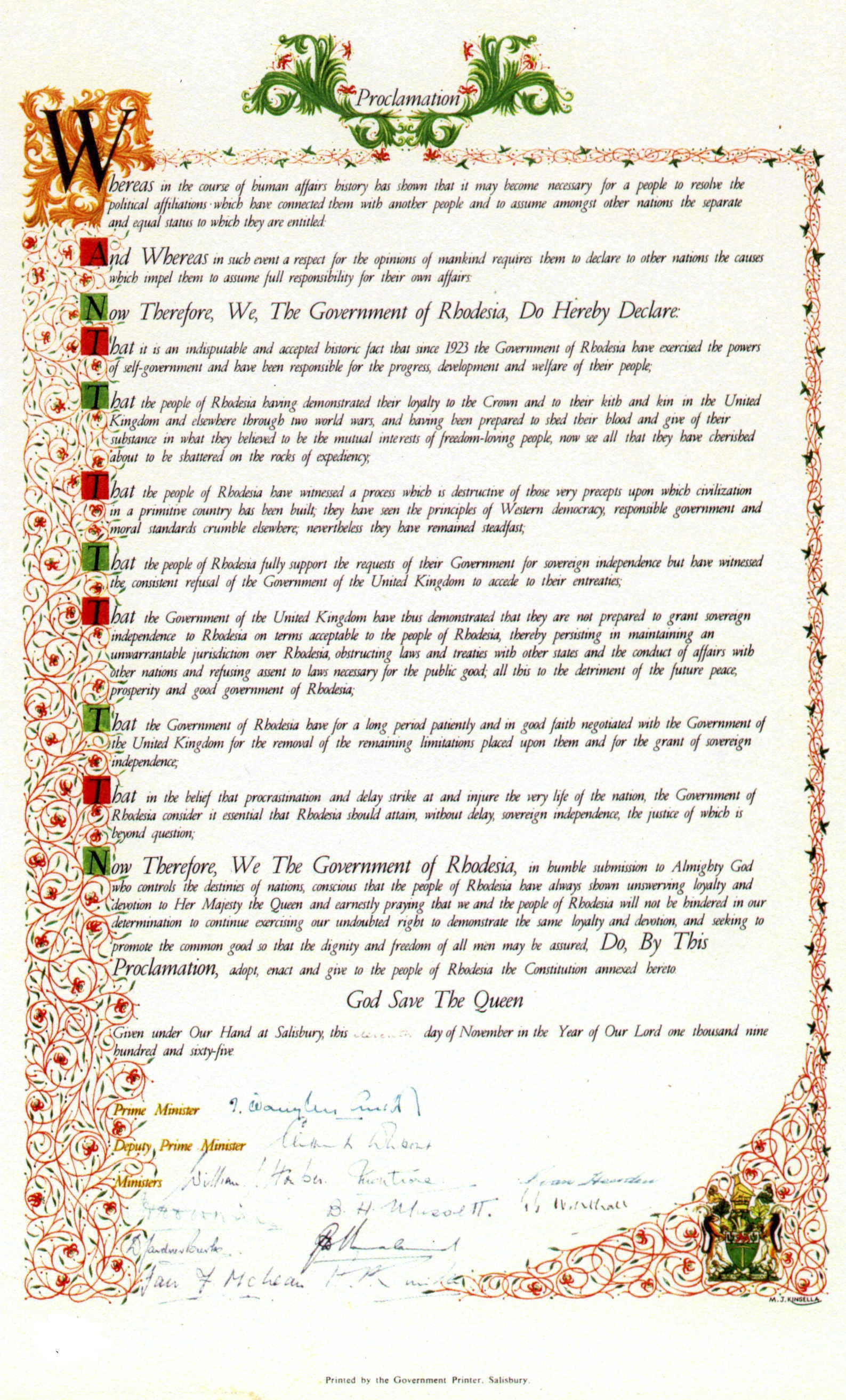
As a result, Parliament passed the Southern Rhodesia Act 1965. Section 1 stated “that Southern Rhodesia continues to be part of Her Majesty’s dominions”. This was plainly nonsense. As a matter of objective reality, the United Kingdom had no control over Southern Rhodesia. It was pure legal fiction. However, from a legal perspective, everybody had to pretend that colonial rule was still in effect.
Parliament is also able to make sweeping constitutional changes. It can repeal the Human Rights Act and abolish the monarchy by a simple Act. Constitutional Acts of Parliament are just Acts of Parliament like any other.3
It can also do things that are wrong. It can declare, for instance, that a law takes effect retroactively. It is generally accepted that the rule of law requires that laws be prospective, rather than retrospective, so that people subject to the law can understand their legal obligations. Although there are some exceptions,4 in general retroactive law is an evil. But this is no constraint on Parliament. Parliament faces no legal restrictions on, for instance, recriminalising homosexual acts and declaring that all homosexual acts are retroactively criminal. It can do bad things.
In fact, it can abolish democracy. It can do away with elections, and indeed has done this twice before, during the World Wars, although nobody thought that this would be a permanent state of affairs. It can delegate powers to pass any law to ministers – an Enabling Act which goes much further than the restricted powers that ministers have to make law at the moment. It can probably5 abolish the courts.
And Parliamentary sovereignty means that Parliament can do things that are simply evil. It can criminalise criticism of the government and send all offenders to prison camps. It can institute slavery. It can require all Jews to wear a yellow star.
I use these extreme examples deliberately. None of them has happened. On the face of it, our constitutional arrangements seem ripe for tyranny. All you need to do is to elect a government with a majority in Parliament, and then it can do what it likes.
Indeed, Lord Hailsham, a Conservative minister who ultimately became Lord Chancellor under Ted Heath and Margaret Thatcher, coined the term ‘elective dictatorship’ to describe this. Even though arguments for constitutional reform today tend to come from the centre and Left, Lord Hailsham was actually concerned about the threat of a socialist Labour government. In the late 1970s, he advocated in his book The Dilemma of Democracy for placing limits on Parliamentary sovereignty because he was a Conservative.
I dislike the term ‘elective dictatorship’. It is simply empirically false that Britain has ever fallen into tyranny since the dawn of the democratic age.
It is true that successive parliaments have passed Acts and successive governments have done things I profoundly disagree with, because they undermine democratic values. I am, for instance, about as close to a free speech absolutist as it is possible to be, and so I consider barbarous the idea of people facing arrest for a mean tweet. And of course I do not think we should have banned Palestine Action.
But this is the hallmark of bad government not a tyrannical state. We can call things bad, vile even, without claiming that we are slipping down the slope towards dictatorship. That is simply histrionic.
If not institutions, what is it that prevents tyranny? Politics.
Earlier I mentioned section 63A(1) of the Scotland Act 1998, which says that the Scottish institutions are permanent. As a matter of law, this is untrue: Parliament could repeal it tomorrow. But obviously, it couldn’t. If Westminster tried to abolish Holyrood without consulting the people of Scotland first, there would be a very serious risk of Scotland’s unilaterally declaring independence. At the very least, it would spark a political crisis. The political reality is that the Scottish Parliament really is entrenched.
Parliament may be sovereign as a matter of strict law. But law must come to heel before political reality. And this means that politics, not law, is the safeguard for our liberty.
This is the case in any country. It is very difficult for a dictator to take power without some kind of popular consent, tacit or not: the people can cause a good deal of trouble to even the most industrious tyrant. Weimar Germany did not crumble because it lacked constitutional safeguards, but because the German people, in some sense, wanted an end to democracy. As the former Supreme Court Justice Lord Sumption has put it:
When societies lose their liberty, it is not usually because some despot has crushed it under his boot. It is because people voluntarily surrendered their liberty out of fear of some external threat.
At root, the British people want to live in a liberal democracy. We may not be the land of little footsoldiers of liberty as myth would have it – our acquiescence to the COVID lockdowns put paid to that idea6 – but we do have a strong, cultural attachment to our institutions and to our democratic way of life. It is this popular attitude that is the ultimate bulwark for our freedom.
1776, 1789, 1848, 1945, 1989: these years stick in the memory because they are for many countries a year of rupture, where a single event led to the imposition of their present liberal-democratic constitutional order. In Britain, liberalism and democracy are a pair of old creeds. It is impossible to give any date of their germination, although we can see the progenitors of liberalism (the more important of the two) at a small scale during the medieval and early-modern period.7 Bit by bit, they developed; Britain’s political order has evolved much like a country house, left alone by some generations, excitedly expanded and remodelled by others, but never fully demolished and rebuilt. 1688, 1832 and 1911 are remembered by us not as ruptures but as renovations, years when the constitution was forced to adapt in order to preserve itself.
The organic growth of the ancient constitution, and the fact that its development largely came from compromise among the elite, has enabled us to avoid the perils of reaction. There has never really been a serious class of people who wish to return to a time before liberal democracy, as there has often been in polities where a ruling class has lost out in a sudden moment of revolution. Our ruling class has always acquiesced in the loss of its power, recognising that changing circumstances have made the old ways untenable. It has never sought to RETVRN.
Our attachment to liberalism and democracy therefore runs deep. To give one provocative example: in May, Germany’s domestic intelligence agency (which has the rather Orwellian name of Federal Office for the Protection of the Constitution) designated the AfD as a “confirmed right-wing extremist” party. This enables wiretapping of AfD meetings and the recruitment of informants. Germany may well ban the party outright.
The AfD may be very Right-wing, but they won 21% of the votes in the last election. Announcing that it is under surveillance and possibly banning it would be unthinkable in Britain. But the German attachment to democracy runs shallower than it does in Britain: the country has only experienced 49 years of liberal democracy as a united polity, 14 of them in the chaotic Weimar years. Seen in this context, the country’s reaction to the AfD is more understandable, even if we do not agree with it as democrats. The point is that it is hard to imagine this happening in Britain.
Is it guaranteed that Britain remains a liberal democracy? No, of course not. But while we should be vigilant, we must not overreact to threats that are actually figments of our imagination. I put to proof all advocates for constitutional change on the basis that it would stop tyranny – do the British people really want to abolish liberal democracy? They may want to do things you dislike. But tyranny is much too strong a word.
Ultimately, Parliamentary sovereignty means that we can get things done with very little friction. And it is one reason to be bullish on Britain. Our hands are no longer tied by the EU. Unlike in America, different bits of government are not staring down one another’s barrels (sometimes literally).
Even though America and Europe have a bigger reach, we have a lower activation energy for political change. We could carve out a path for ourselves as the only big free country where you can Just Do Things.
We have nobody to blame but ourselves for many of the supposed constraints on government action. I have previously written about the judicial review of infrastructure projects. One answer to this specific problem is just to authorise infrastructure by an Act of Parliament. That was, indeed, how the turnpike roads and railways were built. Parliament would pass an Act granting the turnpike trust or railway company’s authority to purchase land compulsorily and build the infrastructure. Because it is done by an Act of Parliament, such things cannot be impeached by anybody else.
The same goes for QUANGOs saying that you cannot build a new town thanks to some spiders. The same goes for judges blocking us from deporting violent criminals on human rights grounds. The same goes for the fact that the Left-wing priority of leasehold reform is held up by the selfsame Human Rights Act. Whatever the political outcomes you want to achieve, whether you are on the Left or the Right or the centre, if you want to fix Britain, you should take comfort in the fact that Parliamentary sovereignty makes the country much easier to fix than America or Europe.
Ultimately, the problem comes back to politics. It is a lack of willpower amongst our leaders. They are unagentic. Dominic Cummings likes to quote the American strategist and air force pilot Colonel Boyd: ‘People, ideas, machines – in that order’. In politics, the machines are the institutional arrangements. You can have the best machines in the world, but if you have the wrong people armed with the wrong ideas, those machines will not be used effectively. Conversely, good machines can make life much, much easier for good people. And the British constitution is a machine that enables quick, decisive action when the country requires saving.
When Lord Hailsham coined the term ‘elective dictatorship’, the country was engulfed by a much more profound sense of crisis than it is today. Between strikes, an IMF bailout, economic stagflation, and IRA bombings, there was a sense on both the Left and the Right that the country was ungovernable: the idea of a coup was seriously entertained by some on the Right. There were concerns that the patient would not survive the medicine. It was in that intellectual milieu that Lord Hailsham wrote his melodrama The Dilemma of Democracy.
And yet, things improved. The country never succumbed to totalitarianism. We got the unions, the public finances, the economy, and the situation in Northern Ireland all back under control. This in itself should serve as a hopeful reminder that things can get better. The country succumbed to neither a socialist tyranny nor a Right-wing coup.
But it should also be a rejoinder to those who think the answer to a temporary crisis is a profound constitutional shift. If the current polls are repeated at the next election (and that is a very big ‘if’), Nigel Farage will be the next Prime Minister. He will promise big things. And even if it is not Farage, the country will face a choice in 2029 between the parties (of both the Left and the Right) calling for radical change, and those who are content to let spin the flywheel of decline.
If the radicals win, then the losing side will doubtless call for formal limits on the power of Parliament. This kind of narcissistic constitutionalism must be resisted. It is unwise to kill off the constitution merely because we disagree with what our leaders happen to be doing at the time. Parliamentary sovereignty is precious, unique to Britain, and we must preserve it.
R (Miller) v Prime Minister [2019] UKSC 41 might have brought about a hastily-conceived change in this position. The Supreme Court held at [46]–[50] that Boris Johnson’s prorogation of Parliament in the autumn of 2019 was unlawful in part because it would jeopardise the executive’s accountability to Parliament. This appeared to be elevating convention to law, and was wrong. The court is not entitled to enforce the convention of Parliamentary accountability, because it is a convention, not a matter of law. It remains to be seen whether Miller 2 did bring about a constitutional revolution, or whether it will become a ‘much-distinguished case’ to use the tedious lawyerly ‘joke’.
This has never been put to the test. In Thoburn v Sunderland City Council [2003] QB 151 Laws LJ said at [59] that Parliament “cannot stipulate as to the manner and form of any subsequent legislation”. One of the ill-advised obiter remarks in R (Jackson) v Attorney-General [2006] 1 AC 262 said that “If the sovereign Parliament can redefine itself downwards, to remove or modify the requirement for the consent of the Upper House, it may very well be that it can also redefine itself upwards, to require a particular Parliamentary majority or a popular referendum for particular types of measure.” (Lady Hale at [163]).
Given that article 9 of the Bill of Rights says “Proceedings in Parlyament ought not to be impeached or questioned in any Court or Place out of Parlyament” I do not think Lady Hale’s position is tenable. By the enrolled bill rule (see British Railways Board v Pickin [1974] AC 765), which is derived from article 9, the courts do not look beyond the words of a statute to consider whether it was passed in accordance with the right Parliamentary procedure. That is for Parliament alone to decide. Parliament’s redefining itself upwards would not be in accordance with Parliamentary sovereignty as we presently understand it; such a redefinition would be a redefinition of the entire constitutional order.
There is one respect in which they are different. Thoburn created a category of constitutional statutes. This is a statute which either “(a) conditions the legal relationship between citizen and State in some general, overarching manner, or (b) enlarges or diminishes the scope of what we would now regard as fundamental constitutional rights” per Laws LJ at [62]. The only difference is that constitutional statutes are not subject to implied repeal, the principle that if two Acts of Parliament are inconsistent with one another, the later Act takes priority, so has impliedly repealed the earlier.
In my view, this was wrong. Implied repeal is an outgrowth of Parliamentary sovereignty: if Parliament cannot bind its successors, then later Acts must take precedence over earlier ones. Defenders of Laws LJ would say that implied repeal is simply a principle of statutory interpretation: after all, Parliament is still able to repeal the constitutional statute. The concept only bites when Parliament has not done its homework and has accidentally passed two inconsistent statutes. To this I would say – if implied repeal is merely a principle of statutory interpretation, then I would say that statutes ought to be interpreted in a manner which runs with the grain of our most important constitutional principle. It might not undermine Parliamentary sovereignty in a very narrow sense, but it is hardly in-keeping with its spirit.
Retroactive laws can be used, for instance, to force taxpayers to pay the tax they have been unethically avoiding for years.
In another of the ill-conceived obiter remarks in Jackson, it was suggested that this would be the point at which the courts would strike down such an Act (Lord Steyn at [102]).
This is not to say that the COVID lockdowns were wrong. Rather, a land of libertarians would have seen rather more resistance to the lockdowns than we did in fact give.
I am here specifically referring to the greater degree of freedom of association enabled by the institution of the trust, as well as the greater freedom of property rights.
No posts
Comments
Nothing yet. Say the first thing.
Sign in to join the conversation.