
This is a collection of some things I have read, listened to, or done in the past month.
How Co-ops Electrified America. “The R[ural] E[lectrification] A[dministration] also had to contend with red tape, legal challenges, and concentrated opposition from local interests. It overcame these obstacles because it had clarity of purpose and focused on outcomes over procedure, but also because it made its beneficiaries — the farmers — active partners in its success.” This should be a lesson to reform movements all around the world . . .
. . . and also to organisations building new infrastructure. Chiltern Railways’ extension to Oxford was an infrastructure project that was on time and on budget – thanks to clarity of purpose, focussing on outcomes over procedure, and making locals active partners in its success.
How Istanbul builds metros cheap and fast. The Transit Costs people are great, and at some point I’ll write a digested version of their reports. This is a précis of the Istanbul case study.
After reading Breakneck, I have been on a bit of a China binge. I have learned the word involution. Apparently Chinese AI researchers are terminally online on the Western Internet. And if you want to get a tonne of practical tips on how to learn Chinese, this blogpost has you covered.
Everything you ever wanted to know about the UK Civil Service – and then some.
The British government plays buckaroo with business. Add an obligation on housebuilders here, a levy on energy providers there. Pharmaceutical companies? Of course they can bear a ‘voluntary’ rebate on drugs sold to the NHS. Eventually, though, the mule will buck, and kick back. Businesses, of course, don’t vote, while voters are “treated as skittish foals that will rear up at the slightest burden”. Good luck to Rachel Reeves in the Budget later this month.
Relatedly, here is the best explanation I’ve ever read of how the UK Building Regulations are a confusing mess which make homes more expensive and uglier.
Just when you think the world can’t get any more haram, Louis CK and Jimmy Carr are doing standup in . . . Riyadh. I wonder what the Gulf Futurists will make of this.
What do you call somebody who’s a weeb about Switzerland? A Suibe? Whatever it is, I am one, and proud of it. So, why is Switzerland so rich? tl;dr – the Swiss have a much more longstanding attachment to economic liberalism than other places. (But wasn’t this also true of Britain, at any rate before 1914 / 1945 depending on whom you ask? Why didn’t Switzerland get an Attlee?)
I went to the San Francisco Bay Area in October. I present without comment ‘The Bay Area is Cursed’.

Another entry in the annals of ‘Covid made everything worse’: why are so many transit agencies facing fiscal cliffs?
Two projects to build new cities have launched, in California and not-quite Cambridge. I am sceptical. I struggle to believe that it is politically easier to build an entirely new city than it is to expand an existing one. That said, the modern condition is sorely lacking ambition, and at least these projects are providing it.
The coronation of Bokassa I and Catherine, the Emperor and Empress of the newly-minted Central African
RepublicEmpire, cost $100 mn in today’s money. It was inspired by the coronation of Napoleon, but sadly the Pope had a scheduling clash. So it seems did everybody else:
Authoritarian African leaders such as Omar Bongo of Gabon, Mobutu Sese Seko of Zaire, and Idi Amin of Uganda found reasons to refuse to visit the Central African Empire for the coronation. Later, in one of his interviews, Bokassa explained their refusals by saying: “They were jealous of me because I had an empire and they didn’t.”
Palantir is a fascinating company. Apparently it was cult-like, but in a good way: after all, what is the boundary between ‘strong corporate culture?’ and ‘cult’? The fact that Palantir was a pariah for so long helped it recruit high-quality people – you had to really want to work there to even apply for the job.
The Renters’ Rights Act is going to make the housing crisis worse.
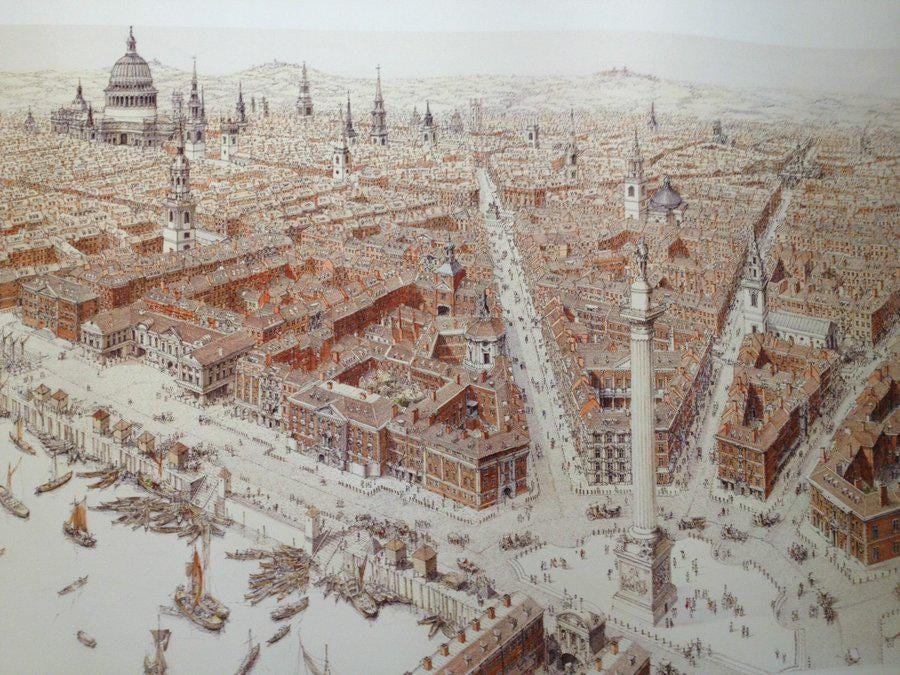
(From Twitter) How London would look if Wren had had his way after the Great Fire.
Why did Communist economic reforms fail? My friend Michael tells the story of, inter alia, how Gorbachev destroyed the Soviet economy by accident.
Progress is downstream of culture. “The key lesson from a16z’s American Dynamism movement is that a fund is both a financial and a cultural institution, and these forces reinforce each other” – Andrew Bennett.
Do I want to talk about Helen Andrews’ viral article about the Great Feminisation? Not particularly. It was clearly designed to go viral, which is why I am not linking to it. Quotations include “the rule of law will not survive the legal profession becoming majority female,” apparently because women tend to be less objective than men (which, apart from anything else, does not tally with my anecdata). There are some interesting nuggets buried in there, but they’re all things I’ve seen better authors like Tanner Greer write about. See Richard Hanania’s critique.
The Future and its Enemies by Virginia Postrel. This book (written in the late 90s) is fantastic, jumping around from legal theory to women’s sanitary products. Its thesis is that the main divide is no longer Left/Right, but Stasist/Dynamist – not where you sit on economics and culture, but about your attitudes towards the future. It is one of the ur-texts of the Progress Movement.
Stasists come in several varieties: most obviously conservatives who want to keep everything the same, and reactionaries who want to wind the clock back. But there are also the kind of progressives who look forward to the future, but only if it unfolds in a manner envisaged in their 13-point plan. Think The West Wing.
Dynamists look forward to the future, but they don’t have a 13 point plan. They embrace the fact that the future is unknowable. They are optimistic about humans’ capacity to solve the problems that the future brings. They explicitly want to allow things to unfold in a manner they have not envisaged.
It’s a great book, and extremely well written: I devoured it in an afternoon. I think she overstates her case, but I think the divide she points to is real. I consider myself a dynamist with cynical characteristics.
Boom: Bubbles and the End of Stagnation by Tobias Huber and Byrne Hobart. Another Progress-themed book. This makes the counterintuitive point that bubbles can be good, actually. Irrational exuberance is how paradigm shifts in innovation happen. Good bubbles create wastage, but it’s outweighed by the benefits of moving the world forwards.
What distinguishes a bad bubble from a good one? H&H don’t quite answer this to my satisfaction, but basically: a good bubble is one that pays off if the future is radically different from the past. A bad bubble is one that pays off when there is mean reversion.
One example they give of a good bubble (a word which they use slightly loosely) is the US government’s expenditure on the Apollo programme:
The symbolic meaning of the program’s end shouldn’t be underestimated. Apollo was nothing less than an instance of the technological sublime. The Apollo 11 mission, and the technological mastery a successful Moon landing represented, elicited a cross-cultural spiritual reaction. Images from the mission were “surrounded with the aura of religion,” from the silvery Saturn V rocket, which towered against the darkness of space before it lifted off and sent the first humans to another world, to the Apollo 8 crew’s reading from the Book of Genesis on Christmas Eve 1968, to Armstrong’s footprints on the lunar surface. In the 20th century, the experience of the technological sublime was a recurrent phenomenon in America – think of the interstate highway system, the Hoover Dam, the Manhattan sky-line, the atomic bomb, the jet airplane, or the Golden Gate Bridge.
After Apollo, that experience essentially vanished. Instead of a new opening upon an endless frontier, Apollo marked the advent of an era of diminishing expectations about the future and decreasing returns on technological progress. It signaled our entry into an age of deceleration, in which technological and scientific ambitions are constantly scaled down. Dreams about sparkling Moon dust died in the mud of Woodstock, which gave rise to more Earth-centric concerns.
English Culture and the Decline of the Industrial Spirit by Martin Wiener. The third book about Progress. This is one of the best books I have ever read, and deserves a blogpost in its own right.
Fiction-wise, I started The Swimming-Pool Library by Alan Hollinghurst. I simply could not finish it. You can draw your own conclusions as to why.
As I mentioned, I went to the Bay Area, attending the Progress Conference. Some random observations:
I think wealthy liberal Americans have been negatively polarised by their obese compatriots to start healthmaxxing. None of them drink, they go to bed early, and it was impossible to find non-healthy snacks in the conference venue. How dull! Every night I ended up drinking with a group of (mainly British) Europeans.
I hadn’t realised until I went to Berkeley just how bad American urbanism is. Berkeley is good by American standards, and awful by the standards of the civilised world. I feel I understand the American YIMBY movement better.
I am pro-BART, and anti-MUNI. My only complaint about the BART is the frequency, but other than that it’s a pretty good S-Bahny system. The MUNI is recognisably a streetcar system from the nineteenth century: like London buses, it needs to go on a stop diet. The fact they don’t have integrated fares is silly, and means the shared underground stations are weirdly designed.
The nice bits of San Francisco are really, really lovely. I didn’t go to any of the other parts.

Earlier in October I went to see The Midnight. I often try to listen to a particular album when I go to a new place, so I will always associate them. Their new album Syndicate was the soundtrack of my visit to the Bay Area. It includes a song about running away to the West Coast . . .
No posts
Comments
Nothing yet. Say the first thing.
Sign in to join the conversation.