
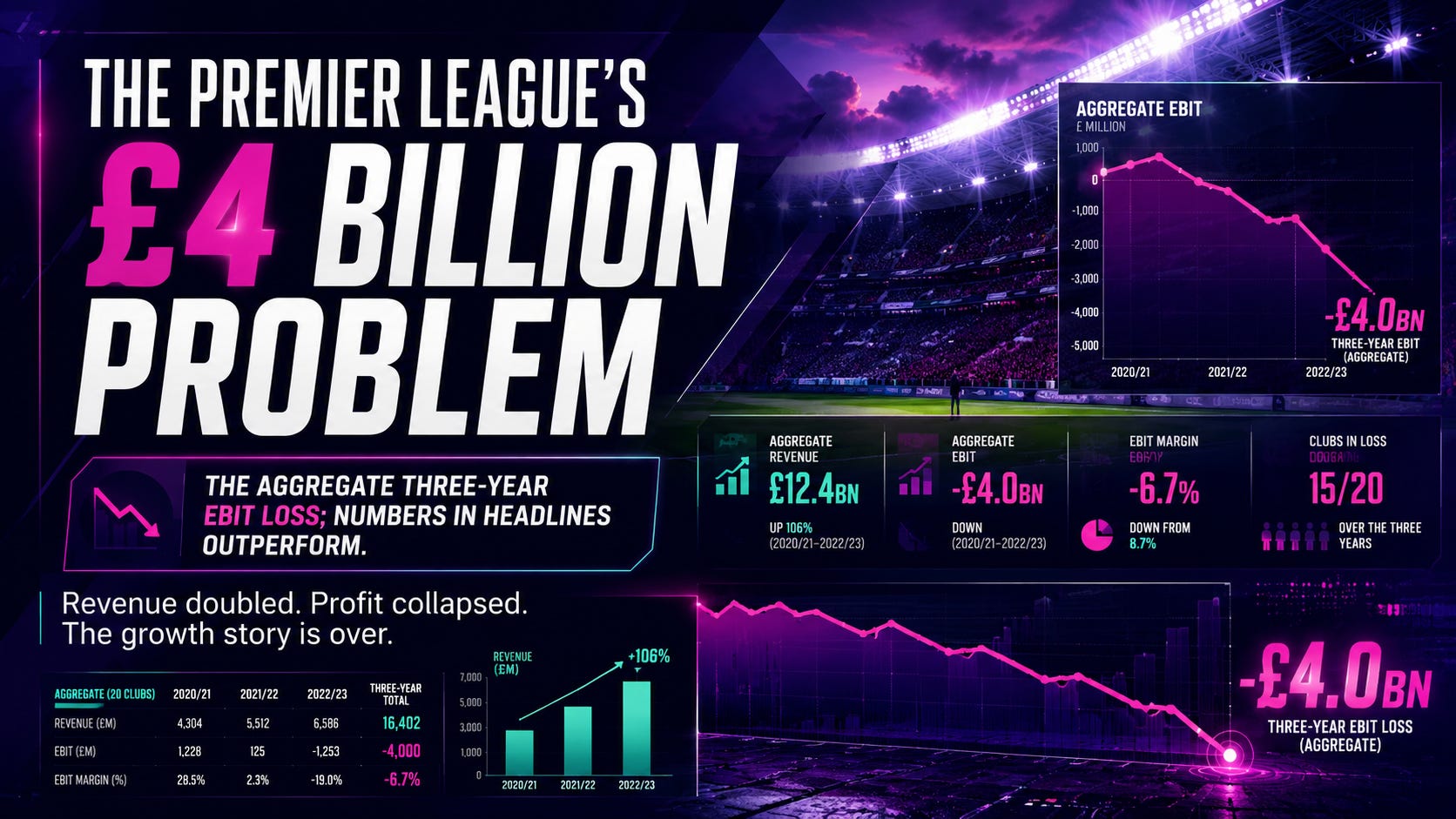
The Premier League is a mature business dressed as a growth story. I’m still a bull on sport — but its time to plot a new course.
Two pieces landed in my inbox within a fortnight of each other, written by people who, as far as I know, don’t talk to one another. Greg Cordell published a forensic ten-year financial history of the Premier League on his Substack, Vanity, Sanity, and Reality. Nick Meacham, over at SportsPro, used his opening address at SportsPro London to list eight things the industry keeps telling itself — and quietly took each one apart. One works from the balance sheet up; the other from the conference stage down, yet they arrive in the same place. The growth era is over.
I want to be clear from the first line, because what follows can read as bearish and it isn’t: I am a bull on sport. The cultural asset is not in question. The demand, in my mind, is not in question. What is now in question is part of any one who did Econ 101 and has to figure out what to do with a mature business?
There is one statistic that lets everybody keep telling the growth story. Premier League revenue more than doubled over the decade, from £3.3 billion to £6.8 billion — a compound annual growth rate of 7.4 per cent, which is really impressive stuff.
It is also the only figure in Cordell’s entire dataset that supports the word “growth. Split the decade in two and the deceleration is stark: revenue grew at 11.4 per cent a year in the first half and 4.8 per cent in the second. The top line did not keep climbing at the same gradient. It flattened. If you adjust for inflation it’s getting closer to zero in the second half of the decade.
Now read the lines beneath it, because that is where a capital allocator should live:
• Adjusted EBITDA — the closest thing to recurring cash profit — fell from £659 million to £573 million. The margin did not soften; it halved, from 19.7 per cent to 8.4 per cent.
• Operating profit (adjusted EBIT) swung from a £75 million loss to a £1.65 billion loss.
• The pre-tax result went from a £115 million profit to a £785 million loss — and that is after clubs leaned on player-trading gains and sales of assets to affiliated parties to flatter the picture and stay the right side of the regulator.
• Cash conversion has all but stopped. Operating cash flow was £169 million last year — 2.5 per cent of revenue, down two-thirds in twelve months, against the 18 to 25 per cent the League routinely generated five years ago.
• And the gap is being financed. Football net debt has nearly quintupled. Net leverage has gone from 1.9 times to 10.6 times. Cordell’s own verdict: a position that was broadly sustainable is now, in aggregate, unsustainable without continued owner support.
Put those together and the diagnosis writes itself — but it is not the one you will hear at most conferences. The Premier League is not a growth business with a margin problem. It is a mature business being financed and operated as if it were still a growth one. A 4.8 per cent top line is being asked to carry double-digit growth in wages, in player amortisation, in capital spend and in debt. The gap between those two numbers — the distance between how fast the money is coming in and how fast it goes out — is being filled by owners writing equity cheques and lenders extending credit. That gap is the whole story.
Whilst the data set is showing this in the EPL, I think we can be pretty certain that a fairly similar story is playing out on the continent.
It would be comforting to call last season an aberration — a post-Covid hangover, a cost spike that washes out. The structure says otherwise.
The engine that drove the growth decade was broadcast, and broadcast has matured in the most literal sense. UK media revenue has grown at under 2 per cent a year since 2018/19, having compounded in the mid-teens before that. Broadcast has now slipped below half of total league revenue for the first time. The forward cycles confirm the new normal rather than break it: the latest domestic rights deal is up around 17 per cent across three years — healthy, but a 5 per cent annual rate, not the old double digits (and to get there the cost per game had to come down and the amount of games had to go up).
This is what a mature media asset looks like: still valuable, still growing, but growing like a utility, not a start-up. Meacham makes the same point from the stage, noting that even at the very top the picture is getting harder, and that Premier League per-game rights values have actually fallen.
The other revenue lines cannot fill the hole. Commercial income has been the consistent performer, but Cordell is explicit that much of it has come from adding ever more — and ever smaller — partners, which is a road with a wall at the end of it. Matchday is where clubs have visibly pushed: new and expanded stadiums, more hospitality, and price rises that are now almost universal — nineteen of twenty clubs raised season-ticket prices last season. That tells you where the pressure is going. It also tells you something uncomfortable about how much further the existing model can be sweated.
I have repeated many times to whoever will listen – Media Growth is flat or down across Europe. Sponsorship is a 4-6% CAGR business, and in the top leagues stadiums are full so either redevelop (take on more debt) or you are into yield management. That is not a growth story anymore.
Here is where the finance textbook and the football reality part company.
When a business matures, economics offers two honest paths. You harvest — stop reinvesting, let the cash flow out, accept a gentle decline and return capital to owners. Or you reinvest to build a new growth curve: a new product, a new market, a new model. Most mature businesses can at least choose to harvest. A football club, structurally, cannot.
The cash cow here is the playing squad, and it is a wasting asset on a scale most investors underestimate. Player amortisation has more than tripled to £2 billion a year and now consumes close to 30 per cent of all revenue. The moment you stop reinvesting, the squad ages, results slide, and the downside is not a softer dividend — it is relegation, which strips out the very revenue that justified the asset in the first place.
So clubs keep spending: net transfer outlay has exceeded £1 billion for eight consecutive years, even as profit and cash flow fell away beneath it. It is a race — everyone sprinting simply to hold position — and it is why “just run it for cash” is not a strategy available to any single club that intends to stay in the division.
The mantra we have heard is about data analytics and getting better at this – or where MCO’s have emerged to better finance trading, diversify risk and increase the pool of playing talent. BUT the push back on this especially from fans – your core audience – is real.
If you cannot harvest, the path too many clubs have actually taken is neither route — it is financial engineering dressed as growth. Selling the women’s team to a sister company. Moving the stadium into a related entity. Bringing retail in-house specifically to inflate the revenue denominator the new cost-control rules measure you against, with no real profit attached. None of that is growth.
The problem is that we have been getting incrementally better at the same business. Whilst the world around us has changed massively.
If football clubs are unwilling to change the business model – and understand that the fan is where the value is then in my mind there is one area left for sports teams to pivot into to drive valuations…
I have spent a good part of the last couple of years looking hard at real estate as the value driver in this industry, and I have done so for a simple reason: the economics everywhere else are getting harder to explain. The stadium is the one asset a club genuinely owns, that it controls, and that is monetised for roughly nineteen days a year when it could be working for three hundred and sixty-five. Treated as a sporting cost centre, it is a drag. Treated as a real-estate platform — a mixed-use district with year-round revenue, partners and footfall that exist whether or not there is a match on Saturday — it becomes the growth curve the playing side can no longer provide on its own. The clubs that understand this are not buying players to grow; they are building places.
But this is Real Estate play is less about the venue itself (stadiums are hard to monetise out of game day and the conferencing and banqueting they do will not move the needle sufficiently) and more about how to use it as the centre of a redevelopment that can build lasting value.
That is the rebuild. It is harder, slower and less glamorous than signing a striker, and it does not fit a venture-capital clock — a point Meacham makes well when he warns that sport needs a generation to settle, not a year to prove itself. But it is real, it is ownable, and it compounds.
The reflexive answer in every boardroom and on every panel right now to “where does the next leg of growth come from?” is artificial intelligence. I would gently suggest we have seen this film before.
AI and technology have always offered a genuinely interesting opportunity to this industry — as has the long-promised deeper connection with the fan. Both are real. But look at the actual mechanism by which sport has monetised every previous wave — crypto, NFTs, fan tokens, betting, gaming — and the pattern is unmistakable. None of them rebuilt the operating model. Every one of them ended up as a sponsorship line: a sleeve patch, a training-kit logo, an “official partner” badge. The technology arrived as a cheque, not as a new business the club runs.
Meacham’s read on AI is exactly this, and the data backs him. AI is already delivering real value to sport — but through efficiency, cost-out and productivity, not top-line growth. The one place it is genuinely scaling on the revenue side is as a sponsorship category, with rights holders signing AI-sector partners at pace. You only have to look at the deals being announced to see it: the technology is being used to plug a sponsorship hole, not to rebuild the model to drive growth. So as we seen betting and gaming pushed out we fill the gap with the next category. That is not a criticism of AI; it is a criticism of how our industry reaches for the shiny new thing as a substitute for the hard structural work.
So here is the bull case. The Premier League is the most valuable cultural and commercial asset in world sport, and that will not change any time soon. But it is a mature business, and the financials are now unambiguous about it. You cannot underwrite it on the growth-stock multiple the revenue headline invites, because the cash flows beneath that headline no longer support the story. You cannot harvest it, because the competitive structure will not let you. And you cannot fix it with a sponsorship dressed as a strategy.
What is left is the genuinely interesting work: rebuilding the model around the assets a club actually owns and can grow for decades — the place, the land, the year-round relationship with a community that is not going anywhere.
I am not predicting a crash in valuations (scarcity, importance, non-correllated etc) or the end of the world, simply seeing the reality and trying to paint the picture. European Football, and the EPL are great products inherently. But they are run on the same basis as they have been for several decades.
Real Estate will be where you see a lot of clubs pivot and you are already seeing it manifest. Its expensive but a clear and tangible asset.
On the Fan…well I wrote my Fan Flywheel thesis and stand by it. There is a massive opportunity out there for the clubs and leagues that embrace technology not as a way to improve what they do today, but to reinvent how clubs could be run in the modern world.
With thanks, and credit, to Greg Cordell (Vanity, Sanity, and Reality) and Nick Meacham (SportsPro), whose two pieces — one from the balance sheet, one from the stage — prompted this one.
Comments
Nothing yet. Say the first thing.
Sign in to join the conversation.