
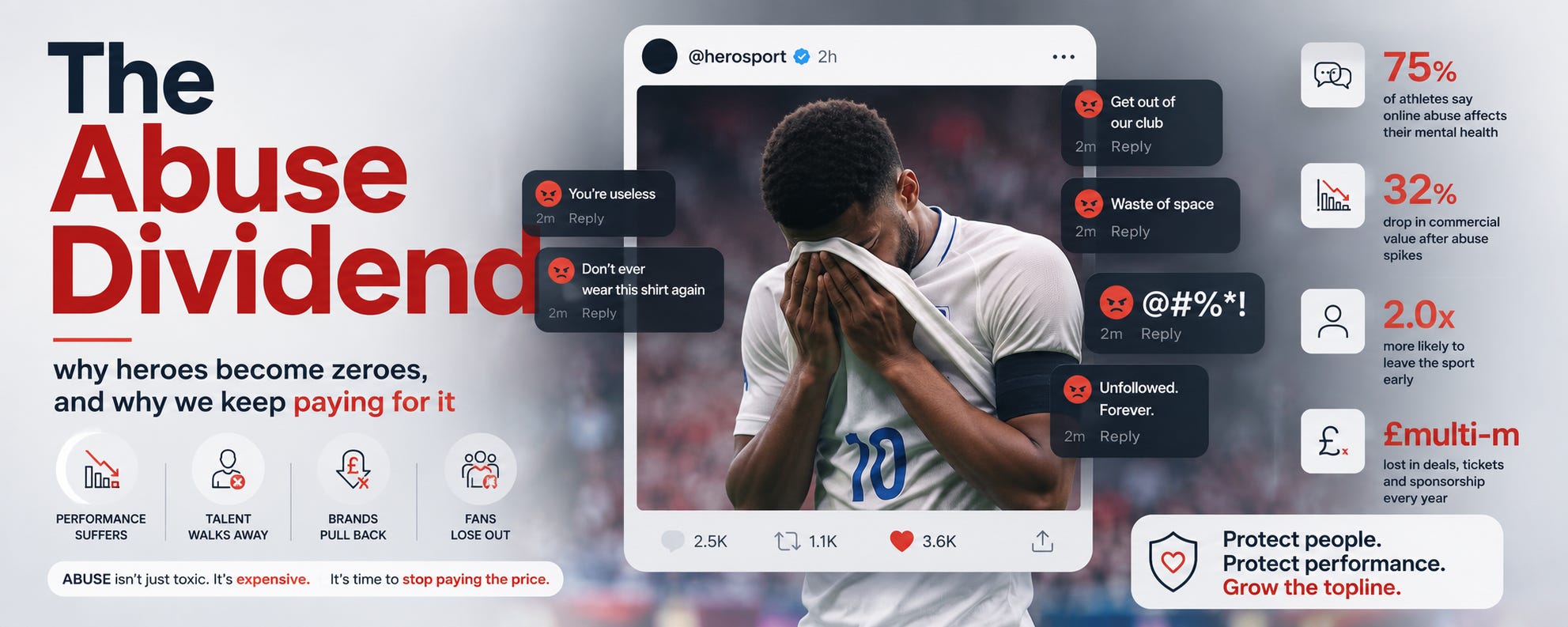
On Saturday night, England beat Norway and the country floated home. By Wednesday night, Argentina had come from behind in the semi-final, and by Thursday morning the same players - and in this case the Coach - were being told — in their mentions, under their posts, in their DMs — exactly what a certain corner of the internet thought of them.
We know what comes next, because the ritual never changes. In a few days, a governing body will publish a report quantifying the abuse. FIFA has already identified more than 89,000 abusive posts during this World Cup, 11% of them racist (i personally suspect this is a sanitised view already). These reports are presented as accountability. But ask yourself who they inform. Not the players — they were the first to know. They read it in real time, unfiltered, at the precise moment they were most exposed. We have built an entire apparatus that measures the wound with impressive precision and does almost nothing to prevent the blade - and its not limited to sports or entertainment.
When I look at social media abuse I don’t just see a welfare problem — though it is one, and a serious one. I see one of the largest unpriced losses in the sports industry.
Consider what abuse actually does to a commercial channel. Athletes disengage, post less, or hand their accounts to agencies who post beige content nobody engages with. Genuine fans — the people sponsors are paying to reach — stop commenting because nobody wants to swim in a cesspit, surrendering the conversation to a vitriolic minority so small it is countable: when Signify’s Threat Matrix analysed 3.7 million messages sent to a group of prominent footballers, the serious abuse traced back to just 507 accounts. A few hundred people setting the tone for millions. Meanwhile sentiment data becomes garbage — try telling a sponsor what fans “really think” when a large share of replies under a big post are bots, betting spam and bile — and campaigns underperform by amounts nobody can measure, because the environment they ran in was never controlled. We are leaving money on the table, and we don’t even count it.
And this is no longer anecdote. Advertising research priced the adjacency problem years ago: consumers shown a brand next to unsafe content are nearly three times less willing to associate with it, two-thirds of high-intent buyers walk away, and roughly half say they would rethink or boycott a brand whose advertising sits beside offensive material. Every sponsor logo above an abusive comment section is running that experiment daily. On the talent side, the numbers are bleaker still: 87% of the online abuse at Tokyo 2020 targeted women, nearly a third of elite British sportswomen report serious abuse online, and 58% of abused athletes say it made them consider quitting sport altogether. That is the asset base of women’s sport — the fastest-growing commercial story in our industry — being eroded at source, unpriced and unmanaged. As my belief is womens sports will rely on commerical more than media for the next cycle thats a major issue to resolve.
The world outside sport has stopped waiting for the platforms to fix this. Australia banned under-16s from social media entirely in December 2025; Brazil, Indonesia and Malaysia have followed this year, and the UK’s own ban comes into force in spring 2027. In March, a California jury found Meta and YouTube liable for negligently designed platform features — the court explicitly ruling that Section 230 doesn’t shield how a platform is built, only what its users post. Massachusetts’ highest court reached the same conclusion in April. The message is stark: legislators are now removing children from the environment, and courts are ruling that the environment itself — the algorithm, the design, the amplification — is the defect. Yet the fundamental changes that would make social media social again remain unmade, because outrage is engagement and engagement is revenue. It’s a problem for sports as social is how they focus on bringing in new audiences…but they will soon be banned from the top of the funnel!
Sport, to its credit, hasn’t done nothing. FIFA has run a social media protection service across tournaments since 2022, and it does real work. But look at how it’s framed and funded: as welfare, as safeguarding, as a cost centre switched on for a month and off again. Protection in sport is episodic charity. It has never been treated as what it actually is — permanent commercial infrastructure, as fundamental to the value of a digital channel as broadcast production is to the value of a match.
Which is why Echo Guardian caught my attention. (Full disclosure: I like what they’re doing enough that I’ve begun advising them — unpaid.)
The shift they represent is simple to state and significant in consequence: don’t monitor abuse — pre-empt it. Harmful content is detected and removed in real time, before the athlete, the fan community or the sponsor ever sees it. The player posts after the semi-final defeat; the racism, the threats, the betting-fuelled fury never reach them or the fans scrolling beneath. And crucially, nothing is destroyed. Every removed comment is logged, categorised and stored — who posted it, where, in what pattern — so clubs, lawyers and police can act from evidence rather than waiting for a traumatised player to file a report about something he should never have had to read. Today, the investigation starts only after the damage is done, because the victim is the reporting mechanism. Inverting that is not a feature. It’s the whole point.
I can hear some people making objections - isn’t this sanitising the feed? Censorship with better branding? No. Nobody is being silenced in the public square; a rights holder is exercising editorial control over its own channels, exactly as a stadium ejects someone hurling racist abuse from the stands without anyone calling it an attack on free expression. Criticism, frustration, even anger about performances all stay — the day fans can’t call a performance poor is the day the product dies. What goes is the racism, the threats, the bots and the spam — and unlike a block button, it goes on the record, not into the void.
Now translate that back into money. Early deployments of this approach show abuse per post collapsing from roughly 40% to under 2% — and engagement rising, not falling, because real fans return when the water is clean. Sentiment becomes data a sponsor can finally trust, and that is quietly the biggest prize: the entire sponsorship measurement industry is built on engagement numbers polluted at source. Clean the environment and you don’t just protect people — you restore the integrity of the asset you’re selling.
So here is the equation I’d put in front of every rights holder, every agency, every college athletics director (since the birth of NIL this has become a key focus) this week. The abuse you tolerate is not free. You pay for it in athletes who withdraw, fans who fall silent, data you can’t sell and campaigns you can’t measure. The platforms won’t fix it for you — the courts and legislators established that this year. But the tools now exist to control your own environment, and to be paid back in engagement, sentiment and sponsor confidence.
England’s players will be heroes again — the cycle guarantees it. The question is whether the organisations who profit from them will still be publishing post-mortems counting the abuse, or whether they’ll have understood the abuse dividend: that protecting your people and growing your commercial value are not competing budget lines.
Doing the right thing is the right thing. It always was. Now it’s also the profitable one.
Comments
Nothing yet. Say the first thing.
Sign in to join the conversation.