
It was Memorial Day weekend.
Flagpoles clinked persistently under the weight of the star-spangled banner in every vacant town we passed.
The smell of weed from passing pick-up trucks mingled with the distant sound of ride-on mowers to create a sensation of nostalgia tinged with foreboding.
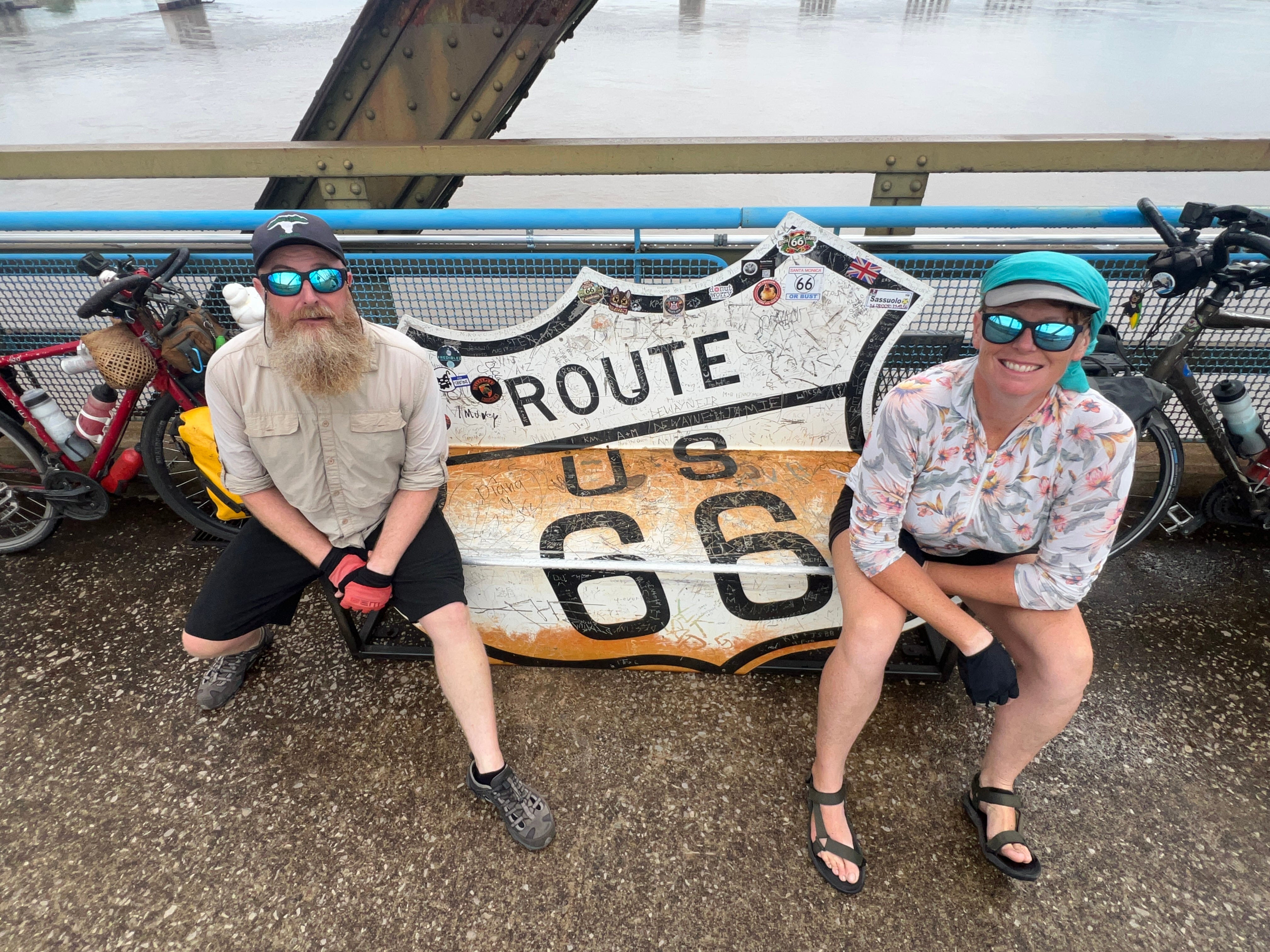
It had turned out that leaving St Louis early on the Sunday morning of a bank holiday weekend was an excellent idea, especially when we found ourselves cycling through some of the Missouri city’s most notorious neighbourhoods on our way towards the Chain of Rocks bridge over the Mississippi on Route 66.
We must have crossed some kind of invisible line on the road somewhere before we turned onto Florissant Avenue and the boarded up windows started appearing.
Manicured lawns were quickly replaced by lots full of straggly weeds. We passed a liquor store with bars on its windows. And then, quite quickly, we were cycling through a neighbourhood that looked like it had been actually bombed.
Many of the buildings, once grand turn-of-the-century redbrick homes like those in other parts of the city, were partially demolished. Very poignantly, some of them bore old signs, clearly from a previous attempted urban renewal scheme, saying “I believe in this neighbourhood.”
An older woman, dressed for church in her Sunday best, picked her way with dignity past litter, potholes, crumbling curbs and shattered shopfronts. She, like the few other residents we passed, was black. The line we had crossed was one of race as much as it was one of socio-economic inequality.
I switched my video camera on briefly, but it felt wrong and disgusting to film and take photographs and I quickly switched it off, so you’ll only catch a brief glimpse in our video above.
Two addicts stumbled out into the middle of the road: one was shouting in our direction and so Mark and I tightened the ranks and speeded up.
A block later, an older man with a defiantly tidy and well-kept home was outside mowing his lawn: the house neighbouring his was derelict and boarded up. He stopped to stare at us as we passed, and seemed on the verge of calling something to us. A warning perhaps, to the white idiot cyclists?
“What has happened to St Louis,” Abe called in alarm, pedalling frantically alongside us with his coat tails flapping. “What awful war has befallen this noble city?”
Abraham Lincoln - for it was he - looked around aghast as we passed a school with smashed in windows, corner lots where the buildings were reduced to rubble.
Listen, reader, we never promised you that everything written in this newsletter was going to be true, did we?
So if I want to resurrect one of the United States’ most hallowed leaders and bring him with me on a bicycle to see what he thinks of the USA 250 years after its independence, 165 years since he took office as the 16th president, I believe I can. You can read on, or you can choose not to.
I acquired my lanky, saturnine familiar days before our arrival in St Louis, in the town of Quincy, Illinois.
We had just crossed the Mississippi and we were strolling around gaping in wonder, both at Quincy’s incredible architectural heritage and its shameful ruin, when we happened upon a sign commemorating the speech Lincoln had given here in October 1858, in a series of debates that led to his election as president.
Abe arrived into corporeality with an embarrassingly fleshy popping sound as I stood in front of the sign. We looked around the town, and I wondered what he would make of its widespread dereliction and largely empty streets.
Quincy had been the third largest city in Illinois at the time Abe gave his speech there, and it was the centre of a booming trade based on river steamers. It ceased thriving in the 1970s and its population, wealth, number of employers and more have been steadily declining since.
I was a little disappointed by Abraham Lincoln’s initial blindness to Quincy’s plight, but he may have been discombobulated by his sudden re-emergence into the world of the living.
After I had answered all the predictable and tedious questions about what year we were in, why he had been resuscitated and the like, I asked him if he’d like to cycle with us, and summoned him up a bike, a carbon copy of my own.
In character and temperament, his reputation for honesty and thoughtfulness I discovered to be well-founded, but he was prone to grandiose, sweeping statements that could be irritating, and was moody at times.
He was also mysteriously paranoid about head injuries, and so, even though he stubbornly retained his lawyerly black wool frock coat, he switched out his high top hat for a cycling helmet and matching wraparound shades. The fact that he didn’t draw more stares in this attire was frankly astonishing.
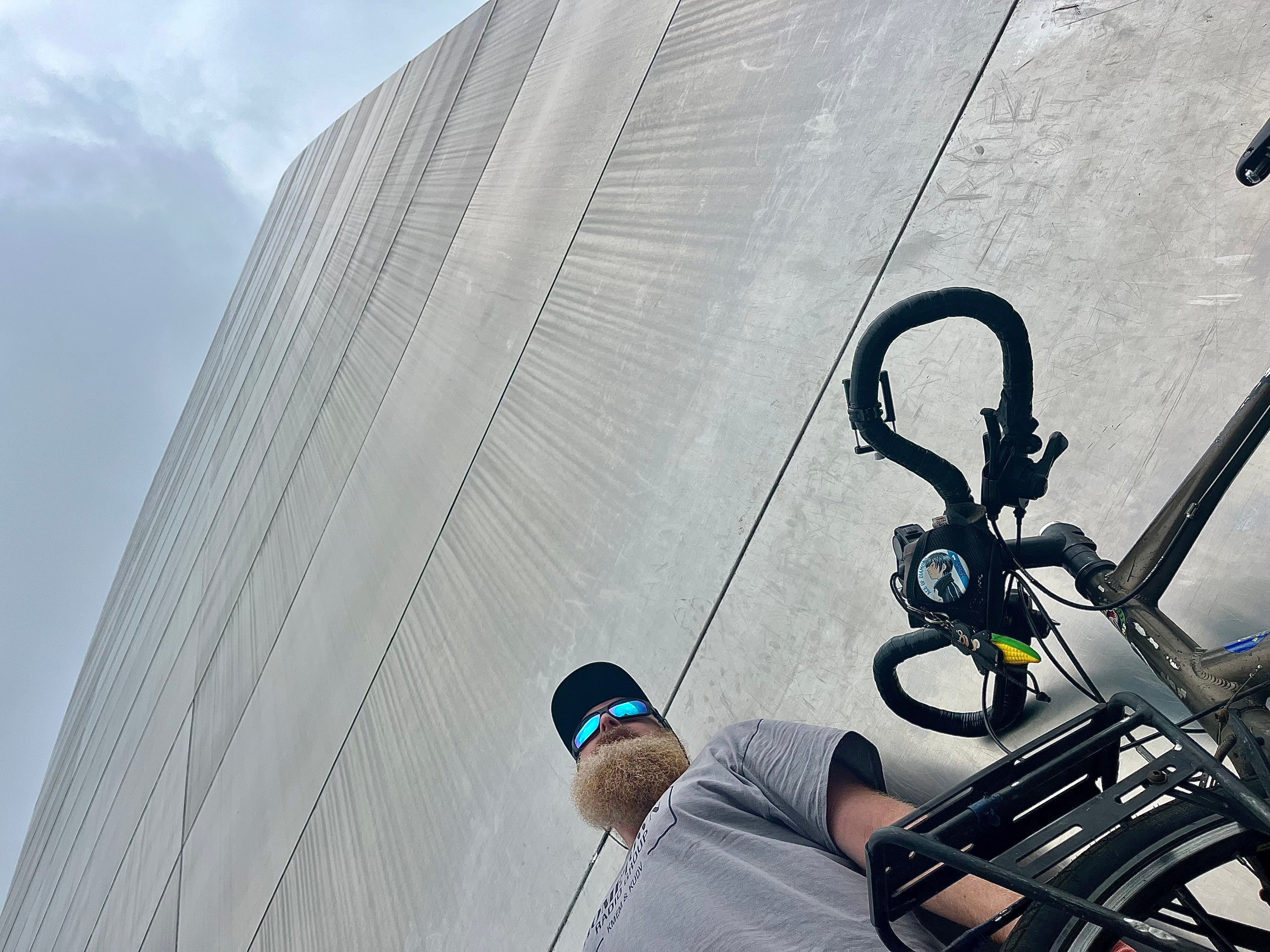
In St Louis, we spent three days resting, sightseeing and attending to neglected things such as haircuts and bike maintenance, in an unoccupied apartment owned by Alex, a Warmshowers host who let us stay three nights in his fixer-upper in The Grove, an area that has recently become gentrified and trendy.
“Where are my sleeping quarters?”
“You’re in the back room, Abe.”
Abe sighed and stomped off to the least well-furnished room in the semi-furnished apartment, where he stayed, sunk into one of his famed melancholy reveries, until we took him out sightseeing with us the next day.
We went to Forest Park for the weekly Saturday Farmer’s Market and he gazed with affectionate approval at the well-fed, confident, multi-ethnic young professionals who were wandering around buying five dollar bunches of Amish kale and queuing serenely with 20 other people for an iced chai latte.
“Is this the America you wanted, Abe?” I couldn’t help but ask as we wandered towards a bandstand where a preposterously good jazz trio were giving it socks for an appreciative audience of tattooed, overalled and flesh tunnelled hipsters.
“These people are prosperous, happy and free,” he said. “What matter that I don’t understand their dress and customs?”
He also thoroughly approved of The Gateway Arch, St Louis’ landmark monument built in 1965 to commemorate Thomas Jefferson’s - and his own - vision of westward expansion and a cohesive Pacific-to-Atlantic USA.
At 192 metres, it’s the biggest arch in the world and an impressive monument that can be seen from all over the Missouri city.
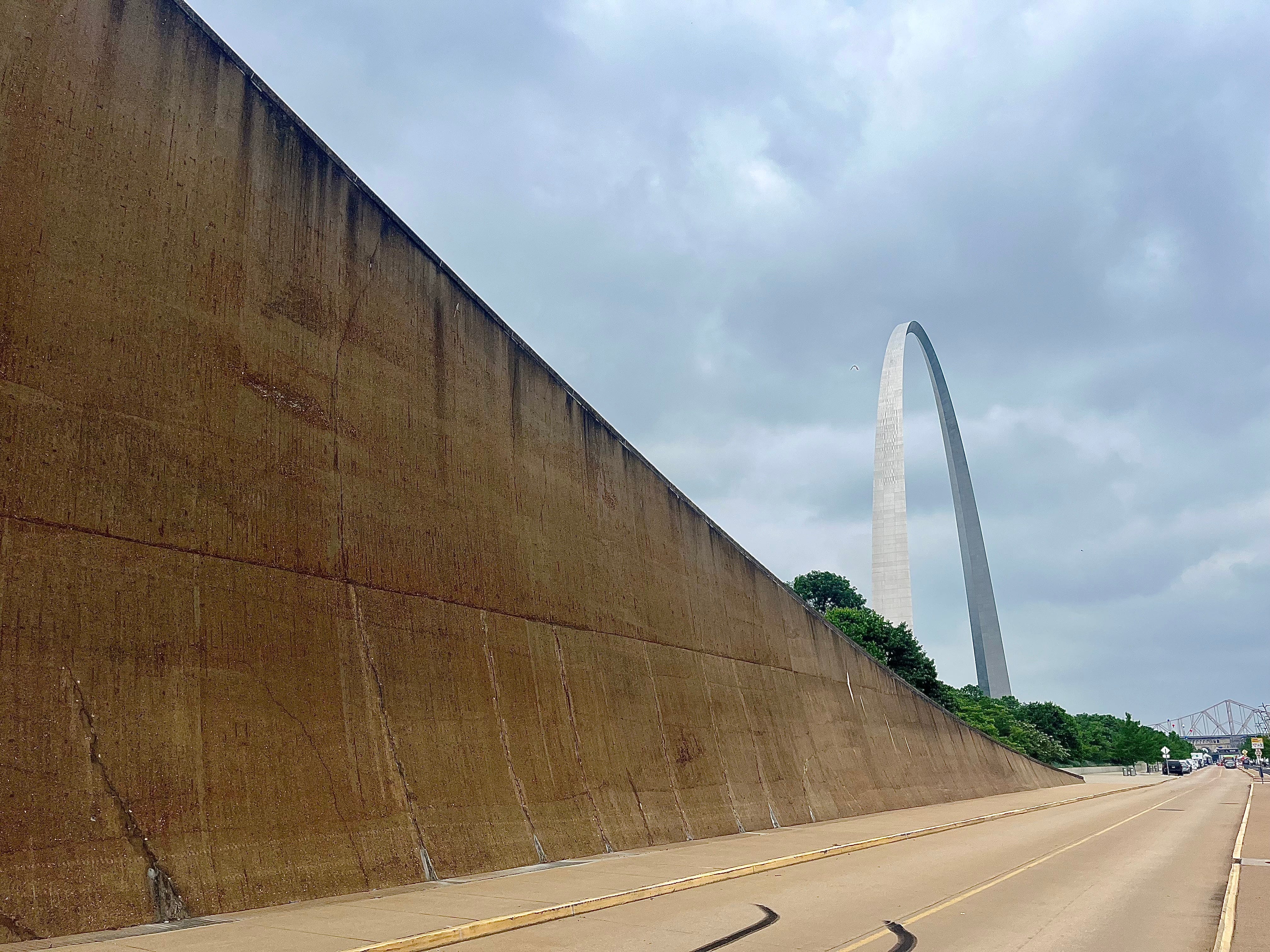
Mark and I wanted to take our time at the arch and soak in the moment, because for us, the arch symbolised the end of the Lewis and Clark trail.
It was 61 days, and 4,158km, since we had left Astoria, near where Meriwether Lewis and William Clark first clapped eyes on the Pacific Ocean in November 1805.
But it had been years since we had first learned that there was an ACA (American Adventure Cycling Association) route that followed the course charted by Lewis and Clark on their transamerican expedition.
Completing this route by arriving in the city of St Louis came with a huge sense of achievement.
The ACA recommends not embarking on the Lewis and Clark trail until May due to weather concerns on what they consider to be one of their most arduous and isolated road routes.
We had taken a calculated risk in setting off in March, and we were extremely lucky, losing only two days to bad weather, one a blizzard in Eastern Montana and one a tornado warning in Iowa.
I lay my hands against the chilled stainless steel surface of the gateway arch. I willed its conductivity to carry away some residues of the journey. I wanted to end at St Louis, and begin anew.
“Can we ascend it?” Abe cut rudely into my reverie. He was striding jerkily about, which normally meant he was feeling peppy and self-important.
Irritated, I told him the urban legend about US presidents being forbidden from ascending the arch: Eisenhower is the only president to have taken the ride to the top, and rumour has it that the Secret Service then forbid it on the grounds that its lift-like pods are too confined and the whole area too difficult to secure.
“It’s considered too much of an assassination risk,” I told my 6’ 8” companion, and that shut him up.
If you’re enjoying these posts and you haven’t already, you can throw us a few bob by clicking the link above. If you’ve already been waaay too generous, you don’t need to do it again.
But by the time we had cycled to the Chain of Rocks bridge the following morning, and had passed through the neighbourhoods of Walnut Grove and Baden, Abe was all outraged talk.
“I shall make a report to Congress immediately,” He wobbled perilously on his bicycle, narrowly avoiding a pothole. “There must be an immediate war relief fund!”
“Abe, there isn’t a war in St Louis,” I told him as we pedalled along the banks of the Mississippi along old Route 66. “The rest of the city is fine.”
It was almost gratifying to see his shock, because it made me feel less naive and foolish.
The destitution and inequality in America really is shocking in its extremes: the areas where you see people living in states of misery and poverty are literally across the street from areas of affluence, and both states of being seem exaggerated to Irish eyes.
It sometimes feels like many in the US are casually surrounded by resources: walk-in pantries and golf carts and RVs and boats and ice-making fridges and garages full of rarely used sports equipment. Lots of these people seem to be employed in fields that would make them “middle class” or certainly middle income, and this standard is noticeably higher in the States than in Ireland.
Of course, we have been using Warmshowers as a way of connecting with people, and that is going to often select for those with the time, money and space to host passing cyclists.
But cycling itself bursts the filter bubble very effectively because you don’t skip anything, and so we end up cycling through industrial zones and poor neighbourhoods, past water treatment plants and factories and trailer parks and strip malls of endless Cannabis shops, the new numbing panacea for all that ails a broad swathe of US society.
The divided nature of American society feels brutal. The flipside of the American dream is an American nightmare of addiction, homelessness and misery and it’s growing.
But there’s a filter bubble that isn’t online but in real life: there are streets that affluent people just don’t drive down, and as a result, the plight of the people who live there is largely invisible in the comfort of their lives.
Attitudes to poverty are frequently depressingly Reaganite, where poverty is seen as a kind of moral failing. In one town, someone we stayed with quite seriously told me that their recent homelessness problem was a result of social housing being made available. He thought it attracted undesirables.
When I pointed out that in Ireland, the main precipitator of homelessness in recent years has been property price hikes, he agreed that house prices had been inflating rapidly in his area. Yet the homeless problem, as far as he was concerned, stemmed from lazy people looking for a handout rather than a runaway market that profits the few and prices out many.
Abraham Lincoln was one of the minds that created the American dream: freedom to pursue prosperity was the ultimate good to his way of thinking, and indeed, many commentators have pointed out that a lot of his objection to slavery was on the grounds of it undercutting and competing with waged labour.
It certainly wasn’t on the grounds of a belief that black people were the equals of white people: he spent a good third of his famed Quincy debate reassuring his audience that he believed in white supremacy, even though you have to read an actual transcript of his speech to find this out: official summaries of the debate gloss over this.
For several hours that Memorial Weekend Sunday, Abe and I argued back and forth about what factors had given rise to what we had just seen in the desolate neighbourhoods of St Louis as we pedalled towards Vandalia, our destination on our first day heading northeast towards the Canadian border.
Things got a bit heated, I’m afraid.
In Vandalia, there’s a wonky concrete replica of St Louis’ Gateway Arch, known as the Little Arch.
It had been a long, hot 133km from St Louis and all our tempers were a frayed. I for one had grown tired of Abe’s insistence that America was a resounding success with a few anomalies.
The America I was seeing was one of such extremes that they were hard to reconcile. The number of those happily living out the American dream seemed equal to the number of those plunged deep into a murky American nightmare.
The fact of the matter is that, by many orders of magnitude, the City of St Louis was the most dangerous place we’ve cycled in on this entire trip, even though the Americans I’ve told this to often think I’m joking.
The murder rates (recorded as intentional homicides per hundred thousand) in many Asian and SE Asian countries we cycled in were below 1 person per 100,000: Japan’s was 0.78 per 100,000 in 2024, while Vietnam generally records between 1.5-2 murders per 100,000. European averages are higher, and in Central Asia, Kazakhstan is the surprise outlier with 2.5 murders per 100,000 in 2024, according to World Bank data.
In St Louis, the murder rate was 54 per 100,000 in 2024. This puts it at a level of danger akin to Haiti, Jamaica and Venezuela, the countries considered the most dangerous for violent crime in the world.
St Louis is not alone amongst American cities: New Orleans, Baltimore, Detroit, Memphis often record similar figures.
“If America is working, Abe, why are so many left behind?” I snapped as we pulled in next to the Little Arch in Vandalia.
He looked mortally offended. “You shall see!” he said. “I am going my own way from now on and I won’t follow your path any more. The farmers are prosperous now, I am sure of it. One failed city is not the sum of America’s grand design.”
He held his finger skyward and drew an orator’s breath. “I shall ride west, and when I have seen all across the land, I will report back to congress. Whatever ails St Louis will not be found on the prairies! And whatever ails America can and will be remedied!”
I thought of the farmers we had met out west, the towns once populated with thousands and now with hundreds, the superfarms growing monocrops as far as the eye can see.
“Well, good luck, Abe,” I said quietly. “And goodbye.”
He turned and looked back, a little uncertainly, framed by the rickety approximation of a grand dream that was Vandalia’s Little Arch. I was suddenly shot through with affection, and regret at the sight of him leaving.
He seemed an embodiment of the bloodyminded inventiveness and sheer will that had created this country with its vision of freedom, as great as it was terrible, with all its aching sadness, bloodshed and moments of fairytale magic, its cheer and its optimism and the goodness of so many of its people.
He waved, and cycled off into the setting sun, to the sudden swelling strains of Simon and Garfunkel’s America. He was gone, to look for America. And so were we.
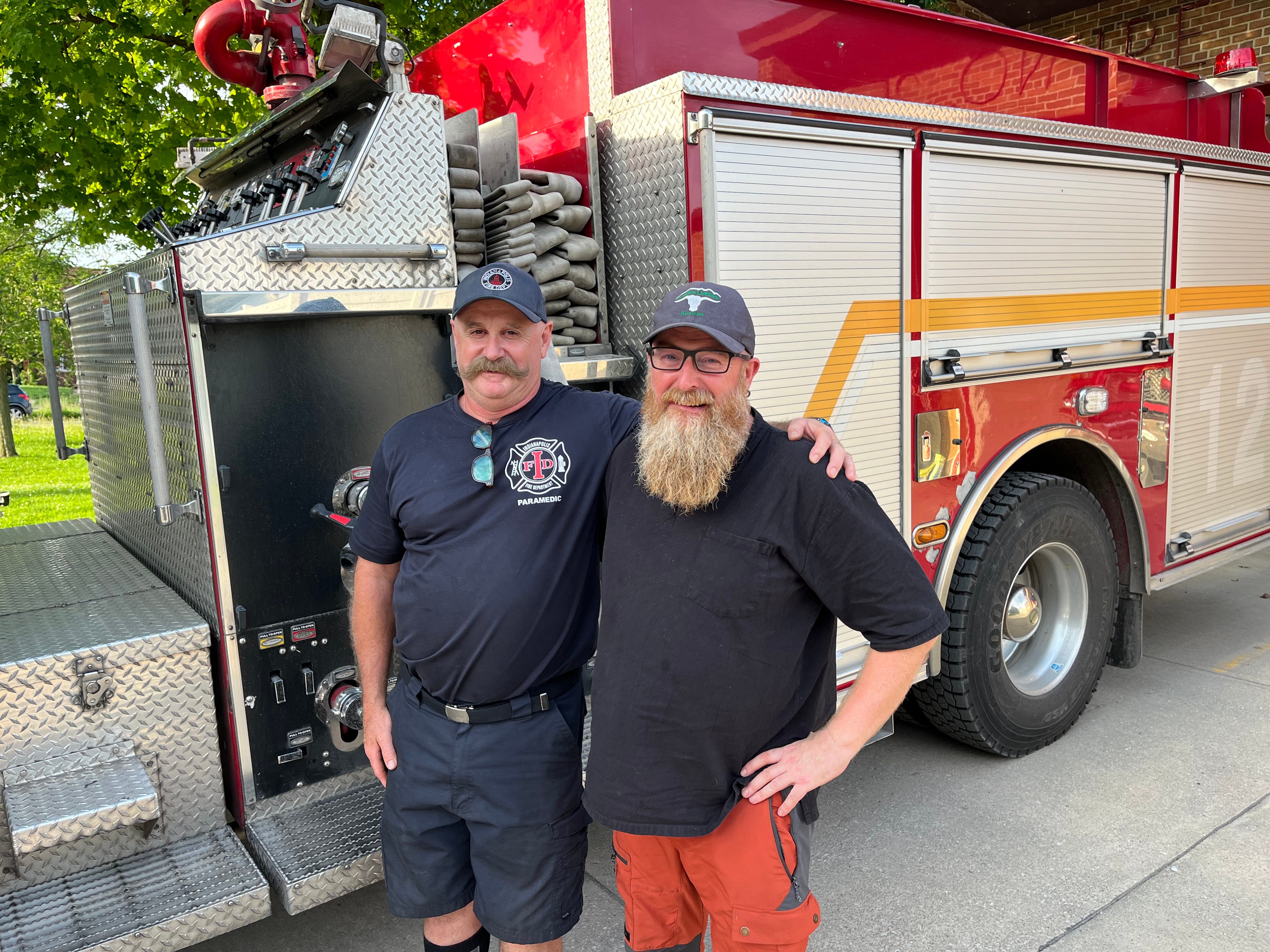
A few weeks ago, Mark and I were on a local radio show in my home town of Cork, and Mark mentioned that as we move east and into the summer, it becomes more difficult and expensive to find places to sleep.
The response was overwhelming and amongst the very large number of offers of help, Dave O’Connor, a fireman in Indianapolis but originally from Mallow, Co Cork, got in touch.
A couple of days out from St Louis, in which we camped in Casey and staying with lovely Warmshowers guests Eric and Sue in Brazil, we arrived at Dave’s house in Noblesville to be greeted by his partner Cortney.
Dave was on shift at the Irvington fire station that evening, and so Cortney took us to the station after we arrived at their home and showered. There, we got to have dinner with the entire fire crew, and swap stories about their working lives and our cycling adventures.
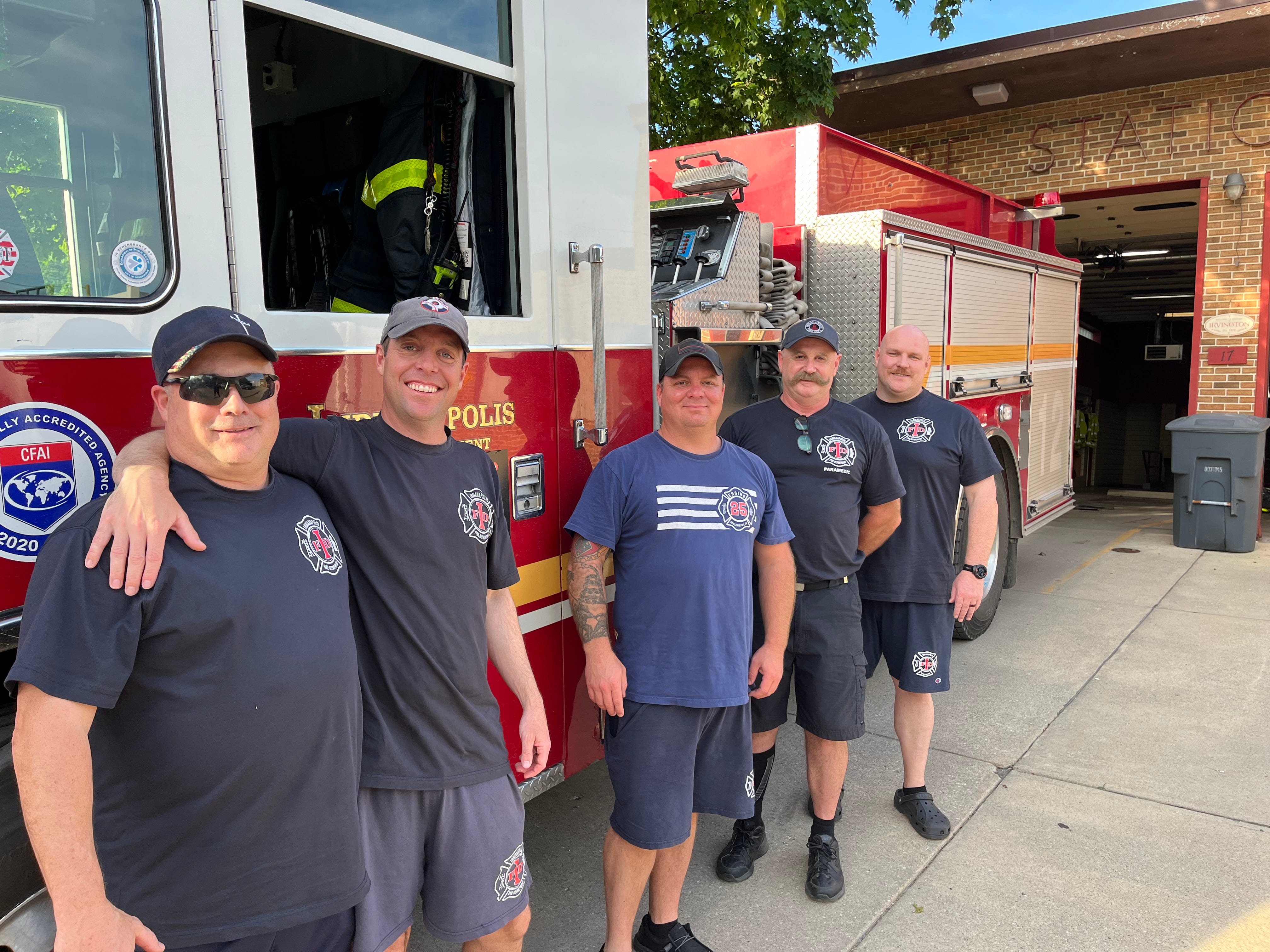
Cortney and Dave went to the most extraordinary lengths to treat us as honoured guests. After an evening spent with Cortney in which we visited a really nice Irish bar and then talked and laughed until late at night, we were woken by the smell of a full Irish breakfast: Dave had come back from his night shift and immediately rustled us up a breakfast that made Mark actually emotional, including brown soda bread Dave made himself.
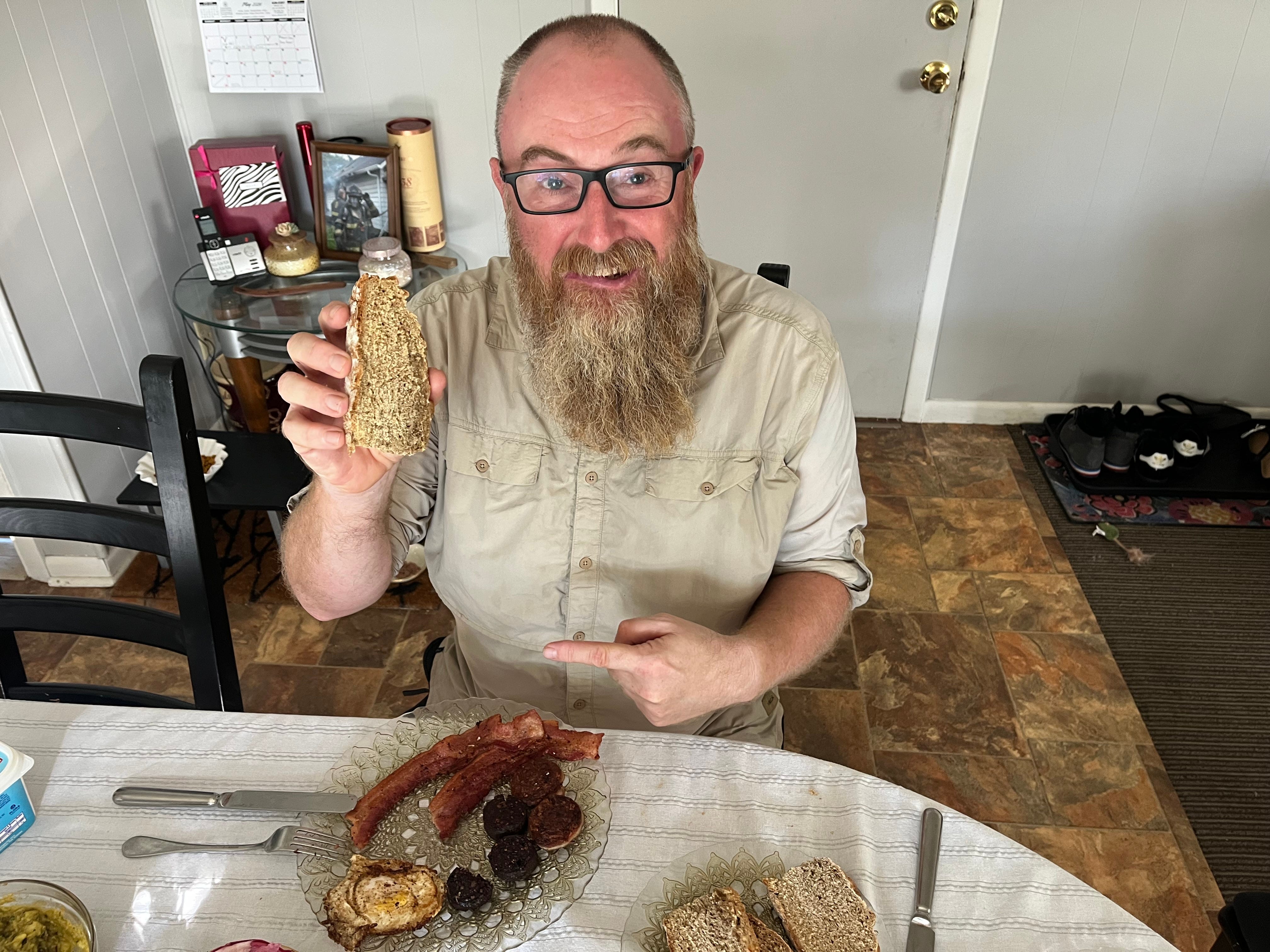
On our way out the door, he further bestowed on us an embarrassment of treats in the form of Cadbury’s chocolate bars and packets of Tayto.
He also gave us patches from Irvington Fire Department, and we were curious to discover that their logo is a headless horseman: it turns out that Irvington is named for Washington Irving, the author of The Legend of Sleepy Hollow, who also had a political career and was US ambassador to Spain in the 1840s.
You live and you learn, and you are also in awe of the absolute sweetness and kindness of people like Dave, Cortney and the Irvington fire crew. The nice thing is that Dave occasionally comes home to visit Mallow and so it is entirely likely our paths will cross again and when they do, the pints are very much on us.
By all accounts, the current political climate in the US is not a good time to overstay a visa.
This meant that, having left St Louis, we had only two weeks to reach Detroit and exit the US for Canada.
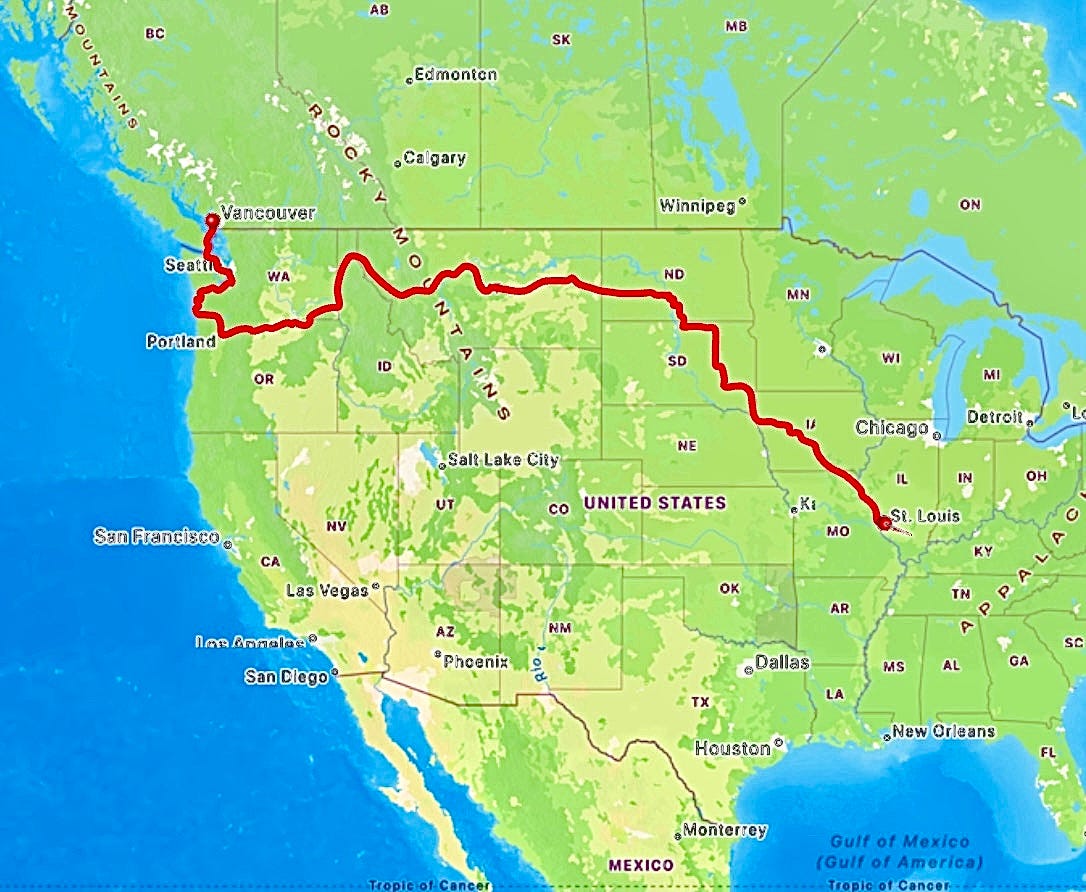
The clock was ticking, and we were set to cover some high mileage, or at least, high mileage for us.
Wabash, Indiana is pronounced “waw-bash” and it has an extraordinary claim to fame: it’s the first town in the world to have been illuminated with electric light.
Once the home of several industries including a tyre manufacturers, it has now, like so much of small town America, fallen on slightly hard times: efforts are being made to restore and preserve some of its Main Street, but on our way up the hill to the home of Jim Garlitz, we saw a large number of beautiful red brick ruins.
Jim and his wife are Good People, capital G capital P.
They told us about how their open door policy for friends of their kids resulted in several unofficial adoptions; waifs and strays always welcome, and we were too.
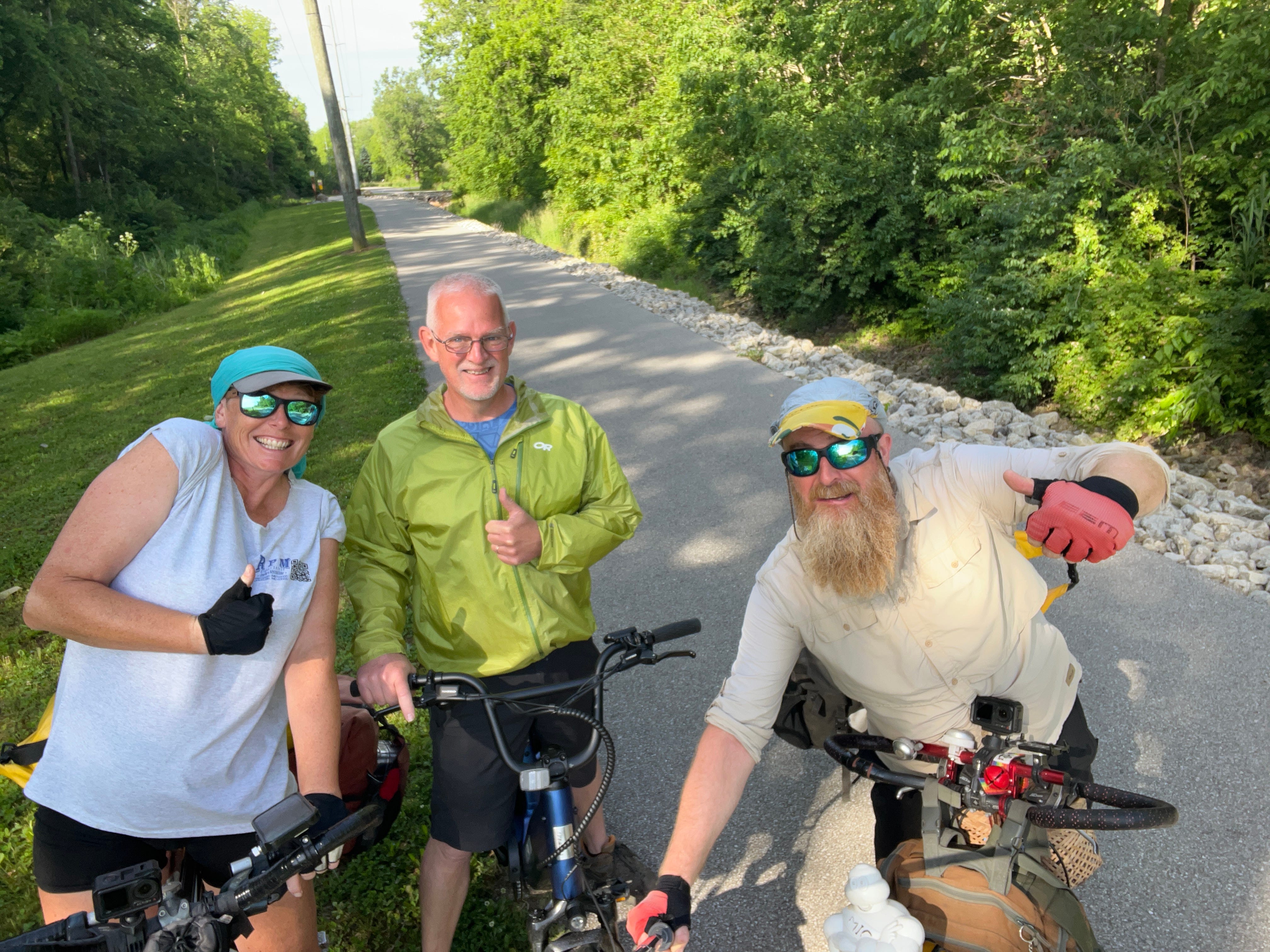
They took us out to eat in a local bar, and our conversations covered everything from the plight of local journalism - Jim studied journalism but couldn’t afford to move his young family to Chicago on a trainee journalists’ wage - to his recent passion for permaculture and beekeeping.
In the morning, he accompanied us to a river trail stretching from Wabash to the town of Lagro, and we bid him a fond goodbye: yet another person we very much hope to see again in future.
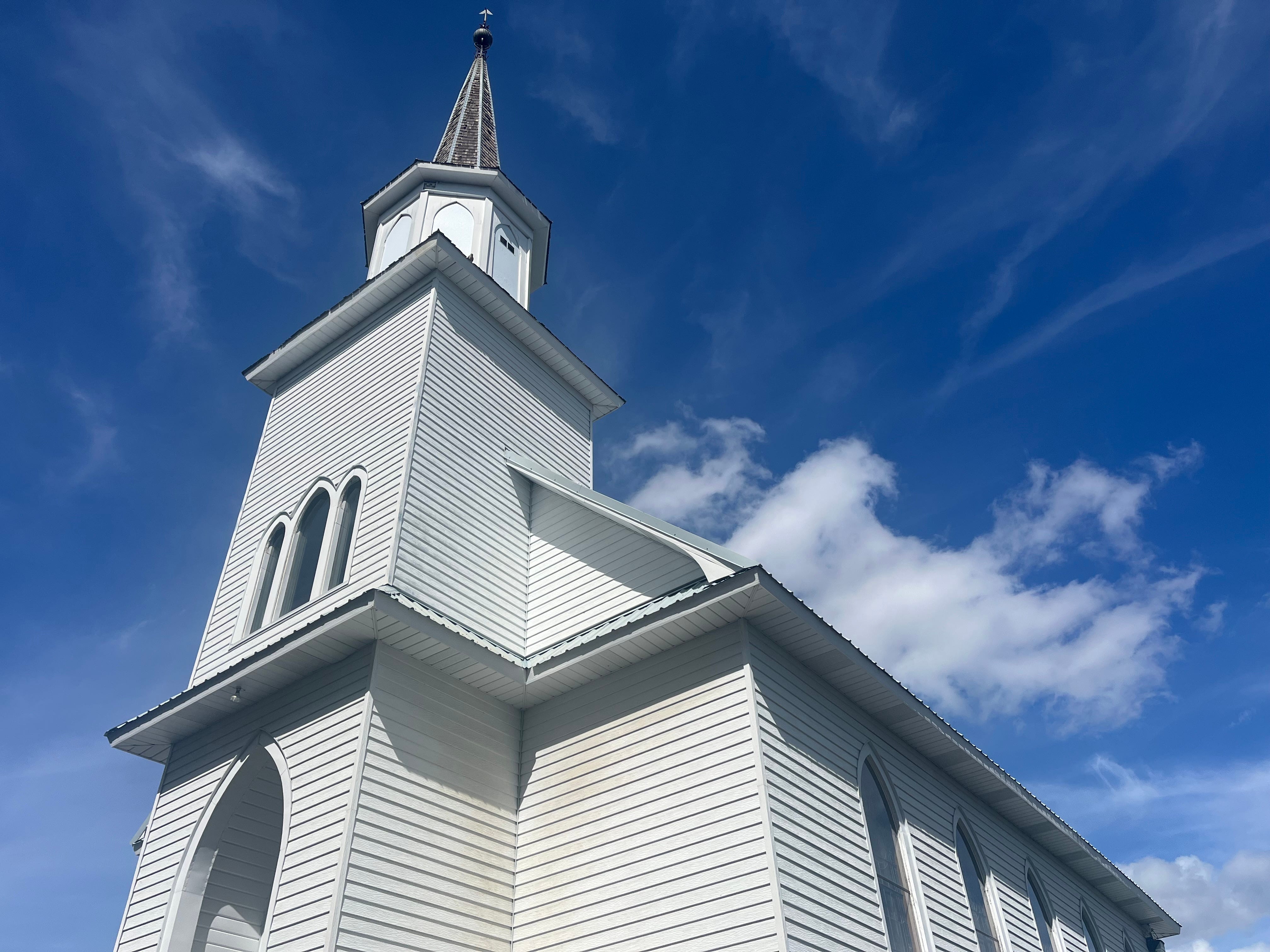
The remainder of our time to Fort Wayne became something of a blur: a few days of strong headwinds and ground to cover, with a general impression of cornfields and occasional stands of trees, and little towns of friendly people and farmers in tractors waving as we passed, and little white churches at crossroads.
We both broke ourselves a little over those couple of days.
As Mark so perspicaciously puts it, sun is one thing, rain is another, but it’s a headwind that’s bad to cycle in. What’s the cycling equivalent of staggering? I feel that that’s how I arrived across a bridge over St Joseph’s river and into Jenny’s home in Fort Wayne.
Jenny is an experienced cyclist and sometime cycle guide, and she immediately sensed our exhaustion and offered to let us stay in her home long as we wanted.
In the coming days, she would extend us the level of phenomenal kindness that has become the norm in the US, and one of the things I will miss the most when we go home. Ireland’s céad míle fáilte (hundred thousand welcomes) pales into insignificance compared with American hospitality.
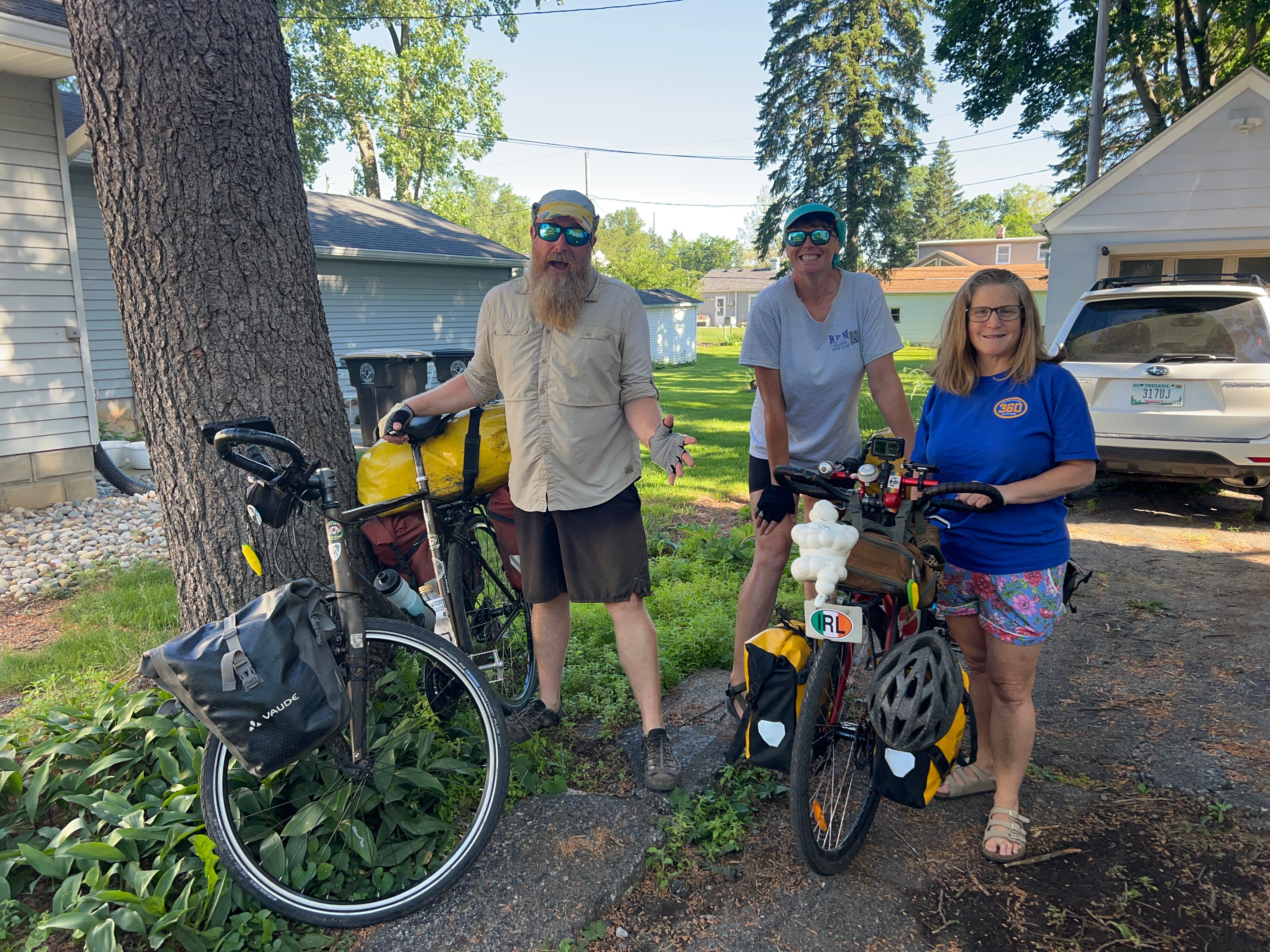
It had been yet another week of extremes, of highs and lows that we’ll hopefully remember for a long time to come.
As we lay in Jenny’s spare room under the cool breeze of the ceiling fan, my mind wandered back to Abe. I wondered how he was getting on pushing west, covering terrain we had traversed weeks earlier.
Maybe he wouldn’t find his dream of America intact, but I was certain he’d be treated with kindness by the people he met.

No posts
Comments
Nothing yet. Say the first thing.
Sign in to join the conversation.