
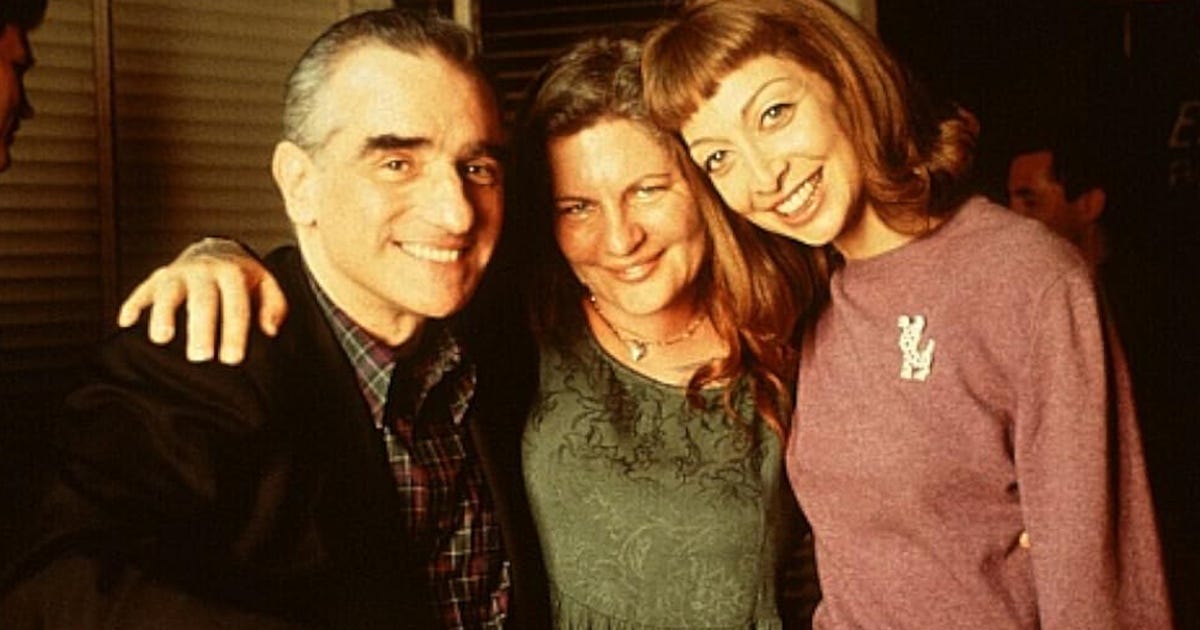
Allison Anders is one of my favorite filmmakers. I recently watched her film Grace of My Heart, starring Illeana Douglas as a singer-songwriter trying to hit it big in 1960’s New York, and realized I had stumbled on yet another of her many masterpieces. I could write for hours about the soundtrack alone, but since this is SPLICE WORLD I’ll cut to the chase:
Grace of My Heart was edited by legendary editor Thelma Schoonmaker. Thelma is Martin Scorsese’s longtime collaborator, who executive produced Grace, and has edited all of Scorsese’s movies since 1980’s Raging Bull.
I loved Grace, and the editing, so much that I tracked down Anders’s rare, long-out-of-print post-production diary from the March 1997 issue of Premiere Magazine UK. As far as I can tell, this article is unavailable anywhere else on the internet, partially because Premiere did not create an online archive before its closure.
The following diary is an amazing document of the ups and downs of editing a film you care deeply about, and the sacrifices we make for our art. I was struck by how contemporary the piece feels, with Anders grappling with her responsibilities as a mother, confronting the misogyny of producers and male editors, and navigating the lack of childcare in the edit bay.
It’s not required to enjoy the diary, but you can rent Grace to stream here, or do what I did and rent the blu ray from Scarecrow Video. You can even buy the Blu-ray here.
Special thanks to Allison for her permission to reprint this diary. And now, our feature presentation…
If someone sent you this link, welcome to SPLICE WORLD!
Most film writing is about the finished product, but SPLICE WORLD is about how it got made from the creative perspective of a seasoned, working editor. When it comes to cinema’s “invisible art,” I write about the creative decisions no one sees and the behind-the-scenes chaos no one talks about.
SPLICE WORLD is free. The world of movies, y’know, spliced.
Director Allison Anders’s post-production diary reveals how Grace Of My Heart, her film about ‘60s songwriters at the Brill Building hitmaking factory, got a vital lift from Martin Scorsese and film editor Thelma Schoonmaker.
Premiere Magazine, March 1997
THE EDITING ROOM LACKS THE glamour of an exotic, far-flung location shoot, but it’s often where the real high drama of filmmaking takes place. This was certainly true for Allison Anders and her film Grace Of My Heart. The writer-director of Gas Food Lodging and Mi Vida Loca, Anders embarked on the project because it was, she says, “a chance to work with a mentor”, namely Martin Scorsese, who served as her executive producer. The production itself was an exhilarating experience. Illeana Douglas, hot off To Die For, stars as Denise Waverly, a Carole King-like songwriter who spends the ‘60s composing a series of Top 40 hits for producer Joel Millner (John Turturro), and surviving a series of doomed relationships — with songwriter Howard Caszatt (Eric Stoltz), married journalist John Murray (Bruce Davison) and Brian Wilson-like producer-genius Jay Phillips (Matt Dillon).
Anders’s first attempt at editing Grace, however, did not work out. Scorsese, who was putting final touches on Casino, suggested that if Anders would wait until that film was released, Thelma Schoonmaker, the legendary film editor who has worked on nearly all of his films, would become available to do Grace. The drawback was that Anders, who had recently adopted a six-year-old son and moved into a new Los Angeles home, would have to come to New York City. Still, the chance to work with Schoonmaker and salvage a cherished project proved an irresistible lure. The following is a “diary” of e-mail messages sent by Anders to her friend, Jerry Maguire director Cameron Crowe (whose on-line tag is Belmondo X), during the months of post-production that followed.
Thelma is worried that I’m unhappy here. She worries that they’ve ripped me from my son and my home and that the work is going slow. I assured her that editing with her has been fantastic, incredible — a fairy tale! Thelma’s creative and intuitive mind is so beautiful — she asks the right questions and she’s a perfectionist, so she won’t rest until she feels those questions have been satisfied in each scene. For instance, while doing this one scene, where we had earlier agreed to rearrange material for greater clarity and emotional connection, she went even further, crosscutting within the scene with complete grace. If any other editor did this, it would be jarring. But the way Thelma has done it, it’s like turning over in your sleep into the arms of your favourite warm body. That’s what her cuts are like. And now — today — she suggested a reordering of a few scenes and I got very excited to try it, and we did, and goddamn!! Each time I’m so happily amazed she says to me with warmth, “It’s all there. You shot it.” She makes me feel so good about the footage; she loves the clothes in the film, the lighting and, most of all, the performances (and then I fall in love with them again), and appreciates the more subtle stuff and my character actors.
Thelma sent me off on a weekend in Woodstock with a beautiful account of her experience filming and cutting Woodstock with Marty. (I don’t know if you knew this, but she said that Marty actually brought cuff links to Woodstock, thinking they’d probably be going to dinner!! She was telling me and Dan [Hassid, Grace’s producer] all about shooting with 15 cameras, in the rain and mud and crowds with no food or bathrooms or lights for night shooting, and fun stuff about them going to Hollywood to do post. They were such grungy hippies — to which Marty always reminds Thelma, “Not all of us!”)
We looked at the dailies for three scenes on Friday, and I felt so much better looking through this stuff and knowing that I could have the things in the scene that I shot and directed and wrote and liked and felt were necessary to the story. ‘Cause Hollywood editors — though not, of course, our dear Richard Chew [Mi Vida Loca, Singles] — have an instinct for throwing that shit out. It’s little wonder that films feel so disjointed and incomplete these days, ‘cause editors are basically working for the studio — or whomever is most likely to hire them back. Nothing is more disgusting than to have to listen to these Hollywood guys (mixers are the worst for this) talk about “the shows” they just did. And they brag about working on these big, pure-shit movies as if they are so obviously talented and such studs to have been included in some awful fucking film I wouldn’t even watch for free on an airplane to China. They always imagine there is someone else who has the power to ultimately make decisions — not me — and that they have to please these people.
And there’s a thing that these Hollywood editors do, which is to get scenes as lean as possible by just chopping, first the ends of scenes, then the heads, then all that unnecessary stuff — y’know, your favourite stuff in the scene. Then, when it breaks your heart, they act like you’re being a big baby, unprofessional. Thelma gets mad over that kind of attitude. For her, the only authority is the director’s vision — not even the director — and the material is the voice for that vision. And she gives time to things like [Grace soundtrack producer] Larry Klein, who is sooo funny in the film, and is such a ham, playing this slick record producer who is always calling the female songwriters sweetheart, etc., and snapping his fingers, going “Roll tape — let’s make hit records.” A lot of this stuff had been cut out, and that hurt me a lot, ‘cause it’s stuff like that that makes you involved with the characters and makes you feel nostalgic within the course of the film for what has passed.
So when we looked at stuff on Friday, I wanted to put back the head of one scene, in which Denise [Illeana Douglas], pregnant, tries to give direction from the control booth to the Click Brothers [an Everly Brothers-like duo], who are in the studio, and Larry keeps interrupting her. Illeana’s looks out of the corner of her eye to him are so priceless — very funny stuff. The scene culminates with a fight between Joel [John Turturro] and Denise over Howard [Eric Stoltz], and ends with her water breaking and everyone freaking out — Thelma was laughing so hard. She said, “No one has done this before — that I know of.” And I felt pretty sure that that’s true. Then we looked at the dailies for another scene — one that Marty used to tease me about for being almost macabre — in which Denise tells Howard that she’s pregnant, then tells him that Denise isn’t her real name, then tells him that she’s an heiress. It’s pretty crazy, yet for the most part a pretty serious scene. So I shot a lot of footage for that scene, but somehow the cut was lacking life. The master shots (when played with no cuts, no close-ups, no mediums) were great and oddly enough felt shorter than what happens when you start focusing your attention on the close-ups of one character then the other — it’s strange, your mind slows down. This is something I never new before, but Thelma and Marty have long since learned how audiences respond psychologically and emotionally to certain kinds of shots put together. Marty has a great example from GoodFellas, in which a guy walks right up to the camera in a tight close-up to give vital information information to the audience — and the preview audience never caught it. Marty spent months in the editing room so frustrated by that — he didn’t know how else to shoot it to make it any clearer — and finally they figured out that it was getting lost because of the scenes before and after it. So they reshuffled — and it worked.
Thelma and Jimmy Kwei (Thelma’s former first assistant, who is co-editing) are bringing the grace and heart back into my movie. Marty is so happy with how well it’s going, and there is so much love and trust around the film now. I felt so close to it today — it felt like a child of mine, truly mine. And that feels good after what I’ve been through on “Rosemary’s Baby” — which is my new name for my piece in Four Rooms. (”What have you done to its eyes??”)
Today was my first day back after our Christmas break, and I was so ready to be back! We looked at the work that Thelma and Jimmy had done over Christmas — and I was giddy, I was so happy. Even if she just prelaps some dialogue from one scene into the next, which seems like a simple thing — the way she does it is so fresh and so surprising, and yet — it’s like, Of course!! And the difference with her skill this way is that it’s not a trick or to show off; it’s exactly what is called for and an inventive way of moving forward — in one case she literally moves John Turturro down a hallway, dragged by Illeana against his will as he complains he hasn’t even had his coffee, and into her office. I shot this — yes — but the way that Thelma prelaps his dialogue surges them forward into the next room.
Thelma sent me home with a Xerox of Marty’s article in The New York Times about Ida Lupino — have you read it? Wonderful. People have such strange ideas about Marty’s attitudes toward women. For one thing, they always think it’s so odd for him to be working with a woman director, like he’s some macho sexist or something. Which is so ridiculous — Alice Doesn’t Live Here Anymore was the only film I had to draw from for Gas Food Lodging.
I only found out Marty was coming in to see stuff when the editing assistant, Carol, called me at noon and said he was on his way — they had no idea either. But he was in a really good mood, and promptly broke the blinds in Thelma’s cutting room and sorta winced sheepishly like a little kid — it was pretty funny. We had quite a lot of stuff to show him — like three or four reels, and he just continued to be sooooo happy — it was just the best feeling. It was so strange, ‘cause he was happy with what I’m happy with — do you realise that for years I’ve walked around thinking my ideas about editing are completely bad and wrong and uninformed?
There was a scene Jimmy had just finished recutting that was so cool — the two rival female songwriters (Illeana and Patsy Kensit, looking very Petula Clark with longer hair) are writing a song for this vanilla pop singer, Kelly Porter (Bridget Fonda as a Lesley Gore type, and believe it or not, Lesley Gore actually wrote the song for her with Larry Klein and David Baerwald, and Miss Lily Banquette from Combustible Edison is Bridget’s voice — it’s such a good song, very much like “You Don’t Own Me”).
Anyway, the songwriters have never met her and they’re waiting and waiting, and then she arrives — and they can see her through the soundproof glass having a tearful lovers’ spat — with a woman! And Marty just loved the new cut, even though I again fell maybe a little too in love with some parts, which makes the scene just a little too long, so I think we found a solution so I can have what I love best and let go of a few other pieces.
I went out last night to a tribute for Marty at the Waldorf-Astoria with the whole gang from Cappa [Scorsese’s production company] — and with Dan and my friend Kim Jones. It was black tie, and we all had fun dressing up. Dan, Kim and I sat at Thelma’s table. She’s great when she’s out like that — she goes out of her way to introduce you. And she was introducing me as “Allison Anders — the director I’m working with,” and hearing her say it kinda blew my mind. And then Thelma introduced me to Daniel Day-Lewis — and I nearly swooned!! I decided I would devote the rest of my life to writing scripts for him — just for him to pass on!! Sweet and sooooo beautiful!!
Yet another event tonight — my eyes are red from lack of sleep! Tonight it was the premiere at MoMA of Marty’s documentary A Personal Journey With Martin Scorsese Through American Movies — you will love it! It’s nearly four hours long and just delicious.
It was again star-studded — Mel Gibson shook my hand and was sure we’d met before. I said, “I can assure you . . .” and didn’t even have to finish the sentence. Ethan Coen and I and Mel was mumbling something about it too — all of us inspired by the incredible director fashion Walsh, Nick Ray, John Ford, André De Toth . . . it was the code! So, I think you gotta wear an eye patch on Jerry Maguire [Crowe’s film with Tom Cruise]. And we should smoke fat cigars too! And actually sit in our director’s chairs like those guys used to do!! Wonder if Ida Lupino wore an eye patch?
We showed the film to Russell Schwartz from Gramercy and Zanne Devine from Universal, and Thelma filled the room out with some close friends of hers and a few people from the office.
At first, everyone was so quiet, and they weren’t laughing much, so I started getting a sinking feeling. But then I reminded myself that this has happened to me on every single movie, and it doesn’t mean people aren’t enjoying the film — every audience is completely different. And it went very, very well — people loved the actors and the music. The Gramercy folks were elated with what they saw — and I had cautioned them ahead of time and was nervous as they were watching it.
Hopefully, our previews will go as well. I walked back to my hotel so high from that screening.
Thelma sent me congratulatory flowers today — the most beautiful I’ve ever had — all these lovely Easter colours and they smell so yummy; her card said how proud she is to have worked on my film. How proud she is — when she is the brilliant one!!
When I read the card, Maya [Smuckler, Anders’s assistant] said, “Is Thelma just the most wonderful person in the world? What’re you gonna do without her??”
I sighed and said, “Write books, and pray that Marty decides to become a Tibetan monk, so I can have her all to myself!”
But my New York director of photography, Adam Holender, said, “I think if Marty became a monk, Thelma would become a monk too.” And methinks this is probably true.
God, I am so tired and so not into these reshoots — some exteriors, etc., that I always figured we’d have to get of New York, since I shot in LA (although I’m using some cool stock footage too; I love stock footage — who makes that stuff?) and some inserts (close-ups of a diaphragm on the ceiling, and silly shit like that). This is not my original crew and they have no history of the care and research that went into certain sets I have to recreate. It’s not their fault at all — they’re great, it’s just the nature of reshoots, and being on a different coast a year later. I just feel bummed out about it. And I feel like no one, much as they try with the usual things, ever takes care of me — no one ever creates the environment I need to feel inspired in. It’s that way for directors — it’s almost part of the job.
No one understands that at the point they force you to cut days, for example, you have already stretched your schedule beyond your ability to accomplish your work. See, the people who ask you to compromise are guys who are negotiators by nature — executives, producers, financiers. They always hold back. That’s the way they do business — they lowball money, resources, etc. So they assume that we, directors, think the same way, but in fact we are the opposite. While they promise less than their capabilities and withhold, we actually promise more than our capabilities — so by the time they force us to compromise, we are already stretched as far as we can stretch.
Last night, the night before shooting, Marty called me and said in this very low, solemn voice, “Allison . . . don’t panic.”
I busted up so hard — he nailed my swarm of chaos so well. Then I whined, “Ohhh, I hate you for making me laugh when I was scowling and tense!” He laughed — he has such a generous laugh. Then I said to him that I would really like to have Monday night to rehearse with Illeana and Matt [Dillon] for their big scene Tuesday, but I have some inserts to get.
I asked, “Would it be terrible of me, since the actors aren’t involved in these inserts, to let the crew do them without me so I can rehearse with my actors?”
Marty was so tender and said, “Well . . . I, uhhhh, well, I could help you out . . . I mean, I could shoot your inserts for you, if you . . . well, if you want me to.” (!!!!!!!!!!!!!!!!)
About an hour later it struck me how hilarious it was that Martin Scorsese is shooting inserts for me!! Yeah, I’m giving this guy a break, y’know, letting him try his hand at directing!! I mean, that’s pretty fuckin’ awesome! One for the trivia books!
I just this minute got e-mail from Peter Fonda. He’s so groovy. Did I tell you how cool he was the day he shot on Grace [the footage was eventually cut] — he had hair down to his ass, and when I thanked him for coming on such short notice, he said, “Allison, I’m glad to be here, I dig your flicks, and I’m always into a gig that gives me free food.” He said that sometimes when he sees catering trucks on movie sets, he just walks up and gets in line with a tray ‘cause he thinks maybe people will figure he’s in the film!
Today we had a conference call with Gramercy to discuss the preview — the demographics, the theatre and where they’re recruiting — and it sounds perfect, actually, I couldn’t feel safer. They really understand and appreciate the film. The only thing I took issue with was the list of films they had as qualifiers for recruiting. Like, they had Sense And Sensibility on the list, and I told them that people who like those perfumey, Laura Ashley-garden films don’t usually get my stuff, ‘cause they have very dated ideas about feminism — they can only handle it in a frockdrama, and they like “clever” dialogue, of which I have none — and the audiences for those films pat themselves on the back afterward for seeing an “art” film, and my stuff is very lowbrow.
Marty was so with me on this. He said, “Allison is absolutely correct — you want an intelligent audience, but not one who takes themselves too seriously.” I was so relieved he understood this. And I further added, “And please don’t put any Tarantino kinds of flicks on the list, ‘cause that has nothing to do with me.” Everyone agreed. I feel very, very good about this — and oddly enough, I’m even excited and looking forward to it.
Marty is much more flipped out than I am, but I think it’s good to heed his nervousness. He says that the nature of previewing is that they come in as the enemy — they want to dislike the film — and that you have to win them over. They’ll give you the first ten minutes, he says, but after that — forget it.
My preview went very well — not one single walkout! And the audience really responded well. The numbers weren’t great, but no one was expecting real high ones for this kind of film. Overall it tested best with women over 30, although women under 30 also rated the film higher than any of the men. Not very surprising. And everyone wants the soundtrack!! Tomorrow we will read through the cards — and 97 percent filled them out, so they must have a lot on their minds! Yikes! but I think the cards will be very useful to us, so i am not shrinking away. The audience was perfectly recruited — so much so that I told Thelma and Dan, “This is definitely our audience, so if they don’t like it — we’re fucked!”
The preview cards were not harsh at all! I mean, there was only one card where I got defensive, going, “Whoa, hey, fuck you!” while I was reading it, but they really were very nice for the most part. (I’ve had much worse feedback from people I’ve invited to screenings!) And the comments were extremely helpful — we know the film is too long, so that was no surprise. There’s trouble in two areas, but these are fixable problems. So we were on the phone today making an attack plan. Thelma laughed over the one card she says she gets every time: needs a good editor! She said on one of Marty’s films a card said, “Where’s Thelma??”
Very, very good preview — scores have come up considerably (with a rather confusing demographic — men under 30 and women over 35 rating it the highest!). And I even stayed for the focus group, and it was really great feedback. People still rate “God Give Me Strength” as among their favourite scenes, so nothing was lost — and my mom didn’t even notice a verse gone, and she was noticing every single little frame that was different.
I feel very good about this — I don’t think we need another preview. We know what we need to do — although some things can’t be changed. Like the film has a very unusual pace, ‘cause in New York it moves pretty briskly, but when we get to LA, it gets much more laidback — which is also a function of the time period and the music being different. It’s hard for people at times, ‘cause they are used to a pace staying the same in a film. One woman in the focus group compared it to The Way We Were. It may be interesting to see what happens in that film, pacewise, when they move to another coast! But I kinda doubt it has the same shift as Grace does. I just don’t think we can do anything about that — and I don’t know that we would want to, either…
I finished my film!!! The end titles are being held up, ‘cause the studio is reluctant to allow me to credit my child-care providers. I missed my son’s kindergarten year so I could edit this film in NY — a tremendous sacrifice for both of us — so it is extremely important to me that this is acknowledged. But my bliss level is high, and I am proud of the movie — in spite of the serious dues I had to pay to make it. This is the first time in my life that I truly feel the film I made is mine — on the deepest level, not just creatively, it feels like me, feels like I feel. It is not perfect. But we don’t want perfection in the end, do we? We want something that breathes, with all its flaws. And this one breathes. ■

Joe Peeler is a Sundance award-winning director and editor who writes about the art of making movies through the lens of film editing.
SPLICE WORLD. The world of movies, y’know, spliced.
No posts
Comments
Nothing yet. Say the first thing.
Sign in to join the conversation.